
Chinese artist and activist Ai Weiwei’s exhibition opened in Helsinki in September 2015. Ai Weiwei @ Helsinki will be on view through the end of February 2016. His first solo exhibition in Finland features 25 works from 1985 to the present, including selection of wooden sculptures and installations, and taking materials from antiques and building structures of old temples. Ai Weiwei’s exhibition is connecting to historical China, raising contemporary questions and speaking of the critical voice, which requires to be heard. The exhibition narrates of the personal and the cultural, weighting the nuances that the artist has tested in practice.
Ai Weiwei is the artistic figurehead for thinking how today’s east meets west in many forms. I call my perception of the works ‘massivity of matter’. Firstly, the amount of matter in a museum space probably recalls any sculpture display as the intervention of matter over the space. In this exhibition, however, the sculptural speaks together with the space, the airy high ceilings are breathing with the objects. Second, the massivity of matter is more of a feeling that comes with the lack of scripture between the works. An echo of Chinese contemporary art, in which ancestral is disconnected from the line of reproducing the artifacts?

Map of China (2008), is Ai Weiwei’s large opening piece to the exhibition. The sculpture is tall, hard to measure, and made of tieli wood fragments that come from ancient temples. This material is centuries old and told to be very rare today. Map of China is made with traditional Chinese woodworking technique bringing the pieces together. The challenge was to create the work without any visible seams. The configuration has the shape of the country showing how there was not a single history or culture in the first place, but only a forced effort to fit all the richness into a one state.
So a question arises, how to connect historical meaning and the general meaning of the past to those issues that define a contemporary consciousness of a man, after he had to struggle with the fascist propaganda and denial? I am not proposing this question as an individualist concern, but more as a rhetorical phrase to speak of a multiple choices. The artist can mirror his personal position on the power/to shed light on the power, which one-sidedly and univocally has taken over all the other voices, eventually starting to represent masses of voices. This is where massivity arises in artistic aesthetics. And perhaps this is why there is no single narrative imposed in the exhibition, because bringing together all the objects would already be a lot. They would utter so strongly, so let them escape the definition, and let the cacophony sing its well-orchestrated noise. Needless to say, as the wood is concerned, the aesthetics is well rehearsed, well mounted, the sculptural is well organized in groups, following up the international sculptural aesthetics of the moment. Working with wood, and collecting pieces that come from a cultural place with this huge time span; say, goes far beyond our contemporary time. This makes the works epic for today. Historical load is apparent. History arrives with the same massivity, as the ancestral would drive you over.
To be a political artist is not easy from the point of view of artistic aesthetics. Our art world needs the voices to break silences, but often the politics becomes massivity. It would perhaps be different to subtly speak without ruins taking over, as objects do have their own weight without us directly attaching them to ‘art’. In this case, the objects are not simply cultural artifacts as they appear in the art museum context, however they connotate in the form of temples, for instance. Some pieces come from temples – that is the shrine nature of a house, narrating about ancestry and patriarchal dominance. These fragments are ultimate references to the age of property, practice, and material attachments.
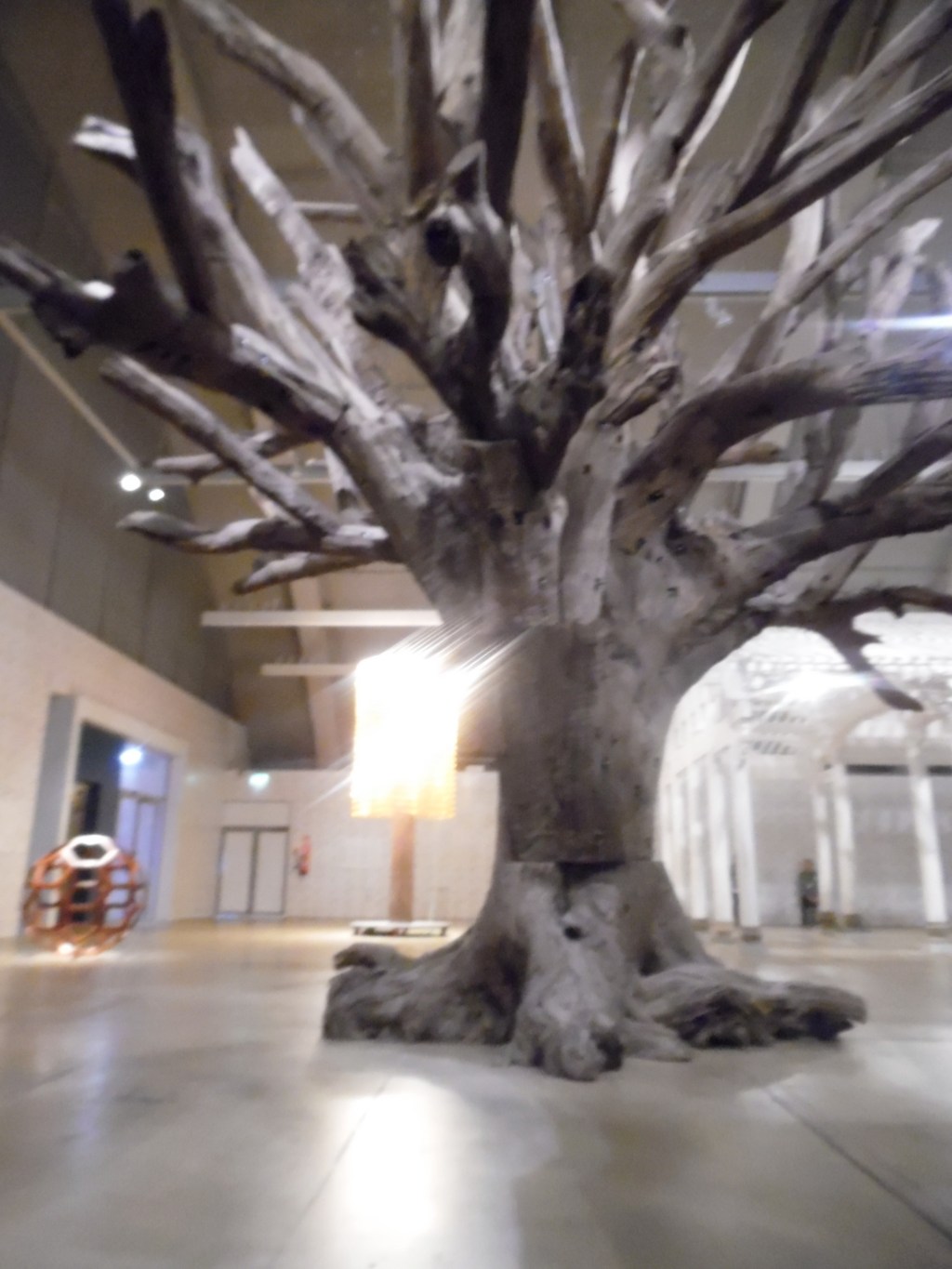
Another sculptural work by Ai Weiwei, is called Tree (2010). It is an assemblage of different woods deriving from individual trees. The dead tree trunks were collected from various locations in the mountains of South China. Differences between components is left visible intentionally:
‘We assembled them (the parts) together to have all the details of a normal tree. At the same time, you’re not comfortable, there’s a strangeness there, an unfamiliarness. And it’s just like trying to imagine what the tree was like.’
Wood as artistic material is so much about nature. Tree as a material is beyond our dominance. It exists and grows without our appropriation. But we did cut trees, we destroyed their existence, and we were cutting down entire forests. In the exhibition, the tree-sculpture is made from pieces to look like a whole tree, an original, yet at the same it is not. It is a look-alike, a not exactly, and a make believe of a tree, a form of a tree, a powerful signifier of a tree, of nature, of origin. It is quite interesting how this sculpture ended up being the center, as other objects are made of wood as well, representing crafty continuation of the artifacts as man made materiality, a continuation of time, which was before mass production.
The modernity of artificial materials, known as the mass-production is another question. Mass production creates massivity. Perhaps the ancestral places speak in the same manner as the modernity. The history is long; we communicate and paraphrase with it. Perhaps this exhibition communicates beyond art, becoming dynamic battlefield for matter and spirit, proposing final materiality in art. Where do we stretch the line between the materials that make the essence of an artwork? We draw from culture, bringing cultural objects into museum to speak for the culture. And this takes place ultimately not in the name of individual subjectivity but for all the collective consciousnesses.
After all, the dialogue between poetic and anti-poetic is what we are looking in the massivity. Poetry does not speak with the loudness unless it was dried out of mythological meaning and it communicates more with the naturalist approach to speak with metaphors. Metaphor can be standing for something, which is not invisible, and stands for something apparent, showing the evidence, creating presence of the political as inevitable. It is standing, yet changing?
There is an evident need for change in the cultural. The aesthetic is more of a repetitive force that takes form in the massivity. The criticism toward west comes in the undertone of the material in consumption, as enlightening force. The materialism is our new religion?
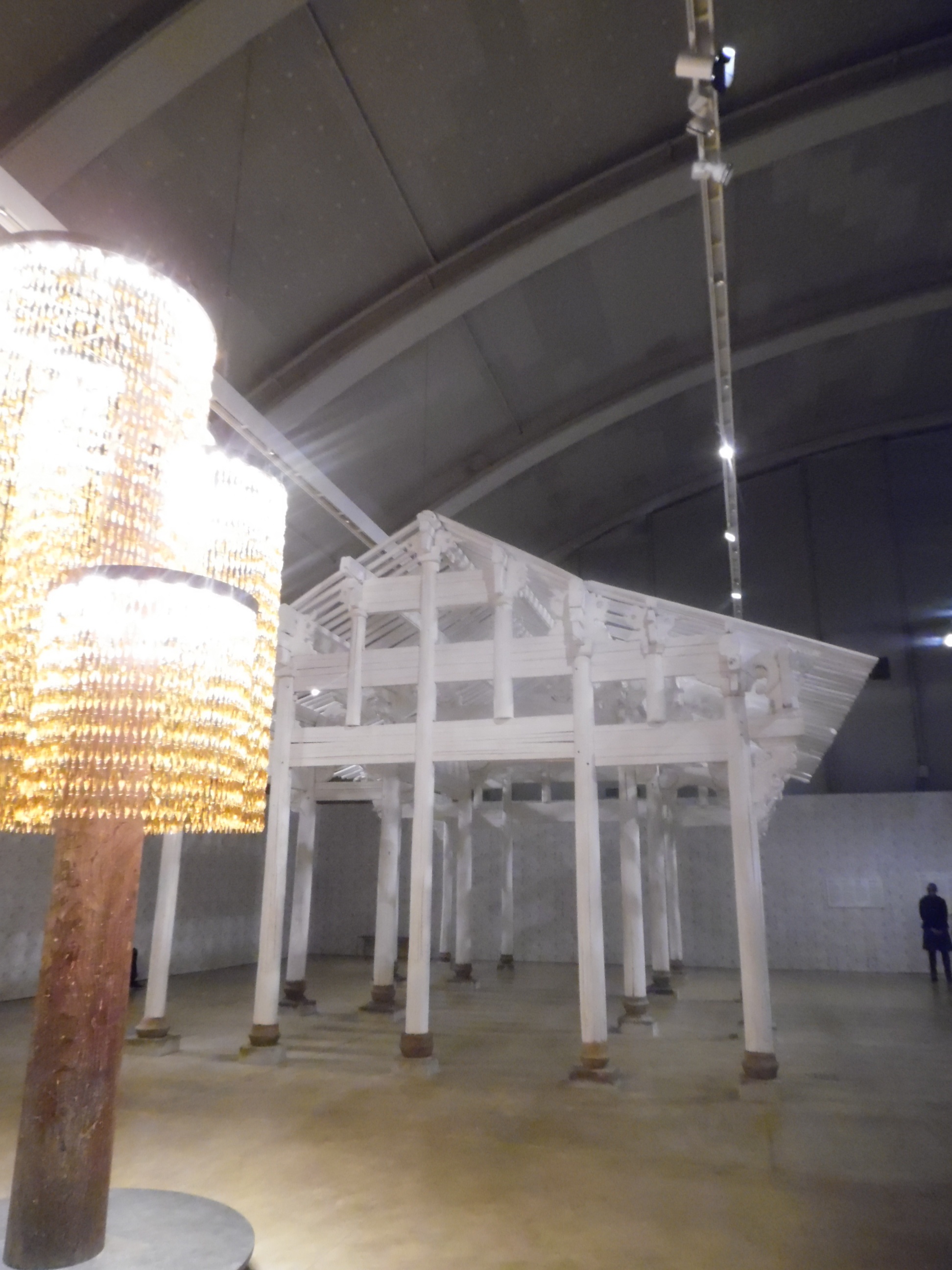
Traveling Light (2007), is a sculpture mounted on a temple pillar, appearing as being a gigantic table lamp or crystal chandelier. Ai Weiwei became interested in light as an object from the point of view of illumination and environment. The large sculpture stands for the idea that objects are close to human scale to be experienced physically.
Divina Proportio (2012), is composed of huali wood, referring to the golden mean, and as mathematical proportions to geometry in the Renaissance.
The exhibition includes two previously unseen works, White House, and Garbage Container, the former speaking of China’s developments and urbanization, the latter about five homeless boys who died tragically.
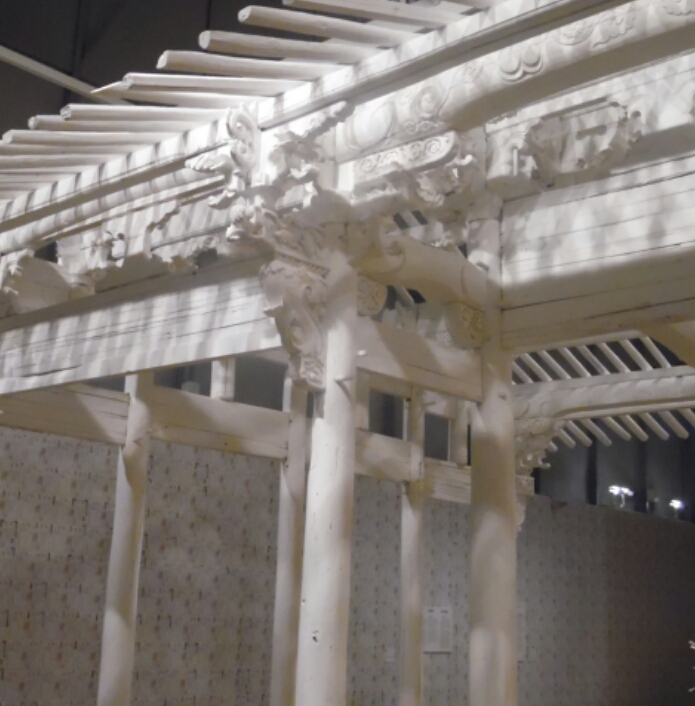
A new piece in the exhibition titled White House (2015) is an entire residential house of the Qing dynasty. The composition includes different woods and is constructed traditionally using nail-less joints. The work stands for the heritage, as the new developments in China have pushed away the traditional. The new white paint on a wooden surface creates questions about past and present, authenticity and change.
But cultures change slowly. The anthroposcience of human life shortly lived, continues in the legacy of a son who outlives his father (in a natural cycle). The artifacts have a longer life than we do, and this ends building the culture as fluid and as anatomically tilted. Objects lend to the patriarchal order creating legacy and interdependency. Objects echo about history, so in the name of the poetics and dialogue whenever they are on display there is an underpinning of voices that mesmerize with their presence.
The exhibition architecture divides the show into two large rooms. On the other side there are objects, which call much of the legacy that is darker, even more personal than the first exhibition space. Ai Weiwei became a prisoner after he was arrested in 2011 at the airport in Beijing. He was sometimes handcuffed to a chair while questioned. He also kept washing his one set of clothes while in prison, drying them on a hanger.
The art in this case becomes a historical conscience of a collective. It necessarily opens as a voice for the people whose history it is part of. The objects, their material consciousness and presence appear as inevitably non-corruptive, with presentation and physical presence, as non-poetic solidity. The substance is speaking through the stone, or the stones would shout, in this case wood objects.
Ai Weiwei’s role as a seer or visionary, means a hard position at home in China. His work Through (2007), is composed of tieli wood once again, having fragments of old temples from Qing dynasty. The scale is massive, and piercing, the tables and pillars form an almost cage-like atmosphere.
He says: ‘Artists are not in a position to decide the conditions imposed upon them but they can make statements about these conditions.’

Artists have their own life, their own existential power, their own presence and saying. When it comes to power propositions with artwork, let’s say this. It is hard to assume that the artist proposes his artwork knowing that the entire nature of the artwork would stand for the resistance of power. Cultural legacy changes in a moment, when it becomes ‘art’. The objects are in a terrain of global and international exchange of matter. When it comes to materiality in the sense or meaning, would not the objects have a saying only inside their cultural reference? Legacy or cultural speaking of the history changes with the art market. When legacy becomes art, it has become layered with different meaning; yet the objects are not entirely free of their cultural origins.
The Garbage Container (2014), impresses as a valuable huali wood piece, reminiscing of a cupboard, and looking like a container when it turned on the side. Another impressive piece is the architectural installation titled Ordos 100 model (2011), which was built together with Swiss architect firm Herzog & De Meuron. Made of carved pinewood, an uncompleted, miniature city was planned to be build in Ordros. Treasure Box (2014), is another construction made of huali wood. interestingly, all the objects seem to highlight the wallpaper, titled as IOU Wallpaper (2011-2013), which has decorative appeal, yet a message that makes everything seem unconventional.

Ai Weiwei’s exhibition at HAM Helsinki in on view until February 28th, 2016.
Artist website: http://aiweiwei.com/
images: Firstindigo&Lifestyle

 Firstindigo&Lifestyle