The Japanese artist Katsushika Hokusai (1760–1849) is usually recognized for a single image—Great Wave Off the Coast of Kanagawa, which is an icon in the global art world. When we recognize the work, it is as if the unpredictability of the sea holds our attention when a mighty wave breaks against the beach. We are lucky, since TheNational Museum of Asian Art has had a commitment to build its Hokusai collection. The institution is now showing an exhibition Hokusai: Mad About Painting in the museum’s Freer Gallery of Art.
In commemoration of the centennial of Charles Lang Freer’s death in 1919, the Freer Gallery presents an exploration of the prolific career of the artist Katsushika Hokusai. Freer himself recognized the richness of the artist’s works assembling the world’s largest collection of Hokusai’s paintings, sketches, and drawings.
Like the Great Wave, many of Hokusai’s paintings convey his interest in the every-chancing ocean in motion, including its fishermen and sea creatures. The artist created thousands of works throughout his long life. He worked mainly in Edo (modern Tokyo) period with a proximity to the Pacific Ocean.
Above on the left, we see one of the wave paintings Breaking Waves (Edo period, 1847), created by Hokusai. It is apparent how the rough curving motion really brings the sea to life. The artist was able to masterfully capture the ocean’s free spirit making it the focus of his works. On the right, another Japanese artist of Edo period, Utagawa Hiroshige (1797-1858) depicts Edo landspaces in his work consisting of six panels. A detail of his work Famous Sites of Edo, spreads in the screens in which each panel has a separate painting that is mounted to one panel of the screen. The coastline and sea are visible through these panels illustrating landscapes. Interestingly, during the life of the two artists, by the early nineteenth century, the city of Edo had grown to a metropolis with a population of more than one million.
Hokusai, Egret on a Bridge Post Edo period, ca. 1801-1802 Japan Ink and color on paper H x W (image): 85.8 × 25.5 cm (33 3/4 × 10 1/16 in) Gift of Charles Lang Freer Freer Gallery of Art
Hokusai showed interest in nature through many of his works. One of them, Egret on a Bridge Post, showsa white egret at night with moonlight illuminating the bird’s pale form. He illustrated the bird on top of a bridge post. Egrets are still seen in Japan’s rivers looking for food.
The works in the exhibition, including Hokusai’s humorous manga about the everyday life, activities and faces of Japan, shows the vastness and the creative mind of an artist, who thought he might achieve a true mastery in painting, if he lived to the age of 110.
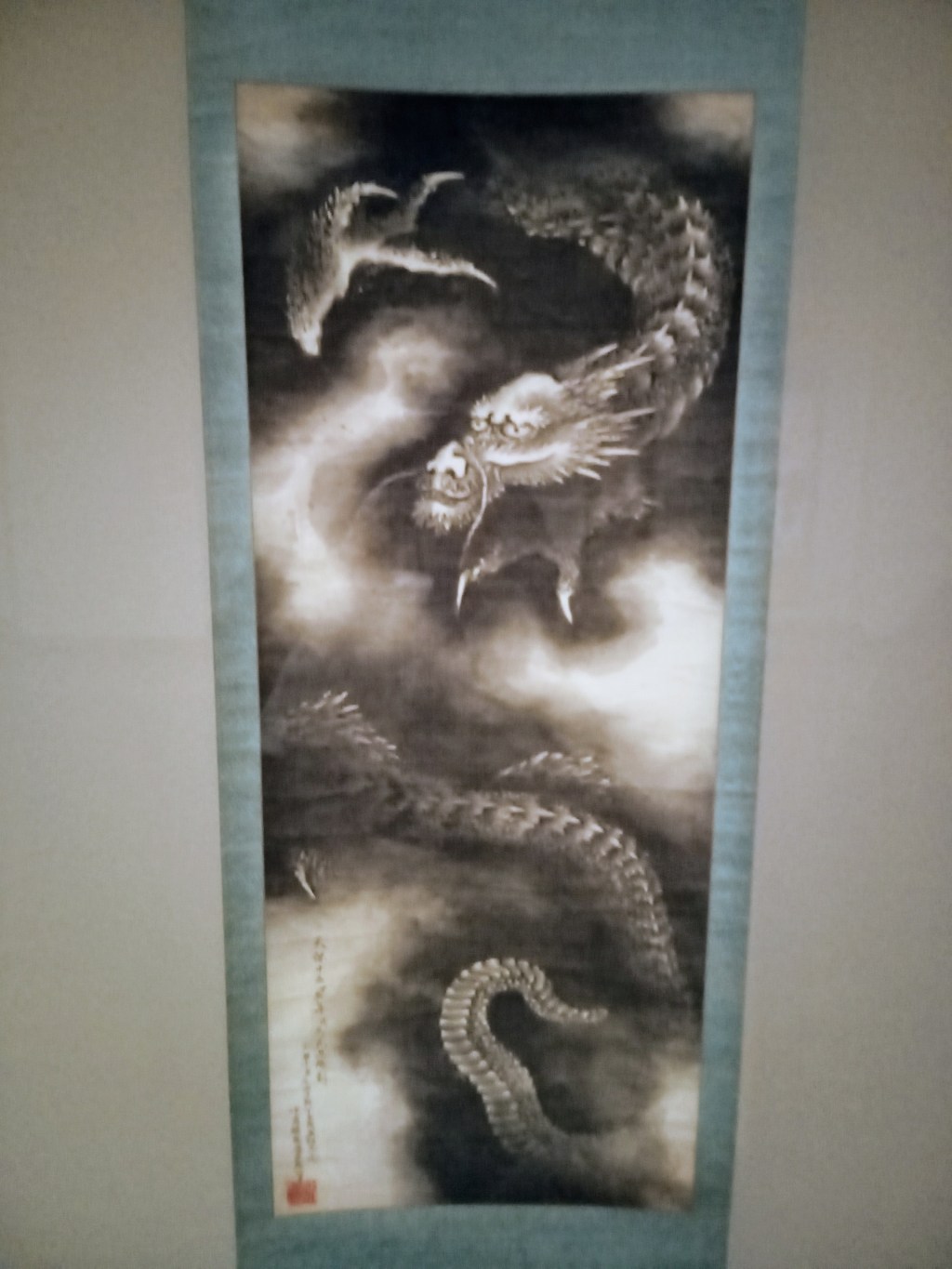
During his eighties, Hokusai painted several mythical creatures known as dragons. The ultimate interest for him might have been in the character’s energy as the artist himself was ageing.
One of these works, Dragon and Clouds (Edo period, 1844), was painted when he was at the age of eighty-five. The painting shows energy and vibrancy in the form of mighty mythical creature. The work is an important addition into documenting Hokusai’s life and art.
Hokusai, Dragon and clouds Edo period, 1760-1849 Japan Ink on paper H x W (image): 88.2 x 35.6 cm (34 3/4 x 14 in) Gift of Charles Lang Freer Freer Gallery of Art
Katsutoshi Yuasa is a Japanese artist who has revitalized the original idea of photography, thinking about its early techniques, and bringing the digital production close to ancient Japanese printmaking practices. His detailed and lengthy artistic process starts usually with a digital snapshot. Eventually the image finds a new life as woodcut print or relief work, which the artist carves and prints all by a hand. In this production the original alters into something else, depicting a feeling or experience. Katsutoshi Yuasa was born in Tokyo. He graduated from the Royal College of Art in London, and has exhibited internationally for over a decade now.
For Katsutoshi Yuasa, the photography contains several layers of meaning. The complexity of the medium implies that the production cannot be perceived as pure images.
Firstindigo&Lifestyle: Your woodcutting is based on photography, did this practice in your mind transform the idea of photography?
Katsutoshi Yuasa: Yes, my process of making art works is a way of thinking about an origin of photography. Or it is about image-making. How we understand and transform an image in front of our eyes to our mind.
I start from a photographic snapshot, but re-emergence of a photographic image is not my goal. My purpose of using a photograph is to make visible something which is perceived but no one sees.
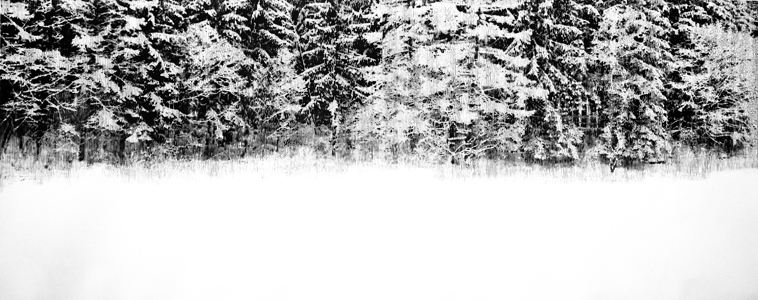
Katsutoshi Yuasa, 2014, After a long pause, 60cm x 150 cm, oil-based woodcut on paper.
Firstindigo&Lifestyle: What is your background in the arts, how did you end up choosing woodcutting?
KY: I studied painting at first when I was a student. But I gave up my paintings because I couldn’t find a good future in my paintings. So I participated in a short printmaking course, and then found positive possibilities in the printmaking. Even that time my interest was photography, so I was thinking photo etching or screen print technique as my primary expression. At first, woodcut print seemed to be too far from photography. But later I concerned carving lines on wood as a similar process to making lights in the dark room. Now I’ve been making woodcut prints and works related to wood for over 10 years. Basically, woodcut print includes questions about light, image, water and colour.
Firstindigo&Lifestyle: In how many countries have you exhibited so far, including art galleries and art fairs?
KY: Maybe about 15 or 16 countries.
Firstindigo&Lifestyle: Coming from Japan, do you find that there are common approaches to making art in Japanese and Nordic cultures, asking this also because your art has been showed in Nordic countries quite often?
KY: My main subject is woodcut print but it is about light, image, water and colour. So I made a project with an idea of these and created a concept from a place where I stayed. When I visited Norway with the art project “20 Coastal Stations”, my subject was water & colour. I’m going to have a exhibition in October 2016 with artists who traveled together in Norway last year (see info here http://www.sfk.museum.no/nn/node/48).
Firstindigo&Lifestyle: You spent also some artist residence time in Finland, how was this experience like, did it change your artistry, how about finding new influences?
KY: I spend a really good time in Finland. During the artist residence in Finland, I searched Scandinavian myths and poems. I’m interested in how myths are made. I made woodcut prints titled as “Illmatar” and “The world without words”. Also “Listen, Nature is full of songs and truth” is a phrase that I borrowed from Finland.
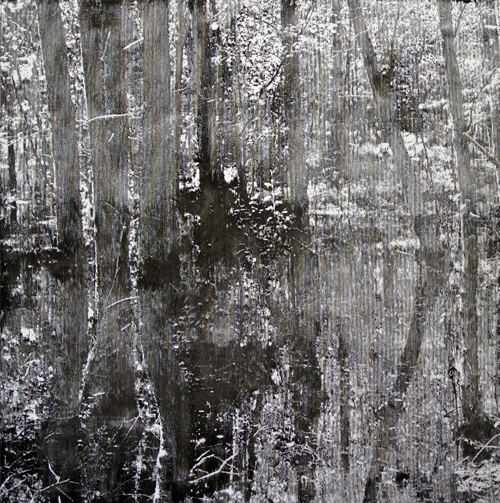
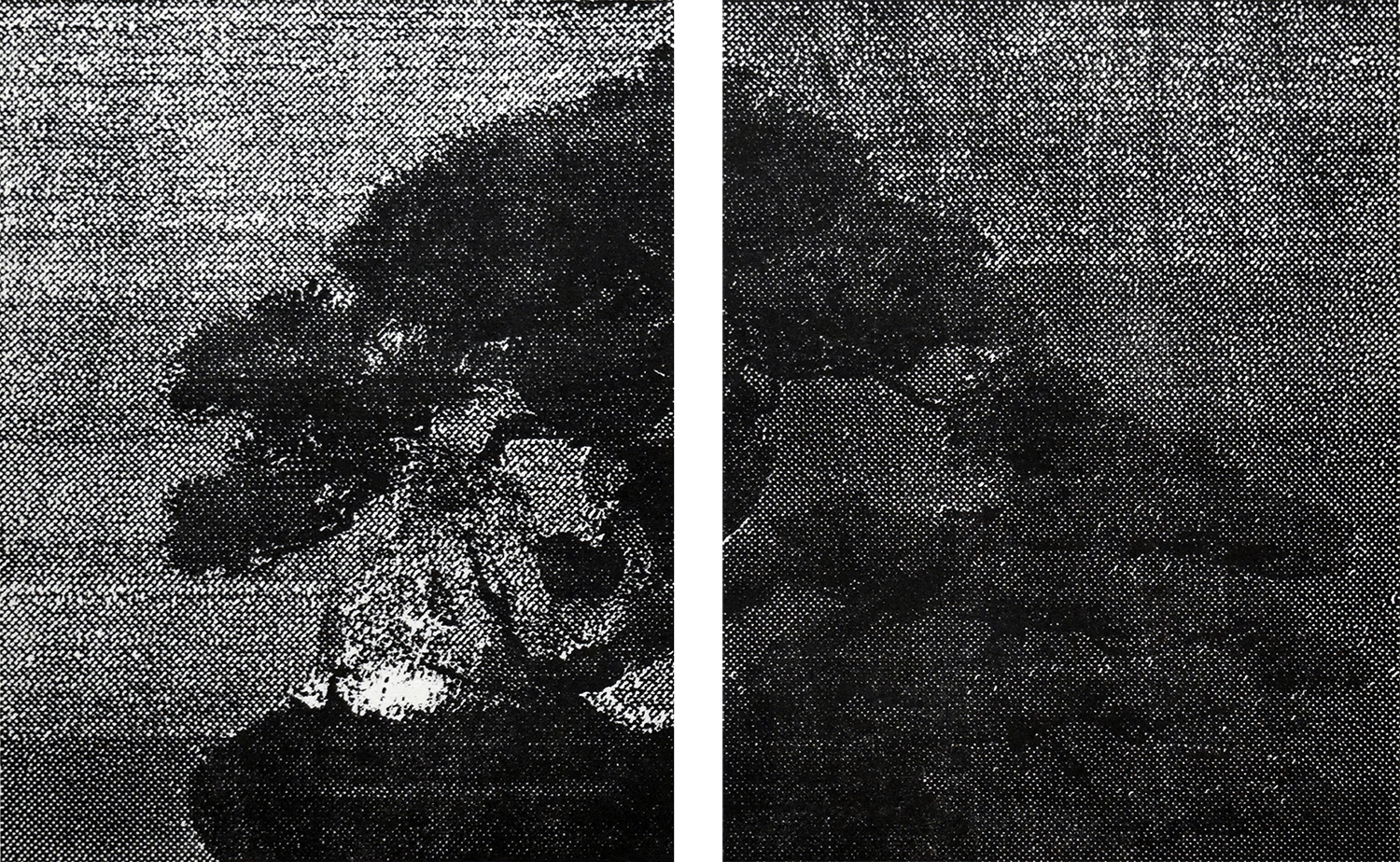
Katsutoshi Yuasa, 2013, The world without words, water-based woodcut on paper.
Firstindigo&Lifestyle: It seems that many of your photographs carry nature imagery, what is your artistic philosophy about nature and how does it change in the process of making your works?
KY: I am not interested in making just beautiful pictures. My interest are words, stories and myths behind the nature and the landscape. The topics are words, images, art, nature, politics and beauty. I would also like to show and include ambivalence in my works.
Firstindigo&Lifestyle: In recent years, you have made a series of works that imply thematic concerns about what is happening in the world. You did a series titled “The Colors of the Innocents”; the theme is based on events in the Middle East adopting Syrian crisis. How did this project come about?
KY: Everyday we see many shocking images on TV or on a screen. There are too many images around us via the internet. I have the works titled as “We lost something but we don’t know what we lost”. And, we can say “We see anything but we don’t remember what we saw” and also “We know something is happening in the world but we don’t know the smell and temperature”. These topics are about cruelty and colour.
Katsutoshi Yuasa, 2015, The colours of the Innocents #4 60cm x 90.5cm. Water-based woodcut on paper.
Firstindigo&Lifestyle: The result of these prints is quite amazing. Tell about the aesthetic choices of making “The Colors of the Innocents”? They are quite different from your other works, which are more representational.
KY: For these works, I was more interested in making colourful works because colour is getting more important in my practice. One colour work is following up from my CMYK printing system. So I made 4 wood blocks with different lines and printed with 4 CMYK colours.
Firstindigo&Lifestyle: You can see that in 2015 there are new lines and shapes emerging, and result is perhaps more geometry and color. The prints titled All is Vanity, CMYCYMMCYMYCYCMYMC, and Nordlys, to name a few, have this form. Can you say that there is a fine line between design and art in the project that you are doing with these shapes?
KY: The most important idea for these works is “A Throw of the Dice Never Abolish Chance”. My interest is making an Image by a chance. Especially the I Ching is very interesting. There is a question that we choose something by a will or a chance. So my latest solo exhibition was titled as Colour/Numbers. How we choose numbers or how a number was chosen by us.
Katsutoshi Yuasa, 2015,Nordlys 45cm diameter Water-based woodcut on paper.
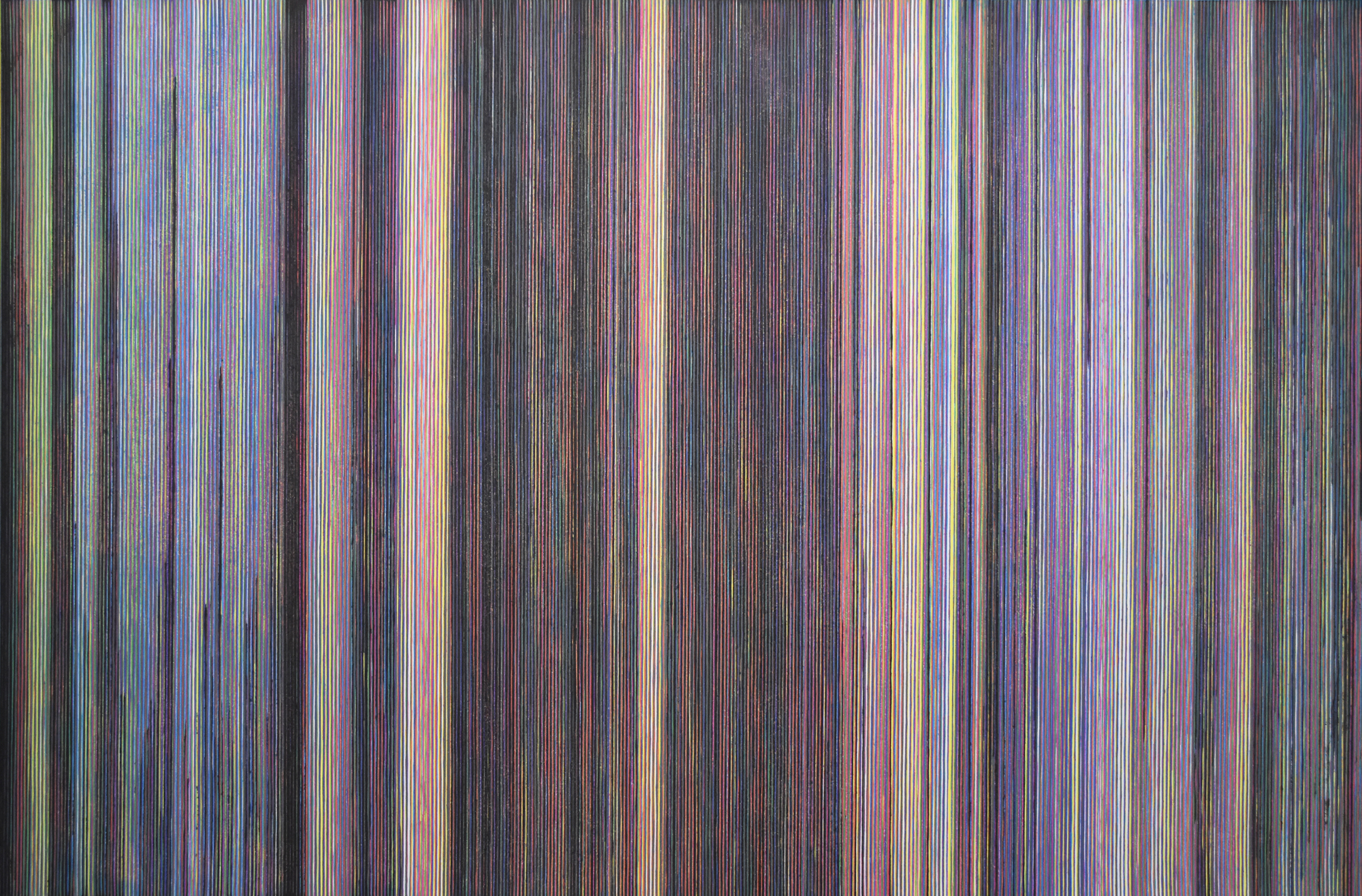
Katsutoshi Yuasa, 2015, CMYCYMMCYMYCYCMYMC / Set of 24 sheets, 64cm x 48cm each / Water-based woodcut on paper.
Firstindigo&Lifestyle: Tell about the “Beyond assumption” exhibition, which you had in Copenhagen in 2011, you kind of wanted to create an oppositional imagery of disaster, could you tell about this background, and what did you choose to be part of the imagery beyond assumption?
Yes, the exhibition “Beyond assumption” is a word from the Natural disaster that hit in Japan in 2011. Artists want to make their art works beyond assumption in the end. And of course Nature is always beyond our assumption. But we made a system under an unstable base. So here art connects to nature.
Firstindigo&Lifestyle: The works from 2016 also are experimenting with different shapes, reflecting pattern explorations, and bringing forth new influences. It seems that you have a flux of going between geometry and nature, to create and implement beauty?
Katsutoshi Yuasa, 2015, Observation point 95.5cm x 190cm Oil-based woodcut on aluminum leaf paper.
KY: Yes, I’m very interested in geometry and patterns. It is about image-making. History and culture are included behind an image.
Katsutoshi Yuasa, 2016 Aesthetics of 12 #1 28cm x 45 cm, oil-based woodcut on paper.
Firstindigo&Lifestyle: Where are you heading next with your art and career?
KY: My next exhibition will be in Norway in October. It includes works from 20 Coastal Stations project. So 6 artists will be showing together, presenting the project. Also, I will have a group exhibition with young Japanese artists, who make water-based woodcut prints, in Melbourne in October.
Cho Kuwakado is a Buddhist priest and director of Lumbini Kindergarten in Saiki City in Japan. He is an Arts educator together with his team that makes Chara-Rimpa mural projects in Japan and abroad. The most recent international collaboration was for the opening event for the celebration of Colegio Madrid’s 75th anniversary in Mexico. In the interview, Cho discusses the background of these projects, and encourages us to think together with his educational philosophy, which is rooted in the history of Art and in the Buddhist thinking.
There are two levels of nature in my thinking. One is a superficial level like weather, vegetation, and ecosystem. Another is a cosmological level from which the superficial workings of nature emerge. Valuable works of art for me entail some elements of nature at a cosmological level. I think that is the source of the universal appeal of fine art work.
Chara-Rimpa is an art project initiative with a global production perspective, how did it get started and when?
It started in Spring 2013 when I began planning for our kindergarten’s 50th anniversary event. I contacted Dr. Yasuyuki Sakura, a graduate of our school and an established artist based in Tokyo, to ask him to be involved in our celebration event. Dr. Sakura agreed to be the art director of our kindergarten as well as to be a co-planner of our anniversary celebration- this was the initiation of the Chara-Rimpa project.
The global production idea came up when teachers from our sister school in California visited our school in Saiki. They were quite attracted by the professional work of Dr. Sakura and in the large mural in our school play yard that was created with 64 kindergartners in one day. I then thought about the possibility of doing a Chara-Rimpa art project in California and was interested to see how it could be carried out. I made a proposal to one of the teachers, Sarah Clark, to visit her school with my artist team. Then we started to talk about the details of a possible mural making project in California. After six months, in June 2014, we visited the town of Burney, CA where the movie “Stand by Me” was filmed. We worked with the sixth graders of Burney Elementary School. Our Chara-Rimpa project in Burney was a great success.
I’m very curious, what is your own background in the intersection of the arts and community involvement/community work?
My family has resided in Saiki City, Oita Prefecture, Japan since the 17th century as a hereditary Buddhist temple chief-priest/caretaker family. I am the 17th head priest of a Shin Buddhist temple, Zenkyoji, as well as the director of its kindergarten. As I grew up, I often looked into the writings and possessions of the former head priests, and I learned that india-ink painting, calligraphy, and mastery in classical Chinese poetry were common practices of former Buddhist priests until a century ago. Nowadays some limited groups of priests do continue these traditional practices. My interest in art came from my predecessor’s interest in Chinese art culture.
With 1500 households belonging to my temple, I think it is an important part of my responsibility to serve our community. Planning art events and workshops building relationships between children and adults is one of my community commitments.
Where did you study, and how did you find your international networks?
I was trained in Buddhist practice at my temple since the age of five. I studied social anthropology at Claremont Colleges (Pitzer) in Southern California, University College London, and Cornell University. My father was a Buddhist priest and a child education specialist. He studied in the US for one year. He developed a scholarly network then, which later led to my interest in studying at a university in the US. When I was a student there, I was fortunate to make friends from various countries, though I lost contact with many of them after graduation. However, through Internet SNS, mainly Facebook, I have reconnected with many friends that I studied with in the US and the UK.
Your recent project took place in Mexico City, how did the murals come about? How do you feel, what was the impact at the local level? Do you use multicultural tactics?
Dr. Sakura and his partner Toshie Yoshioka worked together to develop the design theme of the mural. In a photograph of the elementary school wall, they noticed a water fountain in the lower central part of the wall. The shape of the water fountain resembled a plant pot and they decided to draw a big tree growing from ‘the pot.’ It came out incredibly vibrant and beautiful and the impact of the mural was greater than I had expected. It was an opening event for the celebration of Colegio Madrid’s 75th anniversary. About 20 teachers and 70~80 students participated in making a giant mural on its elementary school building wall. I felt the power of the artists’ imaginations, which enabled many people to work together for the same purpose enthusiastically. The directors, teachers, students, and invited guests all looked happy and marveled to see the beauty of the completed mural. We also organized and ran workshops which incorporated elements of traditional Japanese culture. Our photographer took photographs of Mexican people in “on the job/off the job” style to be used for later workshops in other countries.
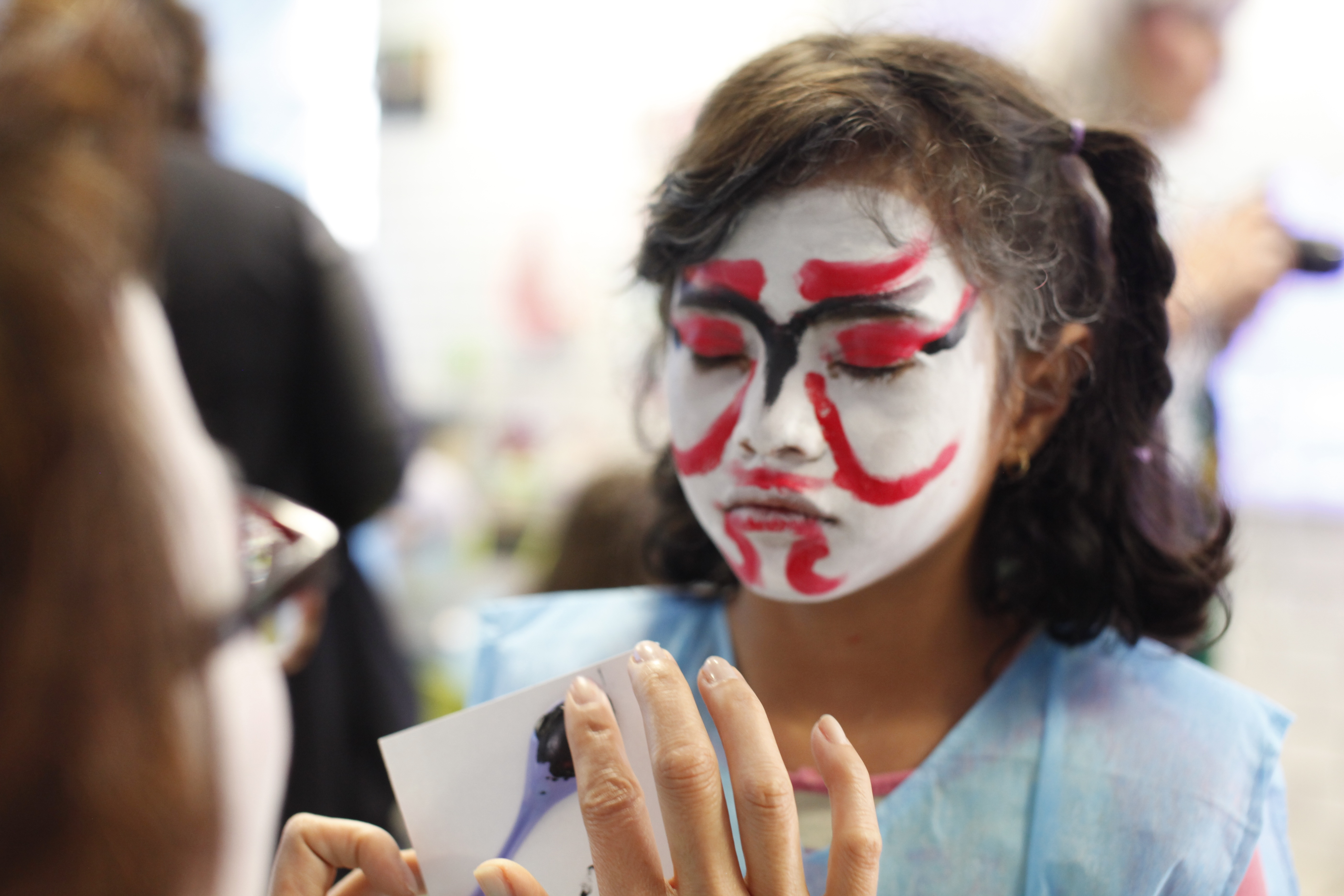
Chara-Rimpa facial painting in process
Donna Sylvester is a Chara-Rimpa collaborator
Chara-Ripma’s president Kudo Hideyasu has multiple roles
Chara-Ripma artists and collaborators come with creative ideas
Who are your greatest influencers in terms of the arts and creativity?
I have always been influenced by the thoughts and activities of Ryuichi Sakamoto (Japanese composer/musician), Levi-Strauss (Claude) for his work “La Pensée Sauvage,” and the Vienna Secession for their quest for freedom in art, departure from historicism and conservatism.
Could you tell us about your most important collaborators, who are they and what is their role in the projects?
Dr. Yasuyuki Sakura is the key artist of our project, conceptualizing the overall plan. His partner Toshie Yoshioka is a splendid designer who creates our workshops and mural design. Hiroaki Seo is our indispensable photographer who records the process of our activities, the finished work, and also captures the fleeting expressions of the participants. Hiroaki is responsible for all those vibrant images of the project and the people involved. Hanako Suro, our writer, communicates in a friendly and warm style to share information about our projects for a Japanese audience. Keiko, my wife, helps me making plans and doing projects. Kate MillingYonezawa always helps me with English wording. Hao Phan, my friend from Cornell University, has been very helpful in planning overseas projects. It was thanks to Hao that our project in Mexico was so successful. I am very appreciative of Hao’s support with her global network. Another Cornell alumna, Young Ju Kwon, owner of the sushi restaurant YUZU, is helping us with possible project development in New York City.
When we plan our overseas projects, it is crucial to have a devoted, experienced person in charge of the art project. Sarah Clark in Burney and Laura Gilabert at Colegio Madrid were such teachers. We were very lucky to have Sarah and Laura in charge of the project at each school.
Do you have a specific education philosophy that gives you guidelines? Does being Japanese implement ideas that you think are unique, and that the world should learn about?
My education philosophy has its base in Buddhism; every individual’s potential is valued equally and is educated accordingly, everyone needs to play a role for a peaceful society.
A former professor of Tokyo University of Arts, art critic Hideto Fuse points out that one of the distinctive characteristics of Japanese art throughout its history is to cultivate “the mind of children” as expressed in the facial beauty of Buddhist statues. I agree with him that the Japanese art tradition valued “the mind of a child” in the sense that Picasso expressed, “It took me four years to paint like Raphael, but a lifetime to paint like a child. “ I think that if there is something Japanese artists can offer to the world, one thing is its artistic tradition of expressing “the mind of a child” in art forms as can be seen in the contemporary works of Takashi Murakami and Yoshitomo Nara.
Do you have a favorite art form, performing arts or visual arts, what does being so multidisciplinary mean to you?
Visiting museums is always a treat for my mind. I was fascinated by William Turner’s work in London. I love music very much. A solo performance by Rostropovich that I attended at Cornell Concert Hall was one of my most fortunate experiences. A Sankaijuku dance performance that I saw in LA was impressive. Form itself does not define my preference. I am more attracted to the spirit expressed in any kind of art form. I think multidisciplinary is a very stimulating concept. It is a very effective approach to reach more audience in the context of technologically progressing diversified modern society. I think our art project can be viewed as a type of participatory art or relational art, which is usually, categorized as multidisciplinary art.
What kind of role does nature play in your thinking? Are there any specific metaphors in the nature that are important for you personally, and in your creative process?
There are two levels of nature in my thinking. One is a superficial level like weather, vegetation, and ecosystem. Another is a cosmological level from which the superficial workings of nature emerge. Valuable works of art for me entail some elements of nature at a cosmological level. I think that is the source of the universal appeal of fine art work.
What kinds of projects you have in mind for the future in Japan and overseas?
Dr. Sakura and I are planning mural making projects in Japanese towns. We are also planning another overseas art project for the next year involving mural making and cultural exchange art workshops. The mural design and the workshops are planned taking into account the project location and the country’s unique culture and traditions.
We are also planning to partake in a local festival here to attract more people and to create an improvisational call-and-response singing event. We are hoping that more people will experience and enjoy the spirit ofChara-Rimpa.
The mural design and the workshops are planned taking into account the project location and the country’s unique culture and traditions.








 Firstindigo&Lifestyle