Bells, tools and meditation are all ancient. When it has been confirmed by historic research, that tools and weapons were among the earliest bronze objects in China, the bells also now belong to this bronze age era. The meditative component has eminently added value and appreciation among the Asian arts. People are looking for nurture from art, and statuesque buddhas seem nurturing, even healing with their meditative poses. Massive sculptures are surrounded with the calm that is often lacking from the demands of the everyday life. The journey inwards requires little more participation.
Chinese bells have a special form that calls for a closer investigation. They are emblems of music, and when tried, the sound can be interestingly different from the Western terms of bell-sound. The church-bells have varying melodies, yet Chinese bells embody tones that are thousands of years old. It is believed, that the sound has not changed since they were casted. Bells still narrate of ancient technology as a soundsystem.
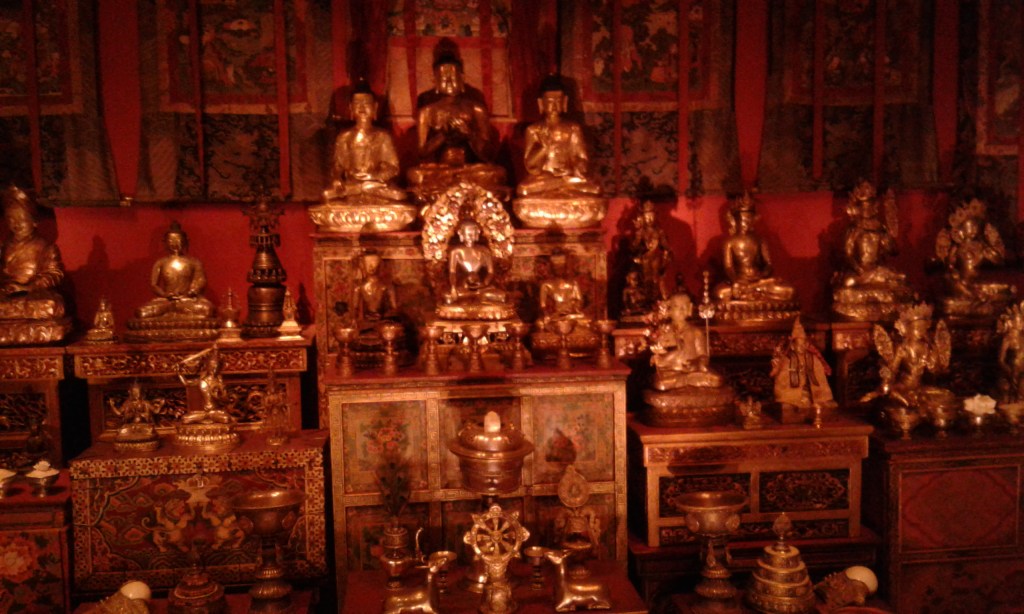
Chinese bells Free Gallery of Art & Arthur M. Sackler Gallery
With the global travel, the world has shrunk, and meditation practices have become increasingly popular. We are at the moment pushed to scrutinize ourselves into increased indoor dwelling, so discovering new possibilities of meditative practices might be useful. Sound is one way to go, listening to music with new awareness, concentrating fully into music or sound may turn the focus into a particular matter. A ‘look’ inwards may be rewarding.
Meditation is a bodily practice of a mind as operator. A word techne would also fit with its stance of the world. Techne is a philosophical term, which includes knowledge at its core. By using it in reference to bodily practice, it might as well connect to understanding your meditation approach. Learn to meditate by meditating, gain knowledge of meditation by doing it. Knowledge is coming from the act and art of doing.
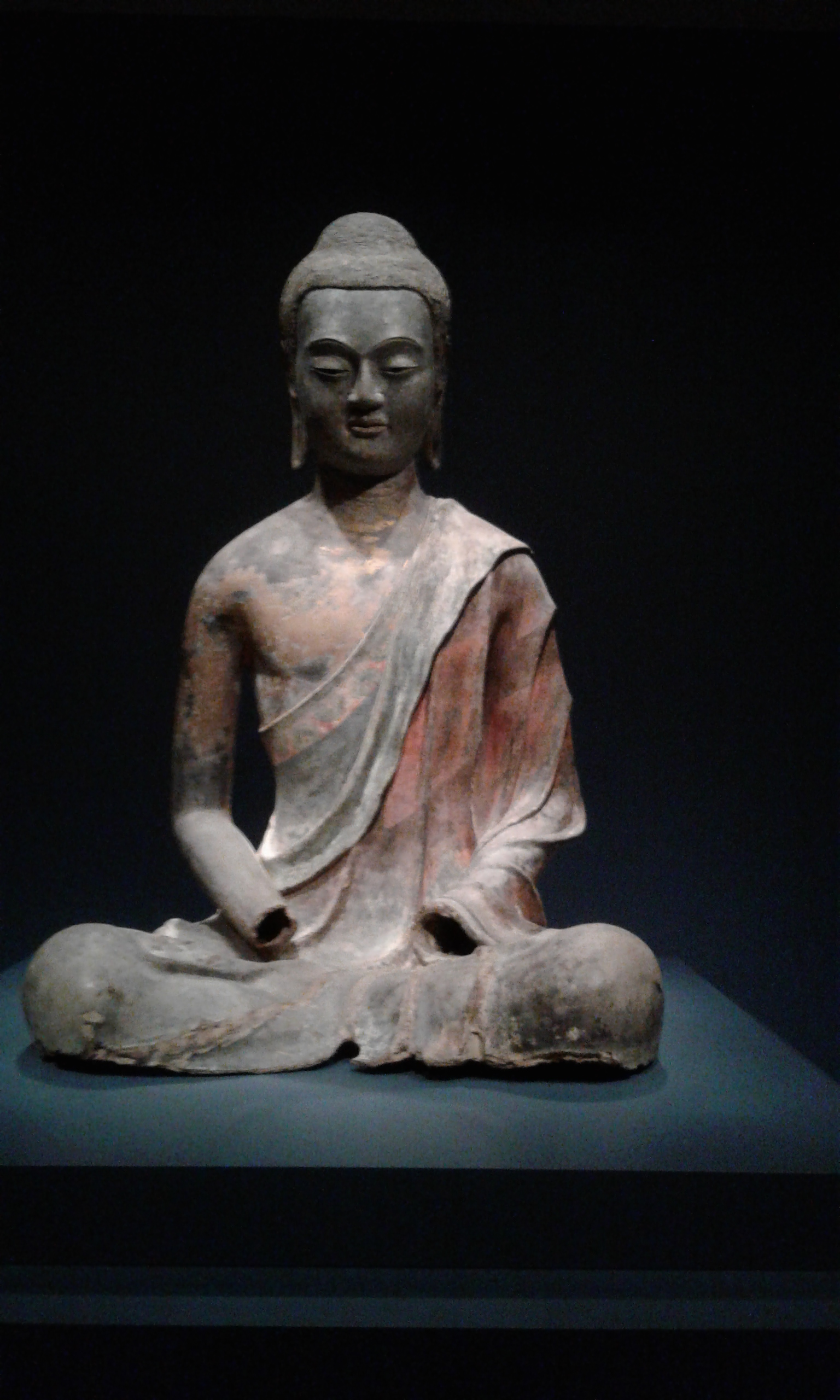
Sitting buddhas are art works that meditate, giving out a pose with a silent approach that is almost demanding us to participate in a technology of looking inwards, of stopping our other activities, breathing with the sculpture. The art stimulates the senses into a sole pattern of sitting with a more disciplinary attitude.
Buddha sculpture at the Free Gallery of Art & Arthur M. Sackler Gallery.
Finnish contemporary composer, oboist and music pedagogue Riikka Talvitie is an artist greatly influenced by her audience. She believes that the audience and community have an impact so important that there is a need for new notions of authorship and agency in music. Her compositions are brought into practice in performances, and so the discussion of the community’s role in collaboration is relevant. As a woman composer, Talvitie also wears an activist hat in society. Women are still in the margins as art music composers.
There are topics and ideas that Talvitie is ready to discuss more, and she collaborates with artists of many genres. She is currently in the process of doing her artistic doctorate in music at the Sibelius Academy, University of the Arts in Helsinki.
Firstindigo&Lifestyle: How did you pick oboe as your instrument?
Riikka Talvitie: As a child, I lived in Kerava, in a small town near Helsinki. When I was seven years old I started to play piano in a local music school which was founded in those years. (This autumn I am composing a piece for the 40-years celebration.)
When I was around 14-years old I asked our music teacher if I could start to play oboe in a school orchestra. In the orchestra, there was also an older student, oboist, who started to teach me. I didn’t know how difficult it was to start the instrument.
Later after school, I did entrance examination for Sibelius Academy with both instruments. I got in with oboe, which was a sort of coincidence. I also started to read mathematics at the University.
Firstindigo&Lifestyle: How much did your own instrument define and influence your creations in the early face of your career?
RT: I just did a video work Self-Portrait which is dealing with this question. The main thematic issue of the work is a relationship between a composer and a musician. I am performing both persons at the same time, so I am discussing with myself. I am also improvising some bodily exercises with the oboe. (See the video here https://fmq.fi/articles/composer-at-work-a-critical-self-portrait)
Firstindigo&Lifestyle: What else in your musical training and background created who you are, and what made you choose composing?
RT: I chose a high school, which was specialized in performing arts. All my friends had something to do with theatre, cinema, literature or dance. So while I was studying oboe playing I composed and improvised music to theatre plays and short movies. I was quite enthusiastic with these projects so I took composition as a secondary subject.
I was also quite interested about contemporary music in general. I played myself a lot and I was visiting many festivals.
Firstindigo&Lifestyle: How many years ago was this, and how has your career path evolved?
RT: I had my first composition lesson in 1994 in a summer course with Jouni Kaipainen and Magnus Lindberg. At that time I had lots of ideas and plans but no craftsmanship or technical skills. After the course I started to study really seriously.
The world might have been a bit different place in the 90’s because I was able to study composition quite long at the Sibelius Academy after I had graduated with oboe.
I have also been twice in Paris. First time I was studying oboe and composition at the conservatory of Paris. And the second time I was following one-year-course of music technology at Ircam.
Finally when I got my first child, in 2004, I stopped playing oboe because I didn’t have time to practise and travel anymore. In the video work I am quite strict to myself and ask: why did you stop playing? You did not think about your career? The answer is not that simple. This autumn I have some oboe performances coming so I am still dealing with the same question.
Firstindigo&Lifestyle: What words describe your music?
Firstindigo&Lifestyle: What kinds of themes do you usually develop in your compositions?
RT: Many themes and interests have changed during the years. When I was younger I got excited with mathematical ideas. Abstract world without social intrigues fascinated me in many ways. Then I have worked a lot with texts – poems, plays etc.
Nowadays, I am more into political and critical themes. I have a feeling that concert music is repeating some kind of old ritual where the most creative ideas are forbidden. Many things are not allowed, socially and aesthetically. I find this quite contradictory to the main purpose of art.
At this moment, my goals are more interactive and communal. I am preparing an artistic research about shared authorship and communality in a composer’s practice.
Firstindigo&Lifestyle: Are there ways to categorize contemporary music? Do contemporary works differ from modern music, say in tonality, and in aesthetical ways?
RT: I just read an interesting book Music After the Fall: Modern Composition and Culturesince 1989 by Tim Rutherford-Johnson. The writer argues that contemporary music is not anymore so much linked to modernism as we tend to think. instead, it should be analysed in the context of globalization, digitization and new media. He starts the new era from the year 1989. I recommend this book to all composers and musicians who are trying to define the state of contemporary music scene today.
I see some trends among composers. The growing use of video and multimedia is now very common in concerts all over. Also the question of material is changing. In modernism a composer created his/her own material on which the composition was built. Now, there is more liberal relation to musical material which can vary from different musical styles to short samples of already existing music or sound.
One of the most important changes is the effect of social media. All the composers are marketing and presenting their works openly in the internet. It gives composers freedom to find their own paths but on the other hand it feels like a global competition of recognition.
Firstindigo&Lifestyle: Does being a woman composer mean something special to you?
RT: Yes, it means a lot. I am a feminist, in a way. I strongly support equality and diversity in the society and correspondingly in the music field.
These values are unfortunately missing in the project of canonizing composers and art works. I am interested in artists who are left outside the canon. A year ago, I was presenting a work by Ethel Smith, a British composer from the beginning of 20th century. She was not mentioned in our music history classes in my youth. And how many others are there?
While doing my artistic research, I have many times wondered why the different waves of feminism haven’t left almost any imprint on art music composition. In Finnish composers society there are still only 10 % female composers. If we think about what happened in performance and video art in the 60’s and 70’s there were lots of artists participating in the happenings for sexual emancipation. At the same time, among contemporary music we just invented new composition techniques 🙂
I have also considered this question while teaching. What values do we forward to the next generation?
Firstindigo&Lifestyle: Finland has a woman composing star, Kaija Saariaho, who is also well-known in New York City music world. Do you think she has developed a way for others to follow?
RT: Kaija Saariaho has an important role in Finnish music life, for sure, and in that sense her career is a sort of example for woman composers. She is also really warm and gentle person towards colleagues, especially for young students.
On the other hand, Kaija is presenting quite traditional image of a composer. Her career is based on international reputation, large commissions, prizes and so on. This position is actually quite hierarchical, and mythical.
There are plenty of artists who don’t want an individual international status. They want to work in working groups or in a pedagogical field. We are different. In that point of view Kaija is not a role model for all Finnish female composers.
Firstindigo&Lifestyle: What are your key influences as a composer, and how do you conceptually start your works?
RT: Every project is slightly different but I still try to give some concrete examples. I start every composition by discussion with other people who are involved. I try to figure out who is playing, what skills musicians have, what are the interests of a producer, what is the schedule, what else is performed in the same concert, is there a musical theme like era or an ideological theme like protection of seas etc. For me it is really important that musicians and performers are fully engaged in the big picture.
I also collaborate quite a lot with other artists. In those situations I normally wait a moment and listen to others. I feel that I have much to learn because contemporary music has been so isolated in the abstract world for a long time. I am also curious about ideas and opinions of my audience. Also different audiences like non-musicians, children, teenagers etc.
When I start to compose I spend a lot of time looking for suitable material for each situation. I sit at the piano and try out things. I look for certain ”constraints or boundaries” for each project. Almost always, I meet the musicians and give some sketches to play. Lately, I have increased to send demos while I am working, just to open up the process and get feedback.
I consciously think composing as an ongoing collaboration.
Firstindigo&Lifestyle: What is the composition process for you like, how long do you usually develop a work?
RT: I like to work slowly and develop ideas with other people.
Firstindigo&Lifestyle: How many solo instrumental works have you composed so far, how about chamber music and orchestral works?
My works in numbers:
– 4 operas
– 1 radio-opera
– 8 works for orchestra
– 14 choir works
– 18 songs
– 12–15 chamber works
– 5 solos
– 1 radiophonic work
– pedagogical works
– theatre projects
– short movies
Riikka Talvitie (composer), The Judge’s Wife, Juha Uusitalo as the Judge. Photo Teemu Mäki, 2017.
Firstindigo&Lifestyle: Recently you have also worked with opera. Could you tell more about these projects?
RT: I have recently composed two operas. The first one is called The Judge’s Wife which is based on TV script written by Caryl Churchill at the time of IRA terrorist attacks 1972. The text deals with the power structures of social classes and the difference between terrorism and a revolutionary act.
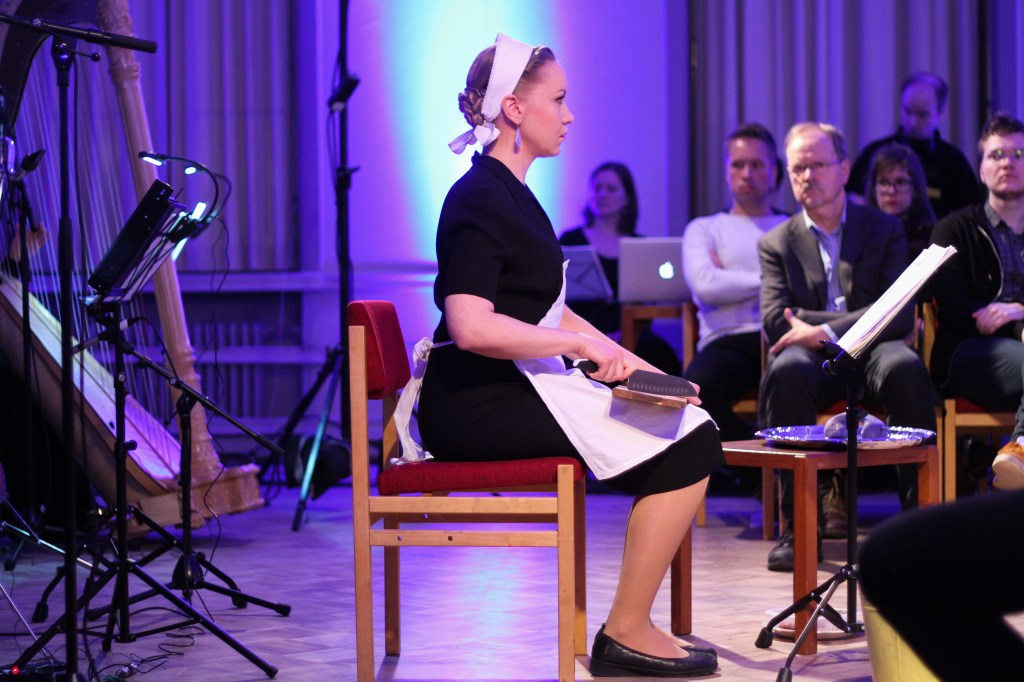
The opera was carried out as a cross-art performance with some additional text and documentary video material by its director Teemu Mäki. The performance was closer to contemporary theater or live art than traditional opera. It included music, drama, videos, texts, humour and also a meal, vichyssoise soup, which is also written into the libretto (http://www.teemumaki.com/theater-judgeswife.html).
Riikka Talvitie (composer), The Judge’s Wife, Tuuli Lindeberg as Judge’s wife. Photo Teemu Mäki, 2017.
The second opera Queen of the cold land was a radio opera commissioned by Finnish Broadcasting Company (Yle-radio). The libretto is a sort of rewriting of the Kalevala – a present-day version of some abstract life situations. The aim of the working group was to look at the Kalevala from a socio-historical point of view. Kalevala is not qualified as a source of Finnish mythology because the mythical images of folk poems have been transformed and merged into new entities by Elias Lönnrot. Lönnrot’s goal was not only to collect poems and to propose them as a coherent epic, but the goals went together with the nationalist idea to create a common image of the past, customs and culture of the Finnish people.
The opera is dealing with several issues like diversity, sexual identity, nationality and naming. As a composer, I would state that the main theme of the musical narration is nationalism or rather the future of national states. This theme is presented in the musical material.
The music consists of orchestral music, chamber music, operatic and folk singing combined with radiophonic possibilities. The composition is based on a variety of materials. The most extensive material consists of national anthems by different states and people. In addition to these I use folk music, war songs, wedding anthems and lullabies.
Firstindigo&Lifestyle: In Finland, composers like Jean Sibelius are master voices in the classical music world, for their emancipatory approach of voicing national myths, and yet speaking to broad international audiences. Sibelius is a widely known European composer in the United States with his Finlandia, and Violin concerto. Has this tradition created a sense of your own status as a composer who has Finnish roots?
RT: As an answer to this question, I just tell that have composed a chamber opera called One seed, one sorrow – conversations with Aino Sibelius. Aino was a wife of Jean Sibelius. At least it was an other perspective to the question of national heroes.
Firstindigo&Lifestyle: We met in Lapland in 2007, while doing a nature piece in Pyhatunturi. Do you still get inspired while spending time in nature?
RT: I am really worried about nature and by that – also inspired. This year I work with several pieces which are processing nature and particularly climate change.
Last spring, I carried out a project called Heinä (Grass) with playwright Pipsa Lonka. It was performed in Silence Festival in Lapland. The performance contained images that a grass had drawn. I tried to read or interpret those images by composing them for bass clarinet and voice. The performance took place in an old cottage with smoke and a dog. The atmosphere was quite unique.
Riikka Talvitie at the Silence Festival, Hiljaisuus Festivaali, Day3. Photo Jouni Ihalainen, 2018.
Firstindigo&Lifestyle: Are you critical of your own work?
RT: Of course I am critical and I would like to rewrite all my compositions but I just don’t have time for that. So let them be…
As for the future composition, I have challenged myself to ask every time ”why do I do this piece”. I feel that every art project should have a reason or meaning or aim which is something more than a commission, a commission fee, reputation or a course credit. This goal can be both an internal musical idea or external starting point. It should be something that connects our work to the surrounding society.
Firstindigo&Lifestyle: Who gives you the best feedback?
RT: The best feedback comes from my children when they ask ”what on earth are you doing” or ”how awkward”.
Firstindigo&Lifestyle: What is the role of commissions in your work?
RT: The art funding is quite different here in Finland than in United States. Mostly I work with small commissions by different musicians, ensembles, choirs, orchestras or festivals. However, the main income of Finnish composers comes from the working scholarships.
Some of my works are collaborations with other musicians and artists. Then we apply funding together as a working group from different foundations and institutions.
Firstindigo&Lifestyle: Do you have specific plans for the future?
RT: I have plenty of plans for the future. In a near future I will finish my artistic doctorate that is about shared authorship and communality. For that, I still have couple of projects to compose. After that I will devote my time to activism.
Firstindigo&Lifestyle: How about dreams, perhaps international presentations and residencies?
RT: An old image of a composer with a wig is quite outdated. This image contains travelling and prestige. Luckily the world has changed – women and mothers can be composer too and they don’t need to represent ”a plaster composer”.
Mainly, I don’t travel. I work nearby. I am quite often at home in the afternoons when my children come home from school. And in the evenings they have hobbies. My plan – not a dream – is to spend time in residencies after my children are grown-ups. I just need to be patient because it will take ten years still.
I don’t dream about an international career, firstly, because I like my daily local life. And, secondly, because I am at this moment interested in subjects and working methods which are rather marginal in classical music f.e. community art, live art, performance and philosophy. These are not the themes of a grand audience.
I dream about ideological aims. I hope we will see the world where the terms of consuming, owning and competing are less valued. I also hope that there would be a turn in over-consuming that finally we are saved from dystopical eco-catastrophe. I am not that worried about my own career.
RT: I have a small activist inside me who says that we should listen to different voices. So I would recommend you some other Finnish female composers here:
Japanese sculptor Yasushi Koyama lives in Helsinki, Finland and exhibits frequently in the local galleries. In this interview, he ponders the aesthetics behind his cute wooden sculptures. The artist brings the two artistic worlds together in his deep knowledge of both Finnish and Japanese cultures. One of his revelations connects to an idea of etic (or ethic), a general belief that influences people’s behavior and attitudes.
Firstindigo&Lifestyle: When did you move to Finland, and how did you decide to go there to study?
Yasushi Koyama: I moved to Finland in Autumn 2007 to study Fine arts in Saimaa University of Applied Sciences in Imatra. In 2006, I met Finnish printmaker Tuula Moilanen and took her art courses in Kyoto Japan. She was a good teacher and gave me some advice for Finnish education and art school. Then I decided to come to Finland to study.
Firstindigo&Lifestyle: What is the best part of having two cultures to live in and with?
YK: The best part is to have another viewpoint beyond one culture. In addition, in my own artwork Finnish culture meets Japanese culture automatically, unconsciously and unintentionally. It is a good mixture of two cultures for me.
Firstindigo&Lifestyle: Do you think that new cultural heritage transforms you?
YK: I am transformed by Finnish culture on a daily basis especially with the sense of nature and with the contemporary culture of art & design in Helsinki. While in Imatra I experienced a lot of nature such as forest, lake, snow, river, waterfall etc. I took many photos of the beautiful Finnish nature during each season. In this point I was transformed to be a person who likes nature. At the same time, it reminded me of how to be a Japanese, because a life with nature is the very style of Japanese culture too. I came to Helsinki in 2012 to have my solo exhibition in NAPA Gallery. In 2012 Helsinki was the world design capital and my exhibition joined in with some events of World design capital 2012. NAPA Gallery had many artists who were related to graphic design. It was very fresh for me. The art of NAPA members inspired my own art language to absorb the feeling of contemporary graphic design into my art. So I am transformed to get the design viewpoint from the Helsinki contemporary culture.
Firstindigo&Lifestyle: You are currently taking part of an exhibition at the Cable Factory in Helsinki. Tell about the background for this particular show.
YK: The show is called “Masters of Saimaa’16”. It is Masters of Fine Arts graduation exhibition in The Saimaa University of Applied Sciences. 9 master degree students have joined in the show. My artworks are 3 works. There are 2 wood sculptures and 1 wood installation from me.
One of the wood sculptures is titled Panda papa and child. It is a large sculpture, 160cm high and weighting more than 400 kg. The artwork is made for my Art for Children project in 2016. People can touch & hug this Panda papa sculpture, so it is interactive art, and the art also connects to our well-being. It is going to be donated to children’s public place as a public art after my upcoming solo exhibition in Galleria AARNI. I have a good memory attached to Panda. When I was 6 years old Panda came to Ueno Zoo in Japan from China. I visited the Zoo to watch the Panda with my father.
Another wood sculpture is titled Walking cat with Katja’s T-shirt – collaboration with Katja Tukiainen. It is 150 cm high and weights more than 200 kg. Artist Katja Tukiainen is my supervisor for my final works of my thesis. Both Katja and I had a similar experience of having cats as pets in our childhood, and we both like cats. Katja Tukiainen has also designed the official T-shirt for the Cable factory. I liked the T-shirts and so got the idea for the collaboration with her.
Then, my wood installation’s goes with the title The horizontal – wood installation. It is composed of 6 pieces of woods that were originally from one large tree (5m high). Each piece weights between 30 kg to 150 kg. It is made from ash wood that my friend gave me. The title is from Eija–Liisa Ahtila’s video work “The horizontal “ to use 6 screen panels to show one long tree in horizontal way. Her video work “The house” was the first contemporary Finnish art that I saw in Tokyo in 2003. Through this work I wanted to express the culture of wood in Finland and Japan, the process of wood sculpting and wood as a material itself. In Finland the forest area is 71% of the entire land area. In Japan the forest area is about 68% of the land area. In the world, the average of forest area is 31%. So in comparison, our countries have a lot of forest and woods. I think that we both have the tradition of wood culture such as wooden buildings, wooden houses, wooden tools, wooden arts etc. So wood is really important material for me.
Yasushi Koyama, Panda papa & child, 2016, birch, oil color, house paint, 162 x 85 x 80 cm.
Firstindigo&Lifestyle: You hear often that Finnish and Japanese cultures have something in common from the point of view of the design cultures. Do you think it’s true and in what ways?
YK: Yes, it is true. As I told, both Finland and Japan have the culture of wood. Both Finnish and Japanese like nature in life. So natural materials have an influence on the expression of our cultures of design, architecture and art. In addition simplicity, clarity and repetitive nature are similar in both cultures.
Firstindigo&Lifestyle: How did you find your artistic expression with the sculpture?
YK: My artworks are animal sculptures described as “Cute, lovely and humorous”. Most of my works are made from one piece of wood by using hand chisels. The rich textures of wood sculpting give people a warm impression. My wood sculptures have the good mixture between traditional wood sculpting and contemporary expression.
I learnt traditional wood sculpturing in Japan, New Zealand, Transylvania and Finland. For example in Finland in school I learnt wood sculpting from Finnish sculptor Pasi Karjula. He cherished the traditional way of wood sculpting using axe and hand chisels as well as other methods.
In the contemporary art context my wood sculptures have the expression of cuteness and positive energy. Finnish painter Katja Tukiainen had an influence on those expressions. And Finnish sculptor Kim Simonsson inspired me with his innocence of cartoonish sculpture. In addition, the graphic design of Marimekko etc., as well as the culture of the Finnish children’s characters, especially the Moomins took effect on me.
At the same time Japanese Manga & Anime and “neo-pop” art by Japanese painter Yoshitomo Nara have influenced my art language of cuteness. The ideas of art works are inspired by animals, natural shape of wood, self-drawing, Finnish art, illustration, textile design and Japanese art & culture.
Firstindigo&Lifestyle: Are your cute animal sculptures loved by both Finnish and Japanese audiences alike?
YK: Yes, I think so. They are loved and sold in both Finland and Japan. The interesting issue is that Finnish people say Yasushi’s works have Japanese feeling, and Japanese people say that Yasushi’s works have Finnish feeling in them. I accept their viewpoints as a good mixture between Finnish and Japanese culture.
Firstindigo&Lifestyle: How do you develop and teach your concepts to kids?
YK: I remember that I was making animal sculptures with clay almost every day when I was between 4-6 years old. My father gave me photo books of animals. After I looked at them I made animals. It was my ordinary life during my childhood. So it was natural for me to make cute animals. Although I was making a human sculpture while in school, after my graduation I remembered my enjoyment with animal sculptures. So it is normal and natural for me to make these cute animal sculptures. After starting to create animals, some friends and gallerists told me that my artworks include concepts for kids. So I will continue developing art based on my own childhood memories.
Firstindigo&Lifestyle: What is your favorite museum or museums in Finland and why?
YK: I have many favorite museums in Finland. It is difficult to tell of all the museums. So I point my favorite 3 art museums with exhibitions in 2016. I liked Ai Weiwei & Yayoi Kusamaexhibitions in Helsinki Art Museum, Ernesto Neto’s exhibition in 5th floor in Kiasma and “Suomen Taiteen Tarina” (Stories of Finnish Art) in Ateneum Art Museum. Ai Weiwei and Yayoi Kusama are top well-known artists in the world. I appreciate HAM to have offered their exhibitions to people in Finland. I also like the space in Kiasma’s 5th floor. Ernesto Neto’s exhibition gave us the participation and experience, the post colonial and interdisciplinary disciplines in the contemporary art context. “Stories of Finnish Art” was very compact exhibition, but at the same time a very profound way to show Finnish art history. I thought it was a great opportunity for tourists in summer to see the exhibition in Ateneum and also for Finland to show their image through Finnish art.
Firstindigo&Lifestyle: How would you describe Finnish aesthetics?
YK: I want to describe 3 concepts of “less is more”, “silence” and “sorrow” as Finnish aesthetics.
When I think about aesthetics, I always think about “etic” of aesthetics. Etic (or ethic) is a general idea or belief that influences people’s behavior and attitudes. I think that Finnish etic are diligent, honest and simple. Finnish aesthetics is the general idea that influences Finnish people’s behavior to understand beauty. So in my opinion one of Finnish aesthetics is about “less is more”. When I see the simple structures of Finnish architectures, it is so obvious.
About “silence” (hiljaisuus in Finnish), and how it is connected to nature. I remember silent landscape of snow in forest during winter. It was very beautiful. One of my Finnish friends gave me the message about nature, comparing sisu to silence (sisu is a Finnish spirit against strong power). “Nature means more than forests or lakes. It means freedom for oneself. Sisu is the most important for Finns. But how can one respect the other’s freedom? To respect one’s own freedom and the other’s freedom, Finns are keeping silent.” It is poetic but precisely showing the Finnish behavior of silence.It says that silence is the expression to respect one’s own and other’s freedom. Silence is one core of beauty related to the idea of freedom in Finnish culture.
About “sorrow” (suru in Finnish). A Finnish pop singer-song writer Kaija Koo says the phrase: Niin kaunis on hiljaisuus, mutta kauniimpaa on kaipaus. It means: So beautiful is silence but more beautiful is longing. So, when a Finn misses another person or a place, they feel sorrow. The sense of sorrow is connected to the feeling of longing and missing. In addition, a Finnish sense of sorrow takes place in the melancholic climate of Finland, such as during cold, dark and snow etc. “Sorrow” is a general and profound concept in Finnish art, film, novel, mythology etc.
Firstindigo&Lifestyle: What does innovation mean to you?
YK: Innovation is the attitude to look for new applications of old knowledge and the one to create new concepts by mixing more than two different concepts and cultures.
Firstindigo&Lifestyle: Who do you collaborate with and where do you work? Is teamwork important to you?
YK: To meet a person is very important for me. So I would like to cherish meeting a person. This time I collaborated with Finnish painter Katja Tukiainen in Cable Factory, Helsinki. I met her in Cable Factory in 2009 coincidentally, when I was walking around the Cable Factory. She was very kind to me even though I didn’t know her at all at that time. She talked to me friendly about Japan and her exhibition in Yokohama, Japan. I think that meeting is sometimes coincidental but often meaningful. I would like to cherish such a meeting. For the collaboration it is important for me to have a similar concepts, and to be able to share ideas. It is important for me to make collaboration beyond your own culture and to create something new from it. I have collaborated with artists such as painters, sculptors and printmakers. For the future I am interested in collaborating with not only artists but also with designers, anthropologists, philosophers, children, and with ordinary people to be transforming my art.
Yasushi Koyama, Walking cat, T-shirt collaboration with Katja Tukiainen, 2016, birch, paint, 152 x 72 x 71 cm.
Firstindigo&Lifestyle: Do you have an opinion about Kusama’s works, she is now extremely popular in the West. How do you like the exhibition in Helsinki at the moment?
In my opinion Kusama’s exhibition includes an important concept of interdisciplinarity, the roles of post colonial and gender in the contemporary art world. So it is natural for the West to accept her art. And her exhibition shows not only art but also an idea to share an experience of her art with visitors. It means that her art works are not only objects but also the image of her art, spirit and that of the contemporary culture. Her exhibition goes beyond art and connects with people in the gallery space to share their experiences. From this point of view, the visitors can participate in her exhibition. And I find that her paintings have an influence coming from native art and aboriginal art. Then, I think that her dot art includes not only pop art but also biological consideration of a cell, Shintoism and neo animism. I imagine that those concepts are fresh and still new to the West. So I admire HAM (Helsinki Art Museum) to have her exhibition.
Firstindigo&Lifestyle: Does Kusama have an approach that can be applied to other things, or could there be a recipe for a good idea to be developed further. There seems to be something that makes people really want to participate in it?
YK: Yayoi Kusama was the world’s most popular artist in 2014. And she is still one of the most popular artist in 2016. I think that the quality of this exhibition is among the top of the world. And her exhibition has been already developed by the point of visitor’s participation, comparing it to her exhibition that I saw in Matsumoto, Japan in 2003. It would be possible for her to use 5 senses to prompt visitors to participate in her art, such as the sense of touch, the sense of smell and auditory sense.
Firstindigo&Lifestyle: Do you think that art should be more sensorial, and available for people to touch?
YK: Yes, at least for me. I think touching art is a much deeper experience than seeing art. I make my large animal wooden sculptures (about 160 x 80 x70 cm) to be touchable and huggable. It is a hands-on way of “interactive art” in a sense that visitors also take action towards the art. And it is also “participation art” as you are touching and hugging a sculpture in the exhibition gallery space or in the public space. The importance of touching art is also connected to the internet period or described as a post-internet period. Although we can see a lot of images through internet, we can’t get a sense of touch through internet as well. So the sense of touch is a strong point attached to my animal sculptures. The feeling of a wood material is little warm and nice to human body. My animal sculptures have been already in some public places as public art. It gives people happiness and experiences in a way that they participate in a society through art.
Firstindigo&Lifestyle: Is there a line between art and design in contemporary art or does there have to be?
YK: For me such a line is not so meaningful in our contemporary time. Design can be art and art can be design. I think that art and design have an effect on each other especially here in Helsinki.
Firstindigo&Lifestyle: What are you planning next, do you have new ideas and exhibitions coming up?
YK: My next exhibition is coming soon 23.11-18.12.2016 in Galleria AARNI in Espoo, Finland. The concept is “Cute” –between SÖPÖ and Kawaii. I mix Finnish cuteness “SÖPÖ” with Japanese cuteness “Kawaii” in my art. In Japan “Kawaii” (= the quality of cuteness) has become a prominent aspect of Japanese popular culture. This term Kawaii has taken on the secondary meanings of cool, groovy, charming and innocent. The book “Kawaii Syndrome” tells “cute” and “neat” have taken precedence over the former Japanese aesthetics of “beautiful” and “refined”. So cuteness is a new cultural wave of Japanese postwar generation especially of the ones born in 70’s and 80’s. This cultural wave has come to Europe particularly through Manga and Anime. For the design of my animal wood sculptures I use Finnish wood, and the Finnish cuteness of SÖPÖ is inspired by Finnish art and design. In the exhibition visitors can see ”Cute” animal sculptures, touch & hug a large sculpture ”Panda Papa & Child”. I am hoping the audiences will enjoy Yasushi Koyama’s world of cute animals in the exhibition coming to Galleria AARNI.




 Firstindigo&Lifestyle