Tag: music

  • Aimee Lee about sound, art books and hanji

    Aimee Lee about sound, art books and hanji

    Aimee Lee is an artist, papermaker, writer, and the leading hanji researcher and practitioner in the United States. With paper, she makes thread, sculpture, books, drawings, prints, garments, and installations. Aimee Lee’s background as a performing artist and musician carries traces of paper as sets and costumes. Her installations are artistic research on paper and sound. She has pursued a career with traditional Korean hanji, coming up with new aesthetic concerns and techniques for her artistic practice.  As a scholar, she is author of award-winning book, Hanji Unfurled (The Legacy Press).

    Firstindigo&Lifestyle: You are a musician, a performer with live violin. How did you start creating performances onsite, including your own installations, manifesting set designs and creating costumes? Did everything start with music?

    Aimee Lee: My early aspirations were to become a concert violinist, but I learned in college that I was not serious enough to devote the requisite hours of practice and study. However, I still loved music and wanted to stay close to musicians, so I continued to play and my first jobs were in music administration—bringing music to people who did not have access, or bringing people together through music.

    When I moved to Chicago for graduate school, I entered an interdisciplinary program that encouraged combining different media, especially performance. It was a book and paper program, but I was interested in the intersection of books and performance. Once I began to make paper, the connection between paper and performance was so compelling that I created installations that were dependent on paper that I made. The performances, which almost always included sound from my violin, activated the installations.


    Firstindigo&Lifestyle: Some of the live performances, which you composed and put together implement almost haunting kind of sound that responds back from the architecture of the venue, and then audience is stretched to interactive listening and feedback, where did you get the ideas to make these works?

    AL: Mostly, I studied classical music, but later learned improvisation and jazz. The heart of what I have always loved to do is rooted in improvisation, whether or not I was aware of it. Human communication, which sound and music are, has always fascinated me, so I wanted immediate feedback and interaction with my audiences. In Chicago, I was influenced by performance residencies with Aaron Williamson and Greg Allen, and by Julie Laffin.

    Firstindigo&Lifestyle: Now, we can perhaps say that you have become a master of hanji, the Korean traditional paper making. Where did you find the enthusiasm to start exploring it, and how did it come about?

    AL: While I studied papermaking history in the graduate school, I noticed that it began in China, moved to Korea, and then traveled to and flourished in Japan. Most of the existing research in English on East Asian paper was based in Japan, and I was unable to find much about hanji (Korean paper). I grew up at a time and place in the US where people always tried to guess my heritage, but they could only imagine that I was Chinese or Japanese. This sense of Korea being overshadowed affected me deeply, so I felt a curiosity about Korean paper history. My Fulbright research in Korea uncovered an entire history and culture that fascinated me on all levels, as an artist, a researcher, a Korean American, a person in the world. After my return to the U.S., I felt a strong responsibility to share what I had learned. I would never call myself a hanji master, but will always be a steadfast hanji ambassador and artist (read Aimee Lee’s exhibition review in Firstindigo&Lifestyle)

    Firstindigo&Lifestyle: Is the knowledge of making hanji widespread in Korea today, how about the new generations and passing down this historic form that goes back hundreds of years?

    AL: Korea has similar issues to the U.S. and other cultures where the current knowledge of traditional craft by the general public is quite limited. It is not a priority in contemporary life, so not many people in Korea are aware of the process of making hanji and its impact on Korean history. There are less than 25 paper mills remaining in Korea, and very few have serious apprentices, because it’s not an easy living. In a world where you could live and work in an urban center with all the amenities you need, why would someone decide to live in a rural area doing manual labor for very little money? There are no good incentives to do the work, even if you believe in continuing an ancient and important tradition.

    Firstindigo&Lifestyle: How sustainable is the process, could you tell about the ecological aspect of the paper making?

    AL: Papermaking on a small scale (meaning individuals or families who are in business) in Korea is ecologically sustainable, though it may not be financially so. The main raw material is the paper mulberry tree, which is cut each year. This coppicing practice encourages the plant to grow back every year, so the same plant can produce material for over 20 years. These are not trees in the way Western minds think of hardwood lumber: they are tall and skinny, almost shrublike, and cutting them down does not kill the plant. The traditional methods of processing always used plant materials so that production byproducts were easy and not toxic to dispose of or reuse. The bulk of the energy that goes into making hanji is human energy, which means that the process is very labor intensive but has a very light ecological footprint.

    Aimee Lee discussing hanji at the Korean Cultural Center, NY, March 2016
    Aimee Lee discusses hanji objects at the Korean Cultural Center in New York, March 2016

    Firstindigo&Lifestyle: Is it correct that Hanji derives from nature, or implies a closeness to it?

    AL: Hanji is made from plants, and could never have been invented without a human closeness to non-human nature by observing the possibilities of certain species and experimenting over time. Dorothy Field, artist and author (my favorite is her book Paper and Threshold) writes beautifully about how certain plants long to become paper, and all they needed was the human hand to let them reach that state.

    Firstindigo&LifestyleCan Hanji accessories, or clothing, be compared to textiles, or is it irrelevant?

    Paper and textile have a very strong connection, aside from each being able to be transformed into the other. The first paper was made from hemp cloth, and hanji can be cut, spun, and woven into cloth. Hanji has been used to make clothing, and today’s contemporary designers and manufacturers are including hanji into their textile production.


    Aimee Lee, All there, 2016. Dye on paper, thread. 11 x 11.5″. Private collection.
    Aimee Lee, All there, 2016, Dye on paper, thread, private collection.

    Firstindigo&Lifestyle: You are teaching as well, could you tell about the workshops and education aspect?

    AL: I mentioned before that sense of responsibility to share knowledge about hanji to a much wider audience. Part of this is from a conservation instinct, out of a fear that hanji is disappearing. But most of it comes from a joyous instinct, out of my love for this material that is so endlessly versatile. I always knew that handmade paper had great range, but even after almost a decade, I continue to find possibilities for hanji. If the substrate was not impressive, I would not feel compelled to promote it. However, I want people to know about hanji as an option, so that they can have another tool in the toolkit. This means that I teach a range of workshops, from preparing fiber to making hanji to manipulating it by hand. I travel continually to spread the word, in the hopes that eventually hanji will become as familiar as other papers, and that paper itself can be regarded on the same level as canvas, clay, metal, glass, wood, and so on.

    Aimee Lee, Beating fiber to make hanji while teaching students at Paper Book Intensive 2016 at Ox-Bow in Saugatuck, Michigan.
    Aimee is beating fiber to make hanji while teaching at Paper Book Intensive 2016 in Saugatuck, Michigan.

    Firstindigo&Lifestyle: The aesthetic form of Hanji art and folk art influences your making, how do people receive these traditional objects, which you are making today?

    AL: Most people don’t know about the lineage of the objects, so the responses are mostly of wonder—they are amazed that my pieces are made of paper in the first place. This provides an opening to share the stories of their historical use, and illuminate the ways that humans have always made objects that are not only useful, but embedded with meaning. Some have asked if I am interested in using the techniques to make much more contemporary ‘looking’ art. I have wanted for years to extend crafts like jiseung into installation and larger work that goes past the original shapes and functions of their predecessors. The issue is that the time and labor that it takes to make one piece is so great that I could only go in that direction if I had a very long and uninterrupted stretch of time to work. However, I am gratified to see that some of my students are moving in that direction after learning about hanji and its applications.
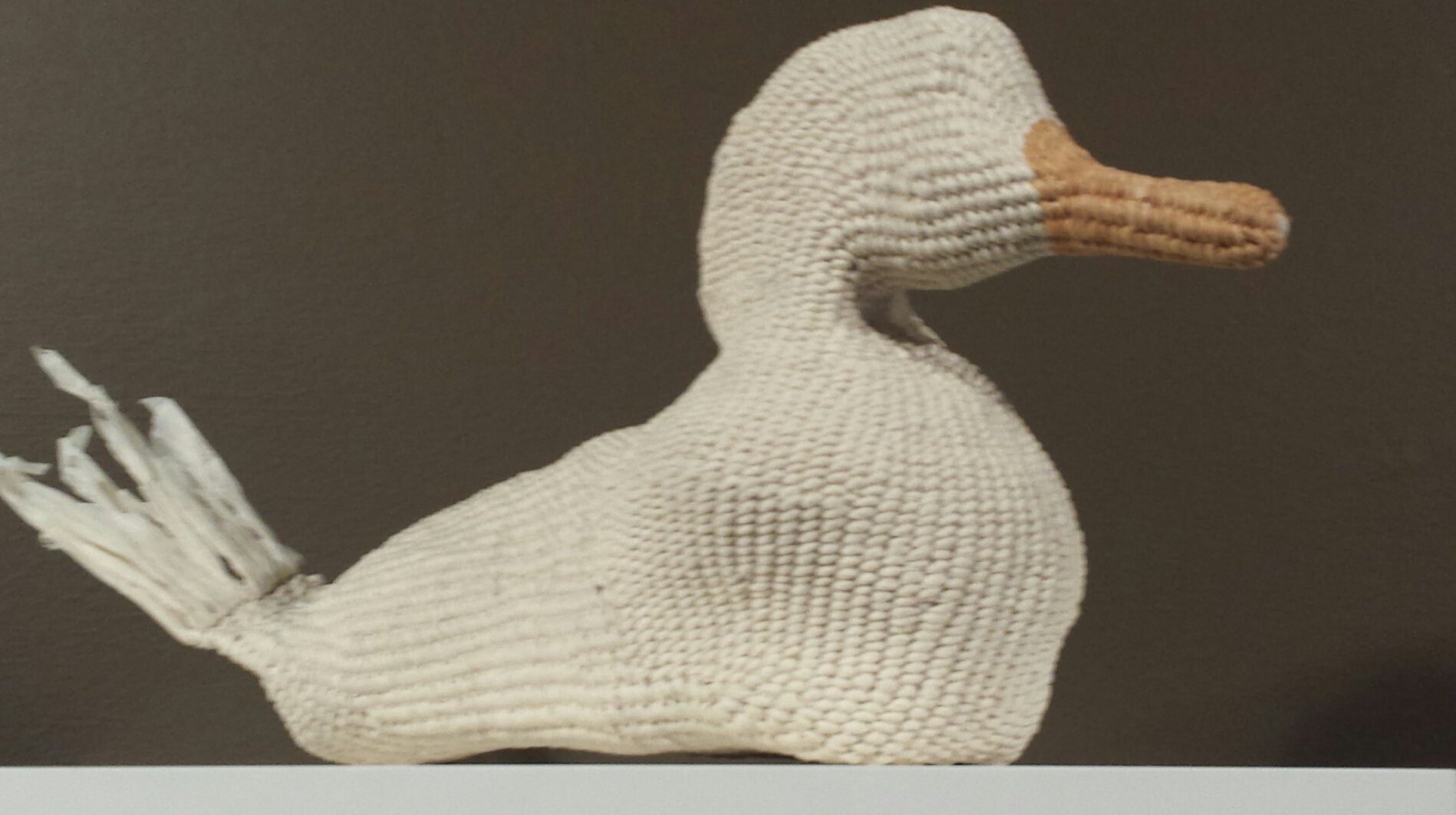
    Aimee Lee, hanji duck, Korean Cultural Center, March 2016
    Aimee Lee, hanji duck, exhibition at the Korean Cultural Center, NY, March 2016

    Firstindigo&Lifestyle: What other materials do you use today in the making of your art?

    AL: For the longest time, I have been very strict about using hanji whenever possible, or other handmade papers. My thread box is always full of different paper threads I have made, though I use cotton, linen, and silk thread to sew my hanji dresses. I also use the raw materials that make these papers, such as the cooked bark before it is beaten to a pulp. I use mostly natural dyes and finishes, which add color, structure, and protection to the paper. Last year, I collaborated with Kristen Martincic on a paper and ceramic installation, and recently had a couple of jewelry metals artists help me with additions to my paper ducks at Haystack Mountain School of Crafts. I’m interested in continuing this last investigation further.

    Firstindigo&Lifestyle: What is fascinating about your use of paper is its multiple dimensions from small objects to books. Your own writing and art (illustration) is sealed into these art books. Tell about the books, which you have made, how did the stories develop?

    AL: Books came first for me, before paper. I was making artists’ books at Oberlin College while studying with Nanette Yannuzzi Macias, which was a game changer. It was a way to combine writing, drawing, storytelling, and all kinds of other media into a form that felt very familiar and yet new. I don’t remember when I started to draw comics, but like improvisation, it was something that came naturally to me. I always thought that the point of being able to make my own books was the ability to create all of my own content. Most of my books contain original writing and stories that come from my own life experience, literature that I love, and the immediate present moment—whether an emotional space or an actual time in history that could be marked in the news cycle.


    Firstindigo&Lifestyle: Do you travel to Korea to get new ideas and exchange?

    AL: I am able to get back every several years, whenever I am funded. However, because of the distance and difficulty of making enough time to visit (I prefer going for longer periods of time), it’s not a journey I make often. Certainly it is inspiring, but it is a challenge as well because the expectations of me as a Korean American woman can be stressful.

    Firstindigo&Lifestyle: Often you hear that there is a division of thought between Eastern and Western approaches or philosophies. Do you feel you are bridging the gap between east and west in your practice, or do you think about these questions?

    AL: This idea comes up often and much of my work can be seen as bridge building between cultures. However, I do my best to stay away from the reductive nature of “East/West” because it sets up an automatic “Us/Them” mentality that can become dangerous. My life experience of feeling reduced to a single word, automatically, because of how I looked, keeps me aware of the unconscious instincts we have to categorize everything. I prefer to present my scholarship and artwork as being rooted in and inspired by many different traditions and cultures. It’s impossible for me to work any other way because I was born to immigrant parents and always lived between at least two disparate cultures.

    The “east meets west” cliché is one I particularly dislike, as if it has just happened, and as if there are only two monoliths in the world. It also comes from the point of view of a certain place being the center or more superior, which is problematic. Most cultures around the world have been in contact with each other for centuries, so cross-cultural understanding is not a new thing or an anomaly. Rather, it’s the norm.

    Firstindigo&Lifestyle: Where do you see yourself as an artist and educator in the future?

    AL: My goal is to build a new hanji studio for myself, where I can work, make paper, and teach independently, while continuing to travel to teach and exhibit. I want to train apprentices in this new space so that I can increase the number of people who can support hanji. There’s at least one more scholarly book left in me as well, so I look forward to finding the ideal setting to properly research and write it. All of this will be unlocked, I think, once I find the right place for myself to be.

    … … …

    Check out Aimee Lee on web: http://aimeelee.net/

    Her artists’ books can be found under the Bionic Hearing Press imprint from Vamp & Tramp.


  • Director Simen Braathen discusses ARCTIC SUPERSTAR

    Director Simen Braathen discusses ARCTIC SUPERSTAR

    Norwegian documentary film director and advertising professional, Simen Braathen introduced his new doc ARCTIC SUPESTAR to audiences in New York City last week. His documentary about a Sámi rapper SlinCraze had the screening and a concert by the rapper at the United Nations as part of the Forum on Indigenous Issues. The film opened the Films From North program at the Tromsø International Film Festival earlier this year receiving a well-deserved welcome. US VICE Magazine described it as “one of the best music documentaries” of 2016.

    Firstindigo&Lifestyle: How did you start doing documentary films originally, did you plan on becoming a director as a career choice, or did it just happen?

    Simen Braathen: ARCTIC SUPERSTAR is my debut film and it was something I stumbled into 4 years ago. I was working in advertising in New York at the time and as a side project, photographer Martin Johansen and I wanted to make a photo exhibition that portrayed Norwegian rappers and the places they represent. You know, instead of reppin’ Brooklyn, Bronx or Compton, you would have rappers throwing up their signs on top of mountains and fjords.

    That’s when we came across SlinCraze – who was not only living in one of strangest, most desolate places I’d ever been, but he was also rapping in this ancient language less than 20.000 people speak. So we brought DOP Kristoffer Kumar for the trip and made a short doc.

    At the exhibition opening the year after, the short film earned way more attention than we could ever dream of. With both Huffington Post and BBC showing up to cover it. That’s when we knew that the story might be strong enough for a real doc. Since then it has been a learning-by-doing-kind of process, but luckily I’ve had some very experienced people helping me through.

    What is your background and education, you studied Social Anthropology at NTNU?

    SB: I’ve also studied creative writing and advertising in Oslo, and moved to the States after graduating, where I spent three years in Colorado and New York. Now. Besides making documentaries I also run a small creative shop called BRUNCH OSLO.

    How did you eventually find about SlinCraze? 

    SB: I knew a couple of Sámi rappers from before, but I was really caught off guard when I first hear SlinCraze’s music. His flow and technique were way better than I ever expected. And his mix of traditional Sámi music with raw hip-hop makes you forget the fact that you have no idea what he’s saying.

    Did you know much about the indigenous Sámi people and their culture in Norway before starting to make this documentary?

    SB: No, sadly most Norwegians know very little about the Sámi people and the things we do know are usually based on stereotypes. Even current journalism from that region tends to ask the same cliché, preconceived questions. I think what made our process a little different was that we were first and foremost interested in music and we shared so many musical references we could connect through. To explore this part of the world and being able to hang out with some really cool people have been a major motivation for making this film.

    In this documentary, the Sámi rapper from Finnmark, Norway is on a mission. Nils Rune Utsi has recently gained a lot of visibility with the definition of a guy wanting to save the language, previously gaining audiences in Norway from all ages. How was the ARCTIC SUPERSTAR screening last week in New York City? 

    SB: Great! It was such an honor to be able to show it both at the United Nations and at the Scandinavia House last week. It was fun to see that people here responded to the same things as the audience in Norway, cause you never know if things will get lost in translation or in cultural differences.

    This is the 15th time that the United Nations Permanent Forum on Indigenous Issues was held at the UN. There were more than 1,200 indigenous representatives from around the world attending to promote indigenous rights. One of the participants, Aili Keskitalo, the President of the Sámi Parliament of Norway, was introducing the screening and the SlinCraze concert on May 10th.

    ArcticSuperstar_Nils Rune Utsi
    Arctic Superstar aka SlinCraze

    What can you say about the German and European responses that you’ve had with the film, would Europeans know more about the subject, and about their indigenous people?

    SB: No, I don’t believe they do, but I think there is something universal about coming from a small place, like SlinCraze does it dreaming big dreams. And I think that is what the audiences recognize and have roots for.

    Did hip hop change Norway essentially, can you say it is much different there than in America?

    SB: I’m not sure how or if it has changed the country, but we’ve had a huge hip-hop scene for many years. Some of our best selling and most influential artists today have their background in hip-hop. One of the things I really like about hip-hop, is that it can be so local. Even in a small country like ours we have subgenres that vary based on where you come from.

    You have career experiences from branding and advertising industries, how is advertising different from making documentaries, do you find it useful to have expertise in both fields so that one gives to the other?

    SB: The creative process is the same. You plant a seed and make sure it grows into it’s full potential. But the time and money you have in making, is obviously very different. As a creative I’ve really enjoyed mixing the two, because making a documentary is such a slow game, and whenever I felt like nothing happened I could turn into advertising. At the same time, advertising can feel pointless at times when clients turn your ideas into crap. So then I would go back to my film where I was in control.

    There is always a lot of curiosity around the Cannes lion prizes. What is your personal opinion, what do you generally think of prizes and awards and their role in the making of your works?

    SB: I personally couldn’t care less about advertising awards and I’ll never understand why people spend more time making case studies for their work, than the actual work. But I guess that’s how a lot of the industry works, how people get promoted and agencies win business.

    How do you usually fund the projects, is Norwegian support for film good and beneficial?

    SB: I don’t know so much about this. It’s is probably more of a question for my producer Stig Andersen at Indie Film in Norway.

    Do you see yourself as an artist; are documentary filmmakers considered to be artists, and how do they talk about art in the advertising industry?

    SB: No, I don’t. I think documentaries sometimes can turn into art in the end, but I never like the ones that set out to be that from the start. The same goes for advertising. If you start by thinking you’re going to make art, you will most likely end up making shitty art that also doesn’t work as an ad.

    Start with something true and make the most out of it. Then maybe it becomes something unique.   -Simen Braathen

    Director Simen Braathen photo Martin Rustad Johansen
    Director Simen Braathen. Photos: Martin Rustad Johansen

    What is your motto of making your works in a couple of sentences?

    SB: Finish it no matter what. Every creative will at some point think, “this idea sucks, I’ll wait for the next” but when you’re stubborn and push things through, you’ll never know where it might end up. In this case we ended up at the UN.

    Do you have great plans for the future, any specific subject matters that are important for you at the moment?

    SB: We just started developing a new project, which is about my grandpa who is 93 years old and plays in a band. Also I’m excited for some of the things we’re doing at BRUNCH, where we help companies tell genuine and more engaging stories.

  • Anri Sala’s musical mystery

    Anri Sala’s musical mystery

    “Anri Sala: Answer Me” -exhibition, which will be on display at the New Museum until April 10th, 2016, features multichannel audio and video installations. In his recent works, Albanian artist Anri Sala has interpreted musical compositions, classical works so to speak, with experiments that are structured into video and sound installations. The monumentally compound works navigate through the limits of our perception; mapping the sound and the spatial, and investigating the sound in the architectural spaces. This experiment transformed New Museum floors into symphonic areas of soundful meaning, leaving room for small encounters.

    Anri Sala’s often political works have tested the boundaries of sound and language in our construction of cultural realities. From cultural point of view, his works seem to investigate contexts that are outside the dominant aspects of reality. Or the realities are rather revealed through the layering of world of sounds. We have adopted a notion that the words create the meaning in our cultural communication. Yet, as Sala with his approaches has shown, it is possible to challenge this definition further by mapping and deconstructing the terrain, in which words actually restrict our ways of interpreting or seeing the world. From this perspective, the everyday life is full of noises that communicate without restricted syntax. Sound, form this point of view, has a great capacity to alter meaning.

    Sound’s features are attached to the material world that is so close to music. For Anri Sala, sound plays a role of an incomplete music, or music, which is in the state of becoming. Sound as a mediating device – even when it is real musical pieces divided into fragments – can document and edit reality, and communicate on a new level of poetic composition. This becomes immanent through the artist’s works, which New Museum profoundly projects. What stays with the viewer, is the personal corporeal experience, which is created in the architectural space as the entirely new perception. The change in the reception of the artistic works is focally in the embodiment. The surrounding sound world invites the viewer to walk into the next room full of sound. Or it freezes on the threshold, making the mystery of the sound’s origin more significant.

    Fragmentation and repetition is evidential in Sala’s second floor installation. The work unfolds as a two-channel HD video from 2014: ‘The Present Moment (in B-flat)’. This installation depicts different interpretations of an original compositional score by Arnold Schoenberg, titled ‘Verklärte Nacht Op. 4’ (1899).’ On the video, the chamber music setting acts as a fictional rearrangement of the historical work. Two videos feature a sextet of two violins, two violas and two cellos that play solitary notes from the musical work. Eventually the original musical score unfolds. The audio-visual installation works powerfully on two separate screens absorbing the body of a viewer into its mellow soundscape. The intimate portraits of the musicians, the movements and gestures of their heads, hands, arms, and backs, act as counterbalance to the interior, in which their playing has been recorded. The setting of empty room or hall creates an atmosphere of a vast space that accumulates sound on multiple stages. Sala’s meditative and mesmerizing piece truly puts an emphasis on the present moment.

    Upstairs, at the fourth floor of the museum, is a presentation of Anri Sala’s installation ‘Ravel Ravel Unravel’, from 2013. This is the work’s US premiere, it debuted in 2013 at the 55th edition of the Venice Biennale, where the artist represented France. In the title work ‘Ravel Ravel’ (2013), Sala reinterprets Maurice Ravel’s ‘Piano Concerto for the Left Hand and Orchestra in D major’. The composer created the composition in 1929 for an Austrian pianist Paul Wittgenstein, who had lost his right arm during the World War I.

    The museum space, in which the ‘Ravel Ravel’ video is installed, is designed to absorb sound and prevent echoes. In this chamber like room, there are two unique and separate performance interpretations of Ravel’s composition taking place. The musical echo is produced with ‘in and out of sync’ parameter, as two simultaneous performances measure temporal dimensions. The two pianists gradually shift out of unison, they are projected with their performances with two different orchestras. The one might evolve slightly different from the other, creating a minimal echo. Shifting between doubling notes and echoes creates the difference of the entire work, leaving the spectator paralyzed and in awe.

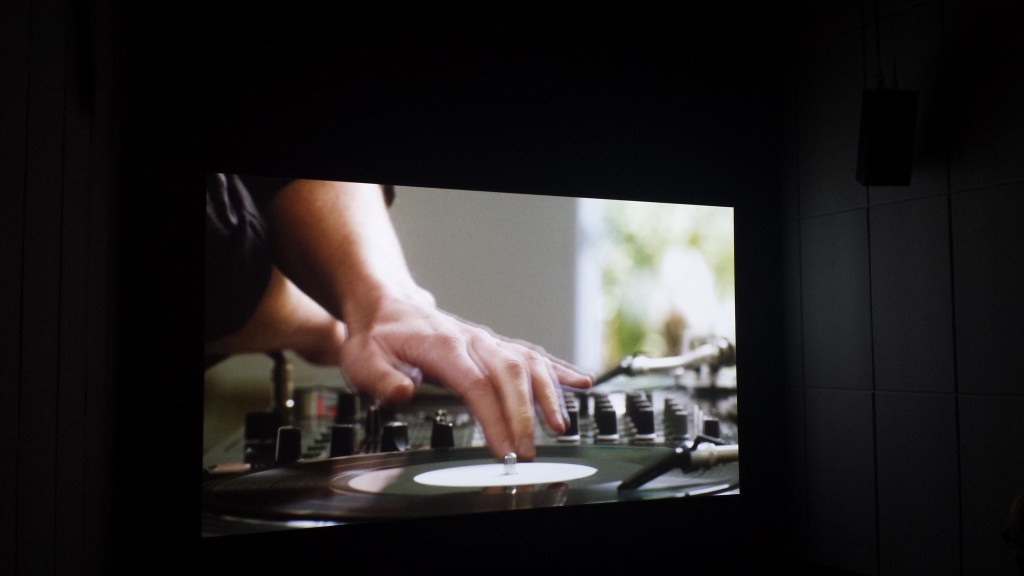
    Sala’s work contours in time, with tempo variation and within the space that has left no chance for error. The other video in the fourth floor being part of this work is titled ‘Unravel’, 2013. It debuted at the Venice Biennial alongside ‘Ravel Ravel’. ‘The Unravel’ video presents DJ Chloé Thévenin who takes part in the manual and physical manifestation of these two concerto recitals. She has the performance recitals on two turntables, in which she accelerates and slows the records in process. Fascinating, a visual turnout of the concerto sound in a new gesture.

    More info about the artist and the current exhibition “Anri Sala: Answer Me” :

    Hauser & Wirth about Anri Sala

    The exhibition info at New Museum