Tag: Olena Jennings

  • HISTORICAL ARRANGEMENT by Olena Jennings

    HISTORICAL ARRANGEMENT by Olena Jennings

    Dip the fabric in a bath
    of onion skins, like she did.
    Let the dye cling
    like her ghost clings to me
    and to her old furniture,
    which has become mine,
    the headboard shaky
    as names being called,
    my name over and over.
    I cannot answer to it.
    Dip the fabric in a bath
    of onion skins.
    I cannot forget her ghost
    in front of the mirror.
    I realize her face
    is framed by my hair.
    She wanders the maze
    of armchairs. I fold my body
    over hers on one of the cushions.
    She clings to me.
    There is the end table that was carried
    with her from the farm
    where they first settled.
    Then she opened the window
    for the first calm in a long time.
    She felt the discomfort
    of knowing her family was not part
    of her peace. This scared her
    and so did the way
    their ghosts cling.

    I work with art in reaction to poetry. I find textiles work best since they are malleable and react to embroidery, dye, and wax. This helps me focus my poetry. Sometimes I rework the poetry after the textile is completed to create a stronger connection. -Olena Jennings

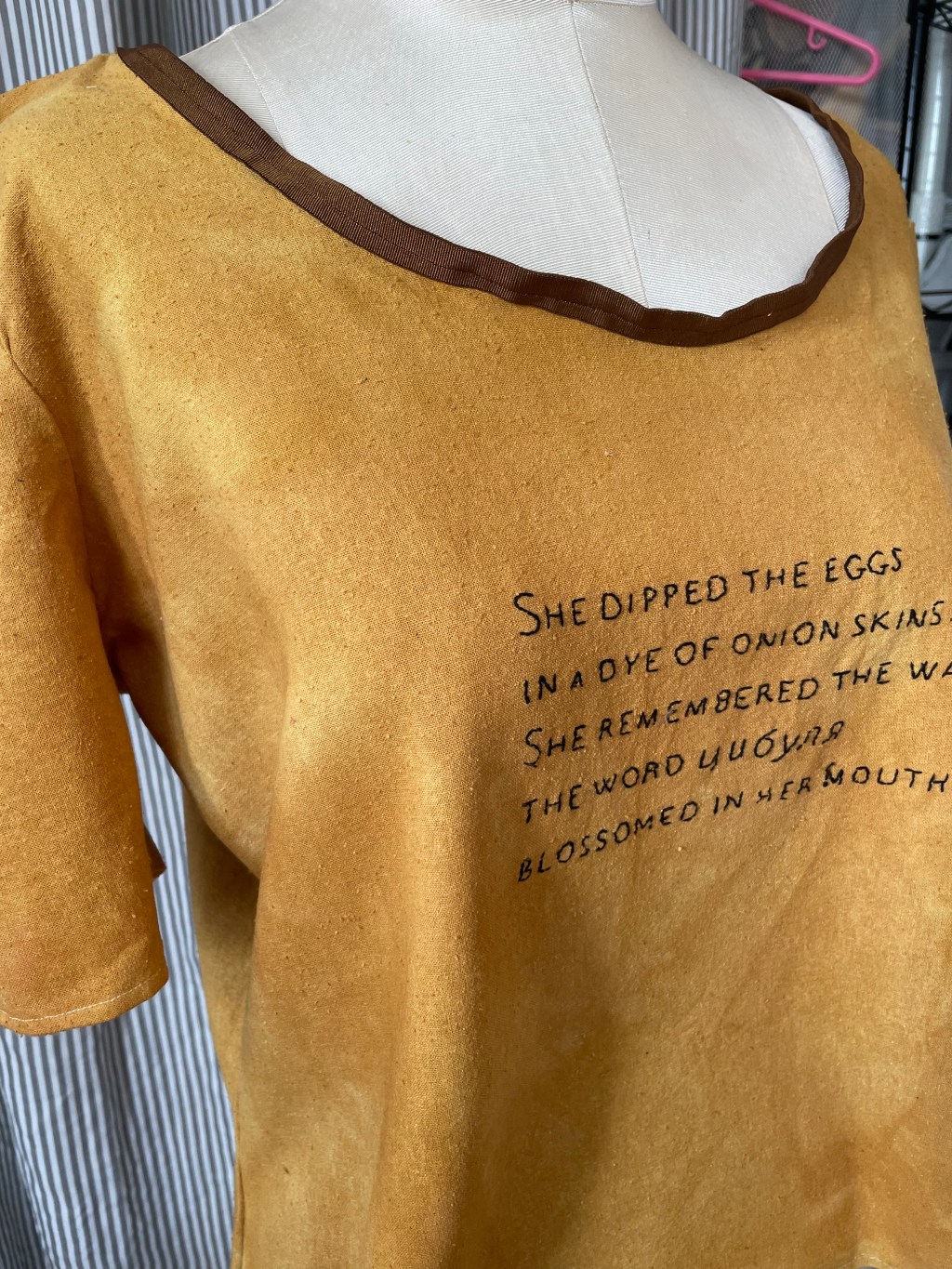
    The idea begins here with collecting onion skins for about a year. They crackle and crunch against each other as thin as a spirit.

    The title of the poem “Historical Arrangement” is about the ghost who is a deceased family member, and the voice in the poem is becoming one with history. What is remarkable is that the voice has her furniture and is taking on her features.

    The art, a woman’s shirt, is part of the poem because this family member is dyeing with onion skins. The voice in the poem is repeating her acts. My ancestor used onion skins to dye eggs, but I carried the process into my present by dyeing fabric.

    _______________

    Olena Jennings is a New York City based writer and translator. She is the author of the poetry collection The Age of Secrets (Lost Horse Press, 2022) and the novel Temporary Shelter (Cervena Barva Press, 2021). Olena Jennings has been a translator or co-translator of collections by Ukrainian poets Iryna Shuvalova, Kateryna Kalytko, Vasyl Makhno, and Yuliya Musakovska, among others. She also founded and curates the Poets of Queens reading series and press.
  • Olena Jennings: What is Left Behind

    Olena Jennings: What is Left Behind

    New York City poet Olena Jennings created a project based on a family photograph, which depicts a story belonging to her grandmother. It inspired her to design a special dress that carries a piece of the memory itself.

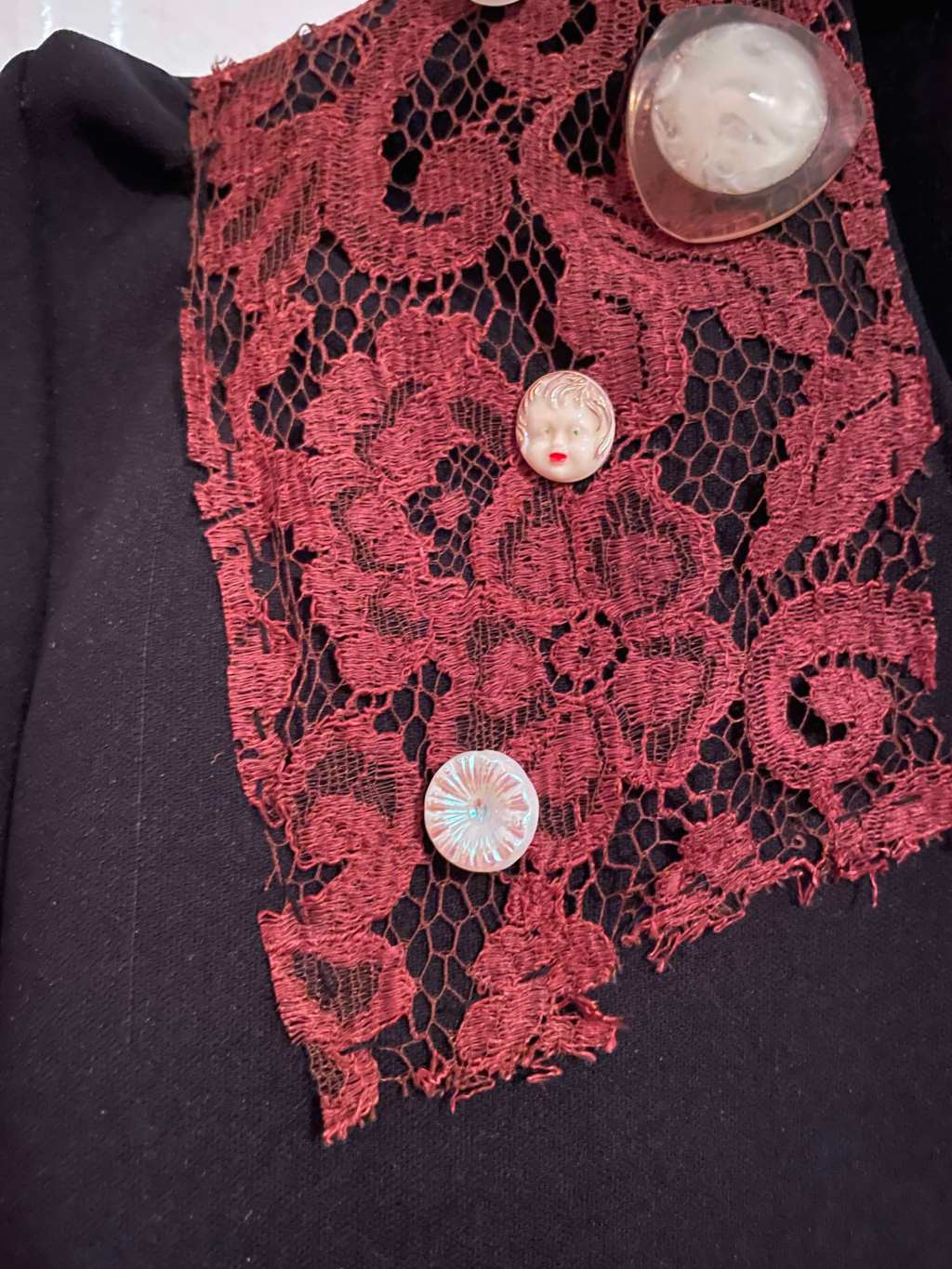
    The project “What is Left Behind”, is a dress design with photo transfer and red lace. The family portrait is an intimate piece of history. Working on a concept so close is unique. It is inspiring from the point of view of the four individual women that it represents, the four sisters. Their gazes are emphasized as if belonging to an era, when smile wasn’t yet invented as a facial expression in photographs. The picture taking was a rather serious event. Yet the photograph served its purpose as a posing for the memory.

    In the design, the black and white photo is surrounded by white and red stitches created with embroidery floss.


    Photo transfer of great aunts as attached to the fabric with embroidery floss stitches. Olena Jennings, What is Left Behind.

    The poem to accompany the dress is about Jennings’ grandmother receiving the family photograph. Like a message from the old country, They Bring The Photo is from the times that passed.

    THEY BRING THE PHOTO

    By Olena Jennings

    She would sew the buttons
    that would fall from her coat,
    threads invisible as webs,
    in the light that spilled
    around her like milk, the warmth
    she remembered from the farm,
    the kittens circling
    and her hands on the udders.

    The visitors
    gave her the photo
    in a weathered air mail envelope,
    their strange car in our driveway,
    his kiss leaving a mark
    on my cheek, letting me know
    I am forbidden to touch the pillow,
    the mark too special to rub off.

    The surprise
    was that she could be found
    anywhere, that she was not
    alone
    as she believed.
    So, she checked beneath the beds
    and in the dust in the attic,
    for those who knew her whereabouts.

    Her sisters’ faces in the photo
    were absent of emotion, distant.
    The black of their clothing reflected
    in their eyes.
    It was as if the space between them
    was bigger
    than the distance
    between their countries.

    Dress by Olena Jennings

    Artist website: https://www.olenajennings.com/

  • An Escape from Solitude

    An Escape from Solitude

    Olena Jennings, New York City based poet and designer, escapes to the train in her latest work. During COVID-19, social distancing has been in place. For Jennings, new kind of creative process has evolved during this time, when thinking of poetry and design together.

    Firstindigo&Lifestyle: Would you like to name some inspirational poets?


    Olena Jennings: Inspirational poets include Alice Notley, Don Mee Choi, Galina Rymbu, Queens poet Micah Zevin, Cladia Rankine, Simone Kearney, and Gala Mukulomova.

    Firstindigo&Lifestyle: Your artistry has evolved from poetry to textile art, and dress making. Hows is this combination working?
    OJ: My thoughts become free as I sew and this process helps me to release words that I catch for the page. It can be meditative. I like the idea of connecting textile works with poetry. It’s fun to force the words into a visual shape. It’s become an important part of my process even if I never share the textile work. It helps me think of the words in a different way. It helps me to give them shape.

    Firstindigo&Lifestyle: Do you feel that your cultural identity is in a process or evolving in the making of your new textile art?

    OJ: My cultural identity is linked with memory. When I go into the past I explore my culture. It makes my culture more personal and different than it might be for other people.

    Firstindigo&Lifestyle: Did COVID-19 change your practice and plans a lot, how have you coped during this time?

    OJ: COVID gave me the solitude that is necessary to be creative on almost a full time basis. Even when I’m working, I am thinking about projects.

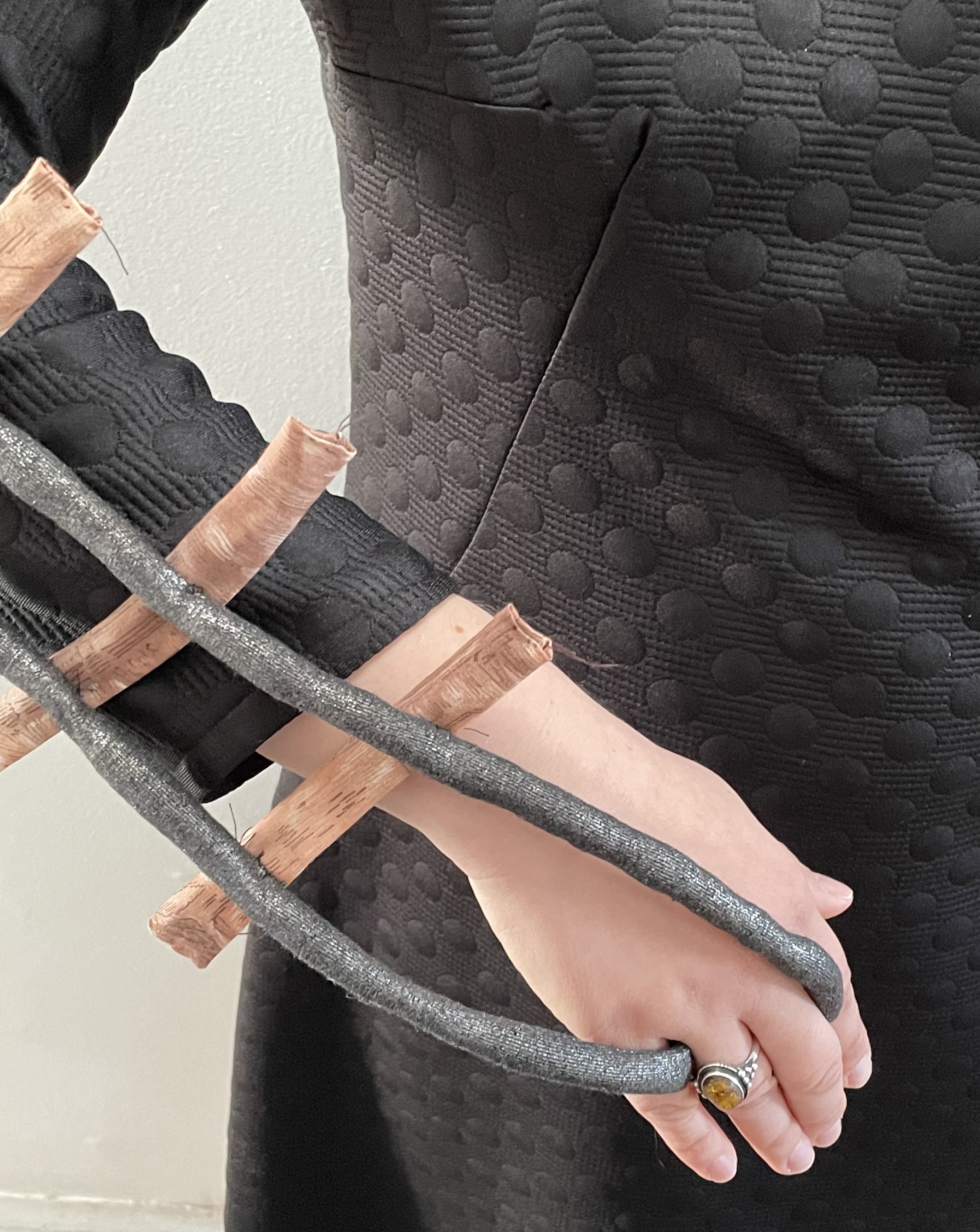
    Firstindigo&Lifestyle: When looking at this dress and the design of it, is there anything special about making the ‘rails’ of the dress?

    OJ: The fabric of this railroad dress, which I made, is polyfil and wood. It was inspired by the poem “Social Distancing” by Christine Turczyn published in Lightwood 4.

    Firstindigo&Lifestyle: The dress is essentially echoing the poem, and the theme of it. There is a special rhythm in Christina Turczyns poem that stimulates this design?

    OJ: The specific line from Christina Turczyns poem is “Anna painted a railroad tie that stretched across her hand.” The fabric that looks like wood came from scraps of the previous dress I made, so everything is connected.

    Firstindigo&Lifestyle: This is fascinating. So eventually, you wrote your own poem “Escape to the Train”. Did the poem by Christina, and making the dress inspired by the poem, end up in your own poem?

    OJ: First came Christina’s poem, then the dress, then my poem came (without thinking of Christina’s at that point.)

    Railroad dress by Olena Jennings.

    ESCAPE TO THE TRAIN

    By Olena Jennings

    They took the photo
    with the fire escape in the background.
    They would sit outside
    among the plants in terra cotta pots
    and smoke cigarettes.
    Sometimes it was the highlight
    of their night until they started
    to plan the train rides.
    They couldn’t speak French
    well and bought a ticket
    to the wrong city that they decided
    to go with because it was much closer:
    their Strasbourg.

    She was the third,
    sat on her own next to a stranger
    who kept pulling his cardigan around him
    as if he had something to hide.
    Her friends’ voices sounded
    like whispers the row behind her.
    Everyone was keeping secrets.

    The journey was captured
    in her arteries. The movement
    tugged at her from within.
    She followed the rhythm,
    getting off a stop early,
    leaving the giggling of her friends
    behind.

    Follow us on instagram: @firstindigoandlifestyle