Tag: painting

  • Color comes with music for Ellen Hackl Fagan

    Color comes with music for Ellen Hackl Fagan

    Firstindigo&Lifestyle: The color field painting created space for exploration of color as a subject matter. How did this field of abstraction influence your work in the first place?

    Ellen Hackl Fagan is an American artist working with painting, which is richly influenced by music of her generation. Starting to figure out her artistic practice in the early 80s, she found color as a strong compositional element. When looking at her paintings, one could say the ideas derive from traditions of Color Field. But it’s more than that.

    The artistic experience and the bodily encounter with the materiality of work create another layer. Music and color go together also in a more profound and ethereal way in some of Hackl Fagan’s work, appearing as if systems and science were components of the network of sound and its emerging visual pattern.

    Firstindigo&Lifestyle: Now, the cobalt is a color, which is a great conversation starter. How many times have you experienced people just being absorbed into the inviting presence of the color?

    EHF: That happens all of the time. In my studio space, which was in the back of ODETTA in Bushwick, one was surrounded by blue from my walls to the floor. I found visitors would linger there, and mentioned often that the blue made them feel really good. So, it emanated a healing resonance with visitors to my space. I think this is one reason why I’ve remained focused on the color and the surface from this particular paint, KT Color, is that it resonates, down to the individual particles, because of the matte surface and the saturated hue. 


    Firstindigo&Lifestyle: Can you tell, how did you find cobalt, and how long has this investigation been your premise?


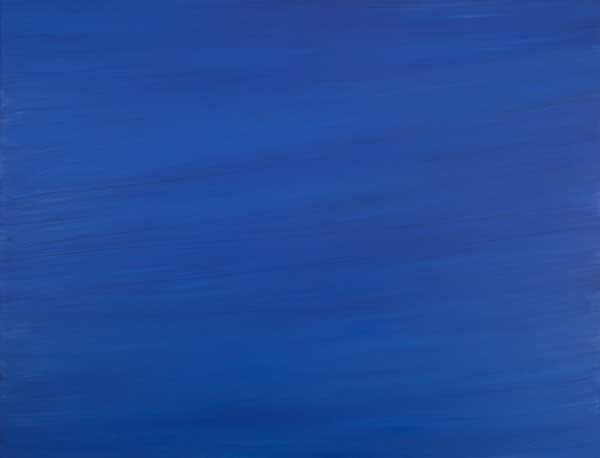
    EHF: I have attempted to make paintings emanate sound through saturated color since 1981. At that time I was pursuing my undergrad degree, BFA in painting and photography, and was seeing a lot of live music. Punk culture was in full force, so sound and design were interchangeable. A painting I created, The Floozies vs the Force, in 1981, was a painting that was predominantly red and blue, and is oversized. I began to see that the cobalt blue used in this painting, a latex/household paint, would turn to a white hot in low-light times of day: dawn and dusk. The red of the painting would recede, and the blue would advance, which was the opposite of what we were trained to understand about color in school. This intrigued me, and I began to consider cobalt blue as a color that had a broader communicative range, and could possibly hold the key to my color/sound investigation.


    Firstindigo&Lifestyle: You say that cobalt has some mystical components, does this mean transcendental in some ways?


    EHF: Yes, I feel that this color actually connects with our spirit, and that it communicates directly to this intangible part of our being, which is why the response to blue is universally tied to the spirit. I think we all feel it.

    Firstindigo&Lifestyle: The process of painting for you is very physical, it’s almost performative how you pour the paint on canvas, and work toward the outcome. Can you explain your process with paint, water, and objects, how they all are involved in your practice and contribute to it?


    I think it’s about immersion. I want to put my full body into painting, connect physically with each aspect of the process, and finish, like a yoga deep breathing exercise, with the eyes as the final part that communicates to the color. I have a long history in dance, and feel that this visceral connection comes from this history, or muscle memory. 


    Firstindigo&Lifestyle: There seems to be an element of covering and revealing in the process?

    EHF: Yes, I call this part “blind painting.” In order to gain a full field of pattern, I have to cover the surface. I can’t know for sure what the outcome will be, which is an aspect of trust I’ve established with the materials themselves. I feel they have more to teach me than I them. I want to explore the full range of their characteristics, which means I cannot be the author of the final image, the paint is the author. I set the stage, facilitate its dynamic potential, and then I leave the room and let gravity and evaporation do their part to finish the work. If I’m not happy with the result, I tend to live with it for a while before going back into it for a second pass. I learned a lot about listening to my materials through ceramics. Often the ceramic work would come out of the group kiln at school with an unexpected result in the glazing and painting that I had put together with the underglazes and oxides. 

    When I pulled the pieces out of the kiln, at first they disappointed me due to my expectations. But, over time, they made me look at the unfamiliar with an open mind, and would convince me that they had a strength to them that I could have never controlled or forseen. This made me want to explore accident and the unexpected more in my painting.

    Firstindigo&Lifestyle: Can you tell about your background, and how did you find your calling as an artist?


    EHF: I have always called myself an artist. From a very young age, 5 or 6, I can remember identifying myself in this way. I am the sixth of eight children, and married into a family of twelve children. My husband was a twin, he passed away in 1996 from an undiagnosed cancer, leaving me to raise three very young sons by myself. The boys are all young men now, with lives of their own, but we are close. I always made drawings, played school, painted, argued, and have had a life where I maintain a space for play. 
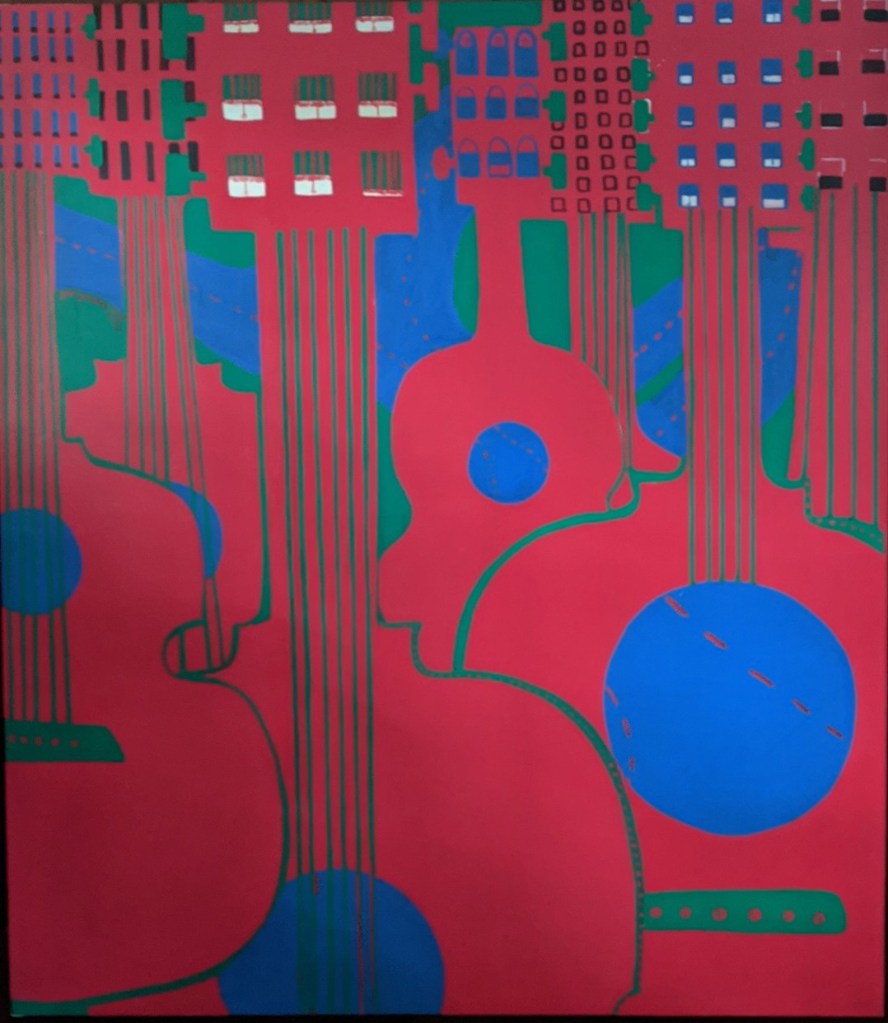
    Margaret Ellen Hackl, City Sounds, 1981, latex house paint on canvas, 60″x57″ in.

    Firstindigo&Lifestyle: What are your influences in different arts of technology, and the systems, which have an impact on your creation?

    EHF: For me, Color Field suggests an immersive experience of deep looking. Color Field has been a part of my development as a painter since 1981these paintings from 1981 are both full body size, which put me in full contact with responding to these contrasting colors when painting them, they literally would throw me off the easel as my eyes were having ocular severe reactions. I nicknamed them “retinal eye bouncers” for the punk era, these were a sympathetic relative to the music I was seeing live so colors spoke of sound, from the moment I began working in a flat, graphic style. Pop Art and Punk graphics were also a major influence at this time.

    EHF: My influences from technology all source from music since 1981. I have referenced punk music, early pioneers of abstract, electronic music like Morton Subotnik, the fluxus influences dating back as early as Dada and Schwitters to John Cage, to Frank Zappa, to Brian Eno and David Byrne. The systems tend to be based in the arts, but many have application in the sciences as well. 

    Firstindigo&Lifestyle: How about the collaborations you have created with musicians and composers?

    EHF: These collaborations have come to me since 1981 as well. Most composers/creators of music, see a relationship in my work to sound and are always eager to join me in my projects, musicians are natural collaborators, so it has been a path rich with artists to work with. 

    Firstindigo&Lifestyle: I remember you having an installation at the New York Public Library, how did this project succeed in terms of audience response?

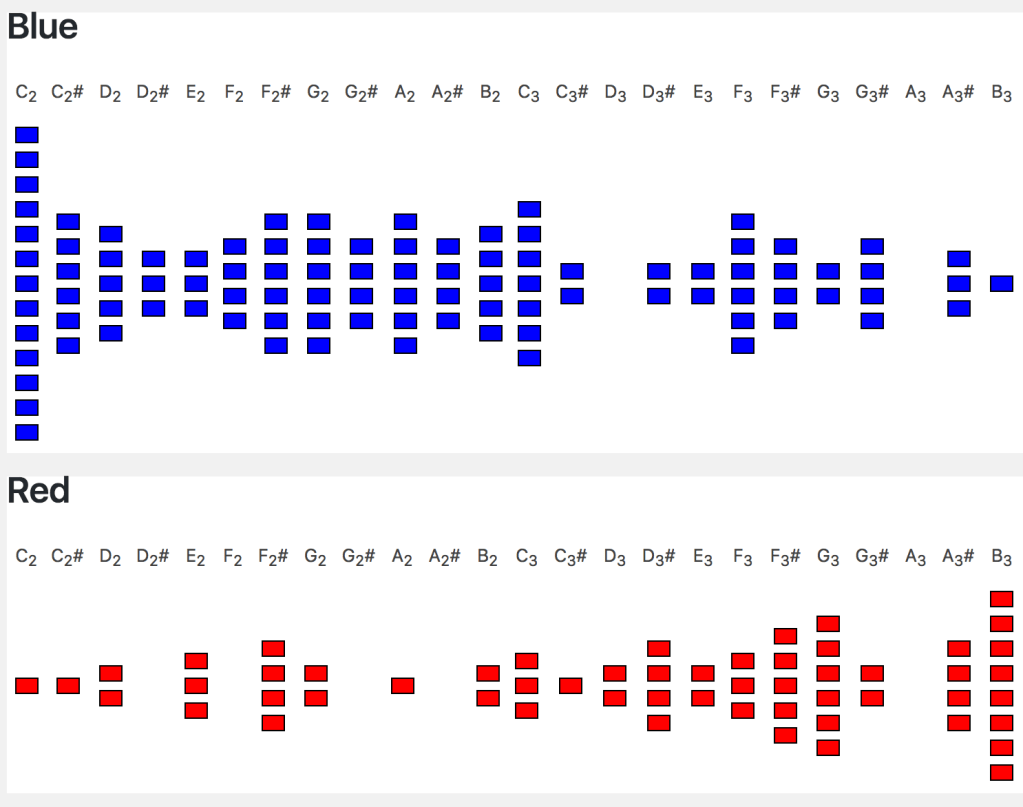
    EHF: I was invited to share a panel with two guest artists, of my choosing. As we all focused on the relationship of sound to color, and vice-versa, I asked the audience to play the Reverse Color Organ all together. We focused on blue and their responses when asked to pair a sound to the color looked like this, then I asked for red. You can see their results pretty much feels like common sense. I would like to collaborate with an institution or a person to gain a lot more viewer input  for the Reverse Color Organ

    Ellen Hackl Fagan, Riverse Color Organ.


    Firstindigo&Lifestyle: Your interest is very much also in the musical and sound aspect of the work. The blue color can have almost symphonic qualities. Do you feel this way?


    EHF: Yes, I am a product of a long history of rock and roll, punk, and some dabbling in jazz and world music especially growing up seeing punk bands and following certain bands over the past three decades. Music is a direct influence in my work.

    Firstindigo&Lifestyle: Could you tell a little more about your recent exhibition, and a project called Helpless?

    EHF: I was thrilled to be invited to create a solo exhibition for Five Points Center for the Visual Arts. I was asked a year ago. As COVID-19 took over our lives and the galleries and museums all closed, it wasn’t certain when this exhibition would open. I give them a ton of credit for staying on time with their programming during all this chaos. It has been a great experience working with them. 
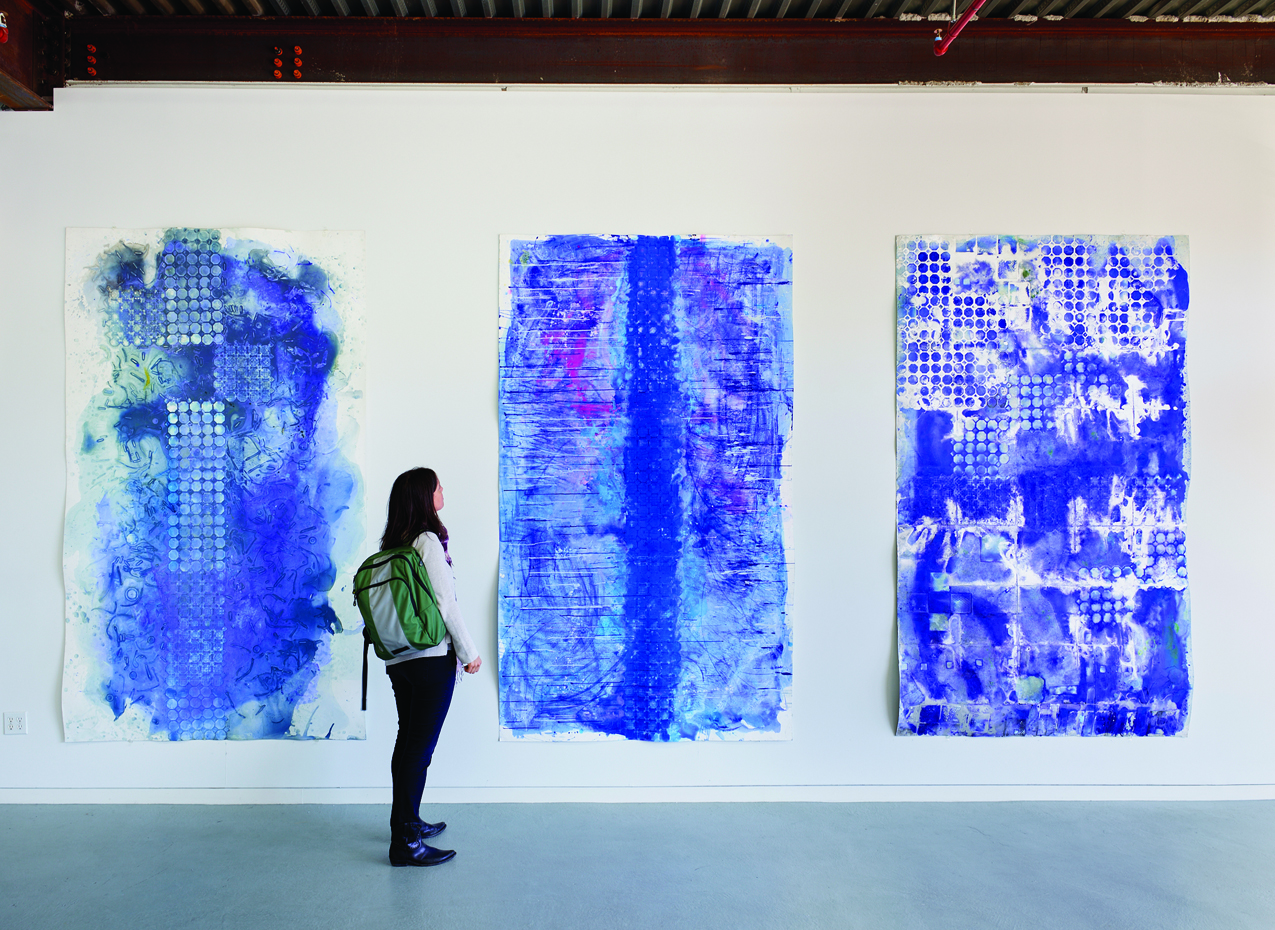

    For Helpless, I began working in the studio in early May in the early night sky there was a congruence of Jupiter, Saturn, and Mars. This was visible to me when we took a Mother’s Day hike in a local park where we were finishing up as it grew dark. We all talked about which planets these might be, etc. These burned in my visual memory as I was painting, and then the song Helpless flooded my mind as well. It became a meditation of sorts, and the title felt right for the exhibition. I’m a real fan of Neil Young’s music, since my teens, it was comforting having his voice in my head. 

    Firstindigo&Lifestyle: COVID-19 has changed a lot of the daily practices. How have you experienced this time in your life?

    EHF: I run a gallery, which has now morphed into three distinct new projects, in addition to my solo work. If given a full time assistant, I’d really get on top of my work load. Mainly, I miss having the freedom to get together with family without a litany of interview-like questions but we’re working it out. I’m finally going to see my mother, who lives in the Midwest, and I continue my work commitment in and out of our recent quarantine periods. Otherwise, I’m staying healthy and patient that we will get through this pandemic. I paint in my garage, and am happy to have carved out this work space last summer. It is my source for happiness, the studio, and I’m thankful for this.

    Ellen Hackl Fagan Studio view. Seeking the Sound of Cobalt Blue, Big Blue, 2020, pigment, acrylic, museum board, FV, 108 x 60 in.

    Featured image: Margaret Ellen Hackl, The Floozies vs the Force, 1981.

  • Patricia Chow and the meaning of ultramarine

    Patricia Chow and the meaning of ultramarine


    By Patricia Chow

    I moved to Los Angeles in 2014, after 11 years as a New Yorker. During those years, I went to graduate school, began and finished a career, learned to love opera, and mounted my first fine art exhibition – a crowd-sourced photography group show that was simultaneously a fundraiser for the nonprofit where I was a board member. What I never did in New York City was paint. At the time, my relationship to painting was purely as a viewer, standing a respectful distance away, wondering how in the world they did that. Who would have thought that three years later, at the instigation of my Los Angeles painting professor, the indomitable Barbara Kerwin, that I would find myself pursuing a graduate degree in painting?


    Our first-year MFA group show was titled “Twelve,” for the 12 of us that started the MFA in Art program at Claremont Graduate University this past August. The works I created for the show were made with oil pigment sticks, built up into a thick impasto texture by smashing them onto the canvas with a palette knife and mixing colors alla prima. The paintings are about the loss of meaning and culture through the generations and across the seas. Words, behaviors, rituals become hybridized, sometimes beyond recognition, when transplanted to a different environment, just as language and writing change over time, eventually past the point of intelligibility. Each of my paintings starts with a Chinese calligraphic text, drawn in black, that becomes obscured through layers of superimposed texture and color, ending in a very different visual experience compared to the black and white text that “birthed” it.

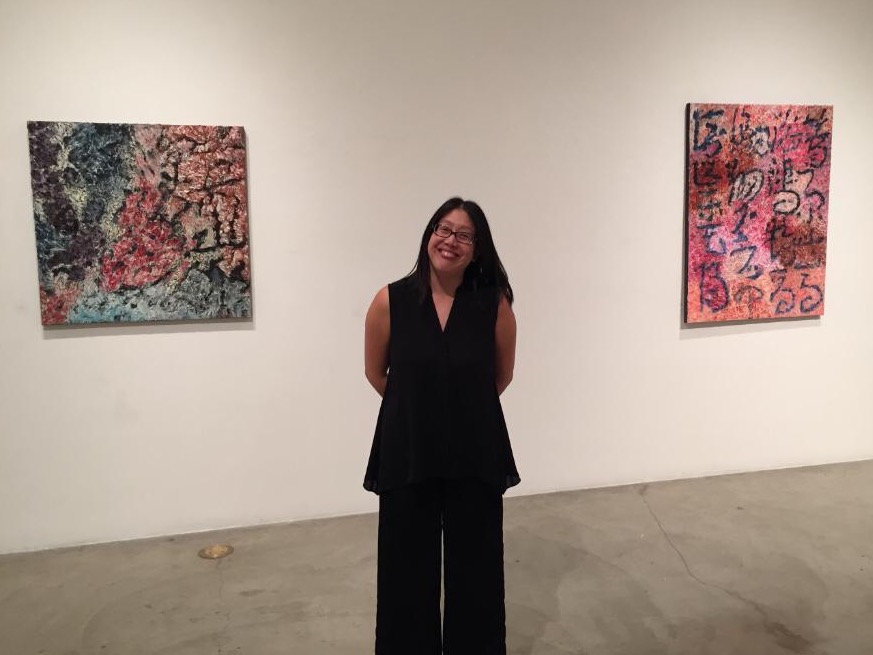
    Patricia Chow in the MFA-exhibition.
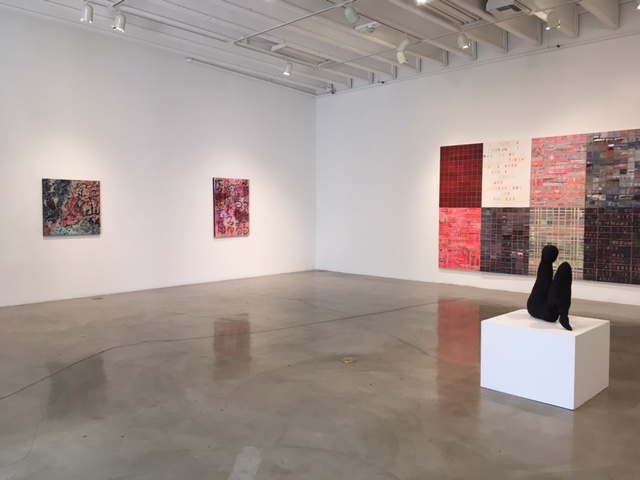
    Patricia Chow’s two paintings pictured left in the Twelve-exhibition at the East and Peggy Phelps Galleries.

    The largest painting (60 x 48 in.) is titled “Outremer” (French for “ultramarine”). The cool colors and coral-like shapes evoke underwater life, but the title also refers to the French territories in the South Pacific (called “outre-mer” in French, meaning “overseas”), that were visited by Gauguin and others interested in the decidedly un-PC idea of “primitivism,” and also where France has conducted a large number of controversial nuclear tests. Thus, in addition to the Chinese text being washed away “underwater,” the painting’s title also alludes to aspects of modern world history that some might prefer to be swept under the rug.

    Patricia Chow with her paintings.
    Patricia Chow with her recent paintings.


    Each of my paintings starts with a Chinese calligraphic text, drawn in black, that becomes obscured through layers of superimposed texture and color, ending in a very different visual experience compared to the black and white text that “birthed” it.


    Patricia Chow is a Los Angeles-based artist whose abstract paintings engage the intersection of Eastern and Western cultures across time and space, and the hybridization and reinterpretation of meaning. She is currently a first-year MFA student in Los Angeles, CA.

    Twelve is on view at the East and Peggy Phelps Galleries, Claremont Graduate University, through October 20, 2017.

  • Francie Lyshak about painting

    Francie Lyshak about painting

    After four decades in painting, American artist Francie Lyshak has a deep knowledge on her practice. A woman-artist who has a lifelong approach to learning, finds nature and it’s varying stages influencing her work. The artist examines nature also with photography. It seems, as if those pictorial notes would transfer into her paintings with subtle poetry and movement. In this interview, she discusses her career, love of painting and the meditative approach to being with her art. Remarkable is how the artist views art as a career, also in psychological terms as a radical act. Francie Lyshak’s recent paintings, which examine movement and gestures, will be on view until April 27, 2017 in the Carter Burden Gallery of NYC.

    Firstindigo and Lifestyle: How did you find yourself doing painting? Where did you grow up?

    Francie Lyshak: I will share with you two central memories that are at the very early roots of my art career (before it begun):

    I am in Detroit, Michigan, in a single family home with a nice yard. I am a small child, somewhere between toddler and latency age.  I am sitting in the mud, alone making a mess and enjoying it totally.

    In the second memory, I am 18 years old, attending my first art history class.  As I watch the projected images of works by modern artists, it is suddenly clear that making paintings is what I need to do with my life.  I began to paint was when I went to a summer art school in Paris around the age of 19.  I haven’t stopped since that time, except for one year in Boston in the early 70’s.  After that point I switched from abstraction to figuration.


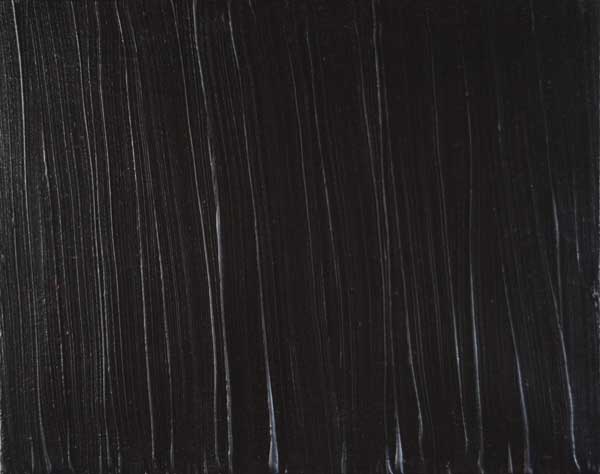
    Lyshak_BlackCurtain_16x20_500
    Francie Lyshak, Black Curtain, oil on canvas, 16×20, Courtesy of the artist.

    Firstindigo and Lifestyle: You have an exhibition opening now at the Carter Burden Gallery in NYC, tell more about the theme of your paintings in the show?

    FL: These paintings focus purely on the physicality of painting, of paint, painter’s tools and the interaction of the painting surface with light.  The use of a palette knife can be a violent destructive attack on a painting’s under-layer.  A flowing brush mark can be evidence of the painter’s sweeping gesture. The painting then becomes a stop-action image of what was either a waltz or a wrestling match between the artist and the medium.  It is painting without any intention other than leaving the physical evidence of its own dynamic birth.

    Firstindigo and Lifestyle: What is really interesting is that your career spans for four decades, and there can be so many changes that fit into that time frame. Did you start with figurative or representational art?

    FL: In my early work, my visual language was a figurative and a metaphorical narrative with strong feminist overtones. This work lasted for two decades in the 1970s and 80s. Animals, humans, dolls and toys populate these paintings, each one describing the psyche captured in a critical moment of time.  Influenced by art therapy theory and practice, their emotional rawness challenged the viewer to contemplate disturbing aspects of life that are typically overlooked or avoided. After years of these explorations, I unearthed evidence of my own childhood sexual abuse.  With the support of the late Ellen Stuart and La MaMa/La Galleria, this work resulted in a one-woman exhibition in 1993 narrating my own trauma recovery through my paintings.  The series of paintings with accompanying prose was published in a book in 1999 entitled, The Secret: Art and Healing from Sexual Abuse. This exhibition provided me with a release from the narratives of the past.  After that show, my work changed slowly but radically, moving towards landscape, then abstraction.

     (Images from The Secret: http://www.francielyshak.com/archive/Secret/index.html).

    Firstindigo and Lifestyle: How did you choose painting and photography, how are they similar or different to you?

    FL: I am a painter.  However, I believe that no matter what medium an artist chooses, they cannot escape their artist’s sensibility. That means that we cannot help but consider the aesthetics in our environment.  Also, we cannot help but be creative.  It is a kind of compulsion that requires an outlet.  In that vein, I took up photography.  This was in part because I found it offensive that paintings are generally only affordable by the wealthy.  I experimented with printing and multiples as a way to make my work more accessible to those with less means.

    Firstindigo and Lifestyle: Can you say that what you do is abstract art, and if so what would this kind of abstraction be?

    FL: The best way to describe my new work is ‘pre-verbal’. Before words,  ideas and memories there is a mental space that is responsive to shape and texture, color and amorphous mood. That is the space that my paintings occupy. My abstract work is not expressionistic, nor is it minimal or conceptual. My newest work has something in common with action painting.  Over the long haul, the trend of my work has been increasingly reductive.  I seem to be constantly trying to reduce the content of my work to its simplest components.  I removed the figure.  I removed the narrative.  I removed the symbolism.  I removed the suggestion of landscape.  Then I tried to suggest empty space alone (which made the work illusionist).  Now I am just looking at the surface, the medium and the tools of application.

    I recently saw a show that was simply lighting in an empty gallery.  I understand that.

    Francie Lyshak_BrushedBlue_34x44_1400
    Francie Lyshak, Brushed Blue, oil on canvas, 34×44, Courtesy of the artist.

    Firstindigo and Lifestyle: How do you choose your works for the exhibition, do you ‘curate’ yourself?

    FL: No, my dealer is fully in control of the choice of work and the hanging.  Of course, it is up to me to choose the paintings from which she makes her selection.

    Firstindigo and Lifestyle: The process is of course different with each artist, do you like to add older paintings into the show, or is it mostly recent works?

    FL: Mostly very recent works are shown in April exhibition.  My first exhibition at Carter Burden had some pieces that were several years old but had never been displayed.

    Firstindigo and Lifestyle: You are watching a lot of movies, how apparent is it that those moods or aesthetics you gain from films enter your works somehow?
     
    FL: I don’t think that the aesthetics of film influence my work, but perhaps the moods do on a subconscious level. I find great solace in the work of these great, underappreciated independent film makers.  They address very important, very real aspects of being human.  Hollywood spends mountains of capital selling fantasy worlds to viewers because it is a natural,human inclination to avoid and escape harsh reality.  The filmmakers that I love make me look at the challenging underbelly of being human.  This gives me courage and support in my effort to stay honest as a painter, to not be fooled by the illusionary rewards of commercial success, to lead my viewers to the challenging aspects of being human.

    I have a fantastic list of my list of favorite movies.  It is a long list and the titles are unrecognizable to most people.  Almost all of the films were borrowed from the New York Public Library which has a treasure trove of great films.

    Firstindigo and Lifestyle: What does a notion of ‘zen’ mean to you as an approach?

    FL: I am not formally trained in Zen practice.  However, I understand that Zen does not have a god head, and is focused on what westerners call mindfulness practices.  My mind is constantly racing.  I hunger for empty space and quietude.  (Perhaps this is reflected in my urge to constantly minimize the content in my paintings.)  We live in an overheated, overstimulating world (at least in NYC).  I know, however, that it is not the fault of my environment that I am so mentally restless.  I reach for ‘zen’ as a pathway towards a quiet mind or to attain full attention.  When I paint, I am in a ‘full attention’ mode.  In this sense, painting is a mindfulness practice.  (Click the link to see a series of paintings that were specifically intended to be ‘meditations spaces.’
    http://www.francielyshak.com/archive/New%20Monochromes/index.html)

    Firstindigo and Lifestyle: What else do you do to balance with making art?

    FL: Not much.  I do some Yoga practice, go to the gym, take walks and, of course, watch movies.  I would add that there isn’t anything much more rewarding that good conversation with other artists and intellectuals.

    Firstindigo and Lifestyle: Where do your influences come from other than abstractions? Do you blend in narrative contents from today’s world and events?
     
    FL: My goodness, the political climate has a tremendous impact on the ‘climate’ of my work.  There is very little joy in my work these days.  On the other hand, I am finding surprising strength and power there.  My work is definitely a mirror of my psychological condition.  My psychological condition is a mirror of my personal and social life (which in these times encompasses the political environment).  A new painting included in this April exhibition is entitled “Silence equals Extinction”.  It was clearly a response to the nightmare political situation in the US.

    Francie Lyshak_KnifedWhite_34x26.
    Francie Lyshak, Knifed White, oil on canvas, 34×26, Courtesy of the artist.

    Firstindigo and Lifestyle: In your photography there is a lot of nature in them; fog, mountains, trees, moon, and so on. How do you find your photographic subjects, do you just happen to be in those places in the moment? 

    FL: Yes, everything was done either in Michigan, where my family has a summer home, or NYC.  I also did some photography when I did some traveling along the Adriatic, Ionian and Aegean Seas and along the Pacific Ocean shore. I am wild about landscapes.

    On influences: 
    I am not influenced by art theory nearly as much as I am influenced by psychoanalytic theory, philosophy and religion.  I have no belief in any religion.  However, I find the search for self and meaning to be central to my practice as an artist.  I am most affected by any work of art that creates a space for the viewer to engage in this search for identity or meaning.  Works by Frieda Kahlo, Mark Rothko and Fred Sandback all succeed at doing this for me; although each uses a radically different method to set a stage for this to happen to the viewer.

    On color: 
    Colors have a strong valence, a kind of personality.  My latest pieces have been in various shades of black.  I am choosing black because I have always feared it.  Black oils cannot be controlled because they are wildly interactive with the light in the environment as it reacts to the surface of the painting.  The color black, for me, has much to do with loss, change and the unknown.  So colors themselves have a kind of personality and meaning and different oil colors also have a unique physicality, such as color density.

    On my use of color in photography and painting:
    I think of myself as a painter.  I have spent forty years painting.  Photography has been  secondary to my work as a painter.  My photography is in the early stages of development; but is created on a foundation of 40 years of evolved aesthetic sensibility and artistic practice.   My photography is mostly rooted in local color or black and white.  My new paintings, on the other hand,  are each a deep explorations of color, the oil paint medium, the painters tools and methods of application.  In other words, my practice as a painter has evolved to a point where I am exploring the very basics of the medium.  It is full circle, back to the beginning.

    Firstindigo and Lifestyle: Do you find inspiration in your travels to foreign places, how about those leaving an impact on your thinking and aesthetics?

    FL: I just traveled to Japan.  Their aesthetic and social values were a great comfort to me.  The Japanese seemed so much more civilized than Americans.  It was heartening to experience their aesthetic and their culture.  I felt that my own values were much more supported by the Japanese culture than they are in my own culture.

    Firstindigo and Lifestyle: Did you ever come up with a notion, who would be your best art audience, or collector?
     
    FL: Probably intellectuals, other painters and psychologically-minded people.  It is hard to tell who is most taken by my work because people usually don’t say much.  Most of us become a little inarticulate in the face of meaningful visual art.  Art takes us to a non-verbal place.  I admire people like you who are willing and able to give us language in the face of visual art.

    Firstindigo and Lifestyle: With so much insight in the practice, we all want to know, what would you like to teach or say for younger generation artists and painters?

    FL: I would like to say to them that it is worth the battle to stay true to their artistic sensibility.  This is because, in the long term, losing touch with one’s core strivings (to be an artist, to be creative) has an unbearable cost.  I would tell them, however, that they shouldn’t expect to be rewarded.  Artmaking is essentially a radical act, because it means turning away from the influence of others and, instead, opening a channel to one’s true self.  Being true to one’s core self usually means letting go of many of the rewards of social/commercial success.  After all, in the short term we are nurturing ourselves rather than others.  Who knows if our art will nurture others in the long term.  That is in the hands of the vagaries of the art market.

    Achieving commercial success in the art world is a totally different side of being an artist.  It takes a combination of ambition, talent, personality, timing, social resources (such as health, social networks, time and money) to make income from making art.  To have these resources is often a matter of privilege and other random social events.  Artists don’t have control over most of these factors.


    Francie Lyshak’s exhibition info: 

    April 6 – 27, 2017

    Examining Movement & Gestures: Jonathan Bauch and Francie Lyshak

    CARTER BURDEN GALLERY, 548 West 28th Street, #534
    New York, NY 10001,  
    http://www.carterburdengallery.org/current-exhibition

    Francie Lyshak, education:

    ·      Pratt Institute, Art Therapy and Creativity Development, Masters of Professional Studies, NYC, 9-76 to 5-78
    ·      Wayne State University, Painting and Drawing, Bachelor of Fine Arts, Detroit, Michigan, 1-69 to 5-70.
    ·      Center for Creative Studies, Fine Arts, Detroit, Michigan, 9-68 to 5-69
    ·      University of Michigan, Humanities, Ann Arbor, Michigan, 9-66 to 5-68

    Artist website: http://www.francielyshak.com/