Tag: Patricia Chow

  • Zoom Life Drawing and Other Oxymorons

    Zoom Life Drawing and Other Oxymorons

    The pandemic lockdown saw the creation of all kinds of things we never would have imagined, such as new best friends you’ve never met, and the ultimate oxymoron: Zoom life drawing.

    Life drawing, of course, means ‘from life’. As in the person you are drawing is in front of you. Which, sadly, was not exactly possible during the lockdown. Undeterred (and unemployed), enterprising life models began broadcasting sessions on Zoom from their homes using their phones, with some even setting up elaborate painted backgrounds.

    At first, all of this was just temporary, until we could all draw in person again. But as the months became years, worldwide drawing communities developed, crossing time and space boundaries, and, for once, not being limited to models physically present in the area. So when lockdown ended, we still wanted to see our friends AND draw the best models from around the world, even if they were on a screen and you couldn’t choose the angle, so the Zoom sessions persisted.

    I personally also didn’t want to give up being able to paint from home without having to lug twenty pounds of supplies across town without a car and having to compete with a dozen other artists for an unobstructed view of the model.

    Fast forward four years. I’ve done hundreds of Zoom life drawing sessions with models I have never met in person, despite having drawn them for years. It’s an extremely strange relationship of intimacy. On the one hand, I know the contours of their bodies in great detail. But I don’t know basic things like how tall they are, or their relative size in proportion to “my basic unit of measurement:me”. These things can’t be determined on Zoom.

    Let me just mention here that for whatever reason, there is a very large number of Zoom life models based in Buenos Aires, Argentina. There are just a handful of models from all other countries on the Zoom circuit, but I counted 26 models from Buenos Aires that I have drawn on Zoom.

    The confluence of several unrelated events brought me to Buenos Aires in October 2024. The timing was determined by the 2024 Urban Sketchers Symposium, which was held in Buenos Aires from October 9-12. While I was not planning to attend the Symposium, many friends from around the world would be there for the event, and sketching together is a lot of fun. But it’s still a long way to travel, so I needed more motivation to make the trip.

    This was provided by a mural painting micro residency at Proyecto’ace, which runs the Palimpsest Project, a mural collaboration over time, where new work is interwoven into the existing murals, instead of painting over them entirely. I like this non-destructive approach, and since I hadn’t previously done any mural painting, I thought this would be a good introduction.

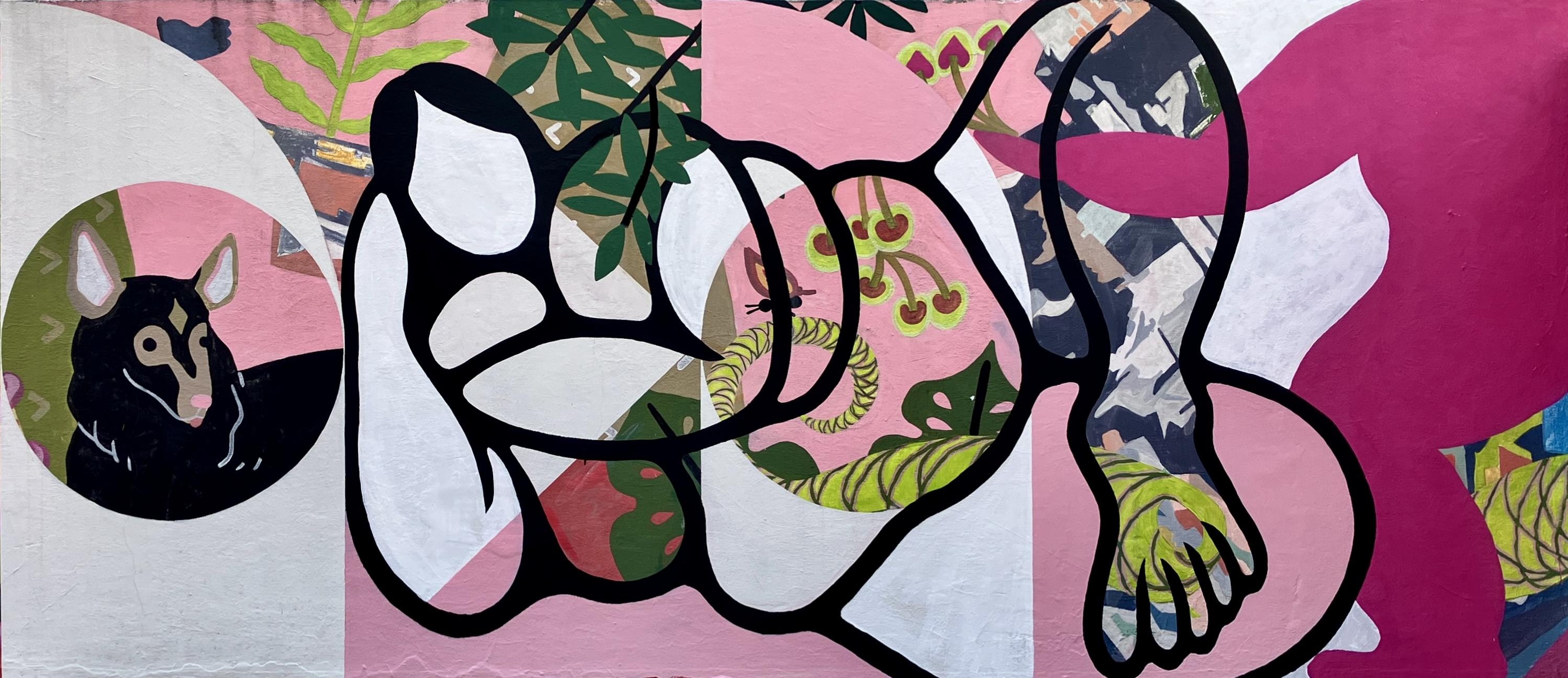
    For the mural project, I envisioned a collage of figure drawings, begun during Zoom sessions, and continuing to my time in Buenos Aires, where I would draw the same models in life, thereby adding a layer of time and space. The final mural incorporated only a single figure, my friend Eliana, painted from Zoom the previous year, into the existing mural. While I painted Eliana in various aspects while in Buenos Aires, it was the painting that I had brought for her as a gift that turned out to be the best fit for the mural.
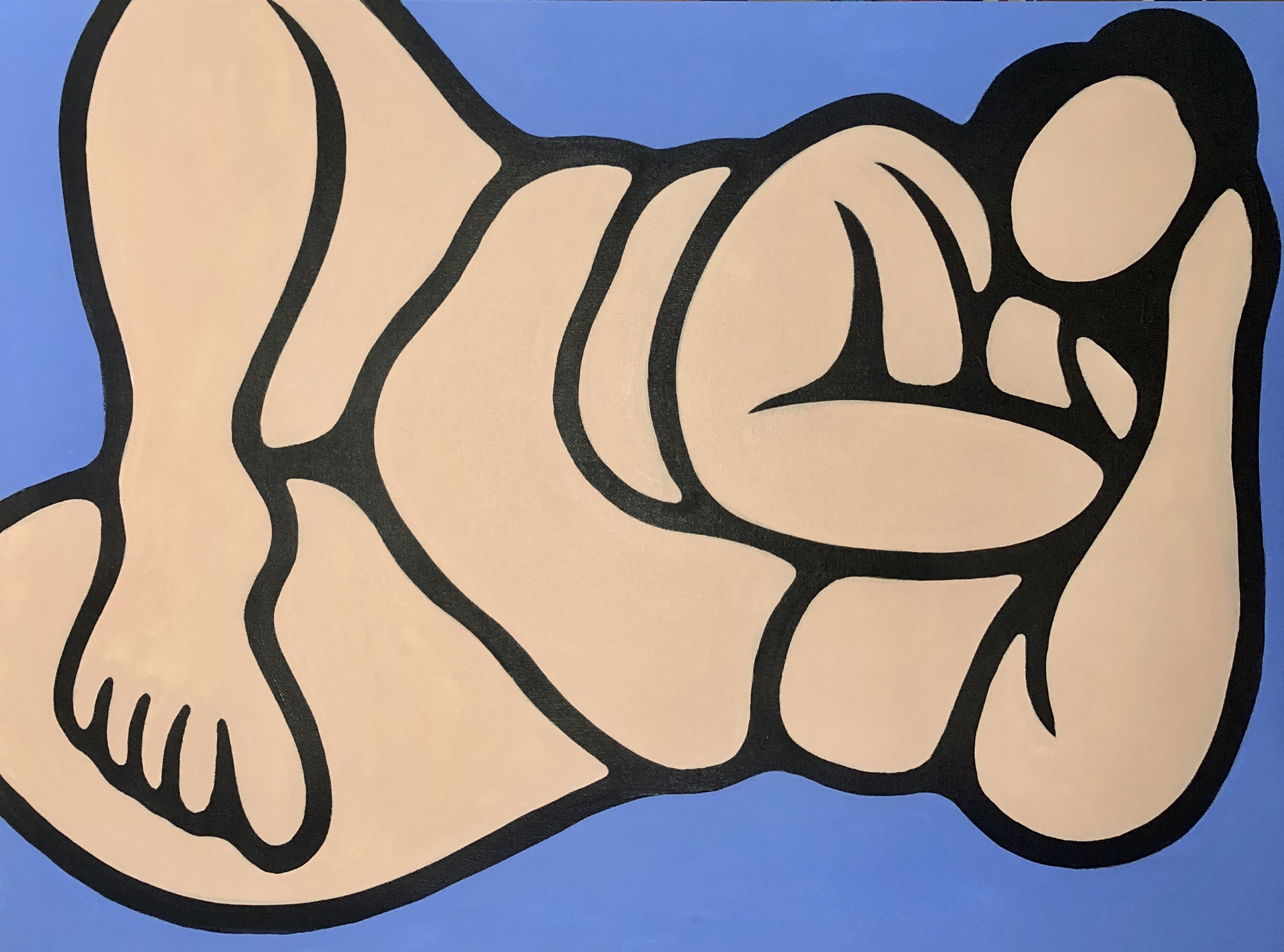
    While the artistic experience helped to expand my horizons, introducing me to new media and ways of working, the best part of the trip really was the opportunity to meet some of my favorite life models in real life. It was a bit like meeting a movie star, and chatting like you’ve known each other for years (which technically you have). I did experience the odd sensation of looking up and thinking that the person in front of me really looks like their Zoom persona. Except for the height.

    The pandemic lockdown saw the creation of all kinds of things we never would have imagined, such as new best friends you’ve never met, and the ultimate oxymoron: Zoom life drawing.

    As the life models themselves admit, you just put the camera on the floor if you want to make yourself look taller, so almost everyone ended up being much shorter than I had imagined. And while I’ve always heard that the camera adds 10 pounds, I’ve never had to subtract those 10 pounds in my imagination–especially not from someone who already looks tiny on Zoom. They turn out to be the size of a child in real life. Quite the surprise for someone from the U.S., where being big is totally normalized. It was a good reminder that the entire rest of the world is not like us.
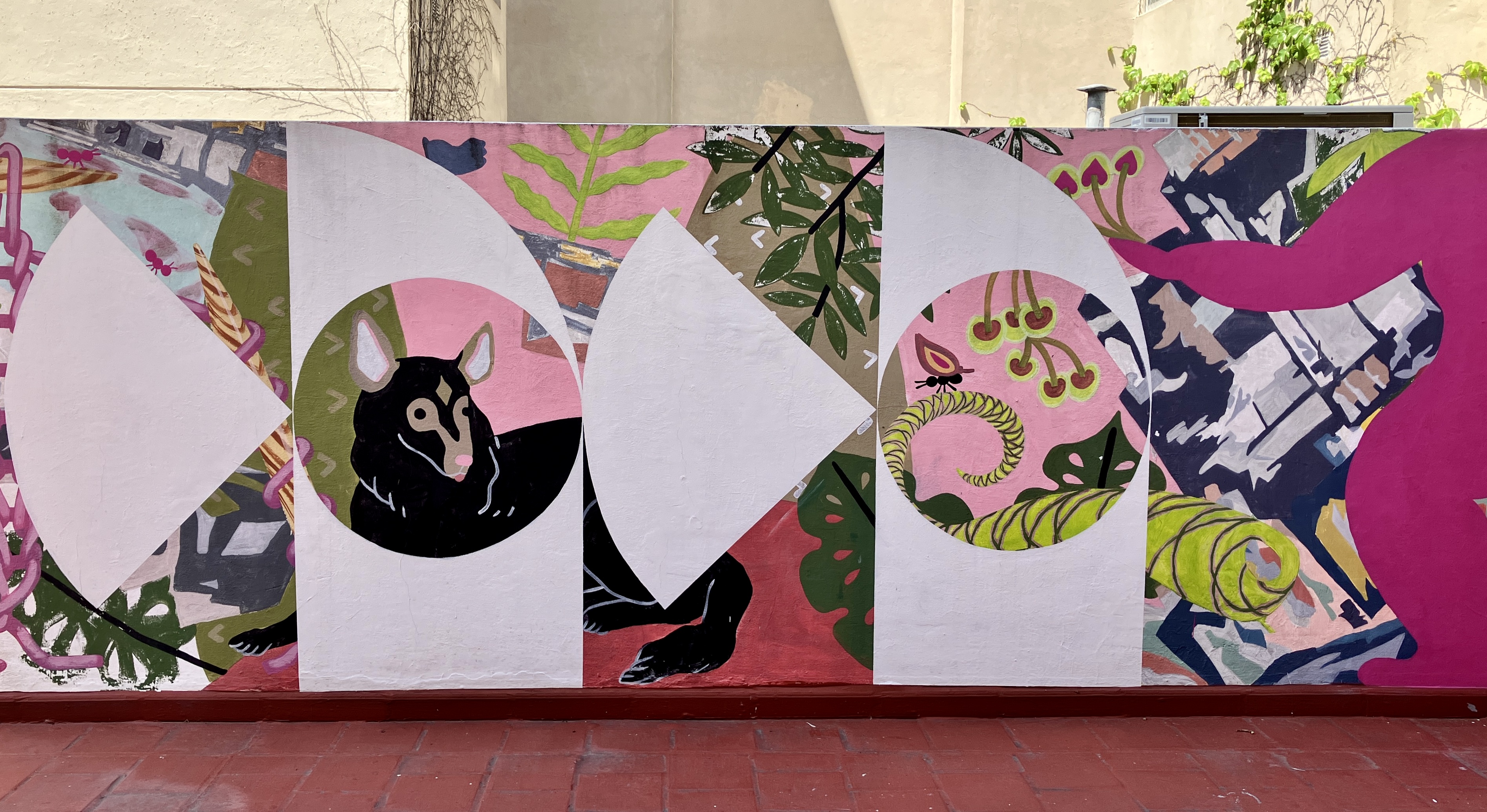
    Existing mural before my intervention
    Final mural


  • Patricia Chow: Pilgrimage to Gwangju

    Patricia Chow: Pilgrimage to Gwangju

    This is the story of how a trip to the 14th Gwangju Biennale in May 2023 led me to throw 10 paintings out of my second story window like Rapunzel’s hair.

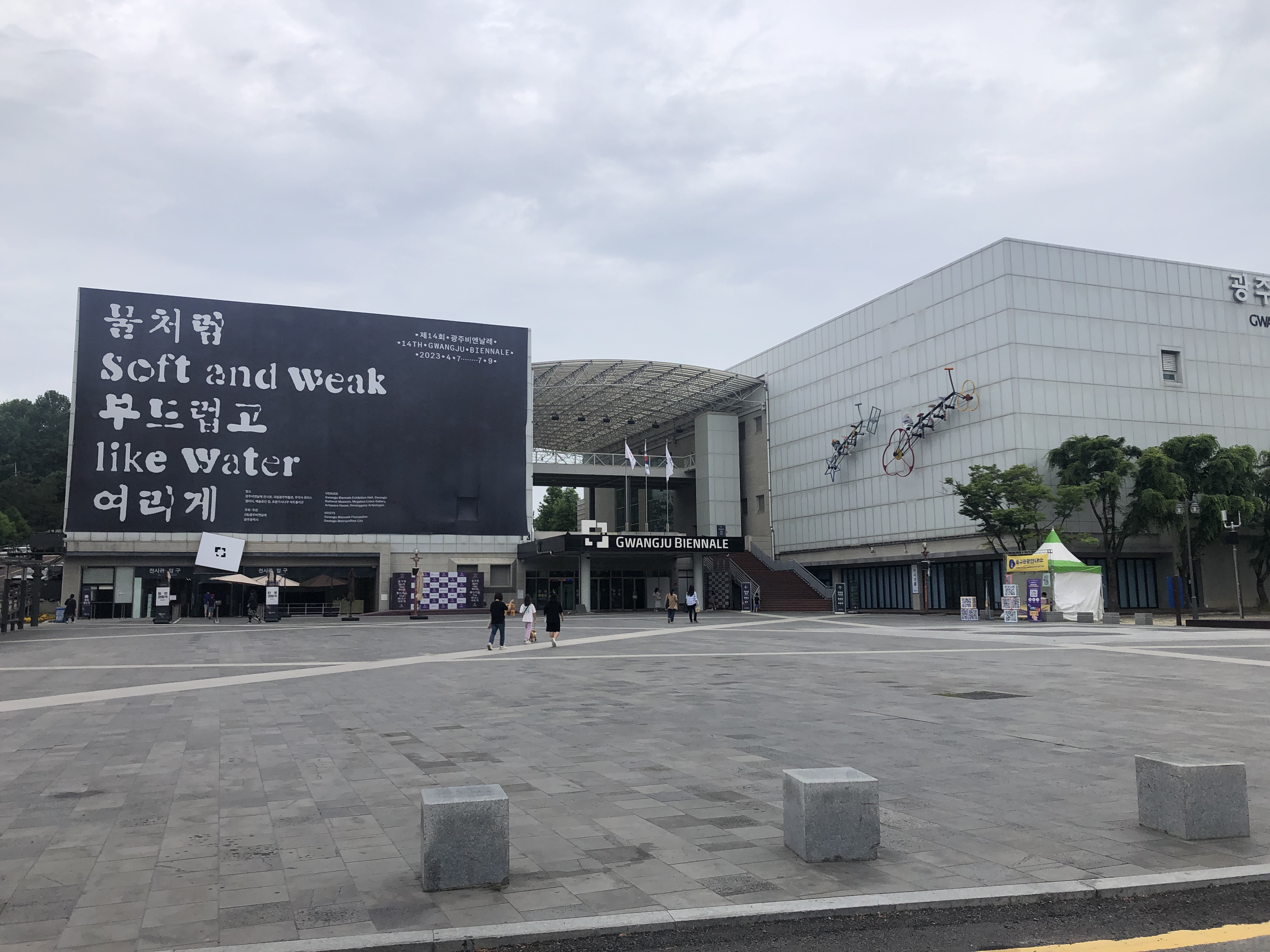
    When I was doing my MFA, I led a graduate seminar on the art biennale phenomenon, and have been slowly making my way to as many of them as possible ever since. A last minute opportunity to visit Korea gave me the chance to see this year’s iteration of the Gwangju Biennale, titled “Soft and weak like water.”

    Gwangju Biennale May 2023

    Gwangju is in southwestern South Korea, about a 2-hour train ride south of Seoul. It is considered the cradle of Korean democracy due to the 5.18 Gwangju Uprising, a pro-democracy popular uprising in May 1980 that was brutally suppressed by the military regime with the loss of up to 2,000 lives. After democracy was restored in 1987, the biennale was founded in 1995 to commemorate the spirit of the uprising and celebrate the city’s cultural heritage.


    This year’s artistic director, Sook-Kyung Lee, senior curator of international art at Tate Modern (and soon-to-be director of the Whitworth Gallery in Manchester), is the event’s first Korean artistic director since Kim Hong-hee in 2006.

    The title “Soft and weak like water” comes from the Tao Te Ching, and according to Lee, “is about the paradoxical power of seemingly weak things, referring to the transformative nature of water that could break hard things like rocks or change the course of a river over a long period of time.”

    Beyond the exhibition in main biennale hall, smaller exhibitions and country pavilions were housed in a multiple venues across town. My favorite was the Horanggasy Art Polygon, a glass pavilion located on the edge of a forest on Yangnim mountain. Walking up the winding alleys of the Yangnim-dong neighborhood felt like wandering around on the nostalgic streets of a Hayao Miyazaki film, with its mix of traditional Korean architecture and turn-of-the-century Western-style houses, now full of small galleries and tea rooms.

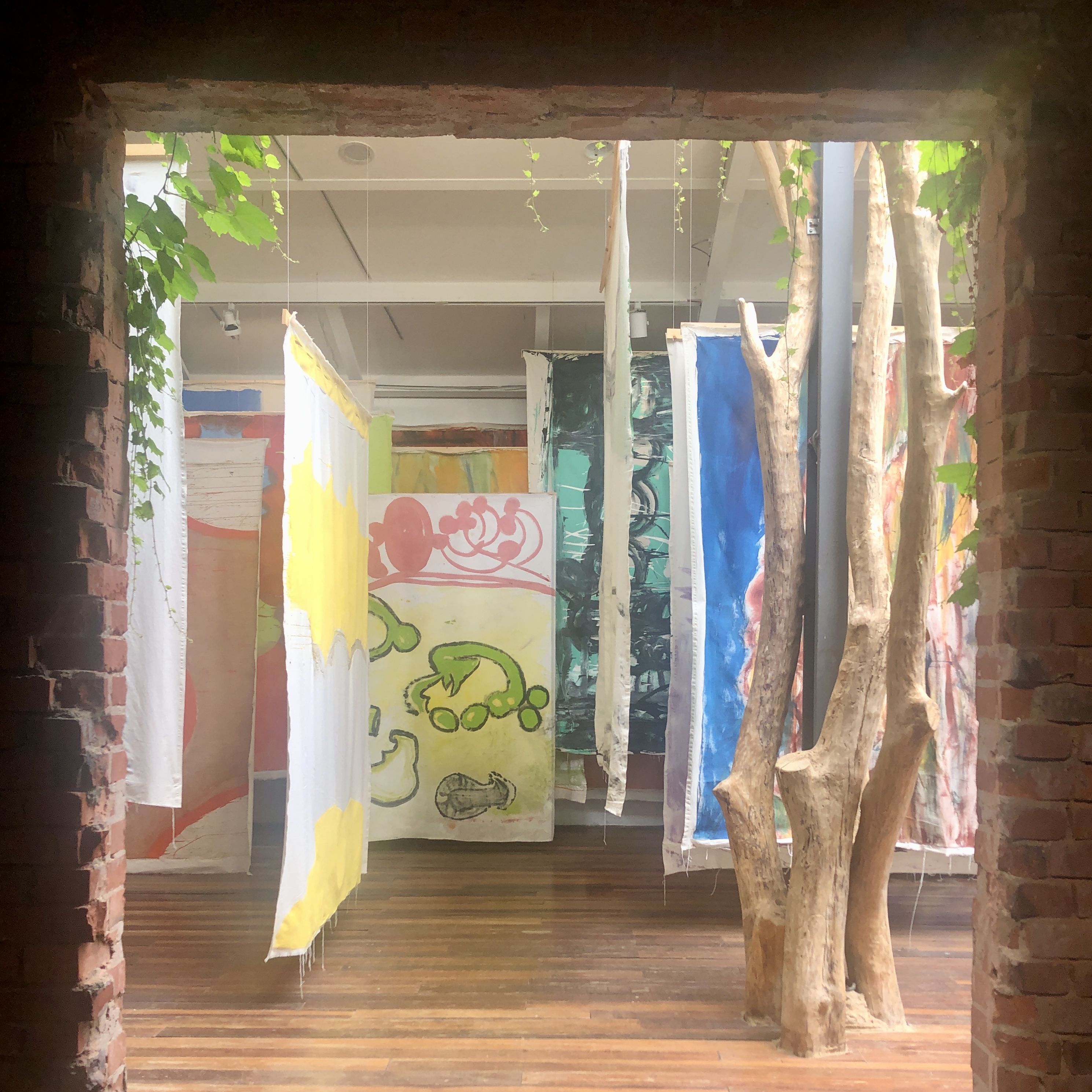
    Vivian Suter installation view.

    Inside the glass pavilion, I encountered for the first time in-person the work of Argentine-Swiss artist Vivian Suter. Suter is the subject of Rosalind Nashashibi’s 2017 short film Vivian’s Garden (one of two films that earned Nashashibi a Turner Prize nomination in 2017). The film is set in the jungle near Lake Atitlan in Guatemala, where Suter has lived and worked for four decades. A flood in her studio in 2005 caked all of her work in mud, and after recovering from the initial shock, Suter discovered that rather than destroying her paintings, nature had simply become part of them, and her practice subsequently incorporated the mud and rain and plants and insects and dog paw prints that are part of her lived environment directly into the paintings.

    What was most prominent when entering the pavilion was the smell of the paintings. This I did not expect. The enclosed space did not smell mildly of oil paint and gesso and canvas. Instead, you could breathe in the earth and rain that had seeped into the vast concentration of hanging cloth paintings. I had never experienced paintings as an olfactory sensation before.

    What I had done was experience music as painting. Specifically, the 1,027 opera broadcasts I listened to during Covid lockdown were distilled into the 18 paintings of the series I called “Synaesthesia” (2022). Synesthesia is perceiving something in one of the senses and simultaneously feeling it in another.

    Kandinsky famously dropped out of law school to study painting after attending a performance of Wagner’s opera Lohengrin, where, he later said, “I saw all my colors in spirit, before my eyes. Wild, almost crazy lines were sketched in front of me.”


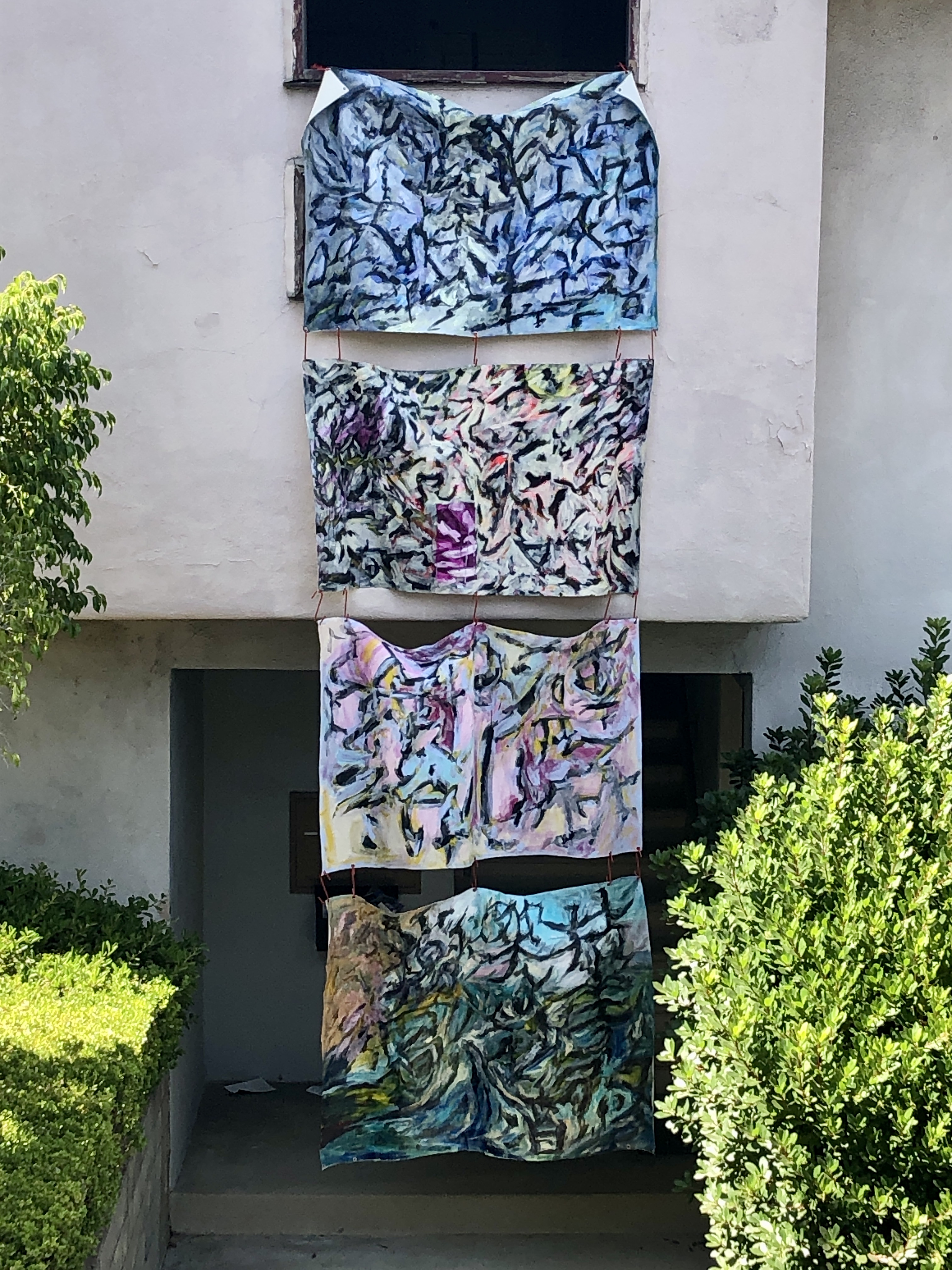
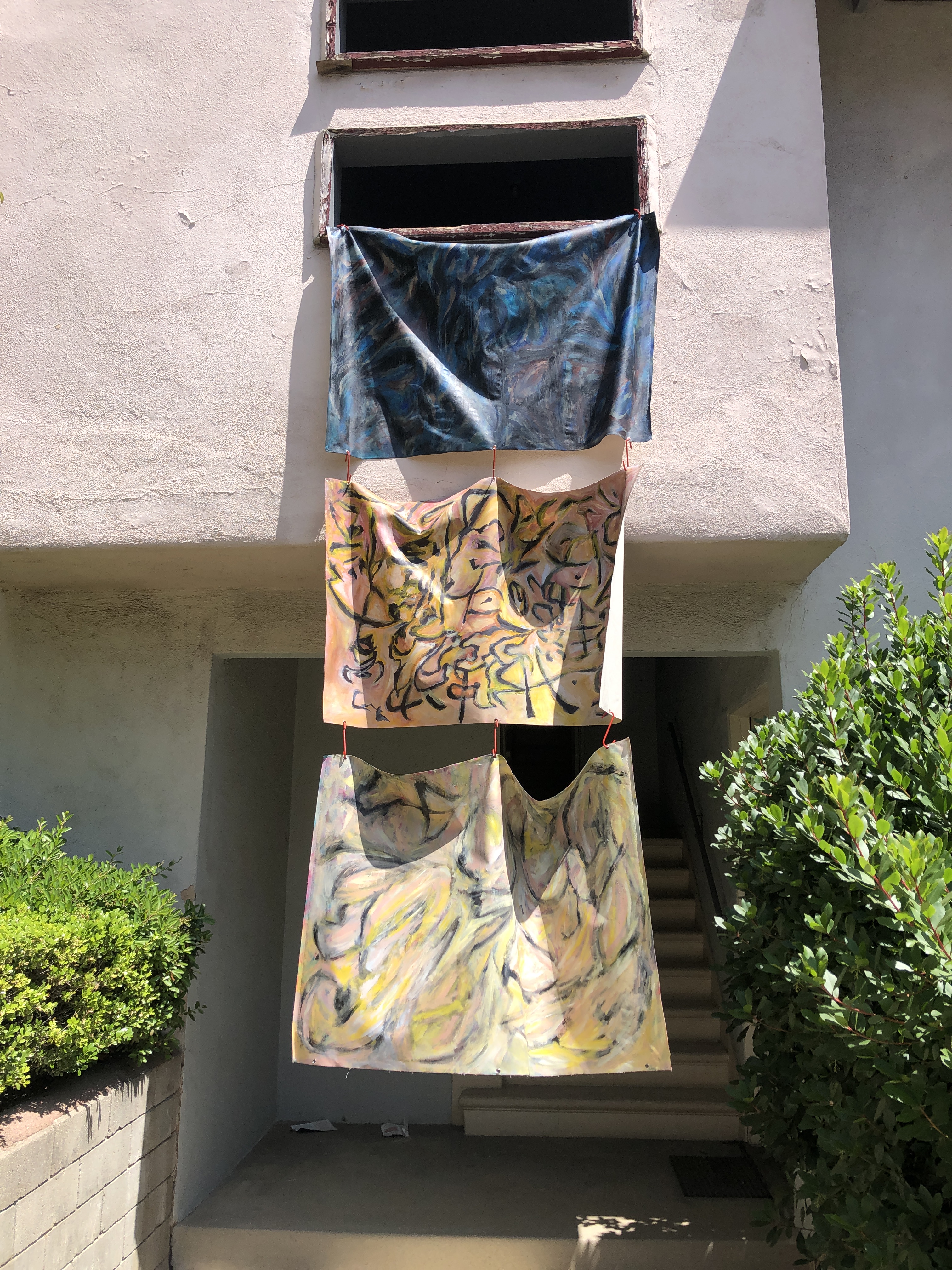
    Each of my paintings are a visual profile of the music of an opera character. In some cases, I painted specific interpreters of those roles. The paintings are acrylic on unstretched canvas, 3 to 4 feet high and about 4½ feet wide. When I got home from Korea, I decided to hang all of them up in my apartment, like in the Suter exhibition. But instead of attaching them to beams in the ceiling or to track lighting (I don’t have either), I attached them to each other, and ultimately hung them off the balconies around my split-level apartment complex. In homage to Kandinsky, I picked out the 10 Wagner opera characters to display.


    And that is how this installation came about.

    Patricia Chow, Tristan (Ben Heppner), Kundry, Isolde, Brünnhilde_installationview
.
    Patricia Chow, Erda, Fricka, Rhinemaidens_installationview.
    Patricia Chow, Tannhäuser, Senta, Ortrud (Leonie Rysanek)_installationview.

    From top to bottom:

    1. Patricia Chow, Tristan (Ben Heppner), Kundry, Isolde, Brünnhilde
    2. Patricia Chow, Erda, Fricka, Rhinemaidens
    3. Patricia Chow, Tannhäuser, Senta, Ortrud (Leonie Rysanek)
  • Patricia Chow: Vallauris, France in 5 weeks

    Patricia Chow: Vallauris, France in 5 weeks

    Patricia Chow, an LA-based abstract painter who creates place-specific sensory works, returned from her artist residency in France.

    Firstindigo&Lifestyle: You have been living mostly in LA during the Covid. I imagine everyday life experiences have changed for you as well.

    Patricia Chow: I was used to frequent international travel prior to Covid, so it was definitely an adjustment during lockdown. My art practice had been centered around translating place-specific sensory and mental lived experiences into abstract paintings, and needless to say, this failed utterly when the only place I experienced for 16 months was the inside of my apartment. My goal for 2021 was to re-acclimate to life in the world, including rebuilding my place-based art practice.

    Firstindigo&Lifestyle: Why Vallauris, France, how did you find about this place and art residency?

    PC: While the world began to reopen for travel in summer 2021, Covid infection rates continued to surge, so I used my skills from my day job as a data analyst to track international infection rates and identify regions where it would actually be safer for me to stay than Los Angeles, where I currently live. The other piece of the puzzle was to identify residencies in those areas that were still operating and had places for late 2021. Prior to omicron, France had been doing well.

    I had wanted to spend some time in Collioure, France, to investigate the origins of fauvism, so this became a starting point for my search. I ended up 300 miles to the east in the town of Vallauris (val-o-REES), where Picasso did his ceramic work in the 1950s. I was very lucky – the A.I.R. Vallauris residency lasted five weeks, and soon after I left, France’s infection rate skyrocketed to 50,000 new daily cases.

    Firstindigo&Lifestyle: The landscape and atmosphere are probably very different from West Coast of the United States. Can you explain what is special about this residency, regarding of art history?

    PC: The Côte d’Azur region has beautiful light and dramatic scenery which have drawn artists for hundreds of years, as well as many museums dedicated to these artists (Chagall, Cocteau, Matisse, Picasso-who has two museums), and museums located in the former homes of the artists (Bonnard, Fragonard, Léger, Renoir), not to mention the fabulous Fondation Maeght. All of this was definitely a draw.

    Another draw was the residency’s self-contained format. The six cohort artists live in the same historic building and work in the same studios, essentially forming our own Covid pod, which helps limit exposure for everyone. While the living arrangements were quite spartan, I felt very lucky with my cohort – we had a lot of synergy in terms of both artistic and intellectual interests, and the final exhibition turned out to be quite cohesive.

    Firstindigo&Lifestyle: How did the new work get exhibited?

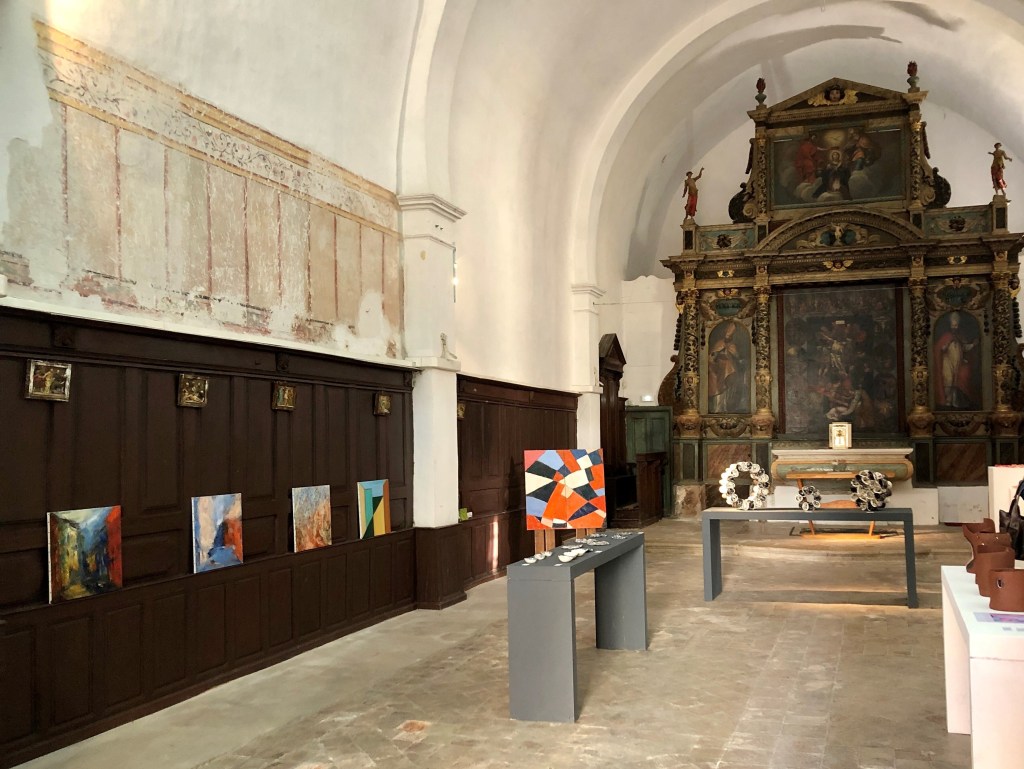
    PC: Another interesting aspect of this residency was the exhibition space for the final show: the Chapelle de la Miséricorde, built in 1664, and housing an enormous Baroque altarpiece from 1724. Of course, this could be both a blessing and a curse – small works might feel overshadowed by the space, and censorship could be a problem for some artists since it is, after all, inside a church.

    Firstindigo&Lifestyle: How would you think this location impacted your creative process, creating new sort of place-specific works?

    PC: I created a series of five mental landscape paintings of Place Lisnard: four 50x50cm studies and one larger painting, a 100x100cm diptych. I call them site-specific paintings because they are the most location-specific paintings I have ever done.

    Place Lisnard is an address, a pin on a map, rather than the conceptual space or idea of a city or place, and the paintings were made specifically for the exhibition space. The series explores different ways of translating the town square in paint, influenced by the many artists who came before me to the region.

    They are unified by a common color palette, which is ubiquitous in the area – found on everything from building exteriors and tromp l’oeil window shutters to bus tickets. The final diptych remains in the collection of the Chapelle de la Miséricorde, where it was first displayed.

    Firstindigo&Lifestyle: What do you feel you were able to take with you from this experience?

    PC: It is so important to stay flexible. Things have a strange way of working themselves out. I had wanted to do a deep dive into André Derain’s fauvist paintings in Collioure, but ended up in Vallauris submerging myself in the landscape paintings of Russian-French painter Nicolas de Staël who had spent some time in the area. One of his paintings from Agrigento is here in L.A., but there is very little written on him in English, and the books in French are hard to obtain in the U.S. But in France, I could just walk into the bookstore at FNAC and pick up a couple of monographs right off the shelf.

    Firstindigo&Lifestyle: During Covid, the material details of our everyday life have also been unusual. Did you experience some hardship during your five week residency, any obstacles and locally specific solutions for overcoming them?

    PC: The availability of materials turned out to be a challenge – the R&F oil sticks I usually use are sold in only two stores in France – and both are in Paris, 900km away. I even wrote to the founder of R&F about it, and he recommended ordering them on Amazon. I ended up pivoting to locally available materials that I had not seen before – Cobra Artist water-mixable oil paint. I had only ever seen the student grade of these in the U.S. The artist grade was much nicer – actually like oil paint, without the complicated cleanup. And since the materials will always dictate to some extent the work that you can do, I ended up painting in thick impasto with a knife, like the de Staël master copies I was doing, while incorporating the specific characteristics of Place Lisnard, the town square where the exhibition space, studio and accommodations were all located.

    Image above: The 5 paintings by Patricia Chow.