Tag: performance

  • Ocean Space in Venice meets indigenous art

    Ocean Space in Venice meets indigenous art

    During the opening week of the Venice Biennale, there are multiple programs of artist talks and performances taking place. This is also true in the Ocean Space-an art and scholarship incubator that was established in 2011. It has supported artistic production and environmental advocacy, bringing together collaboration and creating knowledge that is often missing in mainstream science.

    In the decade of ocean, while many conservation efforts are taking place across the world’s oceans, it is timely that Biennale in 2024 will have a program around the ocean. Playfully coined in the program’s title “Re-stor(y)ing Oceania“, the new exhibition and performance series in Ocean Space may just do that, restoring and mending broken practices. In a multidisciplinary artistic way, two new site-specific commissions by indigenous artists who come from the Pacific worked with a curator Taloi Havini, who is herself an indigenous artist from the Pacific. The new commissions by artists Latai Taumoepeau and Elisapeta Hinemoa Heta combine performance, sculpture, poetry, and movement. Bougainville-born curator Taloi Havini returns to Ocean Space after her own 2021 solo exhibition there.

    Ocean Space is part of TBA21–Academy, which as an educational branch of TBA21 (Thyssen-Bornemisza Art Contemporary) is a center for research initiatives. Ocean Space fosters a deeper relationship with the ocean and waterways, using art to inspire action. The center has been bringing art, science, policy and conservation around the same table.

    TBA21–Academy’s Ocean Space reopened “doors of the Church of San Lorenzo” when inaugurating their home in Venice few years ago. It has become a global incubator presenting and creating action and literacy about the ocean, creating programs and events around different artistic practices, design, architecture and research. Education programs, exhibitions and performances, also open the season of Ocean Space during the 60th Biennale Arte.

    Curator Havini’s vision is guided by an ancestral ‘call-and-response method’. She uses the concept as a vehicle to find solidarity and kinship in times of uncertainty. When exploring knowledge, she is focused on production, transmission, inheritance, mapping, and representation. Havini examines these in relation to land, architecture, and place. “Re-stor(y)ing Oceania” opened in Ocean Space on March 23, 2024, and will be on view through October 13, 2024, during the Venice Biennale.


    Real threats to life call for the need to slow down the clock on extraction and counter this with reverence for life of the Oceans.

    The Pacific Islands are one of the regions most impacted by the damaging effects of climate change. The area has many Indigenous leaders and entire communities who have participated in the call for action on the rising sea levels, and have advocated for the climate emergency that the planet is facing. There is more study of the crisis now, and there is a greater awareness of what is going on in terms of urgency, risk mitigation, and what it means to be vulnerable when it comes to the future of ocean-front communities. The indigenous artists have a voice in this continuum-their perspectives from across Oceania, Australia, and the Asia-Pacific, including the Diaspora, bring exchange and conversation. These voices create the meeting point around which the performances and exhibitions take place.

    The conversations and happenings in Ocean Space include three days of live performances held over the Venice Biennale vernissage week (April 16–20, 2024). These will also remain accessible online after the events. There will be a new archive of stories, including voices from the First Nations artists, curators, writers, community leaders, poets and musicians. Additionally, collaborators include navigators, sailors, fisherfolk and scholars, who will navigate the world’s oceanic spheres, and create further understanding about ocean’s existence.

    For the new commissions, curator Havini invited artist Latai Taumoepeau, who uses faivā (performing art) grounded in Tongan philosophies of relational vā (space) and tā (time). Taumoepeau is 2022 ‘ANTI Festival Live Art’ (Finland) Prize winner.

    Centered in the body, faivā cross-pollinates ancient and everyday temporal practices to make visible the impact of the climate crisis in the Pacific. In the artist’s own words, ‘The more ancient I am, the more contemporary my work is’. The artist’s commission addresses deep-sea mining in a new choral work. Her resistance is shown in a poetic way, using songs that share a power to store histories and carry values and knowledge in Taumoepeau’s homeland of Tonga. The newly commissioned work, Deep Communion sung in minor , “ArchipelaGO, THIS IS NOT A DRILL”, engages audiences in the process of giving Pacific islanders an opportunity to be heard in front of diverse audiences.

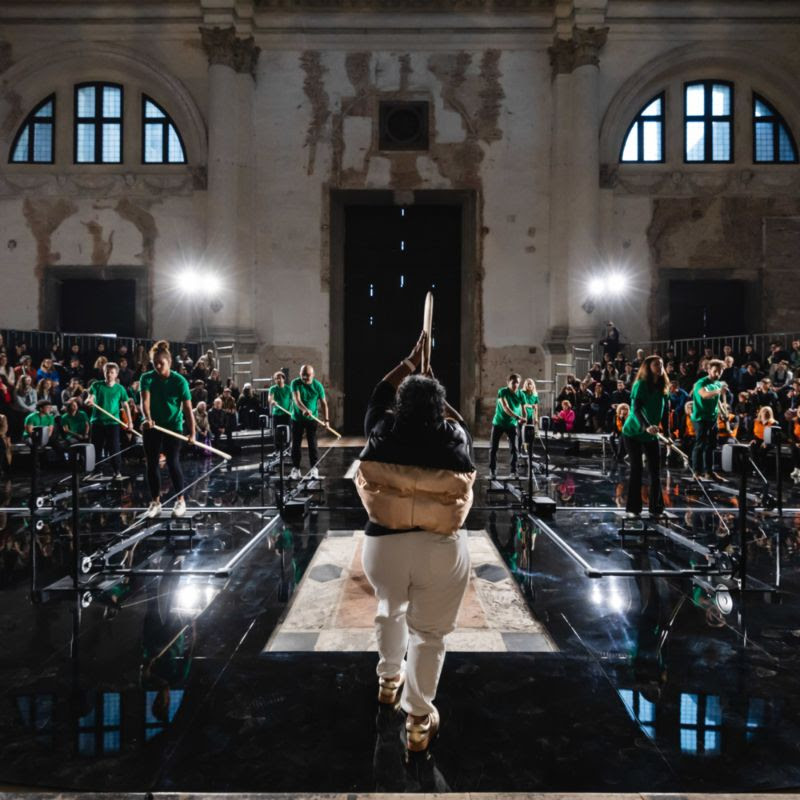
    There are sculptural and interactive machines installed in Ocean Space, which provide audiences with opportunities to engage with the Deep Communion sung in minor. Participants can either activate the installation – which will trigger part of the musical score – or take a seat in the surrounding bleachers to witness the performance. The work is being perfomed by local sports teams in live performance events.

    In response to Taumoepeau‘s new solo commission, a live project space has emerged at Ocean Space that was created in collaboration with architect Elisapeta Heta, a Māori, Samoan, and Tokelauan leader and advocate for change. Her imagination has provided Maori and Pasifika perspectives on the importance of place to design and cultural identity, and brought that knowledge to Ocean Space.

    As her response to the exhibition, the architect includes a new installation that uses a multisensory embodiment of ‘The Body of Wainuiātea‘. This title of the work means a ceremony combining ritual and a ceremony guided by the Māori concept of tikanga. She comes from Aotearoa, New Zealand, using the concepts from her ancestral lands alongside those from across the Te Moana-nui-a-kiwa.


    Tikanga is derived from the Māori word ‘tika’, which means ‘right’ or ‘correct’, so to act in accordance with tikanga is to behave in a way that is culturally proper or appropriate.

    The space is welcoming visitors and audiences, as it is also designed for exchange and collaboration. The space is formed around the ancient way of knowing and relating through story, and waiata (song). The goal is to connect to a greater awareness of atua (the gods’) connections to the Ocean. The tapu (sacred) is very much needed by current environmental and scientific campaigns, which seek to protect the life of the planets’ largest bodies of water.

    Hosting guests through various forms of storytelling, is a common practice in the Pacific communities. Heta’s work, The Body of Wainuiātea, is a safe space for a network of artists, curators, writers, community leaders, poets, musicians, as well as ocean-professionals and scholars to come together. Collaborators include Dr Albert Refiti, Hiramarie Moewaka, and Rhonda Tibble.

    The program is commissioned by TBA21–Academy and Artspace, Sydney, and produced in partnership with OGR Torino culture and innovation hub.

    — — —

    Curator Taloi Havini (Nakas Tribe, Hakö people) was born in Arawa, Autonomous Region of Bougainville and is currently based in Brisbane, Australia. She employs a research practice informed by her matrilineal ties to her land and communities in Bougainville. This manifests in works created using a range of media, including photography, audio – video, sculpture, immersive installation, and print. She curates and collaborates across multi-art platforms using archives, working with communities, and developing commissions locally and internationally.

    Latai Taumoepeau (b:1972 Gadigal Ngura (Sydney), Australia) makes live-art-work. Her faiva (body-centred practice) is from her homelands, the Island Kingdom of Tonga and her birthplace, the Eora Nation. She mimicked, trained, and un-learned dance in multiple institutions of learning, beginning with her village, a suburban church hall, the club, and a university. Latai engages in the socio-political landscape of Australia with sensibilities of race, class & the female body politic; committed to bringing the voice of unseen communities to the frangipani-less foreground. Latai has presented and exhibited across borders, countries, and coastlines. Her works are held in private and public collections, including written publications. Latai is the 2023 recipient of The Creative Australia Emerging and Experimental Arts Award following her win of the 2022 ‘ANTI Festival Live Art’ Prize in Finland.

    Elisapeta Hinemoa Heta (Ngātiwai, Ngāpuhi, Waikato Tainui, Sāmoan, Tokelauan) is a multidisciplinary artist, designer, and mother, living and working in Tāmaki Makaurau, Auckland, Aotearoa New Zealand. Elisapeta’s career has spanned architecture, art, writing, film and performance, teaching and research and has resulted in a rich tapestry of collaborative works and projects that are centered on indigenous mātauranga (knowledge and ways of knowing) and tikanga (protocols and ceremony). In working through multidisciplinary practice, Elisapeta creates experiences that make visible our stories, many of which have been hidden, with a focus on indigenous and wāhine (women) centered story-telling. Through her art practice, Elisapeta, in collaboration with photographer John Miller (Ngāpuhi), took the exhibition Pouwātū: Active Presence to the 22nd Biennale of Sydney: NIRIN 2020, and brought it home to Objectspace Gallery in Tāmaki Makaurau (March – May 2021)

    Program in Ocean Space: March 23-October 13, 2024.
    Address: Chiesa di San Lorenzo
    Castello 5069, Venezia

    Photo: Latai Taumoepeau performing her work ArchipelaGO, THIS IS NOT A DRILL with local sports team in Ocean Space.
  • Olena Jennings: THE MEMORY PROJECT

    Olena Jennings: THE MEMORY PROJECT

    In 2018, a New York City poet Olena Jennings created poetry based on her family’s stories, attempting to visualise photography with words. The poems that resemble photography, carry them as frameworks of memory. In Olena Jenning’s THE MEMORY PROJECT: The memory comes before the poem. The poem comes before the art.

    “I chose ink and paper for the poems. I chose fabric for the art. The poems are a small slice of time in which I experienced memories, many based on photographs in my grandparents’ photo album. I experienced the memories in 2018 and they were embellished by memories I was creating as I lived.” 

    The project was presented in various incarnations at Queens Farm, the Red Barn, and Bliss on Bliss Studio.

    POPPIES        Olena Jennings 

    Red and blue on the dresser,
    dust in the folds,
    stretching towards the dim lamp.
    Click of lipstick cap,
    spritz of perfume,
    snap of purse,
    and she will turn the light off.
    The flowers will wither
    into their dreams
    and I will put my lips
    into their centers,
    ready to blow away pollen.
    The yellow dust caught in my eyes,
    when I see for a moment
    from her perspective, I look out
    onto the yard. I see myself
    throwing a rubber ball into the flowers,
    crushing their petals,
    the place where I convinced
    my little brother there was a snake,
    there was something to fear.
    To make up for my deception,
    I gave him one of the plastic flowers,
    deceiving him again, pretending
    I bought it at the corner gas station
    from which we had collected all
    of our dishes with the points we got
    from pumping gas. I want to make up
    more than that now—absences
    when I would become like that yellow dust,
    a quiet star.

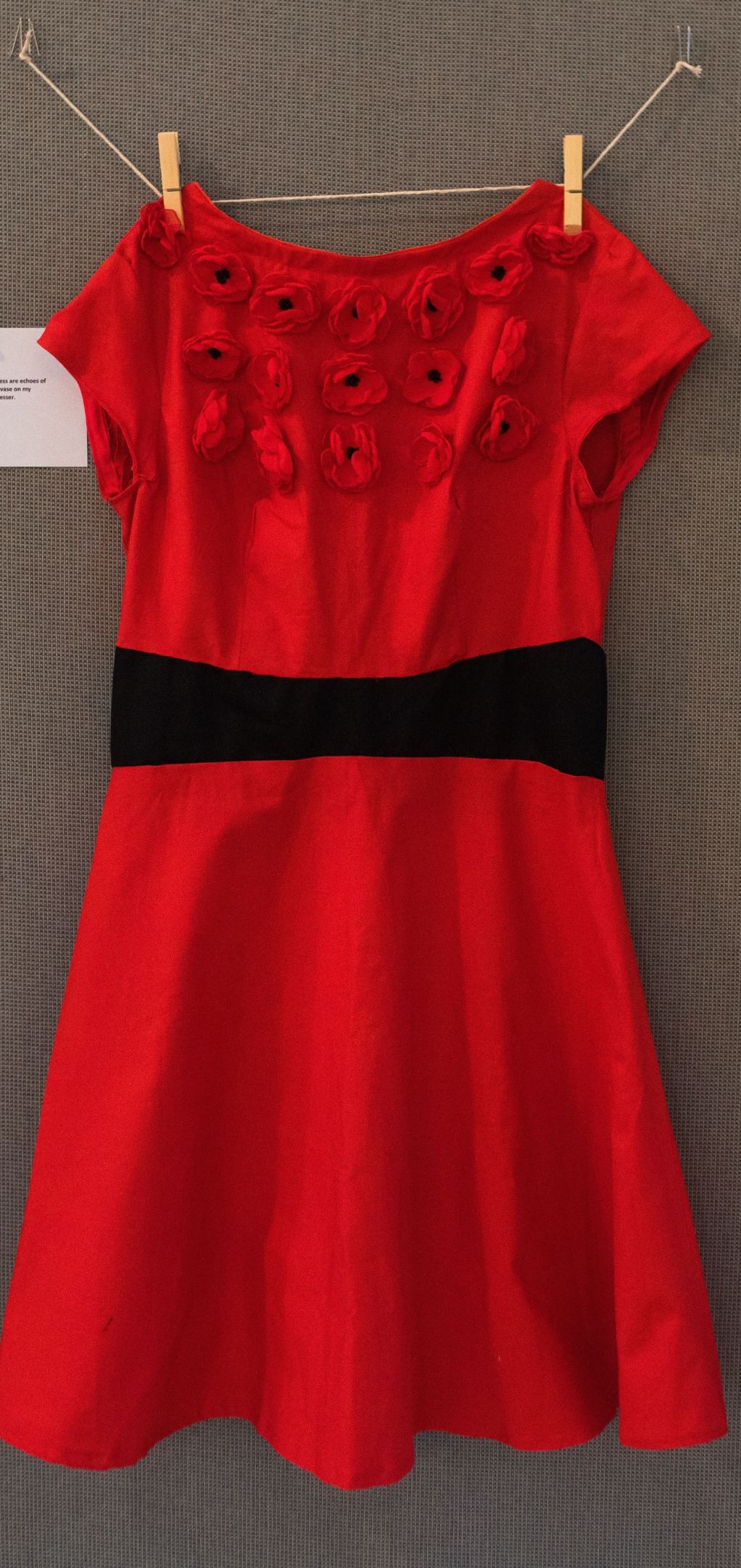
    Olena Jennings, Map Dress, installation view. Photo: Elvis Krajnak.

    PAPER MAPS        Olena Jennings

    Even flat maps have texture.
    They carry with them
    someone’s memory of the streets.
    I will walk near the water
    to draw the places off the map
    on the palm of my hand.

    We used to make paper
    out of recycled letters,
    rough, imperfect,
    for a moment – wet,
    on our knees
    ripping

    We mark our way to the castle
    with the handle of a shovel.
    We could live inside
    our fairytale, find our way
    despite the sand
    in our eyes.

    Poems and dresses by Olena Jennings. Photos of the dresses by Elvis Krajnak.

    https://www.olenajennings.com/

  • Sirkku Ketola: The artistic process of performing Paula

    Sirkku Ketola: The artistic process of performing Paula

    Finnish artist Sirkku Ketola had her performance project A Body Called Paula at the NARS Foundation Gallery in Brooklyn in November. In Finnish the word paula means a ribbon, something to tie or to be enchanted with. It is also a synonym for a trap. Globally Paula is known as a female name, originating from the Greek word ‘Paulus’, which means small.

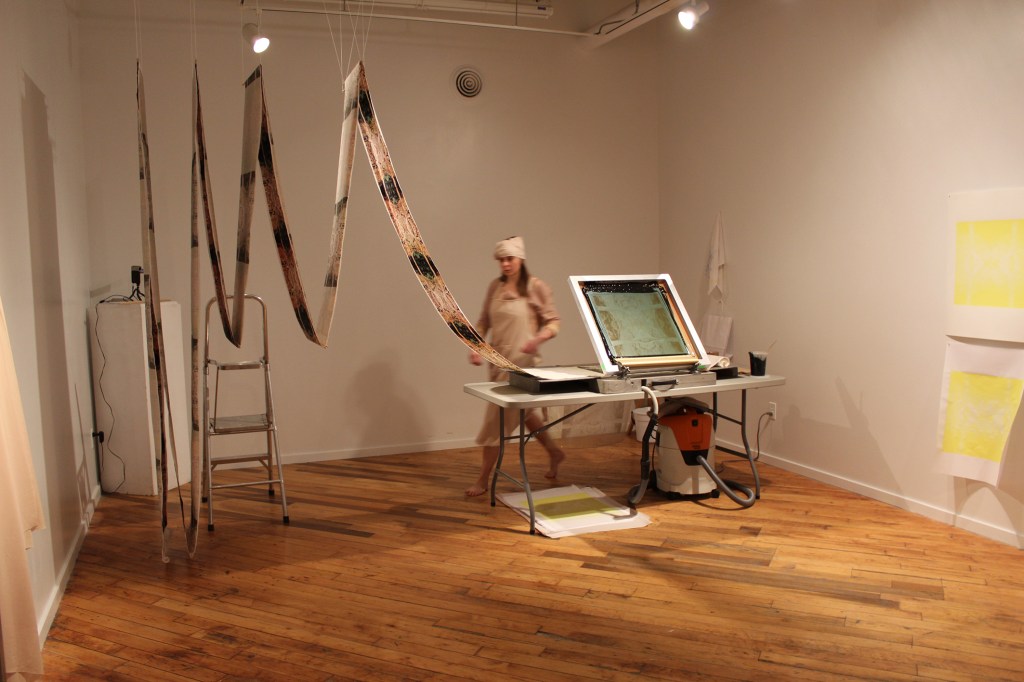
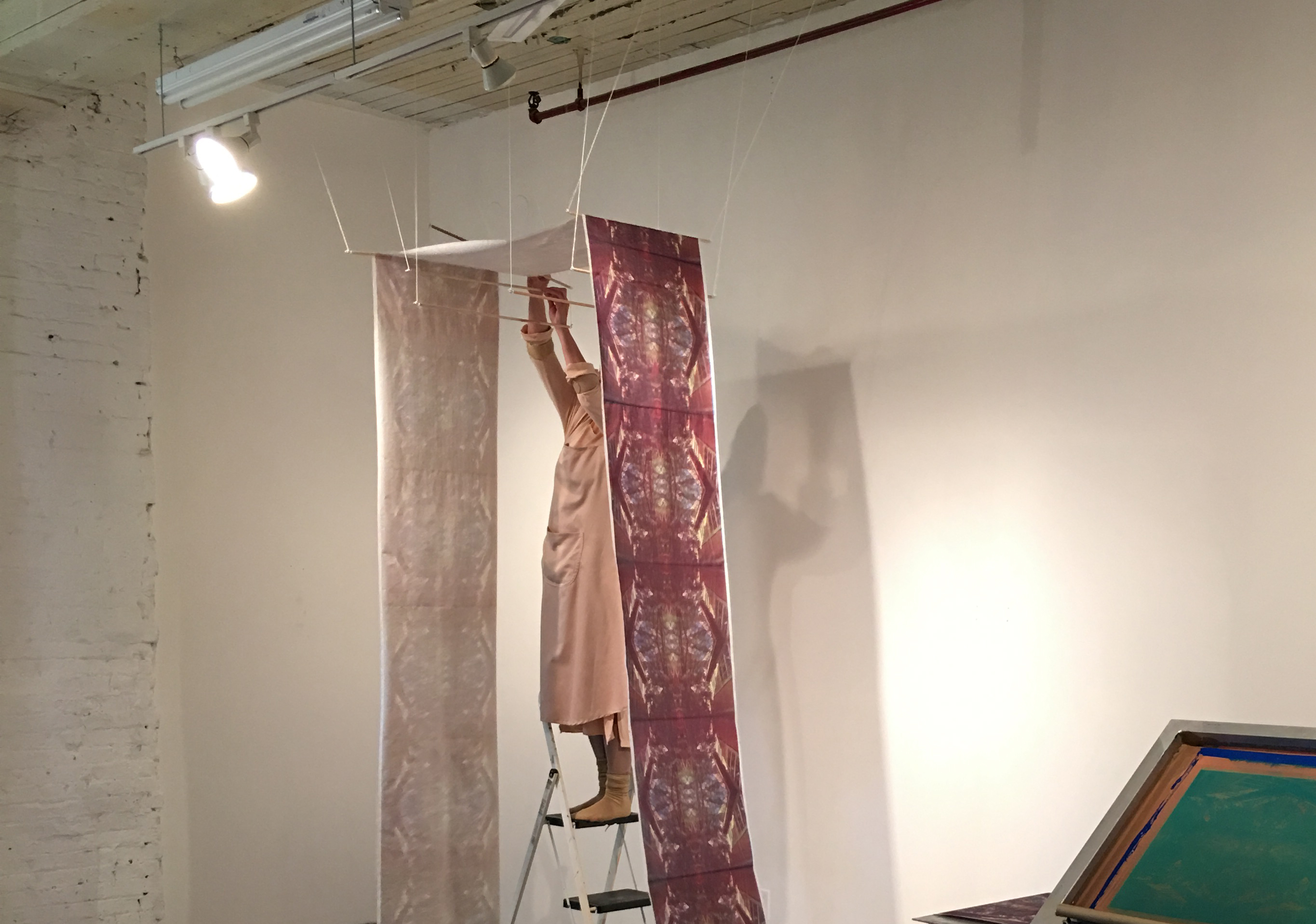
    In her current project of ten years, Ketola creates an installation that mixes screenprinting with performance. Part installation, part performance, A Body Called Paula is a piece that develops over the days of the installation through long-duration printing sessions. The movements and their soundtrack create an enchanting, sensual machine with the main themes of time and temporality, pleasure, and the meditative process of working.

    The narrative story behind the performance hunts beauty through the themes of light, passion, knowledge, reality, and depth, finally balanced out by darkness. What is the measure of time? Ornament is a universal form of visual art in every culture. The installation at NARS is part of Sirkku Ketola’s long-term project. For the duration of ten years ‘A Body Called Paula’ produces hand printed ornaments, or ribbons.


    Paula prints by Sirkku Ketola.
    Paula prints by Sirkku Ketola.

    Firstindigo&Lifestyle: What comes to mind, when you think about your project Paula is that it is so clearly beyond the visual practice, or enhances the physicality of the practice. What is so intriguing is how you dive into the embodiment and stretching of the paper. Is it that the body becomes a continuation of the paper in the printing process, as if being one with the paper? What kind of metaphors would you like to highlight, or are being evoked in the process?

    Sirkku Ketola: I guess I need touchable material to support thinking and understanding. In this case the handling of color and paper together with challenging technical crafting, tune us as one organism, where the tempo is being set in the cohesion of the qualities of the all included matters. The strength of the body, the sensitivity of the hands and the exactness of the eyes, are sensing constantly the fragility, stretching, moistening and drying of the paper, and the consistency and volume of the ink. The local, or should I say site-specific humidity and temperature effect strongly to the functioning of this paper/colour/body formed sensual machine. Also the instant substance of the body, the general vitality, the emotional ambiance, and for example the daytime, give all some special marks, first to the performance, and second to the visual appearance of the ribbon in progress. Imprint is different during mornings and evenings, also in the beginnings and the ends of the ribbons. I have chosen the long and fragile paper to be forced to lose control. The process is too tiring to hold on it. During the series of the performance the same paper roll goes by my hands 12 times so it is impossible to dominate the quality or the crossing effects of different layers. I just must be humble, and let the ribbon teach me. Maybe the greatest thing is that the ribbons still surprise me even though I’ve been working with the same materials for years. The major errors have been avoided, but the danger of errors are constantly present – everything can be irreversibly spoiled even in the last round of printing.

    Sirkku Ketola performing Paula.
    Sirkku Ketola performing Paula in Cable Factory, Helsinki, August 2017.

    Sirkku Ketola: The ornament arises on paper in stages from light to darkness. The colours (yellow/magenta/cyan/black), except being common from every home printer symbolize light, passion, knowledge, reality, depth and darkness. Step by step these colour layers, as named the elements of beauty, while mixing and uniting approach the truth, the code of life or would I say the mystery.

    The hand printed ornament reminds somehow of the DNA. Basically with the repetition of same patterns, the motif is being affected continuously by the changes of the circumstances. All the variations show together endless amount of visual possibilities and diversity. At the same moment the so-called mistakes come part of the entirety and open up routes for the new beginnings.

    Today we talk a lot about unmaterialized art, light and it’s different digitalized reflections. I am blown away by it also, the transfer of energy from one equipment to another accomplishes wonderful outcomes. In my own work process the need of touch, the acception of the tardiness of the body as the part of the thinking self, in other words handling with hands, have so far helped me to the deeper knowledge. I choose to cherish this special bodily tempo – it might be good for human species. When one forces oneself to stop by the slow repetition, one might also have time to understand something essential.

    Sirkku Ketola performing Paula in New York, November 2017.
    Sirkku Ketola performing Paula in Helsinki, August 2017.


    Sirkku Ketola: To be able to do the metamorphosis to become a sensual machine I had to create a role. My character Paula is simultaneously enraptured and trapped (in Finnish there is a sentence with both meanings, derived from the word ‘paula’ which also is a ribbon). She is a metaphor of a small human in cosmos. The name Paula comes originally from the Greek name Paulus which means small. So my Paula works with paula, with her special ribbon. Her job is to communicate visually by printing this repeating and overwhelmingly beautiful ornament. She wanders globally and communicates of the seen beauty. The previous place sets the next pattern, for example the New York effects to Paula will be seen next spring in Helsinki, Finland.

    The machine is slow and time bending. It is a factory that is able to work without problems approximately four times per year. The doctor’s order has set the limit. I forget the rules always in the beginning of the new project, but now, when the Brooklyn ribbon has been finished, the pain in my hands is there and that makes calming down easy. By respecting this manual of the project, it will be possible to enjoy after ten years from now about the yet unknown massive installation, which is made of these forty different and international printed ornament ribbons.

    I feel extremely privileged to be able to define the speed of the assembly line. For that reason the pleasure is an important part of the performance. Paula enjoys her movements and the choreography set by the printing process. The ink flows and the paper glides with the hands accepting to follow the weight of the body. The touch varies from strong to gentle and the rhythm beats with the working steps. The birth of the image feeds the will to come along to the anonymous destination. The possibility for sudden challenges forces the printer into the extreme concentration and to overcome difficulties and accept the errors. With the physicality, the mental part is also reacting all the time to the present. The chosen repetition grows thinking and developes strong pleasure.

    Sirkku Ketola: Feedback, 2016. Handprinted silkscreen on wood. 81 x 105 cm. Process picture.
    Sirkku Ketola: Feedback, 2016. Handprinted silkscreen on wood. 81 x 105 cm. Process picture.

    Firsindindigo&Lifestyle: How do you prepare for the performance of this scale, which is almost a marathon? What is the preparatory phase like, and what happens during the performance aftermath?

    Sirkku Ketola: During the performing period I take specially good care of myself. I try to do the outdoor activities daily, sleep enough and eat healthier. I try also to avoid the evening happenings and alcohol. The preparation for the performance takes mentally the whole day, but the most intense are the two hours before the show. The soundtrack of the performance follows me since morning. I’d like to highlight, the sound scape of my music and the noise of the printing table are essential elements of the performance. When arriving to the show space I tend to eat lightly and drink a lot of water. After it is time to check all the technical equipments and to mix the printing inks, the hue and the saturation needs to be done carefully. I have a special ritual order to do this. After this, I isolate myself, warm up and slowly become my transformation to the role. Thirty minutes before the show it is time to change the costume and become Paula. She doesn’t speak. The aftermath of the show is quick, washing the make up and changing the clothes are rapid, so I’m soon ready to communicate with the world again as myself. Before leaving I clean the colours and check all the technical details for the next day. When arriving home I stretch well and take a warm shower, except in Finland my choice is sauna.

    Paula performance in Nars foundation Photo Nov 17, 3 38 57 PM
    Ketola performing at the NARS Foundation in New York, November 2017.

    Firstindigo&Lifestyle: How is New York as a place different, and this performance venue special, in terms of what is their impact on the quality and outcome of the work? How is the location different from the rest, say, Canada or Finland where you also created this performance piece?

    Sirkku Ketola: The place impacts mainly how the performance is being installed. I like different spaces because they challenge the art work and keep it impossible to predict. The space in NARS in Sunset Park in Brooklyn is many ways special. First, it is near the Finntown, where there was a strong community of Finnish emigrants. During today’s new emigrations flow it felt important to mark the difficult roots of my own country. Second, the size of the gallery was perfect for the project. It fit there well, both visually and functionally. Third, the space is in the building, which is full of working artists, situated in the middle of the industrial Brooklyn. Where else should the sensual machine be? I came to New York as a visiting artist-in-residence of Finnish Cultural Institute for two months. My main goal was to research the structures of the money and power in the contemporary art scene. Beyond A Body Called Paula –project I started to sketch the new large-scale print installation referring to this research theme. The work will be produced during next three years. My colleagues in Brooklyn taught me a lot about independent artists’ living at the capital of contemporary art (NYC).

    Paula, NARS foundation.
    Paula performance, NARS Foundation in New York, November 2017.

    The physical dimensions and the quality of the NARS space gave the rhythm for the installation when growing during the performances. The intimate gallery of the Sunset Park made possible to the paper ribbon to take a shape of a visually fine zig zag when it landed to dry to the perches I mounted. Also the rest of the visual elements of the performance found their places to create a dynamic composition. There was space for Paula to move and the audience was able to have several standpoints. The space was also photogenic with A Body Called Paula – and that’s important in our social media time.

    This was the fourth time and the fourth place for Paula. In Toronto it was seen in a gallery with the long hallway. There the magic of Paula worked like in the story of the Pied Piper, when people saw the action from far, they just had to reach to the space. In Helsinki Paula measured the huge hall in Cable Factory during the five hours marathon performance. And in Turku, Finland she worked behind the lightened window in the darkness of the first autumn evenings by the riverside. And in Brooklyn she captured the industrial space around the other artists. I believe that during the next ten years, Paula can capture many different structures and spaces as rich as she has done in her first year of the process. The big scale quality will be seen in the end of the whole process. All in all, these places are valuable treasures for me, and will affect the final installation.


    — — —
    Next time A Body Called Paula will be seen in Helsinki in March 2018. After that Sirkku Ketola travels mostly in Central Europe. She will be back in New York City during autumn 2019.

    — — —

    The screenprints made in New York have been prepared at the Robert Blackburn Printmaking Workshop: http://www.efanyc.org
    More information:

    Introduction: http://sirkkuketola.com
    Previous exhibitions: http://www.la-bas.fi/ketolaeng.html