Tag: performance&dance

  • Ofri Cnaani’s ‘Wrong Tools’

    Ofri Cnaani’s ‘Wrong Tools’

    Artist Ofri Cnaani has created a new photography exhibition consisting of prints and a performance piece at Andrea Meislin Gallery. Photographies on display echo ideas deriving from Xerox art of the 1960s simultaneously connecting with the visual world of the mesmerizing early photography of the 20th century. The exhibition ‘Wrong Tools’ will be on display until October 24, performances taking place on Wednesdays, Fridays and Saturdays. Cnaani’s Blue Print photographs are like intuitive maps constructed of performative ideas that associate with artist’s own body. With both of her performance and photographs, she creates a presence. The works are building up from fragments, and the pieces are put together in a compelling logic. These could be like ruptures built on the Internet surface, where constant image flows create new associations. Here is Ofri’s interview.

    Firstindigo&Lifestyle: Your ongoing solo exhibition ‘Wrong Tools’, at the Andrea Meislin gallery speaks a strong esthetic and spatial approach with performance element added to the photography gallery. The performative element also looks back from the blueprints, which display hands in various positions doing tasks, perhaps. Are these prints your hands making the past performances, or projects?

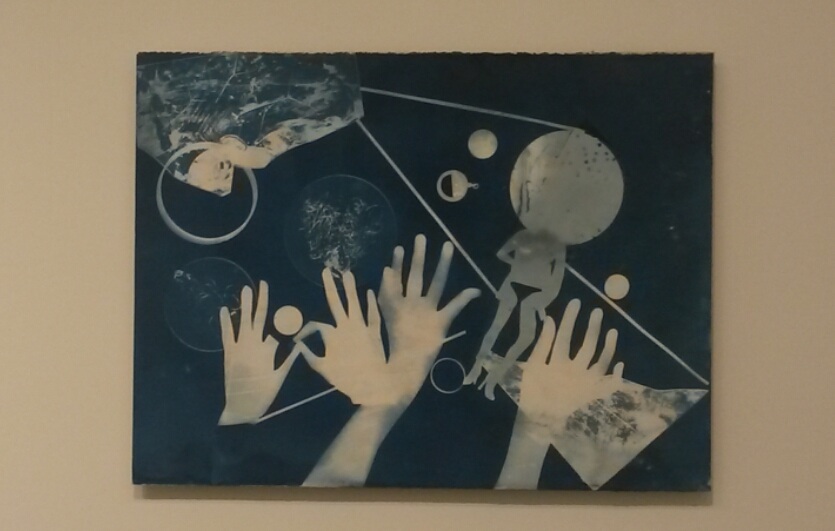
    Ofri Cnaani: In the cyanotypes I’m using my own body. I’m using the special qualities of one of the earliest photo techniques to promote some sort of performative photography. In a way, it is very similar to what I do in the performance: I’m creating an image in a limited amount of time that is constructed from found objects, made objects and my own body. Like in the personalized ‘image maps’ I’m creating in the performance, here too, I have a limited control of the final result. The process is always between failure and magic.

    In your actual performance that I observed taking place during the opening night at the gallery’s foyer with windows, you encounter audience member on a participatory table setting, where each unique guest sits opposites of you. The scene comes out as very intimate and poetic; we are simultaneously looking at the wall where the reflection of the table surface is displayed with your real-time construction of objects and images on it. And, we are grasping the exchange between you and the other person embodying the performance. Quite interesting, a guest was taking pictures with her phone of the very situation as well. What is taking place in these moments? How do the photographs and the recording of the event resonate in the doing of the performance physically?  

    OC: When someone sits with me, I first offer him or her a ‘reading’ of his or her visible future. I used a tarot-like deck that I designed titled ‘future business’. I also ask them to give me one personal item and to choose two items from my collection of small objects. I’m using the message on card they chose and the three objects they selected and gave me as a starting point, to create a live collage-like image. I called it ‘image map’. This image is captured and printed using a special apparatus I build for the show. Lastly I stamped it with a ‘Copy’ stamp and signed it with red ink, handing the Original Copy to my visitor.

    As the title ‘Wrong Tools’ already implies so many interesting visual connotations, could you tell more what is the idea or meaning behind it, is it metaphoric with a larger idea and also coming to the performance? Does it resonate solely with ideas, which derive from computing?

    OC: My husband, who is great in building things, always says everything is very easy if only one is using the right tools. I realized I’m always using the wrong tools.  My studio is a mess and I’m always using the tools that are wrong for the job. I like to think about my method, using the collections of two and three-dimensional objects in my performance, as ‘endless metabolism’. I’m using the same little objects for different performances, as well as for the cyanotypes and other photos. The same objects travel between many of my projects, always been used in different ways, but never used as they were originally meant to be used.
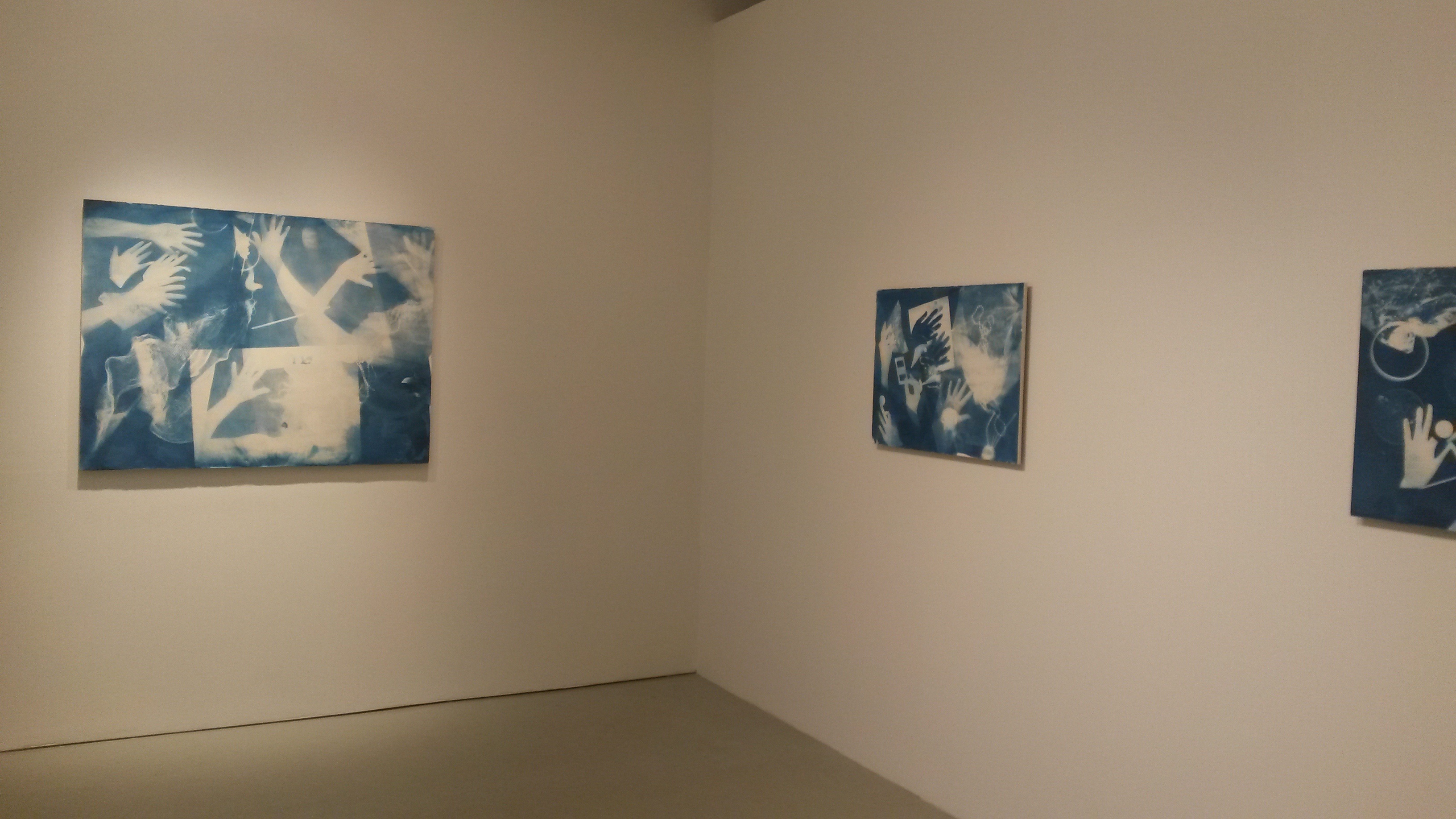
    Ofri Cnaani_OC real and fake-series_Cyanotypes
    Ofri Cnaani, OC real and fake-series, Cyanotypes, at Andrea Meislin Gallery

    Then, your exhibition at the gallery has these colorful images called ‘future business’, that have a short message embedded in them. It seems that they relate to the performance, do they have an element of time in them as well?

    OC: The monoprints are also ‘one of a kind’ and were made in a similar way. I’ve been using cut-outs and flat objects, placed them on paper and rolled them under the press, so each one is a different arrangement, although some of the cut-outs appear more than once. The texts are the same texts on the special edition tarot deck I produced and then use in my performance.

    On each card there is a message we get regularly as an online user like ‘Delete All’ ‘Unsubscribe’ or ‘Change Your Profile’. These lines are charged with a very different meaning when we receive them as messages in a one-on-one ‘reading’ session where we all are so vulnerable.
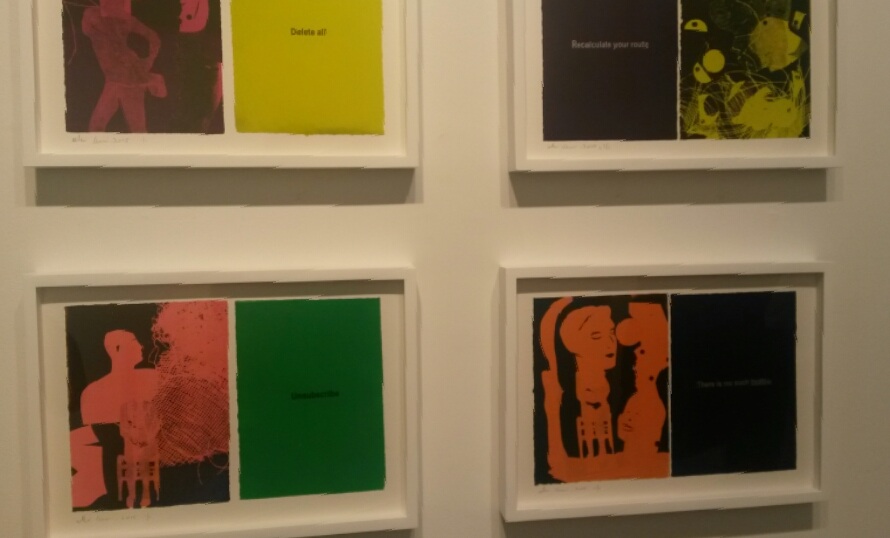
    Ofri Cnaani_future business-series_monotype prints
    Ofri Cnaani, Future Business-series, Monotype Prints, 2015

    Adi Puterman curated your exhibition for Andrea Meislin Gallery, what do you wish to tell about the curating exchange and process, do you know each others tactics well?

    OC: Adi and I worked on the show for over a year and she was very involved with each step: from the concept of having an on-going 6 weeks performance in the gallery, to the selection of the pieces, and communicating my ideas in a written text.

    I have noticed that your artist career includes plenty of performance works, such as the ‘Seven Words’ at the Metropolitan Museum. This past work is also very interdisciplinary. Is a question of the different art forms relevant to you in your own art making, or are all forms closely related?

    OC: I’m driven by concepts and often by time constraints (like a different space I’m working in or a different collection or archive I’m using). I’m less driven by a specific medium or style.

    As an educator of the arts, how do you teach time-based process to your students, do you have guidelines for that?

    OC: We see many projects and discuss them, we read texts and using mind-mapping method in order to understand them and connect them to other ideas, texts and art works.

    I often think that New York city is such a creative hub with so much international potential gathered in one place. Do you consider that as an international artist based in the city you have a specific role or identity, which is perhaps one here, and another that goes back home in Israel communicating and identifying with the contemporary art scene there?

    OC: I’m not sure what do you mean by that but once you leave the place you were born and raised, your identity is always ‘more than one’ and in a constant negotiation.

    You have created public artwork, do these works imply a different kind of activism or sensibility that comes with the public space, or are all ideas you are doing basically interrelated? 

    OC: My work is context specific. When I work in the public realm I work not only with a specific building and its specific history. The process always involves a community or a group of individuals. The process in those projects is part of the final piece. The final images are never known when I start working on a public piece.

    Can you tell a little what are your next steps going to be like?

    OC: Next week I’ll be doing a performance that is similar to the one in the gallery at Dallas Aurora. My project is part of ‘Altered States’ exhibition, curated by Julia Kaganskiy. Next month I’m going to Inhotim in Brazil to work with the park employees to create a participatory performance titled ‘Frequently Asked’ that will be then presented in Inhotim on early December.

    Ofri Cnaani, Blue Print, 38.5x49.5, on display at Andrea Meislin Gallery
    Ofri Cnaani, Blue Print, 38.5×49.5, on display at Andrea Meislin Gallery. Images by Firstindigo&Lifestyle
  • Artist spotlight: Johanna Tuukkanen, The Outstanding performer

    Artist spotlight: Johanna Tuukkanen, The Outstanding performer

    I interviewed Johanna Tuukkanen, who is currently preparing her PhD in art education and cultural policy. She is a well-known curator and art-maker herself, and the Artistic Director of ANTI festival based in Finland’s Kuopio. This week, January 30, 2015, she will also have a premiere of a new work Panopticon together with her colleague, choreographer Pirjo Yli-Maunula in Oulu, which is a vibrant capital in Northern Finland. Their new multidisciplinary work will articulate a hot topic of women’s ‘controlled bodies’, as they are often portrayed in fashion industry and magazines, taking a theme of aesthetic violence in relation to women’s bodies as a starting point in their performance. Simultaneously, their performance asks, are we allowed to mock this phenomenon, and even make fun of it in the arts? Johanna Tuukkanen has been making noise with her performance art for good 15 years now, highlighting women’s bodies in her performances many times before.

    Johanna Tuukkanen in Huippusuoritus, Outstanding Performance, Photo: Pekka Mäkinen
    Johanna Tuukkanen in Huippusuoritus, Outstanding Performance, Photo: Pekka Mäkinen

    Firstindigo&Lifestyle: Johanna, I have known you from the early 2000s onwards. It seems that there has been a lot of currency exchange around your artistry since that time. Finnish art scene, I believe, has also developed and changed during the past 15 years. Could you highlight in a nutshell, how did the 21-century look so far in the art world from your personal point of view? What are your greatest pros and cons in the field as a participant with so many roles?

    Johanna Tuukkanen: You are right, things really have changed! After studying performance and new dance in the Netherlands and Germany in 1990s, I moved back to Finland in 1997. In terms of the art scene, it was a kind of culture shock for me and it definitely took some time to find my way around it. From very early on, I found myself thinking how else I could make a difference in the arts other than working just as an artist.

    Since then, I do see and have also personally experienced that the field has expanded greatly, it has opened and it is accepted – not totally but more and more – that for example in the field of dance, there are multiple traditions from which an artistic practice can stem from, not only one or two. Also the growing interest in site-specifity, a kind of ‘trend’, has resulted in other kinds of expansions and effected how a cultural production organization whether a museum, a theatre, a festival or a freelance collective might operate. Currently I’m thinking a lot about the concept of social in the arts as many artists are producing socially engaged works in collectives and communities where the artist is not the central point of the work but the interest in a process, in shared authorship, in participation and dialogue…

    As a participant in the field, I feel that there are several communities in the art world where one can find a kind of ideological home and vast amount of possibilities. Yet, at the same time, although we do have some rather brave funding bodies, generally speaking our funding structures have not been able to develop in line with the field – thinking especially the amount of work that it produced by the freelance artists and companies in comparison with the institutions established in the 70s.

    Firstindigo&Lifestyle: You are known as a hardcore doer, and as a hands on professional when it comes to performance and to its management, to your curator’s role as well, and to a founder of a successful art-festival. Where lies the secret behind it all, how do you manage all your roles, or your doings, and don’t get burned-out at the same time? You seem to be shining.

    JT: Wow, thank you! I don’t really see myself that way… But yes, to say that I’m a doer is perhaps a good way to put it. I suppose I’ve been interested in many things and just started doing them, rather naively sometimes. I’ve not been waiting around for someone else to do the work but really dug my hands into stuff, working beyond my comfort zones, not counting hours… I can’t recommend it to anyone! To be enthusiastic, to get excited is a great energy and force also. For me doing different things is also very energizing, things feed off each other and I never feel that ‘I’m doing the same job’. Maybe also because I’m not a very organized person!

    But to be honest, time management is a big issue for me. I’m a very work oriented person and I have to actively work on prioritizing time for my family and friends and my own well-being. But I do do it! These days I prioritize regular exercise, try to eat well and sleep enough. I try to have one day off every week but if it’s not possible, I’ll make up for it by taking extended weekends off or mini holidays.

    I’m lucky to be working for organizations and things I really believe in and I feel connected to and supported by an international community. I’ve also managed to organize my life so that I live with my lovely family in a beautiful house where I can enjoy everyday aesthetics, quietness, the Finnish lake landscape, the forest and an amazing sauna.

    Firstindigo&Lifestyle: I associate you strongly with ANTI Contemporary Art Festival. How did this idea come forth, and develop into an international success story?

    JT: This is a long story but to put it short, I was working in the Regional Arts Council of North Savo at that time and with my regional artist colleague we wanted to create a new, international multidisciplinary contemporary art festival in Kuopio, to create international networking opportunities for local artists and to active the city and different sites in Kuopio through art. We really didn’t know how it would turn out, it was a real experiment! But already since the first festival, there was a lot of international interest and the festival was a great success. The networks I’d started building in the early 2000 were crucial for our international growth and reputation and of course artists themselves are great messengers of a quality festival. I’ve personally always thought that international networking is very important and for me it has also set the standards how to run a festival. But I suppose the most important thing is that ANTI has a unique concept and in fact, it’s also modelled in different parts of the world. This all has taken an enormous amount of work and I’m grateful for the wonderful individuals who have worked for the festival over the years.

    Firstindigo&Lifestyle: I admire your knowledge on the performance field, internationally you seem to have a network of artists that resonate with your own way of working. Was it organic to find collaborators accross the country borders?

     JT:  Yes, it all has happened very organically. ANTI has also been a partner in two European projects and it has been a great gift and learning process to collaborate with international live art curators and festival directors.

    Firstindigo&Lifestyle: Finland is getting a Dance House finally, how did the miracle happen?

     JT: Well, I’m extremely happy to be working for the Dance House but the background work with the private funding bodies was done and negotiated before I even started so I can’t take any credit for it. The Dance House initiative is very lucky to have a fantastic project manager, Hanna-Mari Peltomäki, but also the time was right – the Finnish dance sector was ready, the private funding partners were ready and lots work was done in a rather short amount of time.

    Firstindigo&Lifestyle: What does living and working in Finland mean to you? Where else in the world would you imagine to live?

    JT:  Living in Finland and outside the Helsinki area has been a very conscious cultural political choice for me. I’ve wanted to show that great art can be made anywhere and it is really crucial to have artists and cultural professional working and making an impact in different regions. These days, especially with digitalisation and good connections, I don’t really think it matters so much where you live.

    But in recent years, as my children are getting older and as I want to find new professional challenges, I’ve become open to other options as well. Like I said earlier, I’m very work oriented so it’s probably work that will take me somewhere… There many places I could imagine living i.e. Australia and Denmark. But where ever I’d go, my work has to be meaningful. I can’t really imagine moving somewhere for the sake of the place or city.

    Firstindigo&Lifestyle: Where are you heading next, any specific plans for the future?

    JT: Good question. I’m open and up for new challenges. I completed an MA in Cultural Policy last year and enjoyed that process greatly. What a luxury to deepen one’s knowledge and expertise! I’m the beginning of my PhD so probably for the next years I will be juggling my time between the Dance House, ANTI Festival and my research…unless something totally unexpected happens. Which of course is very likely in this life.

    Johanna Tuukkanen and Pirjo Yli-Maunula, Panopticon, Photo: Pekka Mäkinen
    Johanna Tuukkanen and Pirjo Yli-Maunula, Panopticon-premiere, Jan 30, 2015. Photo: Pekka Mäkinen
  • Artist Spotlight: Daniella Rabbani

    Artist Spotlight: Daniella Rabbani

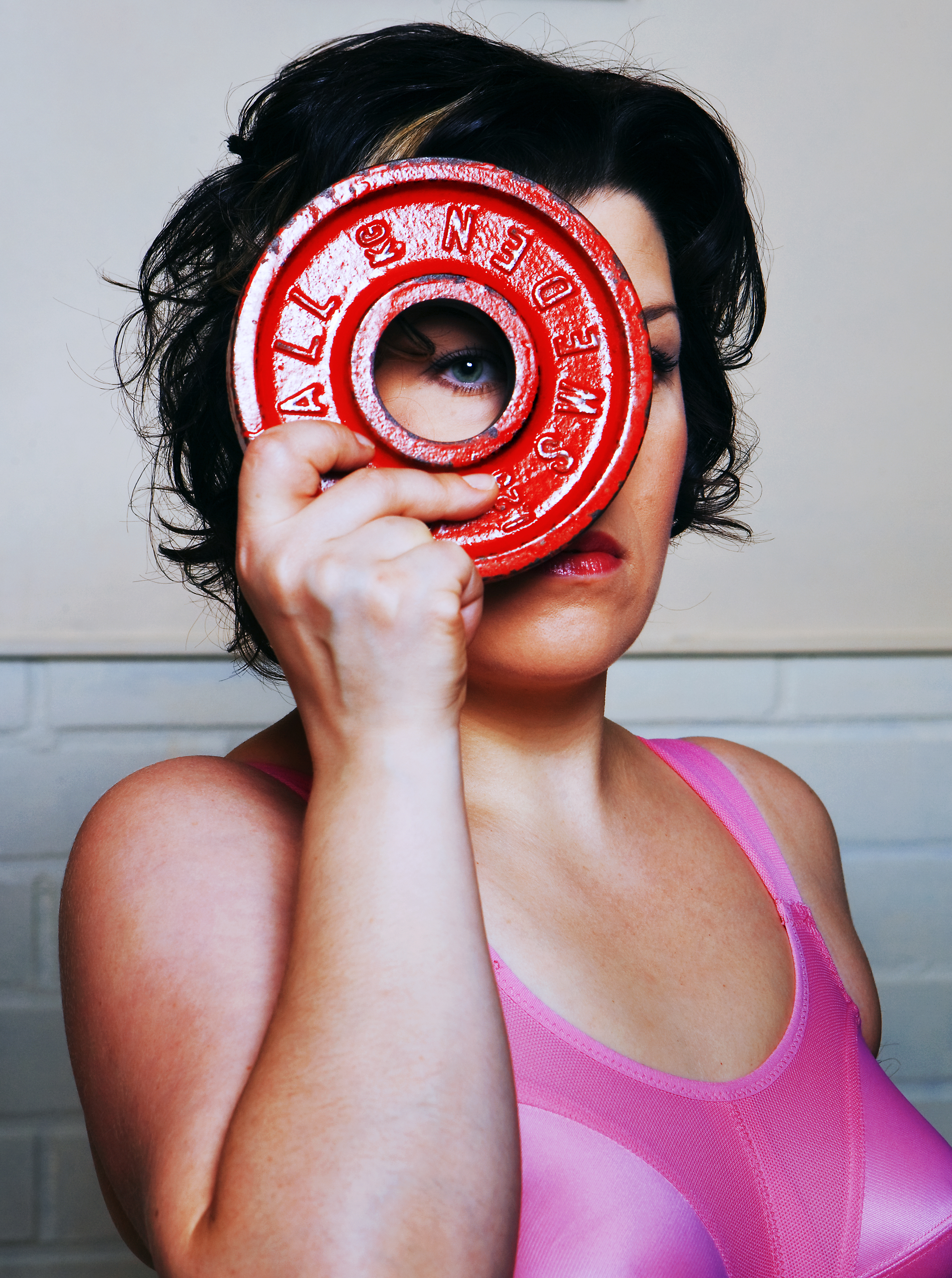
    Daniella Rabbani, actress, singer,  and a new yorker is currently producing and starring in #GYMSHORTS, a series of Web Shorts. Daniella graduated from New York University’s Tisch School of the Arts with a focus on acting for television. She also studied at The Stella Adler Studio of Acting.  
    Firstindigo&Lifestyle: What productions/premieres did you do recently? 
     

    DANIELLA RABBANI: THE GOLDEN LAND, THE OFF BROADWAY MUSICAL I WAS IN THIS PAST FALL WAS NOMINATED FOR A DRAMA DESK! I GOT TO DRESS UP AND GO TO THE NOMINEE RECEPTION AND THE AWARD CEREMONY. IT WAS SO FUN!  I’M CURRENTLY PRODUCING AND STARRING IN #GYMSHORTS ABOUT THE FUNNY THINGS THAT HAPPEN AT THE GYM. IT’S AWESOME. I GET TO DO BE REALLY GOOFY WITH SOME OF THE FUNNIEST ACTORS I KNOW AND PUMP IRON WITH TRAINERS LIKE BRETT HOEBEL FROM THE BIGGEST LOSER. IT’S HYSTERICAL.

    Firstindigo&Lifestyle: Who are your greatest mentors and idols? 

    DR: I’VE BEEN VERY BLESSED IN MY LIFE TO HAVE SEASONED  PROFESSIONALS, MASTERS AT WHAT THEY DO, TAKE ME UNDER THEIR WING. I APPRENTICED UNDER THE STELLA ADLER STUDIO’S HEAD OF MOVEMENT, JENA NECRASON, FOR YEARS. SHE TAUGHT ME HOW TO FOLLOW MY INSTINCTS, TO TELL A STORY WITHOUT ANY WORDS AT ALL, TO COLLABORATE AND TO TEACH. I ALSO SING IN YIDDISH. ZALMEN MLOTEK, THE ARTISTIC DIRECTOR OF THE NATIONAL YIDDISH THEATER, HUNKERED DOWN WITH ME FOR HOURS AND HOURS TEACHING ME BEAUTIFUL YIDDISH FOLK AND THEATER TUNES. WE TOURED TOGETHER FOR YEARS. EVEN ARTISTS I HAVEN’T MET YET- GIRLS LIKE GRETA GURWIG, LENA DUNHAM, ZOOEY DESCHANEL, MINDY KALING – GIRLS WHO TAKE THEIR ARTISTRY AND FATE INTO THEIR OWN HANDS- THESE ARE MENTORS TO ME TOO.

    What is your favorite performance genre, which one do you like more, musical theater, drama or film? 

    DR: I’M INSPIRED TO CREATE MORE WEB-BASED FEMALE DRIVEN COMEDIC CONTENT. I THINK THE WEB IS THE WAVE OF THE FUTURE AND I DIG IT. MY BACKGROUND IS IN THEATER, WHICH I TOTALLY LOVE, AND MY FUTURE IS IN TV (IT’S ALWAYS BEEN MY DREAM). STATING A PREFERENCE IS LIKE PLAYING FAVORITES WITH YOUR CHILDREN… EVERYONE DOES IT BUT IT’S NOT THE TYPE OF THING YOU’RE GONNA ADMIT.


    Do you tour, how is it different to perform in New York City and elsewhere?
     

    DR: I TOUR LESS THESE DAYS. THE LAST TIME I SANG A CONCERT OUT OF TOWN, WE WERE IN WARSAW, POLAND SINGING TO HUNDREDS OF POLES IN YIDDISH. IT WAS INTENSE. BEAUTIFUL AND INSPIRING, SAD AND HAUNTING… I GOT TO GET TO KNOW WARSAW A BIT AND EVEN TOUR AROUND KRAKOW AND AUSCHWITZ… IT WAS A COMPLICATED, LIFE CHANGING TRIP.

     
    How do you consider yourself as a role model for young people?
     
    DR: WHEN I PERFORM, I TRY TO BE MY FULLEST SELF- BY EMBRACING MY HUMANITY WITH ALL ITS GREATNESS AND EVEN MY IMPERFECTIONS. I HOPE THAT THE AUDIENCE WATCHING CAN FEEL INSPIRED TO LIVE THEIR FULLEST LIVES AS WELL.
     
    Daniella Rabbani’s own website. Follow @DaniellaRabbani on Twitter.,  @drabbani on Instagram.