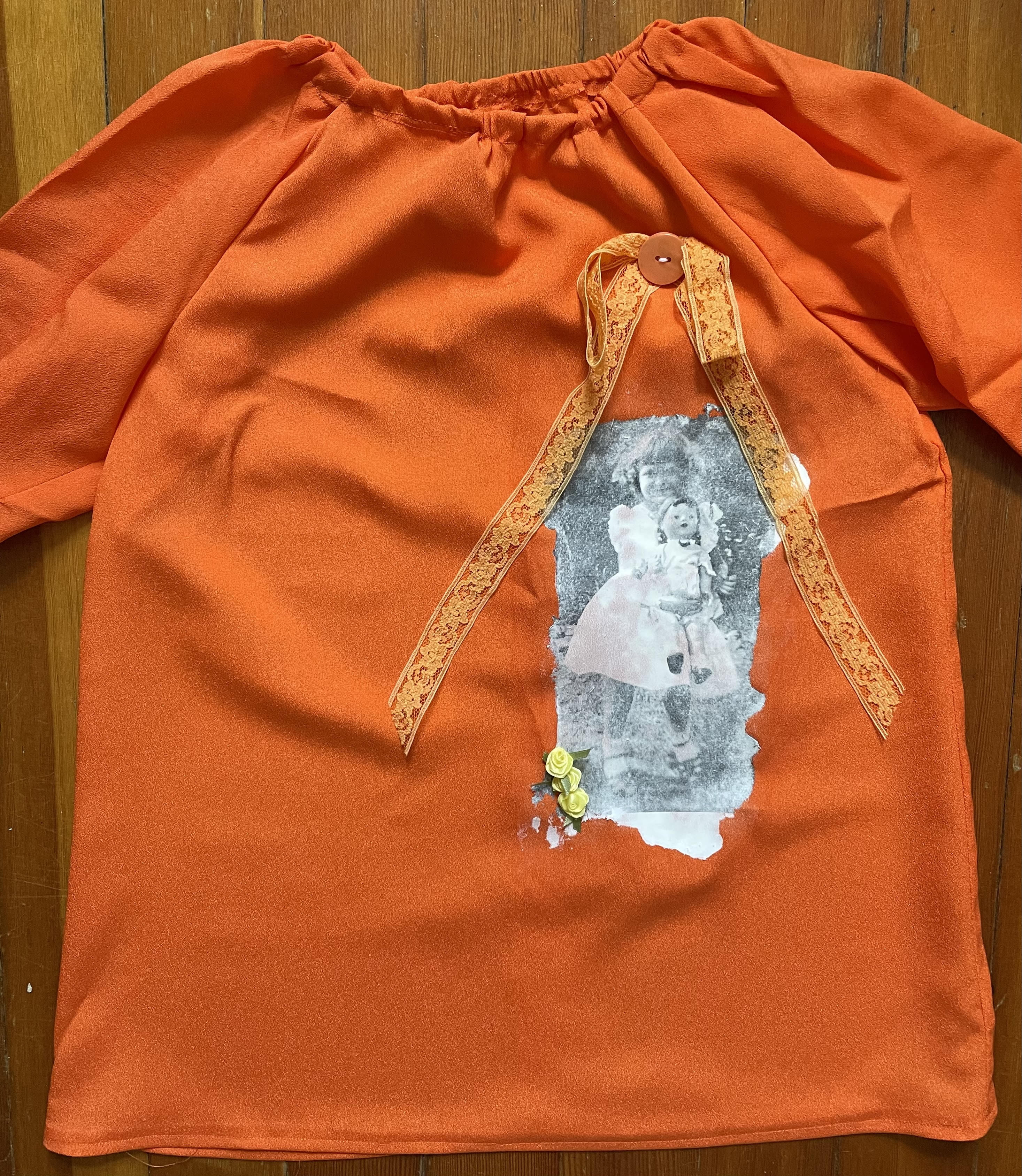
New York based artist and poet Olena Jennings created an installation of two artworks that are based on a family photograph. These two pieces revolve around one photograph of a little girl, who is Jenning’s mother, on a swing with a doll in the 1950s. The installation includes also connected poems.
Natalie is a character in a long poem by Jennings. She is someone beloved who goes through many transformations. The colorful wall piece of Jennings’ installation (above), includes an excerpt of a poem from the collection The Age of Secrets (Lost Horse Press, 2022) about Natalie and the doll. The poem embroidered onto the artwork’s fabric is published as, When I Moved To the City. (https://www.apofenie.com/poetry/2021/1/22/when-i-moved-to-the-city):
Natalie was the doll. I worried her eyes would close and get stuck, stay that way forever.
-Olena Jennings, 2021 (excerpt, see the whole poem through the link above)
The family photograph is transferred also into the bright orange crepe fabric, which is a new dress made by Jennings. This orange doll’s attire as part of the art installation, is a replica of the one that the doll actually wore in the family photo. Mother of the artist still has the doll in her house.
This orange dress is decorated with Ukrainian-patterned ribbon, reflecting my cultural background. The orange dress is the doll’s. I often work with memory, as depicted here in a moment from the past that is repeated in each piece. -Olena Jennings
Firstindigo&lifestyle: As a Ukrainian descendant, how are you dealing with the war in Ukraine, and thinking of your family and friends? Do you connect your poems and images to the tragedy happening today with the Ukrainian children?
I think every piece of art I create now has to do with the war in Ukraine. It’s impossible to ignore and the sadness is tangible. As part of this project, I am digging into my roots through images that were taken there or shortly after my family’s arrival in the US. I do this to work through my own emotions and to find a point of connection with my friends in Ukraine. -Olena Jennings
Below is the new unpublished poem INTERLOCKED, which Jennings created in conjunction to her art installation.
INTERLOCKED
A body is bare, ready for the dress of chiffon. My body is bare, in the mirror where her gaze falls. The doll’s is made of plastic, her belly button blossoms. Mine is made of warmth, my lips wet and petal-like. I have long conversations with her, her eyes stare back. We talk about the girls who ignore me on the swings. We talk about the way I can almost reach the sky, I always want more blue.
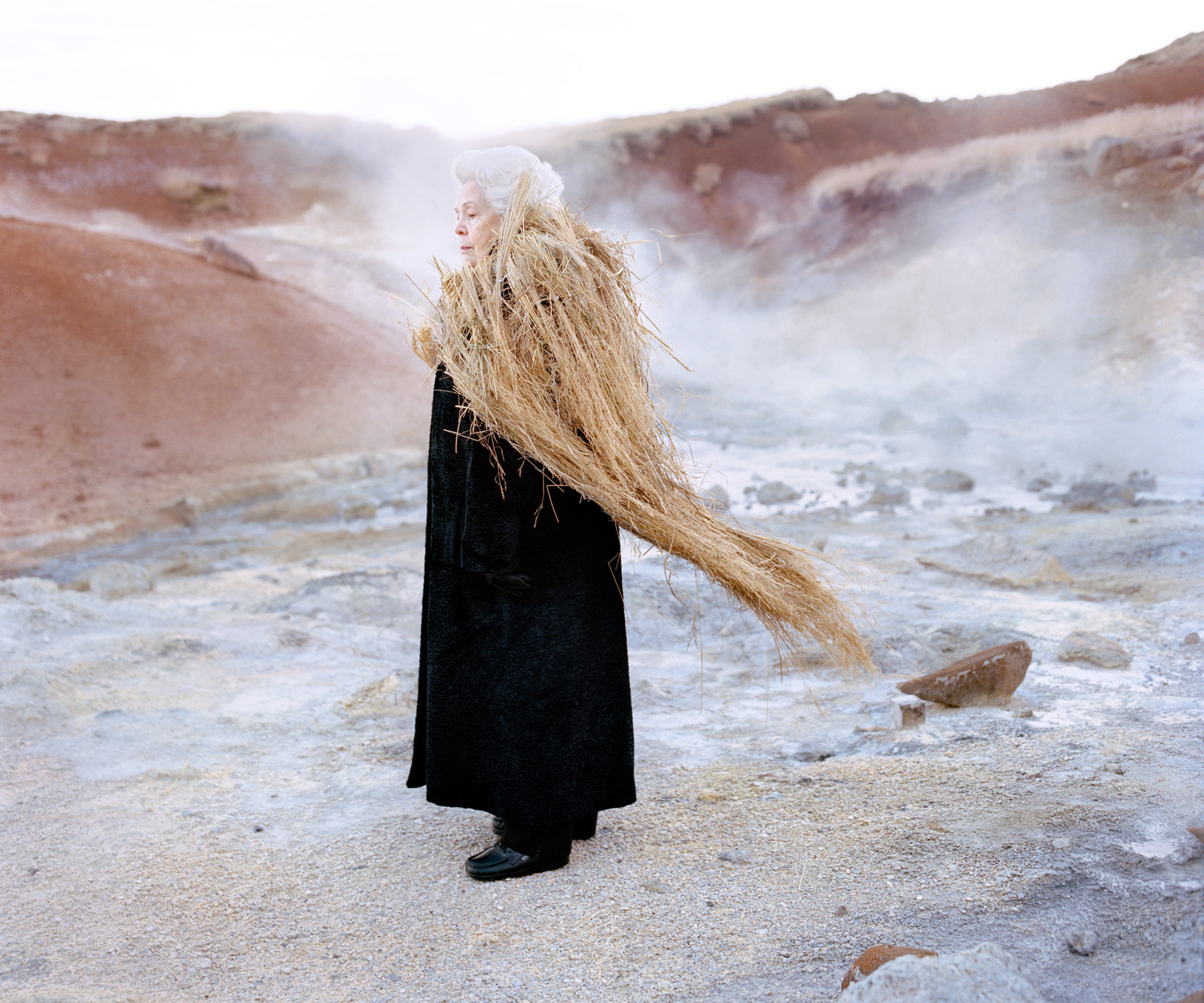
“Eyes as Big as Plates” is an ongoing collaborative photographic project between the Finnish-Norwegian artist duo Riitta Ikonen and Karoline Hjorth. This unique collaboration is now presented as a solo exhibition in New York City at the Brooklyn based Chimney Gallery. In the exhibition, 12 photographs are installed in the gallery space so that they form a visual unity in a column-like formation. This way the solitary portraits emerge naturally from the gallery space, which itself is raw and original. Eyes as Big as Plates presents solitary humans standing meditatively in their favored setting. What makes them special is their organic attire made of leaves, branches, pine needles, rocks, or flowers. The models are senior citizens. Ikonen’s & Hjorth’s photographs have another layer in them. The wearable sculptures connect the humans into their stages organically, making them part of the world they inhabit. The Chimney exhibition features newer works from Greenland, South Korea, NY, Iceland, Japan, Finland and Norway.
Firstindigo&Lifestyle: Karoline and Riitta, can you tell more about the idea behind the elderly portraits. Where did the idea to do the series originate?
Karoline and Riitta: The series is produced in collaboration with retired farmers, fishermen, zoologists, plumbers, opera singers, housewives, artists, academics and ninety-year-old parachutists. These are people we meet through friends, relatives and newspaper ads, in hardware stores, noodle bars, indoor gardening society meetings, swimming pools, senior centers, on the city streets etc. Our creative point of departure lies in the collaboration with these contributors, who we consider as co-creators. As we started our investigation into local folktales we reasoned that the older the local interviewee we would work with, the closer we would be to the tellers of the tales and the talking rocks of the stories. Those Nordic hills hadn’t changed since the tales, but the people sure had. So far it doesn’t seem to us that the answer can be predicted by the age of the answerer. Thinking of older people as a unit that operates in a certain manner is rather lazy with much of the western society unnecessarily confused when it comes to the ‘usefulness’ of older people. Attitude with knowledge, life experience and stamina are some of the main traits we have found amongst all our collaborators, as well as a formidable curiosity for new experiences. As Eyes as Big as Plates continues to cross borders, it also aims to rediscover a demographic group too often labeled as marginalized and generate new perspectives on who we are and where we belong.
Firstindigo&Lifestyle: You shoot the portraits in the nature, so it seems that thoughts about environment, and people’s relationship to it is really part of the visual narrative?
Karoline and Riitta: Each image presents a solitary figure in a landscape, dressed in elements from surroundings that indicate neither time nor place. Nature acts as both content and context and the characters literally inhabit the landscape wearing sculptures. In the beginning of the project we were curious and on a mission to find out what kind of connection the Norwegians had with their rocks, fjords and hills and especially keen on looking at the folktales where nature or natural phenomenons were personified.
Folktales often made complex natural and sociological issues understandable and accessible, with phenomena taking on forms and characteristics that even a mere mortal could have a dialogue with. Perhaps our Eyes as Big as Plates images aim to discuss the contemporary human in the nature in a similarly approachable language. As the project started crossing borders, our quest soon turned more towards investigating universal questions about imagination and curiosity, and evolved more into a search for modern human’s belonging to nature.
The location is chosen based on conversations with each collaborator, who might have a special connection with a certain landscape or a specific plant in the area. Sometimes we spend days finding the perfect location, sometimes we discover it within minutes. Most often the best collaborators and locations are found through chance encounters and lucky coincidences, which is also some of the main reasons why the project is still ongoing – the unpredictability is highly addictive.
Each image always starts with a conversation with the contributors. Most often, and ideally, we meet our model before the actual shoot day to chit chat about the world, life, interests, neighbourhood, relationship with nature, opera, moss, fishing, weather…, and see if there is something there that we can just magnify a little. We try to find out as much as possible about who our model and collaborator is beforehand in order to best present them and their relationship with their surroundings. The ‘costumes’ are just a primal response to real people in their settings. We always start from scratch with each contributor. Some of them are eager to participate in all stages of the process, from collecting the materials to deciding on the location and even putting together the sculpture, while others prefer that we make the choices that best reflects them.
Firstindigo&Lifestyle: I recall that Karoline found Riitta, or was it visa versa, as collaborator in a fun and memorable way?
Karoline and Riitta:Eyes as Big as Plates started life on the southwest coast of Norway in 2011. When Riitta was searching for a collaborator online, the three words ‘Norway + grannies + photographer’ found Karoline as the top search result, as she had just finished a book on Norwegian grandmothers. Karoline loved Riitta’s work and sense of humour, and one email and two months later, they met for the first time on the doorstep of a little white wooden house in Sandnes.
It was a very natural marriage of our complementing skills, where we come up with one image from two heads. Part sculpture, part installation and part photography, we work together from beginning to the end of the process. Karoline is the photographer in the duo while Riitta works mainly with the creation of the wearable sculptures in the images, but most importantly we operate with one mindset and vision, to the extent that we barely need to talk during the shoots, as we both know exactly what we are aiming for.
Firstindigo&Lifestyle: How many countries have you embedded in these portraits, and how many people?
Karoline and Riitta: Over 60 people from 12 countries (Norway, Finland, Sweden, Iceland, Faroe Islands, Greenland, UK, France, US, South Korea, Czech Republic and Japan.)
Firstindigo&Lifestyle: Do you remember the most memorable portrait ever in the making of it, perhaps related to the how the situation or process evolved?
Karoline and Riitta: It is quite impossible to pick one portrait as the most memorable, especially since so many of them feels more and more precious as time passes and our dear collaborators (and us) grow older. There are so many incredible encounters over the years, many that have turned into long-lasting friendships and we feel like we are the luckiest artist duo alive. One day the most memorable portrait is the very first one made together with Halvar in Norway, another day it is the memory of Riitta’s mum midnight swimming back and forth in lake Kalvä side by side with beavers on a freezing Midsummer’s Eve in North Karelia, or the very magical double shoot with Karoline’s grandparents last summer, some days we remember the intense weather conditions, other days we treasure the silence we all experienced, or the eagle that flew past us, the fog that landed just perfectly in time or the ruthless sun that never left the scene, it all depends on the time of year, season and mode of the day what comes into mind.
Firstindigo&Lifestyle: Your recently published a book about the project, and it bears the title “Eyes as Big as Plates”. What do you want to tell about the book tour?
Karoline and Riitta: The book is a culmination of the first six years of this ongoing project, and each book is hand-finished, unique with thinly pressed vegetation veiled underneath the cover cloth to honour each of the 60 collaborators in the project. We teamed up with Swedish designer Greger Ulf Nilson and the independent, Oslo based Press Publishing. For the release tour we returned to many of the countries we had visited to produced the works, and enjoyed a fantastic, fun and intense book launch tour to New York, Paris, Helsinki, Oslo, Landskrona, Nuuk, Seoul, Tokyo and London all over the course of 4 months. The book was also shortlisted for the Paris Photo- Aperture PhotoBook awards in the ‘First Photobook’ category, as a finalist from nearly 1000 submissions.
Firstindigo&Lifestyle: The book also initiated a Kickstarter fundraising process. Do you want to share some tips, or ideas for this kind of succesful outcome?
Karoline and Riitta: Our Kickstarter experience was a true rollercoaster and the outcome was just quite unbelievable. We spent weeks preparing, researching and gathering material, editing texts, having the material reviewed, putting together the video piece, sourcing the perfect soundtrack etc. Obviously we already had quite a lot of material from our 6 years of production and process material, and even an established audience that we could reach out to. We took day and night shifts between New York and Oslo emailing people non stop with personal emails, and our magic bullet in the campaign came in the form of Kickstarter’s weekly newsletter where we were recommended amongst 3 other projects to their whole worldwide community. Until this moment, we fought for each and every pledge and it was a slow start. We were lucky to be picked up – and in 24 hours went from 29% to 120% funded…
Hot tip: Make sure you set aside enough time to babysit and nurture the project and campaign while it is live, throughout the duration of the campaign. Then, once the campaign is successful, starts the aftermath of following up with delivering the rewards. We spent probably nearly a month sending emails, packages, postcards, printing, resending, chasing post etc. It was hard, but mainly exciting and definitely worth it.
Firstindigo&Lifestyle: Karoline, since you are Norwegian, and I haven’t asked this previously from you, I’m kind of curious what do you want to say about Norwegian art scene and support?
Karoline: The Norwegian art scene is small, but it has got quite a unique support and funding system in place for artists. There are many different opportunities when it comes to project funding, stipends, grants etc and recently some exhibition venues have slowly started to get used to the thought that artists might also deserve payment for the exhibitions they produce, instead of paying for renting a space, which I understand is more common in for example Finland. Norway still has a long way to go in terms of the gender gap though, both in terms of the most-selling artists, the most represented artists and the movers and shakers of the gallery world.
Firstindigo&Lifestyle: Do you think that the art education is exceptional in Norway?
Karoline: I studied abroad, so I cannot speak from my own experience here, but after hearing from my colleagues who did study in Norway, my impression is that there are many other countries with much more progressive art education.
Firstindigo&Lifestyle: Riitta, you are Finnish, what does ‘Nordic’ collaboration mean to you, do you find that you both share similar ideas or mindset because of the Nordic factor?
Riitta: We both grew up with an understanding of the outdoors as something intermixable with the indoors. It is part of everyday and the awareness and interaction with our surroundings still drives our practices strongly. Both of us live in big cities so there is a definite need to roll in the leaves regularly.
Firstindigo&Lifestyle: Where do you see that this project could be developing on its next phase, have you figured out the ‘after’ yet since the book came out?
Karoline and Riitta: We are taking part in a public art project in Seoul, South Korea this winter with newly produced work made in collaboration with seniors living in and around the Olympic village in the PyeongChang area, these will be on display on the Seoullo 7017, a newly renovated former highway turned into a pedestrian walkway that connects the eastern and western sides of Seoul. We are also taking part in a group exhibition in Germany (The Museum Schloss Moyland) this winter and spring, followed by a solo show in Finland in the summer (Pielisen Museo in Lieksa), and more exhibitions in Detroit in the autumn. We have promised each other that we will continue the project as long as it’s fun and we are still very much enjoying ourselves. In the continuation of the project our focus might shift more to investigating the impact of climate change on people living in different parts of the world. We feel compelled to use our voice and platform to discuss the things we find important and urgent.
***
Karoline Hjorth completed her BA Photographic Arts and MA International Journalism from the University of Westminster (London) in 2009 and Riitta Ikonen graduated from the Royal College of Art in 2008, with an MA in Communication Art.
After four decades in painting, American artist Francie Lyshak has a deep knowledge on her practice. A woman-artist who has a lifelong approach to learning, finds nature and it’s varying stages influencing her work. The artist examines nature also with photography. It seems, as if those pictorial notes would transfer into her paintings with subtle poetry and movement. In this interview, she discusses her career, love of painting and the meditative approach to being with her art. Remarkable is how the artist views art as a career, also in psychological terms as a radical act. Francie Lyshak’s recent paintings, which examine movement and gestures, will be on view until April 27, 2017 in the Carter Burden Gallery of NYC.
Firstindigo and Lifestyle: How did you find yourself doing painting? Where did you grow up?
Francie Lyshak: I will share with you two central memories that are at the very early roots of my art career (before it begun):
I am in Detroit, Michigan, in a single family home with a nice yard. I am a small child, somewhere between toddler and latency age. I am sitting in the mud, alone making a mess and enjoying it totally.
In the second memory, I am 18 years old, attending my first art history class. As I watch the projected images of works by modern artists, it is suddenly clear that making paintings is what I need to do with my life. I began to paint was when I went to a summer art school in Paris around the age of 19. I haven’t stopped since that time, except for one year in Boston in the early 70’s. After that point I switched from abstraction to figuration.
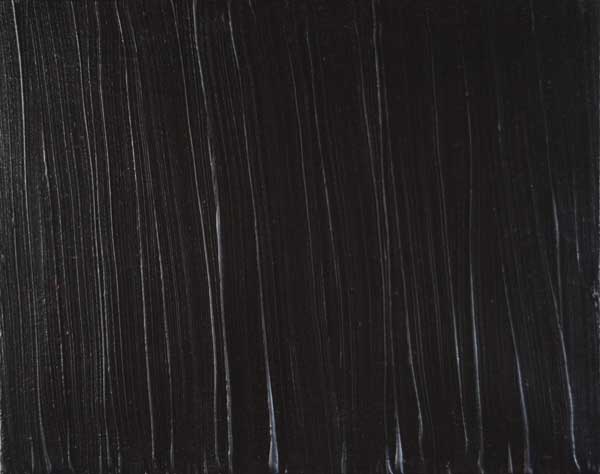
Francie Lyshak, Black Curtain, oil on canvas, 16×20, Courtesy of the artist.
Firstindigo and Lifestyle: You have an exhibition opening now at the Carter Burden Gallery in NYC, tell more about the theme of your paintings in the show?
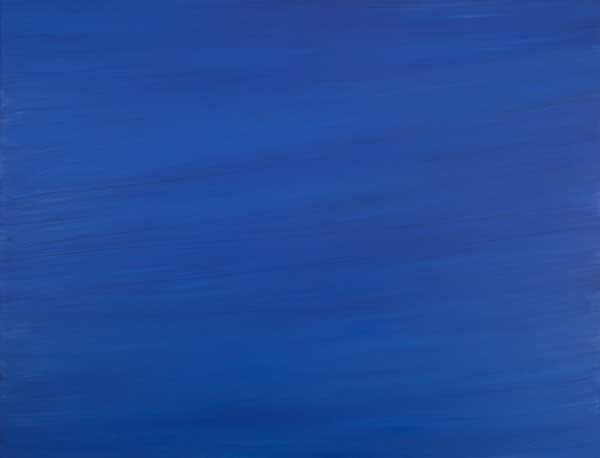
FL: These paintings focus purely on the physicality of painting, of paint, painter’s tools and the interaction of the painting surface with light. The use of a palette knife can be a violent destructive attack on a painting’s under-layer. A flowing brush mark can be evidence of the painter’s sweeping gesture. The painting then becomes a stop-action image of what was either a waltz or a wrestling match between the artist and the medium. It is painting without any intention other than leaving the physical evidence of its own dynamic birth.
Firstindigo and Lifestyle: What is really interesting is that your career spans for four decades, and there can be so many changes that fit into that time frame. Did you start with figurative or representational art?
FL: In my early work, my visual language was a figurative and a metaphorical narrative with strong feminist overtones. This work lasted for two decades in the 1970s and 80s. Animals, humans, dolls and toys populate these paintings, each one describing the psyche captured in a critical moment of time. Influenced by art therapy theory and practice, their emotional rawness challenged the viewer to contemplate disturbing aspects of life that are typically overlooked or avoided. After years of these explorations, I unearthed evidence of my own childhood sexual abuse. With the support of the late Ellen Stuart and La MaMa/La Galleria, this work resulted in a one-woman exhibition in 1993 narrating my own trauma recovery through my paintings. The series of paintings with accompanying prose was published in a book in 1999 entitled, The Secret: Art and Healing from Sexual Abuse. This exhibition provided me with a release from the narratives of the past. After that show, my work changed slowly but radically, moving towards landscape, then abstraction.
Firstindigo and Lifestyle: How did you choose painting and photography, how are they similar or different to you?
FL: I am a painter. However, I believe that no matter what medium an artist chooses, they cannot escape their artist’s sensibility. That means that we cannot help but consider the aesthetics in our environment. Also, we cannot help but be creative. It is a kind of compulsion that requires an outlet. In that vein, I took up photography. This was in part because I found it offensive that paintings are generally only affordable by the wealthy. I experimented with printing and multiples as a way to make my work more accessible to those with less means.
Firstindigo and Lifestyle: Can you say that what you do is abstract art, and if so what would this kind of abstraction be?
FL: The best way to describe my new work is ‘pre-verbal’. Before words, ideas and memories there is a mental space that is responsive to shape and texture, color and amorphous mood. That is the space that my paintings occupy. My abstract work is not expressionistic, nor is it minimal or conceptual. My newest work has something in common with action painting. Over the long haul, the trend of my work has been increasingly reductive. I seem to be constantly trying to reduce the content of my work to its simplest components. I removed the figure. I removed the narrative. I removed the symbolism. I removed the suggestion of landscape. Then I tried to suggest empty space alone (which made the work illusionist). Now I am just looking at the surface, the medium and the tools of application.
I recently saw a show that was simply lighting in an empty gallery. I understand that.
Francie Lyshak, Brushed Blue, oil on canvas, 34×44, Courtesy of the artist.
Firstindigo and Lifestyle: How do you choose your works for the exhibition, do you ‘curate’ yourself?
FL: No, my dealer is fully in control of the choice of work and the hanging. Of course, it is up to me to choose the paintings from which she makes her selection.
Firstindigo and Lifestyle: The process is of course different with each artist, do you like to add older paintings into the show, or is it mostly recent works?
FL: Mostly very recent works are shown in April exhibition. My first exhibition at Carter Burden had some pieces that were several years old but had never been displayed.
Firstindigo and Lifestyle: You are watching a lot of movies, how apparent is it that those moods or aesthetics you gain from films enter your works somehow? FL: I don’t think that the aesthetics of film influence my work, but perhaps the moods do on a subconscious level. I find great solace in the work of these great, underappreciated independent film makers. They address very important, very real aspects of being human. Hollywood spends mountains of capital selling fantasy worlds to viewers because it is a natural,human inclination to avoid and escape harsh reality. The filmmakers that I love make me look at the challenging underbelly of being human. This gives me courage and support in my effort to stay honest as a painter, to not be fooled by the illusionary rewards of commercial success, to lead my viewers to the challenging aspects of being human.
I have a fantastic list of my list of favorite movies. It is a long list and the titles are unrecognizable to most people. Almost all of the films were borrowed from the New York Public Library which has a treasure trove of great films.
Firstindigo and Lifestyle: What does a notion of ‘zen’ mean to you as an approach?
FL: I am not formally trained in Zen practice. However, I understand that Zen does not have a god head, and is focused on what westerners call mindfulness practices. My mind is constantly racing. I hunger for empty space and quietude. (Perhaps this is reflected in my urge to constantly minimize the content in my paintings.) We live in an overheated, overstimulating world (at least in NYC). I know, however, that it is not the fault of my environment that I am so mentally restless. I reach for ‘zen’ as a pathway towards a quiet mind or to attain full attention. When I paint, I am in a ‘full attention’ mode. In this sense, painting is a mindfulness practice. (Click the link to see a series of paintings that were specifically intended to be ‘meditations spaces.’ http://www.francielyshak.com/archive/New%20Monochromes/index.html)
Firstindigo and Lifestyle: What else do you do to balance with making art?
FL: Not much. I do some Yoga practice, go to the gym, take walks and, of course, watch movies. I would add that there isn’t anything much more rewarding that good conversation with other artists and intellectuals.
Firstindigo and Lifestyle: Where do your influences come from other than abstractions? Do you blend in narrative contents from today’s world and events? FL: My goodness, the political climate has a tremendous impact on the ‘climate’ of my work. There is very little joy in my work these days. On the other hand, I am finding surprising strength and power there. My work is definitely a mirror of my psychological condition. My psychological condition is a mirror of my personal and social life (which in these times encompasses the political environment). A new painting included in this April exhibition is entitled “Silence equals Extinction”. It was clearly a response to the nightmare political situation in the US.
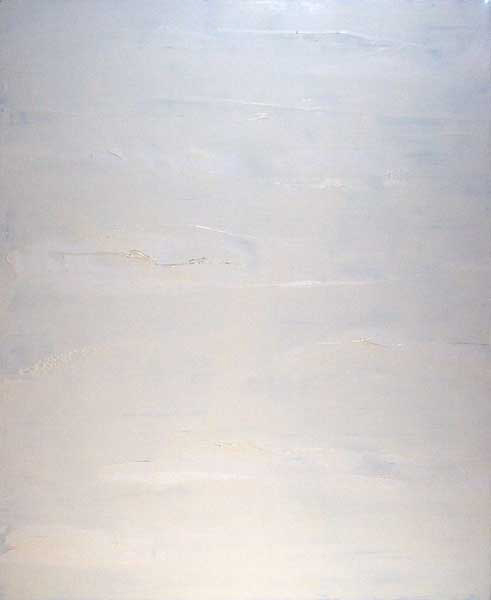
Francie Lyshak, Knifed White, oil on canvas, 34×26, Courtesy of the artist.
Firstindigo and Lifestyle: In your photography there is a lot of nature in them; fog, mountains, trees, moon, and so on. How do you find your photographic subjects, do you just happen to be in those places in the moment?
FL: Yes, everything was done either in Michigan, where my family has a summer home, or NYC. I also did some photography when I did some traveling along the Adriatic, Ionian and Aegean Seas and along the Pacific Ocean shore. I am wild about landscapes.
On influences:
I am not influenced by art theory nearly as much as I am influenced by psychoanalytic theory, philosophy and religion. I have no belief in any religion. However, I find the search for self and meaning to be central to my practice as an artist. I am most affected by any work of art that creates a space for the viewer to engage in this search for identity or meaning. Works by Frieda Kahlo, Mark Rothko and Fred Sandback all succeed at doing this for me; although each uses a radically different method to set a stage for this to happen to the viewer.
On color:
Colors have a strong valence, a kind of personality. My latest pieces have been in various shades of black. I am choosing black because I have always feared it. Black oils cannot be controlled because they are wildly interactive with the light in the environment as it reacts to the surface of the painting. The color black, for me, has much to do with loss, change and the unknown. So colors themselves have a kind of personality and meaning and different oil colors also have a unique physicality, such as color density.
On my use of color in photography and painting:
I think of myself as a painter. I have spent forty years painting. Photography has been secondary to my work as a painter. My photography is in the early stages of development; but is created on a foundation of 40 years of evolved aesthetic sensibility and artistic practice. My photography is mostly rooted in local color or black and white. My new paintings, on the other hand, are each a deep explorations of color, the oil paint medium, the painters tools and methods of application. In other words, my practice as a painter has evolved to a point where I am exploring the very basics of the medium. It is full circle, back to the beginning.
Firstindigo and Lifestyle: Do you find inspiration in your travels to foreign places, how about those leaving an impact on your thinking and aesthetics?
FL: I just traveled to Japan. Their aesthetic and social values were a great comfort to me. The Japanese seemed so much more civilized than Americans. It was heartening to experience their aesthetic and their culture. I felt that my own values were much more supported by the Japanese culture than they are in my own culture.
Firstindigo and Lifestyle: Did you ever come up with a notion, who would be your best art audience, or collector? FL: Probably intellectuals, other painters and psychologically-minded people. It is hard to tell who is most taken by my work because people usually don’t say much. Most of us become a little inarticulate in the face of meaningful visual art. Art takes us to a non-verbal place. I admire people like you who are willing and able to give us language in the face of visual art.
Firstindigo and Lifestyle: With so much insight in the practice, we all want to know, what would you like to teach or say for younger generation artists and painters?
FL: I would like to say to them that it is worth the battle to stay true to their artistic sensibility. This is because, in the long term, losing touch with one’s core strivings (to be an artist, to be creative) has an unbearable cost. I would tell them, however, that they shouldn’t expect to be rewarded. Artmaking is essentially a radical act, because it means turning away from the influence of others and, instead, opening a channel to one’s true self. Being true to one’s core self usually means letting go of many of the rewards of social/commercial success. After all, in the short term we are nurturing ourselves rather than others. Who knows if our art will nurture others in the long term. That is in the hands of the vagaries of the art market.
Achieving commercial success in the art world is a totally different side of being an artist. It takes a combination of ambition, talent, personality, timing, social resources (such as health, social networks, time and money) to make income from making art. To have these resources is often a matter of privilege and other random social events. Artists don’t have control over most of these factors.
Francie Lyshak’s exhibition info:
April 6 – 27, 2017
Examining Movement & Gestures: Jonathan Bauch and Francie Lyshak
· Pratt Institute, Art Therapy and Creativity Development, Masters of Professional Studies, NYC, 9-76 to 5-78
· Wayne State University, Painting and Drawing, Bachelor of Fine Arts, Detroit, Michigan, 1-69 to 5-70.
· Center for Creative Studies, Fine Arts, Detroit, Michigan, 9-68 to 5-69
· University of Michigan, Humanities, Ann Arbor, Michigan, 9-66 to 5-68






 Firstindigo&Lifestyle