Tag: photography

  • Ofri Cnaani’s ‘Wrong Tools’

    Ofri Cnaani’s ‘Wrong Tools’

    Artist Ofri Cnaani has created a new photography exhibition consisting of prints and a performance piece at Andrea Meislin Gallery. Photographies on display echo ideas deriving from Xerox art of the 1960s simultaneously connecting with the visual world of the mesmerizing early photography of the 20th century. The exhibition ‘Wrong Tools’ will be on display until October 24, performances taking place on Wednesdays, Fridays and Saturdays. Cnaani’s Blue Print photographs are like intuitive maps constructed of performative ideas that associate with artist’s own body. With both of her performance and photographs, she creates a presence. The works are building up from fragments, and the pieces are put together in a compelling logic. These could be like ruptures built on the Internet surface, where constant image flows create new associations. Here is Ofri’s interview.

    Firstindigo&Lifestyle: Your ongoing solo exhibition ‘Wrong Tools’, at the Andrea Meislin gallery speaks a strong esthetic and spatial approach with performance element added to the photography gallery. The performative element also looks back from the blueprints, which display hands in various positions doing tasks, perhaps. Are these prints your hands making the past performances, or projects?

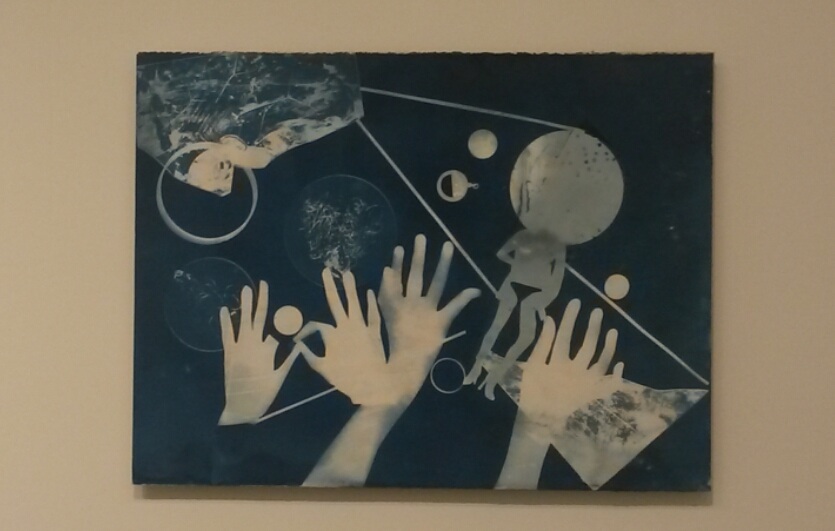
    Ofri Cnaani: In the cyanotypes I’m using my own body. I’m using the special qualities of one of the earliest photo techniques to promote some sort of performative photography. In a way, it is very similar to what I do in the performance: I’m creating an image in a limited amount of time that is constructed from found objects, made objects and my own body. Like in the personalized ‘image maps’ I’m creating in the performance, here too, I have a limited control of the final result. The process is always between failure and magic.

    In your actual performance that I observed taking place during the opening night at the gallery’s foyer with windows, you encounter audience member on a participatory table setting, where each unique guest sits opposites of you. The scene comes out as very intimate and poetic; we are simultaneously looking at the wall where the reflection of the table surface is displayed with your real-time construction of objects and images on it. And, we are grasping the exchange between you and the other person embodying the performance. Quite interesting, a guest was taking pictures with her phone of the very situation as well. What is taking place in these moments? How do the photographs and the recording of the event resonate in the doing of the performance physically?  

    OC: When someone sits with me, I first offer him or her a ‘reading’ of his or her visible future. I used a tarot-like deck that I designed titled ‘future business’. I also ask them to give me one personal item and to choose two items from my collection of small objects. I’m using the message on card they chose and the three objects they selected and gave me as a starting point, to create a live collage-like image. I called it ‘image map’. This image is captured and printed using a special apparatus I build for the show. Lastly I stamped it with a ‘Copy’ stamp and signed it with red ink, handing the Original Copy to my visitor.

    As the title ‘Wrong Tools’ already implies so many interesting visual connotations, could you tell more what is the idea or meaning behind it, is it metaphoric with a larger idea and also coming to the performance? Does it resonate solely with ideas, which derive from computing?

    OC: My husband, who is great in building things, always says everything is very easy if only one is using the right tools. I realized I’m always using the wrong tools.  My studio is a mess and I’m always using the tools that are wrong for the job. I like to think about my method, using the collections of two and three-dimensional objects in my performance, as ‘endless metabolism’. I’m using the same little objects for different performances, as well as for the cyanotypes and other photos. The same objects travel between many of my projects, always been used in different ways, but never used as they were originally meant to be used.
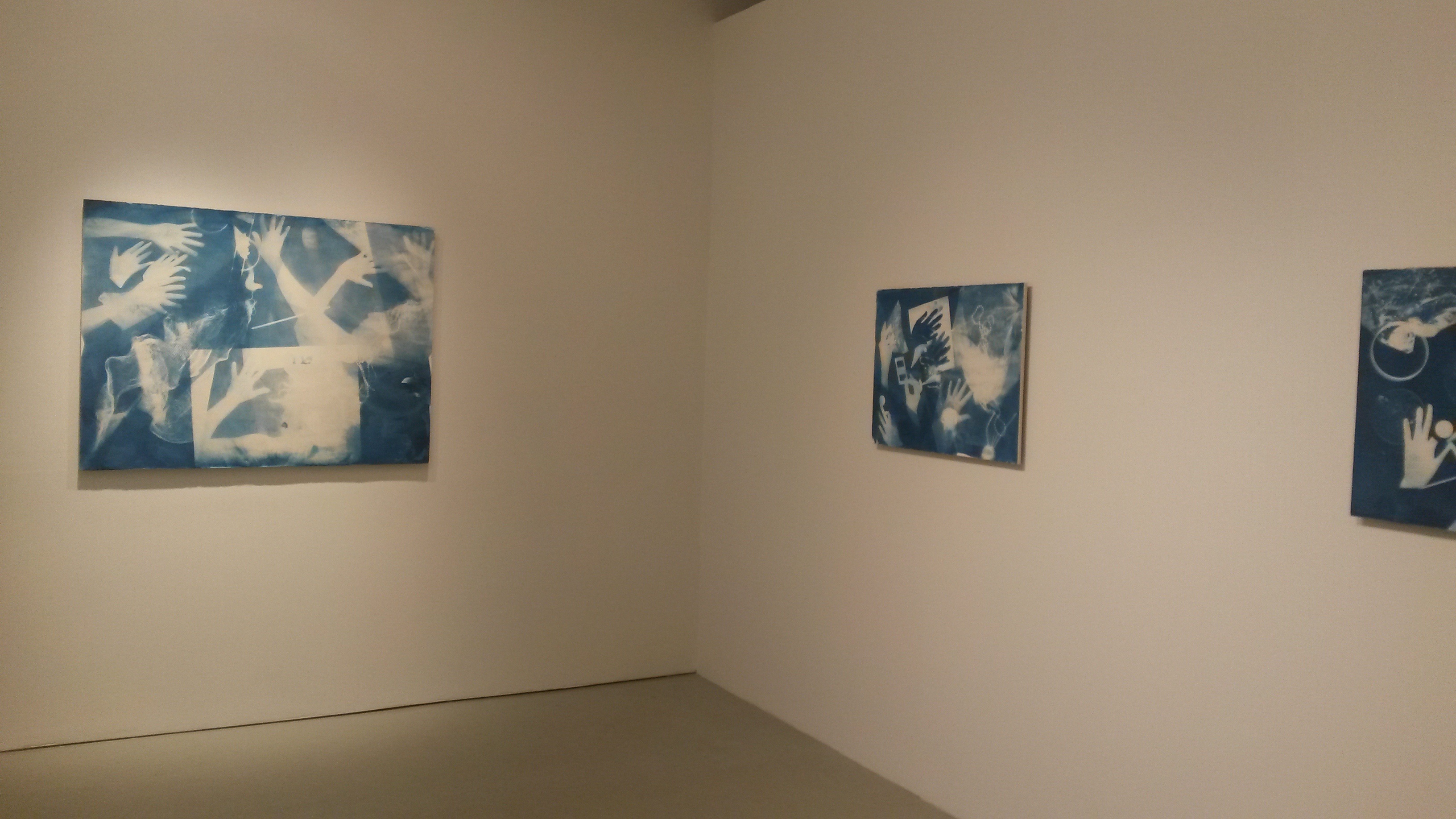
    Ofri Cnaani_OC real and fake-series_Cyanotypes
    Ofri Cnaani, OC real and fake-series, Cyanotypes, at Andrea Meislin Gallery

    Then, your exhibition at the gallery has these colorful images called ‘future business’, that have a short message embedded in them. It seems that they relate to the performance, do they have an element of time in them as well?

    OC: The monoprints are also ‘one of a kind’ and were made in a similar way. I’ve been using cut-outs and flat objects, placed them on paper and rolled them under the press, so each one is a different arrangement, although some of the cut-outs appear more than once. The texts are the same texts on the special edition tarot deck I produced and then use in my performance.

    On each card there is a message we get regularly as an online user like ‘Delete All’ ‘Unsubscribe’ or ‘Change Your Profile’. These lines are charged with a very different meaning when we receive them as messages in a one-on-one ‘reading’ session where we all are so vulnerable.
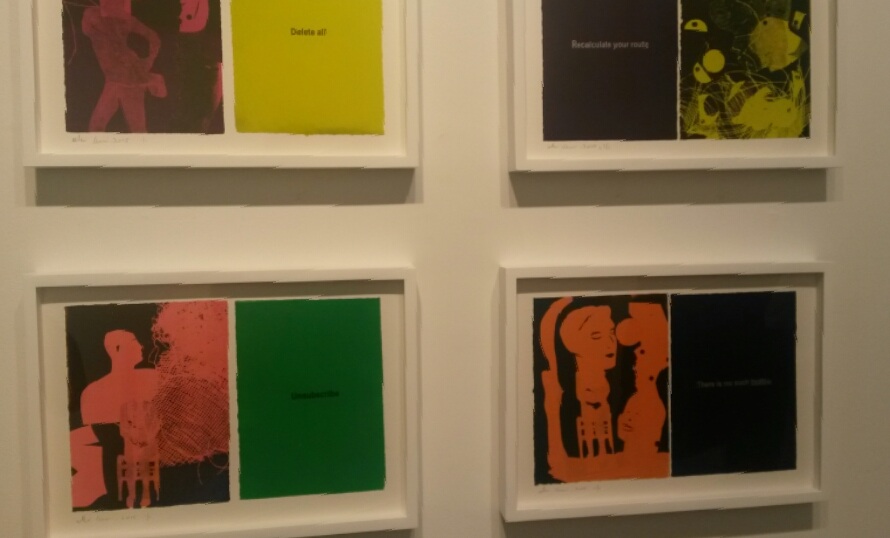
    Ofri Cnaani_future business-series_monotype prints
    Ofri Cnaani, Future Business-series, Monotype Prints, 2015

    Adi Puterman curated your exhibition for Andrea Meislin Gallery, what do you wish to tell about the curating exchange and process, do you know each others tactics well?

    OC: Adi and I worked on the show for over a year and she was very involved with each step: from the concept of having an on-going 6 weeks performance in the gallery, to the selection of the pieces, and communicating my ideas in a written text.

    I have noticed that your artist career includes plenty of performance works, such as the ‘Seven Words’ at the Metropolitan Museum. This past work is also very interdisciplinary. Is a question of the different art forms relevant to you in your own art making, or are all forms closely related?

    OC: I’m driven by concepts and often by time constraints (like a different space I’m working in or a different collection or archive I’m using). I’m less driven by a specific medium or style.

    As an educator of the arts, how do you teach time-based process to your students, do you have guidelines for that?

    OC: We see many projects and discuss them, we read texts and using mind-mapping method in order to understand them and connect them to other ideas, texts and art works.

    I often think that New York city is such a creative hub with so much international potential gathered in one place. Do you consider that as an international artist based in the city you have a specific role or identity, which is perhaps one here, and another that goes back home in Israel communicating and identifying with the contemporary art scene there?

    OC: I’m not sure what do you mean by that but once you leave the place you were born and raised, your identity is always ‘more than one’ and in a constant negotiation.

    You have created public artwork, do these works imply a different kind of activism or sensibility that comes with the public space, or are all ideas you are doing basically interrelated? 

    OC: My work is context specific. When I work in the public realm I work not only with a specific building and its specific history. The process always involves a community or a group of individuals. The process in those projects is part of the final piece. The final images are never known when I start working on a public piece.

    Can you tell a little what are your next steps going to be like?

    OC: Next week I’ll be doing a performance that is similar to the one in the gallery at Dallas Aurora. My project is part of ‘Altered States’ exhibition, curated by Julia Kaganskiy. Next month I’m going to Inhotim in Brazil to work with the park employees to create a participatory performance titled ‘Frequently Asked’ that will be then presented in Inhotim on early December.

    Ofri Cnaani, Blue Print, 38.5x49.5, on display at Andrea Meislin Gallery
    Ofri Cnaani, Blue Print, 38.5×49.5, on display at Andrea Meislin Gallery. Images by Firstindigo&Lifestyle
  • Visitor experiences at Frieze 2015

    Visitor experiences at Frieze 2015


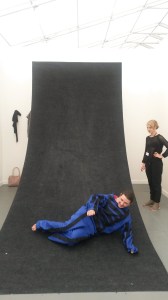
    Brazilian artist Martha Araújo’s piece Para um corpo nas suas impossibilidades, (For a body in its impossilibities) was created in 1985. Now at 2015 Frieze Art Fair, we celebrate the corporeal experience at the skateboard ramp dressed in suits that are patched with Velcro straps. The user-experience is less of a performance, and more of a subjective experience, which is very much according to the manifesto written by the artist. Martha Araújo (born in 1943) wrote the following:

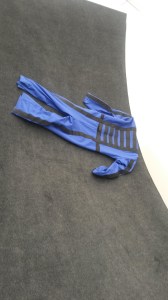
    Believing in the impossible is also a way of making art, for it is to doubt the impossibilities that make our dreams and follies feasible. Our proposal consists of experiencing situations in which the body crawls (on the ground floor) and tries to climb vertically. It is a search to achieve utopia; an exercise in transcendence. For this we will wear two pairs of overalls with several strips of Velcro attached to them vertically and horizontally. We will also use  a runner rug measuring 6.00 x 2.00 m, stuck to a skate track-type wooden framework. The Velcro strips on the overalls are the elements that fix the bodies to the rug.


    The project was curated in the Frame section of the art fair by Galeria Jaqueline Martins from São Paulo. The gallery won the prize for most innovative Stand Prize this year. The stand is comprised of the ramp and few suits, which the public can wear and then try the structure. The booth also has black and white photographs from 1985, which document artist Araújo and her crew experimenting with the concept. At Frieze, these photographs are on sale, and so are the suits. The ramp belonging to the artwork can be reproduced with the suits.

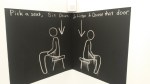
    Another visitor intervention at the Frieze was Japanese artist Aki Sasamoto’s Coffee/Tea project. Being one of the Frieze 2015 Projects, the artist created a three-dimensional personal test experience that included multiple-choice questionnaire. The maze-like structure was among the gallery booths, having several rooms, in which visitors/viewers make a choice between two objects or situations. Different choices lead through rooms and doors and then to the exit, where participants discover which personality suits the course of actions they chose. Here is my test in photographic documentation.

    In the beginning, the structure encourages you to think that you are boarding a spaceship, artist has written a dark statement on the wall:

    The world is ending. You are selected to board a spaceship with one animal. Which will you bring? A. Peacock, B. Horse, C. Tiger, D. Sheep

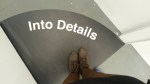
    As we don’t actually make this choice between four animals; we can choose to enter between two doors, one on the right and one on the left. Behind the left door there is a table with teacups and tea poured on them. Today I’m happy they would offer tea. Through my next choice, I’m encountering two kinds of blue on the floor; the other one looks like tiled, so will follow that one. Not quite getting the sitdown-point, where would have to ponder between the choices, rather stay moving and opening doors. Then, not quite sure how, suddenly entering the door with ‘intodetails’ exit floor mat in black-and-white. Feels like a fast experience. There was another blue, this time gymnastic mat on the floor with wooden board in the middle. A chance to balance a little bit, and the exit was right there.

    Is there anything in common with these two art projects? Martha Araújo’s art dates back to the mid- 1980s, and Aki Sasamoto’s project is very recent. The getting-involvedness, and the intellectual mind vs. trust yourself and let your body lead the way -issue; has both of these projects. Sasamoto’s making choices project encounters also our bodily input, as this is about experience. The color blue seems to be a fascinating factor in both projects.  Araújo’s and Sasamoto’s projects will be living in the form of re-enactments. Being convinced that there will be more photography and live-documentations happening.

  • Leah Oates in spotlight: artist, curator, gallerist

    Leah Oates in spotlight: artist, curator, gallerist

    A woman to watch now in the art world is an artist with multiple roles. Leah Oates runs her own art gallery Station Independent Projects in New York’s Lower East Side. In the interview she sheds light on how she found her path. 

    Firstindigo&Lifestyle: Your photography reflects multiple textures, showing light, contrast, opening up to magical worlds, how did you find your own medium?

    Leah Oates: I started as a painter and printmaker, and I still see the influence of both in my current work with the layering and density of color and light. The common thread with my past work in other medias was always photography as I painted and printed from photographs but in the past I saw the photos I took at support materials or documentation. At some point I realized that the photography was the main and most continuous thread in my work so transitioned to how I work now.

    Firstindigo&Lifestyle: Do you feel that memories, or where you come from resonates in your art?  Your works have been also exhibited overseas, how was the experience in China, for instance?

    LO: Where I was raised and my specific family definitely connects to my current work. My grandmother is a biologist who studied at Harvard and one of my uncles worked for the Environmental Protection Agency (he is now a private consultant on environmental issues) and another worked for the Army Corp of Engineers. Thus there was a lot of dialogue about the environment, nature, human rights and politics.

    My mom, brother and grandmother are painters and my grandfather was a painter and photographer who ran a photo studio when he was young taking family, wedding and baby photos. He later became a real estate lawyer with a big Irish Catholic brood of six kids including my dad Danny who was a writer and carpenter. I have an uncle who is a successful ceramic artist in Maine and an aunt who is a glass artist in Massachusetts.

    This mix very much informed my work as well as growing up in the city of Cambridge, Massachusetts and in rural town in Sanford, Maine where my family goes back in both states to the 1600s.

    Being and working in China was amazing. We all absolutely loved it there from the street culture to the food to the parks to the incredible energy there. It was wonderful to photograph there and yes its polluted and yes it can be messy but the light is wonderful and the people are friendly, sweet and almost old fashioned. We would go back in a heartbeat.

    With China I had a lot of reverence for their history beyond Mao and the revolution etc. China is an ancient place and much older than the US or Europe with so much amazing history. China is a work in progress and like all places has things to work on but it’s a really vibrant, alive and interesting place.

    My work there dealt with the changes happening in the culture related to climate change, random urban planning that is erasing local culture and customs and how nature reacts to all of this within a rapidly expanding urban setting.

    This slideshow requires JavaScript.

    Firstindigo&Lifestyle: Could you describe in few words how did your road lead to New York?

    LO: My husband Pierre traveled to NYC on a few business trips and instantly loved the NYC. We where living in Chicago at the time and liked it but NYC is closer to both our families in New England and Canada and it has a thriving and large art community so we moved here when I finished up my MFA.  At first I was not sure about living in NYC for that long but gave it a try.

    I began ironically to love NYC after September 11th as the city just melted ones heart. I saw how the city came together in a way I would not have imagined as you know normally is like ‘get outta my way’, or ‘move it fast’, on a daily basis here.  But the thing about New Yorkers is that in a crisis situation they have your back and this is what I learned about NYC that made me really fall for this city.

    And the art community is the best I’ve experienced. People are energetic, they work hard and like to do so, are open to new things and they make things happen and quickly. It’s a hopping, creative, and no nonsense art city. Yes there is the regular nonsense you have in any city but things really get done here and in high volume and at top quality too.  You see the best here and yes the worst too but here we move so fast that there is no time for that stuff. It’s a very discerning crowd here.


    I’ll give an example. Pierre, my husband has shot films in other cities and it always move so much slower than in NYC and he often hits walls initially either from unions or agents etc. In NYC it’s the total opposite where he finds what he needs easily and hears yes a lot! It gets done here without the baloney. Here it’s a YES lets do it mentality which I really like, and opens things potentially for innovation, creativity and hybrids. I now cannot conceive of living anywhere else, and I’m now head over heals in love with this city.

    Firstindigo&Lifestyle: It’s quite easy to imagine that last few years have been truly busy in leading your own art space. How do you feel the transition has been in terms of becoming a gallerist?

    LO: I love running a gallery, and working with my artists to plan their shows.  I’m really happy about the quality of the shows, level of press and number of curator visits and attention that the gallery shows have received and sales have been good.

    It’s been an amazing experience all around. The first few months when I initially opened where very exciting and there was a bit of anxiety about how it would impact our family. Mainly it was our son Max who wanted his mom to be around 24/7 but he really got behind the gallery when he saw the space and saw that it made me happy. He even wanted to serve drinks and where a suit which was so cute! There has been a good balance between family, the gallery and my studio practice for quite some time now so it all good.

    Firstindigo&Lifestyle> What is your secret in balancing between different roles in the art world?

    LO: Most artists or art professionals have jobs so it’s the norm in most cases unless you’re very rich.

    A quote I like is ‘A good artist studies art and a great artist studies everything’. My dream is to be an artist, curator and gallerist, so I’ve followed this to see where it leads. It’s an interesting and rich journey that is worth taking. What I’ve learned too is to plan out the week and get the work done. Just do it and don’t think too much about it. Get your self into studio and get working as through the work interesting stuff happens and if your not there it’s less likely to happen. The same goes for running the gallery.

    Additionally, trust yourself and go for it, plan strategically and it’s ok to say no, rest when needed and spend time with those that make you feel good and even better loved.

    Firstindigo&Lifestyle: You have also featured artists in the art fairs; do you find attending art fairs rewarding?

    LO: The gallery participated in Pulse NY last year and it went really well with sales and press, work placed in a corporate collection and several private collections and so much great feedback and contacts. It was a complete buzz and reinforced that the gallery artists and program was as good as I thought it was. People who visited our booth loved it and where so positive. But with all of this great stuff we only broke even and fairs are expensive to do. But they are now so much a part of the art world that it’s a must to do them as a gallery and again I think it best to be strategic with this and keep to a budget. I have only good thing to say about Pulse from a gallery perspective. This fair is run very professionally and everyone is super nice and efficient. Everything they promised they delivered on.

    As an artist I’m not a huge fan of fairs overall but I do love Pulse, Spring Break and The Independent art fairs. They are so different as fairs but seem to push the dialogue forward and are visually interesting.

    As an artist at fairs I like running into so many people and taking about art but think that fairs can be too formulaic and favor art that is easy to process with too much surface and not enough depth.  As an artist I think fairs are a survey of trends, are about status and art world hierarchy and not so much about art or pushing the dialogue ahead. But again as a gallerist, curator or as an artist participating in a fair you have to do it as it’s for the potential for so much attention in a short period of time and in a condensed fashion.


    Firstindigo&Lifestyle: It is very delighting that Station Independent features Finnish artists. Could you tell in few words about the Finnish collaborations that are coming up this summer?

    LO: Yes I’m pleased that the gallery will be hosting two guest curated shows this summer by Ilari Laamanen and Leena-Maija Rossi both from Finnish Cultural Institute.

    Ilari has curated a group show of Finnish artists called  ‘The Powers That Be’ which is on view from July 17-August 9th. This show is part of FCINY’s 25th Anniversary year’s program on Urban Nature and explores human’s relationship to the environment.

    Rossi has curated a two person show that explores shifting ideas on dwellings in urban space called  ‘(Un)livable’ with work by Kari Soinio and Janet Biggs which opens August 13th and is on view through September 6th.

    Firstindigo&Lifestyle: How would you define your own curatorial motto?

    LO: My curatorial motto is to not follow trends but to follow art and artists. I’ve been following the gallery artists from between 5-25 years. Also, it’s important to love the work your showing and to choose work based on its merits and not on if it’s easy to sell. It’s all about the artwork itself and about dialogues about art within a larger context of the past, present and future.

    ***

    The gallery and artist websites:

    www.stationindependent.com
    www.leahoates.com