Tag: video

  • IC-98 art duo from Finland

    IC-98 art duo from Finland

    Firstindigo&Lifestyle interviewed artist duo IC-98 from Finland, who are Patrik Söderlund and Visa Suonpää, respectively. Their recent site-specific installation ‘Hours, Years, Aeons’, was produced for the Pavilion of Finland at the 56th International Art Exhibition of the Venice Biennale. IC-98 projects scale with in-depth research; being abstract and taking form in installations and in publications. Their animation language draws from the collective history of nature and culture. As the duo says:

    Our work is post-historical, it is set in a distant future after the age of man. It’s about nature, which still has to deal with the consequences of the human era. It’s not natural nature, but a twisted one.


    Firstindigo&Lifestyle: How did IC-98 get started, what was your thesis during the first few years?

    IC-98 (artist duo Patrik Söderlund and Visa Suonpää): We met at the University of Turku, majoring in Cultural History and Art History. We wanted to broaden the scope of academic writing by bringing our “writing” into public space. This idea became our program: to make site-specific interventions in public space, be they installations or anonymously distributed booklets.

    How do your art works communicate with theoretical thinking, do you consider to be conceptual artists?

    IC-98: The works start with conceptual and/or contextual analysis. This depends on the project at hand. Site-specific works start from research; animations are amalgamations of conceptual thinking, adjusted storytelling and handcraft. But if we should characterize ourselves shortly, we’d say we are conceptualists first.

    Can you name some of the most important theoretical premises that could be your guidelines? How about your artistic influences?

    IC-98: Our theory comes mostly from the left-leaning French poststructuralism: Michel Foucault, Gilles Deleuze & Felix Guattari, Michel Serres, with an important German addition: the work of Walter Benjamin. Artistically we do not have many modern or contemporary influences. Visually we lean towards 19th Century and the history of depicting landscape: Claude Lorrain, Gianbattista Piranesi, Caspar David Friedrich, and William Turner. The important thing about 19th Century is the fact that it is often at the same time the prehistory and a mirror image of our own time: in many respects, the world was the same but the underlying processes are still more visible (think Jacquard loom vs. laptop: they share the same binary logic but where laptop is a black box, in the loom we still see how the thing actually works).

    Could you tell more about the process itself, in what ways do your concepts or visual process evolve, are there any common or repeating parameters in the making? For example, how do you choose your visual atmospheres, like create the sets, lighting, how does the process unravel itself?

    IC-98: The style is based on the fact that the animations visually start with pencil drawing. From this stems the fact that the animations are black and white. So it is a material, not a stylistic element. The different atmospheres and recurring elements, our visual vocabulary (fog, mist, stars, water) is functions of the scripts, which often deal with multi-rhythmic time and transformations of energy and matter. The script always comes first; even lighting should carry parts of the story. If we cannot justify a visual element, we omit it from the final work. Technically the “scene” is fashioned after 18th century theatre: the image is composed of flat layers and digital effects between these layers. We try to keep it simple, not to be too much carried away by the limitless possibilities of cgi (Computer-generated imagery). When we compose a scene, the pencil drawings are first scanned, then composed into layered scenes and lastly animated.

    What do you want to say about your idea of ‘Events’, and about the ‘possibilities’ that can be found in your artworks?

    IC-98: The idea of a moment being pregnant with possibilities – or situationistically speaking “constructed situations” – comes from our earlier practice. We combined situationist thinking with Deleuze’s idea of the actual and the virtual and Benjamin’s Theses on History to conceive an idea of an intervention/work as an event making the user/viewer aware of the interconnectedness of past and future possibilities. As Deleuze beautifully writes, the present moment is surrounded by a cloud of virtualities, the unactualized past events, which maybe did not take place but can still happen. This we still consider the political element of our work even when the animations might at first sights appear visually anachronistic.

    Is it relevant to always question time and space as elements in you work-in-process?

    IC-98: Coming from the background of both visual arts and history, the complex nature of time is elemental in our work. Animation enables us to show multiple temporal rhythms in one image frame. Sometimes it is about the passage of time as such, then again it might be about a certain time in history.

    What are the three things you would tell about yourself to North American audience today as an introduction?

    IC-98: We have worked over multiple media for almost 20 years now. During this time, we have developed a visual language – be it artist publications, installations or animated films –, which combines the theoretical and the political with the visual and emotional. And important element here is the combination of old school (drawing) craft and the new digital media.

    You have participated in Art Fairs in New York City, in fact at the VOLTA Art Fair couple of years ago, how was the reception from the audience and organization, how about other experiences from local scene?

    IC-98: The reception has been good, though ours are relatively difficult works in the fast paced fair circuit. You need to be able to give time to the work. Then again, even a quick glance of the “surface” communicates the classical quality of crafting the artwork – though it’s in digital form.
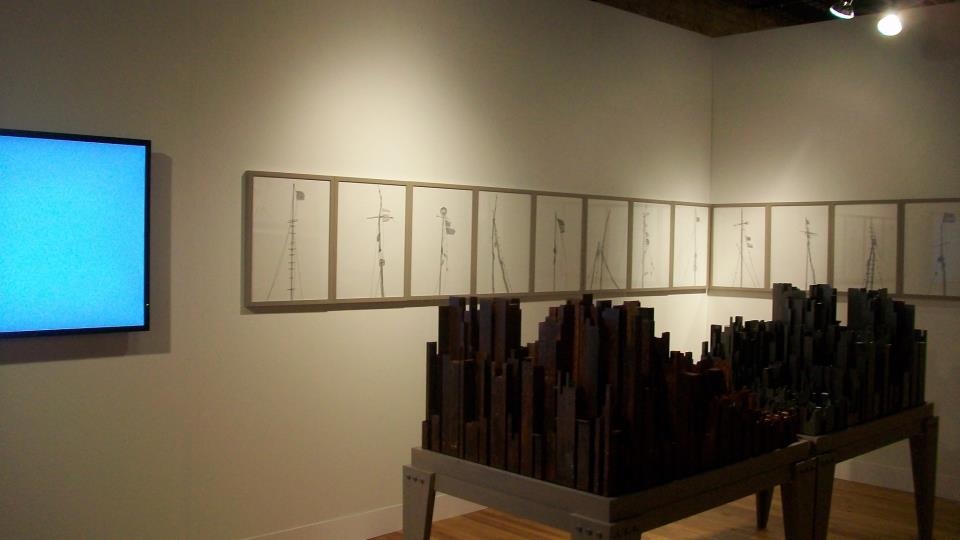
    IC-98 installation at VOLTA NY-2013 with Galleria Heino. photo: Firstindigo&Lifestyle

    Some time has passed since the opening of the 56th Venice Biennale, what are your most important remarks from the art biennale so far, did the location and site change the actual process? How do you feel, are you able to follow up what takes place during the art exhibition?

    IC-98: Working on site-specific projects has taught us that it’s always about communication between the site and us, the hermeneutics of place. In Venice we realized, that we had mostly done the research over the years already (the questions of territory, public space, wood and woods, the history of the Finnish welfare state, the relations of humanity, architecture and nature as a whole). The challenge then was to find the best way to tell the story in a framework of very strict regulations. We were first working on a more ephemeral and performative format, but had to recur to our most well known medium in the end: the animated film.

    During the biennale we have mostly received comments from visitors now and then. But, the perception of our own work hasn’t changed during the process. We have always done a lot of thinking and tried to take into account all the possible permutations of a given site or situation.

    It seems that ‘Hours, Years, Aeons’ has duration and layers, what does the work narrate about? It starts forming in the cave, and goes through time in history? Does it deal with today’s hot topics, such as climate change?

    IC-98: It’s very much about climate change, the much talked about questions of the Anthropocene (note: Wickipedia defines this as: proposed epoch that begins when human activities started to have a significant global impact on Earth’s ecosystems). But our work is post-historical, it is set in a distant future after the age of man. It’s about nature, which still has to deal with the consequences of the human era. It’s not natural nature, but a twisted one. The work exists both as a spatial multi-screen installation and the linear film shown in Venice. The Venice version let’s us experience long, geological stretches of time – the aeons.

    Specifically, the work has a background in the nuclear waste repositories, how something is buried deep into the ground. But as we all know, what is buried, will once surface again.

    Did you find time-based media works as your medium from the very beginning of your artistic career? How about your sculptural works, and the ways different media communicate with each other?

    IC-98: We considered our free distribution books already time-based in a sense. The installations often include an interactive element, which means that they work in space but also as a part of lived time. We have liked the idea of the viewer as a user. But formally we entered the temporal realm when we wanted to make animations. The main idea was to be able to show the chains of cause and effect and use certain cinematic techniques to speak not only to the intellect but also the senses.

    Time-based media has a different nature than other art works. What is your opinion about it, how do you see your art from the point of view of the future, what could be the time-span?

    IC-98: In all probability our works will seem as anachronistic or as nostalgic as any other cultural product of our time. The paradoxical thing is, we always try to conceal the technological or digital basis of our works. We try to make our works look like they could have been made in any era. It would be nice, if in the future it would be impossible to say from the outset when watching our work: “That’s so 2010’s!” Then again, the animations are all about the resolution, the bit-depth, the ratio, and the available digital effects…

    Finally, what are your ongoing and new propositions for the future?

    IC-98: We are in the preproduction phase of our first feature film, ‘The Kingdom of Birds. It’s loosely based on the life’s work of Finnish deep ecologist, eco-fundamentalist, ornithologist and fisherman Pentti Linkola. The film imagines an old fisherman’s last day on earth in a future where all of mankind has perished. It is time for other species.

    The 56th La Biennale di Venezia is open until November 2015, where IC-98 is represented.

    Check out the artist websites following the links below:

    IC-98 homepage: www.socialtoolbox.com

    IC-98 animations: https://vimeo.com/ic98

    IC-98 monograph: http://issuu.com/framefinland/docs/ic98_hoursyearsaeons_1_
  • Artist spotlight: Hiroaki Umeda discusses his recent works

    Artist spotlight: Hiroaki Umeda discusses his recent works

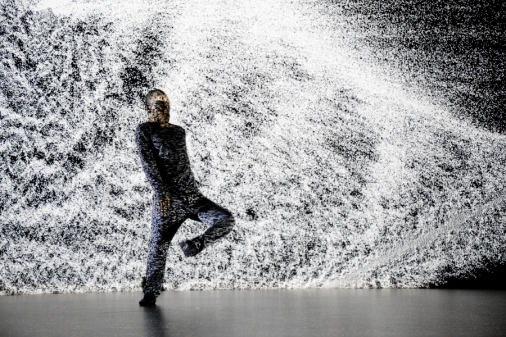
    Japanese contemporary choreographer Hiroaki Umeda recently presented his new choreography Peripheral Stream with L.A. Dance Project at Théâtre du Châtelet in Paris. in 2013, he worked with an ensemble of 11 dancers from GöteborgsOperans Danskompani in Sweden. In the piece, Interfacial Scale, Umeda created the choreography, set, costume, light and sound design. As well as being a choreographer and dancer, Umeda is a visual artist, photographer and video artist. He established his own company S20 in 2000. Umeda has entered the international scene with his multimedia performance works that employ his own body and self-created video images, music and lighting designs. These are recorded on a single notebook computer.

    (On the video Hiroaki Umeda talks about the Interfacial Scale which he created for the GöteborgsOperans Danskompani in Sweden in 2013)

    Since he first drew attention at the 2002 Yokohama Dance Collection R, Umeda has gone on to win praise of dance professionals around the world for the way he wraps his improvisational body movement in intricately woven spaces defined by light (video) and music with the beauty of an art installation. (Tatsuro Ishii for 国際交流基金 / The Japan Foundation Performing Arts Network)

    FIRSTINDIGO&LIFESTYLE: You are known for your own choreographic language that has influences from different styles, and, from the movement point of view is highly flowing and gestural. Is there a way to trace the evolution of it, how did the movement develop?

    Hiroaki Umeda: I started to dance at the age of 20, which is very late in general. At the beginning, I took some dance classes, such as Ballet, Hip Hop and etc. After a year of taking some dance lessons, I realized that there is no specific “dance style” that I want to learn: the dance I wanted to pursue had in fact not existed yet. Plus, I found that what is interesting for me in dance was, not the style, but what lays beneath those styles which is the “principal of movement.” So I started figuring out and understanding the principal of movement by myself, then I applied that principal to my body movement. I would say that my dance should be addressed not as dance but rather as a movement, since I focus on, again, what lays beneath the system of dance, which is the system of movement.

    HIROAKI UMEDA: "Haptic." Photo: Shin Yamagata.
    HIROAKI UMEDA: “Haptic.” Photo: Shin Yamagata.

    You are a Japanese contemporary choreographer, can you describe the dance scene in Japan?

    HU: I have been accepted more abroad than in Japan from the beginning of my career, so I cannot say much on behalf of the Japanese choreographers about what you are asking. However, I personally feel that contemporary dance scene in Japan has not been developed enough yet. The scene is very closed. But on the other hand, it is also true that because of the close-knit circumstances, it has developed very idiosyncratic styles. I cannot say if this close-knit condition is good or not good for the Japanese contemporary dance scene. Anyway, in Japan now, there are so many people who have been struggling and working hard to develop and open-up the scene more; that is a really big hope for me and I thank them a lot.

    You started your artistic career with photography, and then moved towards dance, how did this transition happen?

    HU: I was looking for an art style, which can accept real-time expression, thus, more than photography, I found that dance could be suitable for what I want to express. Dance is an art form in which I can physically put myself into in real time. In photography, on the contrary, it was really hard for me to materialize a piece in real. That is why I shifted to dance from photography. However, I have not totally detached myself from the photographic art form since I have been taking a standpoint throughout that dance can be a form of visual art. Lighting design, which I learned in photography, is now an essential factor for a dance piece.

    The way you construct your choreography seems multidisciplinary. The sound and lighting design, and the visual dimension is crucial in your composition? Can you even differentiate which comes first?

    HU: In practice, I start from abstract drawings, in fact, just lines. This drawing expresses my image of the tension of space, and it functions like the score of the piece to become. According to the drawings, which envision the whole image of the piece, I put together all materials, such as sound, light, dance and etc.

    The visual addition or sometimes ’distortion’ makes your compositions also appear aesthetically ’charged’, could you say something about it?

    HU: In my work, I focus a lot on how the bodily sensation could emerge from the space, and how, in turn, the bodily sensation could change the tension of space. That is, first and foremost, what I am interested in. The basic composition of my piece is always based on choreographing the tension of the space. By acutely tuning into the space, it is possible to attain a lot of stimuli that can provide you with physical sensations.

    What does it culturally mean to be a Japanese choreographer now, from the point of view of globalization?

    HU: have not been working consciously as a “Japanese” choreographer. I have been working as just an artist, focusing on how to bring my pieces to more people all over the world. I think that it is more important to be one of the many artists of the world, than just a Japanese artist.

    Does Butoh as art movement mean anything to you? How about Kabuki, Gutai, and action art? They have also called you ’’avant-garde’’?

    HU: I really appreciate their art works. But actually I am not so close to those Japanese avant-garde cultures. And I cannot tell if they have called me as “avant-garde.”

    What role a nature and technology play in your mind-set?

    HU: Nature and technology are not oppositional concepts for me. As a matter of fact, technology is a tool to understand and approximate nature. By the same token, I think that human beings and art, which human beings create, are a part of nature.

    Where did you grow up? Where do you work these days?

    HU: For the last several years I have been traveling almost all year round. I grew up in Tokyo, and I consider Tokyo as my hometown. But I have been working everywhere in the world. I think that what I do in my art is not connected to any specific country, city or place, so actually I don’t mind working any place in the world.

    You did a work for Gothenburg Dance Company (GöteborgsOperans Danskompani). How was it to work in Sweden, also in terms of cultural exchange? Did dancers like the movement?

    HU: Dancers of the company were from all over the world. They were really skillful and had great intelligence, and were very professional. To start off with, I gave them a system of movement which becomes the under layer of my choreography, and the dancers tried to find their own movements from tapping into that system. I am sure that I enjoyed seeing their movements develop from my system, even more than they enjoyed learning my system. At the moment, I have limited experience as a choreographer for big companies so the dancers helped me a lot and I learned so much from them. I would say that the process was more of collaboration, rather than providing choreography to the dancers.

    In terms of the cultural exchange you are asking, the company was too international to feel any specific cultural differences. I would say that working with them was rather like a kind of universal project, working in various mixed cultures.

    How was it to collaborate in Benjamin Millepied’s LA Dance Project 2? How was the audience response in Paris?

    HU: Compared to LA Dance Project, the Gothenburg Dance Company was strict in terms of working procedures and time schedule precisely because they are a huge public company; I needed to follow their administrative schedule in terms of creative process, which I totally understood. On the contrary, Benjamin’s LA Dance Project is, although they have diverse range or repertoire, still small in scale as a company. For this reason, I could work more closely with the dancers and staff that enabled me to go further and experiment more in the piece. To be very honest, I didn’t expect a good response from audience in the Châtlet. Surprisingly, however, the Paris audience quite openly accepted and appreciated my piece. I was impressed by their open-mindedness.

    Can you name some of your influence or mentors, colleagues?

    HU: There are too many names to list up here.

    What are your plans for the future, and dreams?

    HU: From last year, I have started making choreography devoid of human body. For me, human bodies are not the only elements for choreographic consideration. In fact, I want to really challenge choreographing anything with “movement,” and develop a dance piece with various elements. One of my dreams now is to choreograph water.


  • Volta NY 14: Inzilo by Mohau Modisakeng

    Volta NY 14: Inzilo by Mohau Modisakeng

    South African Mohau Modisakeng’s beautiful video Inzilo was an eye-catchers at VOLTA NY 2014. The slow-motion video opens up a theme of mourning from a personal point of view. Inzilo is a word that ”refers to a practice in some South African traditions around the loss of a loved one characterized by a period of mourning.” Dressed only in a piece of black garment and a hat, Mohau, as a solo performer goes through a process where he transits from one stage to the next. Sitting on a chair motionless, he first looks ethereal both arms stretched on his side, as the camera rotates slightly around the white room. Then he starts scattering, picking pieces of the burnt fabric (in this case wax) and ash from his hands. Gradually, it appears that as layers of burnt go, a new skin is revealed. The camera shows close-ups of his hands and feet covered with debris. Eventually, head bent down, he decides to get up, shakes and throws the remained pieces with a dust cloud in the air. His performance represents a rite of passage, a transition from mourning to normal.

    Performing rituals is one powerful way to convey African indigenous, diasporic and post-apartheid messages via contemporary art. We have seen this happen in the dance works of South African choreographer Vincent Mantsoe, based in France. This similar kind of purity of emotions and thought comes across from Mohau Modisakeng’s video, which is a dialogue between a performance and the visual.

    Mohau Modisakeng was represented at VOLTA NY 2014 by BRUNDYN + gallery from CAPE TOWN. The artist was born in Soweto. He lives and works between Johannesburg and Cape Town. He completed his undergraduate degree at the Michaelis School of Fine Art, Cape Town in 2009 and worked towards his Masters degree at the same institution. He was awarded the SASOL New Signatures Award for 2011. The artist was presented at VOLTA NY also in 2013.

    visit BRUNDYN + gallery http://www.brundyngonsalves.com/gallery/