Patricia Chow, an LA-based abstract painter who creates place-specific sensory works, returned from her artist residency in France.
Firstindigo&Lifestyle: You have been living mostly in LA during the Covid. I imagine everyday life experiences have changed for you as well.
Patricia Chow: I was used to frequent international travel prior to Covid, so it was definitely an adjustment during lockdown. My art practice had been centered around translating place-specific sensory and mental lived experiences into abstract paintings, and needless to say, this failed utterly when the only place I experienced for 16 months was the inside of my apartment. My goal for 2021 was to re-acclimate to life in the world, including rebuilding my place-based art practice.
Firstindigo&Lifestyle: Why Vallauris, France, how did you find about this place and art residency?
PC: While the world began to reopen for travel in summer 2021, Covid infection rates continued to surge, so I used my skills from my day job as a data analyst to track international infection rates and identify regions where it would actually be safer for me to stay than Los Angeles, where I currently live. The other piece of the puzzle was to identify residencies in those areas that were still operating and had places for late 2021. Prior to omicron, France had been doing well.
I had wanted to spend some time in Collioure, France, to investigate the origins of fauvism, so this became a starting point for my search. I ended up 300 miles to the east in the town of Vallauris (val-o-REES), where Picasso did his ceramic work in the 1950s. I was very lucky – the A.I.R. Vallauris residency lasted five weeks, and soon after I left, France’s infection rate skyrocketed to 50,000 new daily cases.
Firstindigo&Lifestyle: The landscape and atmosphere are probably very different from West Coast of the United States. Can you explain what is special about this residency, regarding of art history?
PC: The Côte d’Azur region has beautiful light and dramatic scenery which have drawn artists for hundreds of years, as well as many museums dedicated to these artists (Chagall, Cocteau, Matisse, Picasso-who has two museums), and museums located in the former homes of the artists (Bonnard, Fragonard, Léger, Renoir), not to mention the fabulous Fondation Maeght. All of this was definitely a draw.
Another draw was the residency’s self-contained format. The six cohort artists live in the same historic building and work in the same studios, essentially forming our own Covid pod, which helps limit exposure for everyone. While the living arrangements were quite spartan, I felt very lucky with my cohort – we had a lot of synergy in terms of both artistic and intellectual interests, and the final exhibition turned out to be quite cohesive.
Firstindigo&Lifestyle: How did the new work get exhibited?
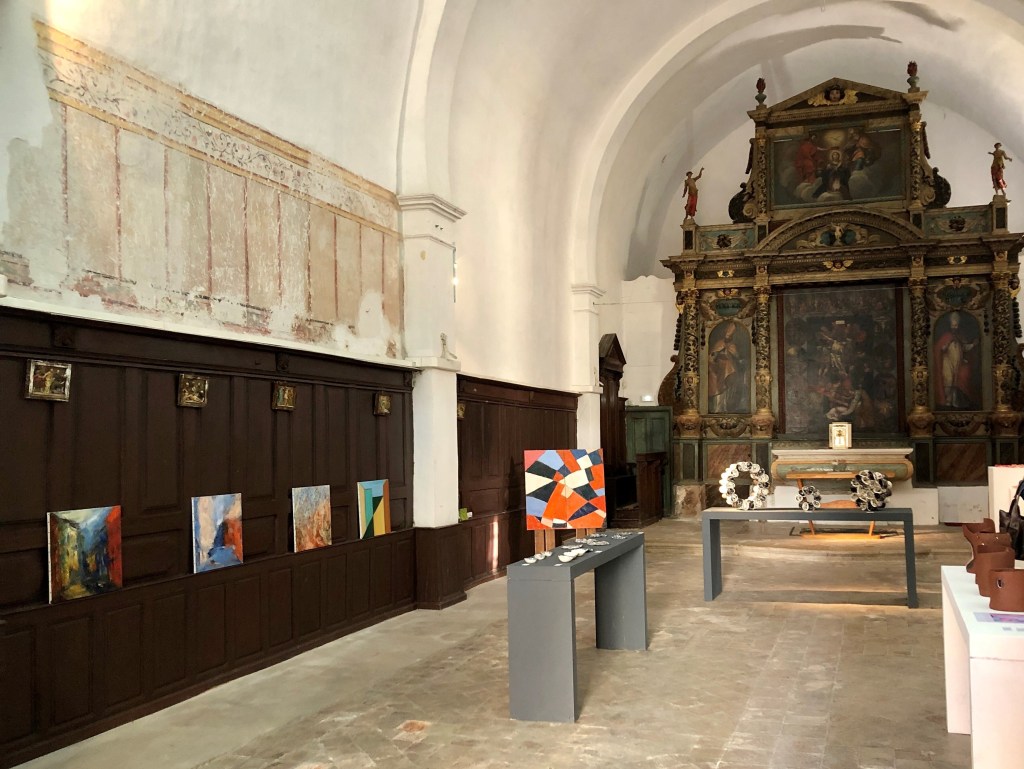
PC: Another interesting aspect of this residency was the exhibition space for the final show: the Chapelle de la Miséricorde, built in 1664, and housing an enormous Baroque altarpiece from 1724. Of course, this could be both a blessing and a curse – small works might feel overshadowed by the space, and censorship could be a problem for some artists since it is, after all, inside a church.
Firstindigo&Lifestyle: How would you think this location impacted your creative process, creating new sort of place-specific works?
PC: I created a series of five mental landscape paintings of Place Lisnard: four 50x50cm studies and one larger painting, a 100x100cm diptych. I call them site-specific paintings because they are the most location-specific paintings I have ever done.
Place Lisnard is an address, a pin on a map, rather than the conceptual space or idea of a city or place, and the paintings were made specifically for the exhibition space. The series explores different ways of translating the town square in paint, influenced by the many artists who came before me to the region.
They are unified by a common color palette, which is ubiquitous in the area – found on everything from building exteriors and tromp l’oeil window shutters to bus tickets. The final diptych remains in the collection of the Chapelle de la Miséricorde, where it was first displayed.
Firstindigo&Lifestyle: What do you feel you were able to take with youfrom this experience?
PC: It is so important to stay flexible. Things have a strange way of working themselves out. I had wanted to do a deep dive into André Derain’s fauvist paintings in Collioure, but ended up in Vallauris submerging myself in the landscape paintings of Russian-French painter Nicolas de Staël who had spent some time in the area. One of his paintings from Agrigento is here in L.A., but there is very little written on him in English, and the books in French are hard to obtain in the U.S. But in France, I could just walk into the bookstore at FNAC and pick up a couple of monographs right off the shelf.
Firstindigo&Lifestyle: During Covid, the material details of our everyday life have also been unusual. Did you experiencesome hardship during your five week residency, any obstacles and locally specific solutions for overcoming them?
PC: The availability of materials turned out to be a challenge – the R&F oil sticks I usually use are sold in only two stores in France – and both are in Paris, 900km away. I even wrote to the founder of R&F about it, and he recommended ordering them on Amazon. I ended up pivoting to locally available materials that I had not seen before – Cobra Artist water-mixable oil paint. I had only ever seen the student grade of these in the U.S. The artist grade was much nicer – actually like oil paint, without the complicated cleanup. And since the materials will always dictate to some extent the work that you can do, I ended up painting in thick impasto with a knife, like the de Staël master copies I was doing, while incorporating the specific characteristics of Place Lisnard, the town square where the exhibition space, studio and accommodations were all located.
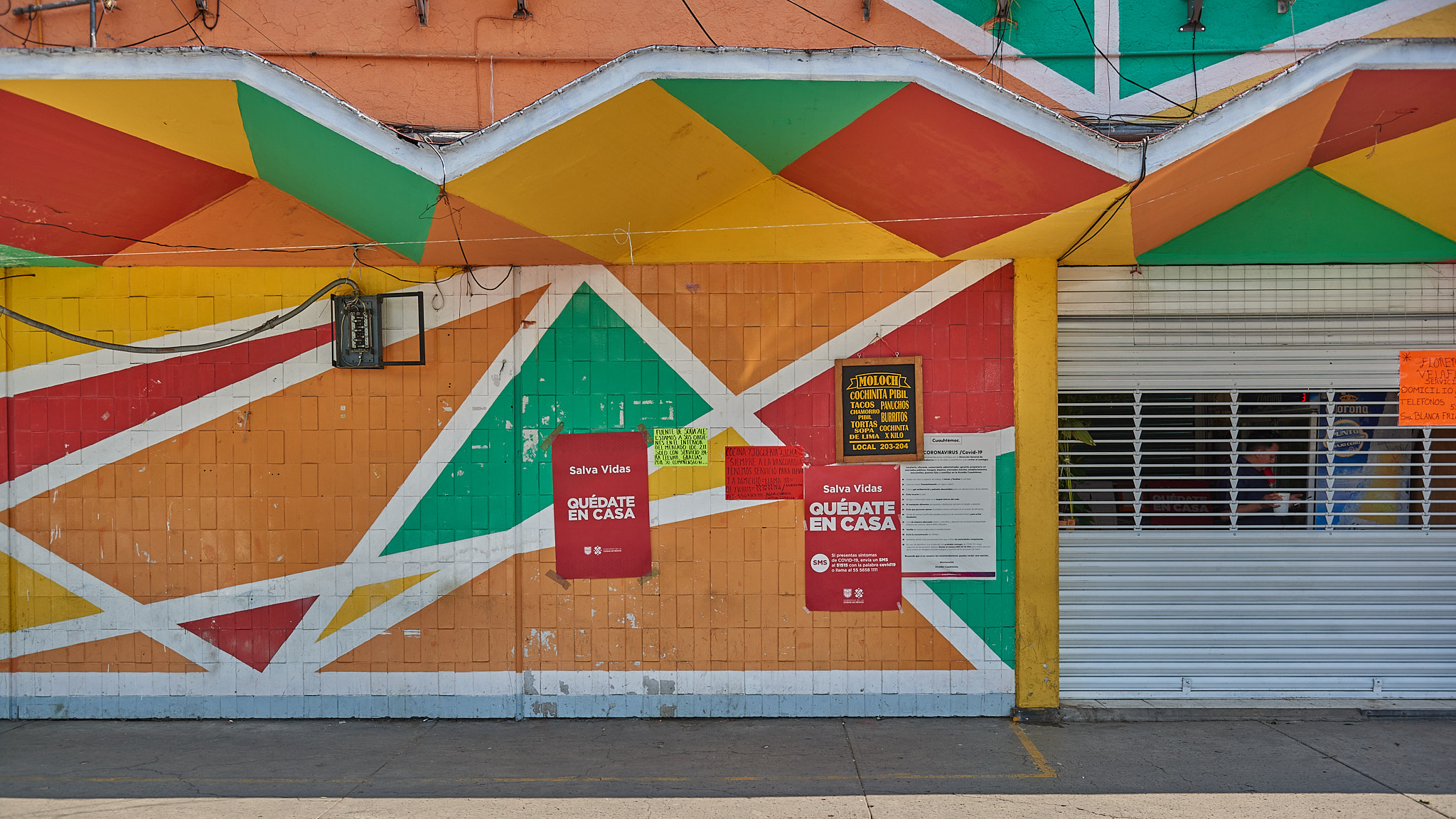
Pandemic has left many cities different, as if touched by invisible forces that folded a new narrative in front of us, for what is here now, and what might be more common in the future. At least, it is true to New York City. Finnish film director, visual artist and choreographer, Anna Nykyri created a short film “In-Between”, 2020 (2’51), to capture cityscapes during the pandemic. The artist collaborated with the photographers Aukusti Heinonen, Juan Pablo de la Vega and Griselda San Martin in Helsinki, Mexico City, and New York, respectively, to show relationships of the transient bodies that avoid contact with each other in these cities.
From short film, In-Between (2020). Image: Juan Pablo de la Vega
The documentary film curated by Andrea Valencia, is conceived as a montage that compiles photography and moving image to grasp the results of social distancing in the three cities, which are connected by the shared experience of the pandemic. By capturing details and fragments of the spaces and the moving bodies, “In-Between” suggests that, while movement and touch are being restricted, we are living an emotional collective experience.*
Firstindigo&Lifestyle: As an artist, your practice is quite multidisciplinary. What is interesting is the way your dance and choreography, and film-making, communicate fresh angles to these fields. Maybe there is a level of interconnectivity between these artistic disciplines. Can you tell, how did you eventually pick your artistic practices?
Anna Nykyri: My intention as an artist has always been trying to create an artform, that would bring together my artistic interests at the time. So, I never tried to be a director, screenwriter, visual artist or choreographer. The current piece that I’m creating matters the most. My definition as an artist can be defined through the piece.
Firstindigo&Lifestyle: Where we come from, to some extend defines what becomes of us, or let me put it this way. I think that sometimes we dream very early on, what we want to be doing when we grow up. Where did you grow up and go to school?
AN: As a 4-year-old, I told my parents I wanted to be a dancer. We lived in the rural countryside and the ballet classes were too far away to attend multiple times a week. Kaustinen, where we lived in, is famous for it’s folk music tradition. So, music it was. During the ten years I played violin, I almost never practiced, was really bad at it but somehow managed to get along with the others to an American tour (twice) and understood what it meant and took to be an artist.
Later on I started singing and playing piano. After a college of music I went to Kemi-Tornio University of Applied Sciences to study my BA in media, started ballet classes and continued to MA-studies in Finnish Academy of Fine Arts specializing in moving image (MFA). I was lucky to have Eija-Liisa Ahtila, Veli Granö, Salla Tykkä and LiisaRoberts as my professors. They were great teachers and certainly had a great impact on my working processes. During the Academy of Fine Arts I also studied pedagogical dance studies in Jyväskylä University & later MA Choreography studies in Trinity Laban College of Music and Dance in London. I guess I have just always really loved learning new things.
Firstindigo&Lifestyle: Trinity Laban is a dear place in my own artistic history. When I was a student there, it was a place to find interdisciplinary approaches. You are a recent graduate. Did you find that the choreographer training supported multiple directions and platforms?
AN: Yes, I absolutely think it did. Still, after attending the MFA studies in Finnish Academy of Fine Arts with an unlimited number of courses to attend with a huge number of supportive one-to-one meetings with teachers & curators, studying in MA Choreography studies in Trinity Laban was much more self-lead. Also, the system of art grading is a different kind of process there, and I feel that being judged by juries was certainly the opposite of the pedagogical angle I had been used to. Of course the school had great teachers, and they are known for having creative professionals doing and implementing the curriculum. But, I personally felt that the system was partly old-fashioned. So, I struggled with disagreeing with some of the principles the system is built on, but fought my way through it, eventually. And learned a lot for sure.
Sonic Presence of an Absent Choreography
Firstindigo&Lifestyle: Sound is an important part of your choreographic and creative work as well. In choreography, sound often comes together with the moving bodies. But, how do you compose a dance piece without choreography being visually present on stage, relying solely on sound?
AN: I have had the joy to work in artistic collaboration with many great sound designers, sound artists and composers, to mention a few: Petri Kuljuntausta, Olli Huhtanen, Mikko Joensuu, Antti Nykyri and Félix Blume.
Immersive sound installation and choreographic environment “Sonic Presence of an Absent Choreography” is an artistic collaboration between curator Andrea Valencia (MEX/US), sound artist Félix Blume, choreographer, dancer Veli Lehtovaara and me. The installation was made for Prague Quadrenniale 2019, Finnish ECR Exhibition Fluid Stages and was curated by KOKIMO. The piece consists entirely of recorded sounds of a dance. Through the installation, we aimed to reveal the ephemerality of the body on the stage through the immaterial media of sound.
In this particular artistic collaboration, the choreography was based on a visual score, an image I brought to the rehearsals. The image is a picture of an empty advertisement board, filled with strands of old, ripped posters. I took the picture during a nighttime in Tampere, while passing by. For some reason I just felt like the empty advertisement board in the silent city environment had all the sound and choreographic elements in it. Choreographer, dancer Veli Lehtovaara looked at the image for a while and then started dancing. Sound artist Félix Blume recorded Veli´s dance and did a great job by creating a sound score for the piece and further mixing the sounds for the installation in artistic collaboration with me and Veli.
Video documentation from the recordings of the piece, by Félix Blume (6min 41sec): https://vimeo.com/289907108
Firstindigo&Lifestyle: The all encompassing subject at the moment is of course the Covid pandemic. You created a film that was based on the pandemic in different locations of the world. Can you shed some more light on the process of making this short film?
AN: The short film “In-Between” (2020, https://vimeo.com/432870117 ) is a second work, which I had the chance to work with the great New York/Mexico City based curator Andrea Valencia. I met Andrea whilst working in ISCP residency, New York in 2017 and we instantly bonded, sharing the interest for empty spaces in the cityscape, for instance. Aukusti, who is specialized in photographing architecture, I knew from beforehand and had wanted to work with for a while already, but Juan Pablo, who especially blew my mind with his photos on the cityscapes and Griselda, who is and amazing portrait photographer (for example for New York Times magazine) were introduced to me through our curator Andrea Valencia.
The documentary film is conceived as a montage that compiles photography and moving images to grasp the results of social distancing in the three cities, which are connected by the shared experience of the pandemic. By capturing details and fragments of the spaces and the moving bodies, In-Between suggests that, while movement and touch are being restricted, we are living an emotional collective experience. -Andrea Valencia
Firstindigo&Lifestyle: How do you think the collaboration taking place between multiple countries came together from the point of view of editing and bringing the entire visual material together?
AN: The working process, first of all, included people from various time zones during the pandemic, which created certain restrictions for timing our online meetings. Also, in Helsinki, the Covid situation during the late springtime 2020 was comparably easy, but in New York City and Mexico City, I guess no one really knew the magnitude of things at that point. So, we had to be really strict about the safety of the photographers participating, some of them having small children etc.
I felt that my main task as director in this particular project was to suggest ideas of the angles from which to shoot the world during pandemic. So, we had long talks with the photographers on the themes of the film, but still wanted to give them a lot of freedom and it was a surprise for me, how they would approach the subject. Editing the photos and videos together was an important part of the process, and reminded of editing an archival montage. During the summer 2020, we edited the film in Helsinki with Jaakko Peltokangas. Sound design of the film was made by Olli Huhtanen, whose work I deeply admire. We wanted to publish the film online so that it would be possible for everyone to access. At the same time, the film was made really fast, the clock was ticking and we knew it would stay online however it would turn out to be, there would be no going back.
Firstindigo&Lifestyle: It is very inspiring that you are an artist between two or many artistic endeavors. It could also be challenging, but at the same time it seems to be rewarding. What obstacles can you recall having while finding parameters in your career?
AN: Working as a multidisciplinary artist within film, fine arts, contemporary choreography and sometimes also television, for me the most challenging part has been accepting the fact that it’s OK not to be good at everything, learning as you go. For example, in Trinity Laban, I was surrounded by amazing dancers. Dance has been a part of my life as a hobby and part of my practice for a while already. Still, there were MA Choreography students with amazing talents in that section, while my background was mostly in film and visual arts.
Visual Score by Anna Nykyri
Firstindigo&Lifestyle: Can you say that you are more of a choreographer than filmmaker, or is it a completely irrelevant question?
AN: I define myself as a visual artist, working with moving image, film, cinematic installations and choreographic environments.
Firstindigo&Lifestyle: How did your everyday life and work life balance shift, and change during the pandemic so far?
AN: It certainly changed a lot. Basically, all my artistic collaborations turned into remote work – into zoom meetings etc. During the late fall, I was screenwriting and directing a pilot episode for a documentary television series for YLE. Shooting documentary footage during the pandemic was hard work for all of us – mostly with the extremely tight safety restrictions to keep everyone safe. For the past 1,5 months I’ve been lucky enough to work remotely from a cabin at Iso-Syöte, which is the southernmost fall of Finland.
My weekly dance classes shifted into online classes (mostly Gaga movement language, developed by choreographer Ohad Naharin, which I can warmly recommend to everyone: https://www.gagapeople.com/en/) and gym training into home workouts. I really am grateful for all the dance & sports practitioners, who have continued teaching online! The online classes and workshops have saved me during these unexpected times.
Firstindigo&Lifestyle: This year, you are going to be participating in WRO Media Art Biennale in Poland. It is so interesting, as it also consists of a collaboration that you started at the new award-winning Oodi library in central Helsinki?
AN: I’m super excited about the WRO Media Art Biennale opening in Wroclaw, Poland, May 12-15, 2021! I’m currently developing a new piece consisting of moving images in collaboration with visual artist Kaisu Koivisto, Helsinki Artist’s Association (project coordinator Anna Puhakka) and curator Agnieszka Kubicka-Dzieduszycka from the WRO Art Center. The collaboration project, called “Synthesis”, began in Autumn 2020 with a shared exhibition in Central Library Oodi and includes, on top of the WRO Biennale, a following exhibition at Oodi in November 2021. Our interactive video installation will be presented in Wrocklaw in late autumn 2021 as well as in Helsinki, but we will already have an open talk during the opening week of the biennale: https://wro2021.wrocenter.pl/en/works/synthesis/. In the talk we will be reflecting the starting point for our work, Polish artist Pawel Janicki’s algorithmic structure “Synthesis”, and where has it led us.
The theme of the biennale is “reverso”. Me and Kaisu are at the moment gathering footage from our personal archives and filming some new footage. With this kind of theme, I think it has been a lot of fun to think of, what actually matters to us as artists, going back to the “roots”. Currently we are digging into the possibilities of MaxMSP program, testing the possible outcomes of an interactive installation, a choreographic environment.
Firstindigo&Lifestyle: There is a lingering feeling that pandemic left us with some new ideas of how to connect and collaborate. Did you have any time to think what you want to do next?
AN: The year 2021 will be busy with the upcoming exhibitions and a screenwriting process of a fictional short film and a feature length film. Luckily, with the upcoming film works I’m collaborating with an experienced producer, Markku Tuurna and an established dramaturge Tarja Kylmä with both of the films. In 2022, I will also present an installation at the façade of Gallery Forum Box.
Also, for years already, my dream has been to have the time to focus on a research plan, apply for PhD studies, continuing my artistic research in relation to the choreographic environment within post graduate studies.
Who knows, what’s going to happen? There’s always a new adventure waiting around the corner.
— — — *‘In-Between’ was supported and commissioned by The Finnish Cultural and Academic Institutes’ Together Alone project and supported by Arts Promotion Centre Finland.
Directed & screenwritten by: Anna Nykyri Photography by: Griselda San Martin, Juan Pablo de la Vega, Aukusti Heinonen Edited by: Jaakko Peltokangas Sound designed by: Olli Huhtanen Curated by: Andrea Valencia
Featured image:
Short film, Passing by: Passing by (2020) Documentary short film 1’50” Passing by shows a carcass of a young roe deer slowly decomposing in a forest, whilst cars are fast passing by on a nearby highway. The film creates a strong emotional charge of passing by; moving from the highway into the forest, details of fur, flies, a carcass – then distancing again, leaving the calf to be covered by the forest.
The film was supported by The Promotion Center for Audiovisual Culture AVEK / Media Art and Arts Promotion Centre Finland.
Directed and screenwritten by: Anna Nykyri Cinematography by: Italo Moncada Edited by: Jaakko Peltokangas Music by: Mikko Joensuu Sound designed by: Juuso Oksala Color correction by: Juuso Laatio
Firstindigo&Lifestyle:The color field painting created space for exploration of color as a subject matter. How did this field of abstraction influence your work in the first place?
Ellen Hackl Fagan is an American artist working with painting, which is richly influenced by music of her generation. Starting to figure out her artistic practice in the early 80s, she found color as a strong compositional element. When looking at her paintings, one could say the ideas derive from traditions of Color Field. But it’s more than that.
The artistic experience and the bodily encounter with the materiality of work create another layer. Music and color go together also in a more profound and ethereal way in some of Hackl Fagan’s work, appearing as if systems and science were components of the network of sound and its emerging visual pattern.
Firstindigo&Lifestyle: Now, the cobalt is a color, which is a great conversation starter. How many times have you experienced people just being absorbed into the inviting presence of the color?
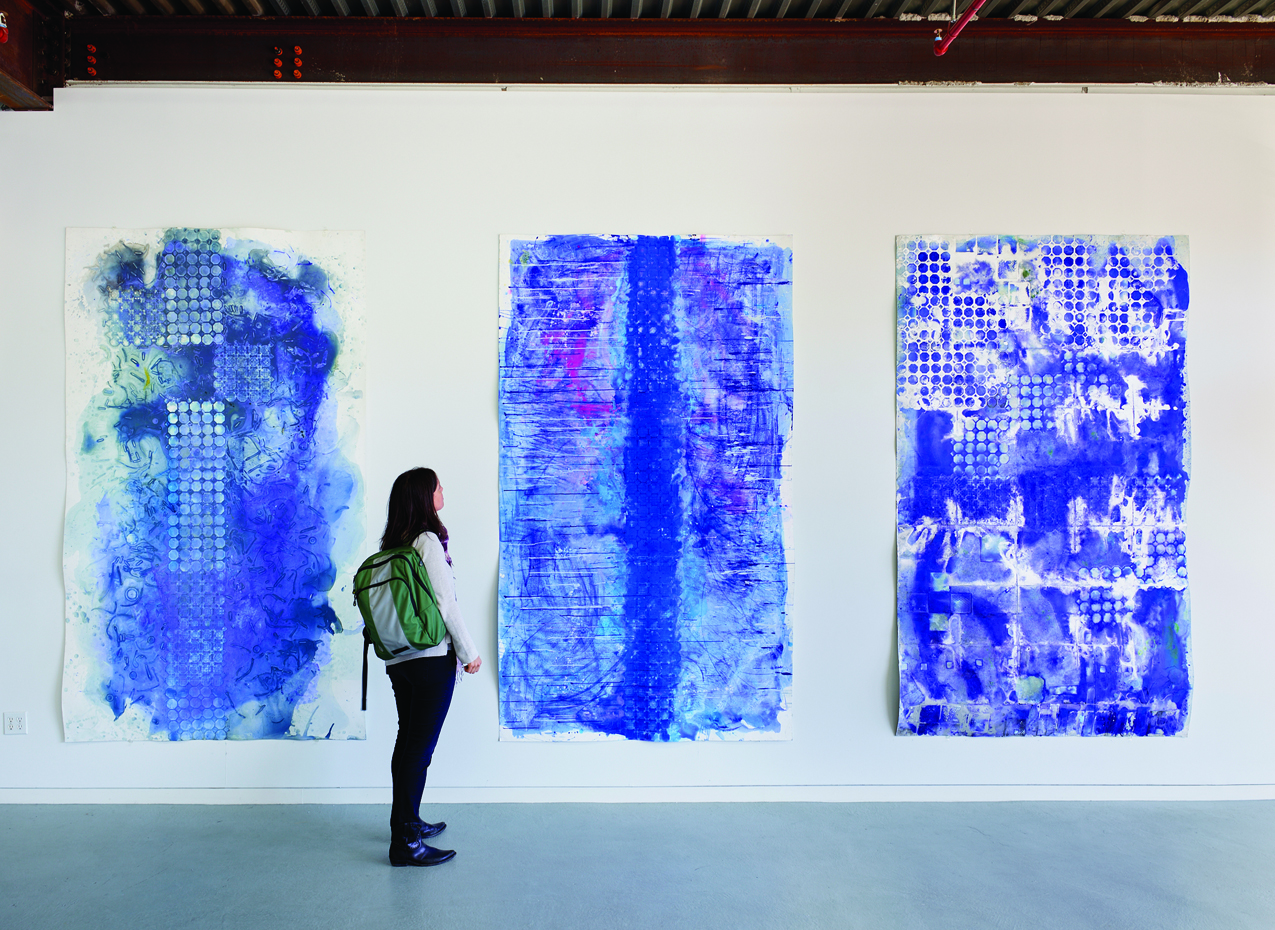
EHF: That happens all of the time. In my studio space, which was in the back of ODETTA in Bushwick, one was surrounded by blue from my walls to the floor. I found visitors would linger there, and mentioned often that the blue made them feel really good. So, it emanated a healing resonance with visitors to my space. I think this is one reason why I’ve remained focused on the color and the surface from this particular paint, KT Color, is that it resonates, down to the individual particles, because of the matte surface and the saturated hue.
Firstindigo&Lifestyle:Can you tell, how did you find cobalt, and how long has this investigation been your premise?
EHF: I have attempted to make paintings emanate sound through saturated color since 1981. At that time I was pursuing my undergrad degree, BFA in painting and photography, and was seeing a lot of live music. Punk culture was in full force, so sound and design were interchangeable. A painting I created, The Floozies vs the Force, in 1981, was a painting that was predominantly red and blue, and is oversized. I began to see that the cobalt blue used in this painting, a latex/household paint, would turn to a white hot in low-light times of day: dawn and dusk. The red of the painting would recede, and the blue would advance, which was the opposite of what we were trained to understand about color in school. This intrigued me, and I began to consider cobalt blue as a color that had a broader communicative range, and could possibly hold the key to my color/sound investigation.
Firstindigo&Lifestyle:You say that cobalt has some mystical components, does this mean transcendental in some ways?
EHF: Yes, I feel that this color actually connects with our spirit, and that it communicates directly to this intangible part of our being, which is why the response to blue is universally tied to the spirit. I think we all feel it.
Firstindigo&Lifestyle:The process of painting for you is very physical, it’s almost performative how you pour the paint on canvas, and work toward the outcome. Can you explain your process with paint, water, and objects, how they all are involved in your practice and contribute to it?
I think it’s about immersion. I want to put my full body into painting, connect physically with each aspect of the process, and finish, like a yoga deep breathing exercise, with the eyes as the final part that communicates to the color. I have a long history in dance, and feel that this visceral connection comes from this history, or muscle memory.
Firstindigo&Lifestyle:There seems to be an element of covering and revealing in the process?
EHF: Yes, I call this part “blind painting.” In order to gain a full field of pattern, I have to cover the surface. I can’t know for sure what the outcome will be, which is an aspect of trust I’ve established with the materials themselves. I feel they have more to teach me than I them. I want to explore the full range of their characteristics, which means I cannot be the author of the final image, the paint is the author. I set the stage, facilitate its dynamic potential, and then I leave the room and let gravity and evaporation do their part to finish the work. If I’m not happy with the result, I tend to live with it for a while before going back into it for a second pass. I learned a lot about listening to my materials through ceramics. Often the ceramic work would come out of the group kiln at school with an unexpected result in the glazing and painting that I had put together with the underglazes and oxides.
When I pulled the pieces out of the kiln, at first they disappointed me due to my expectations. But, over time, they made me look at the unfamiliar with an open mind, and would convince me that they had a strength to them that I could have never controlled or forseen. This made me want to explore accident and the unexpected more in my painting.
Firstindigo&Lifestyle:Can you tell about your background, and how did you find your calling as an artist?
EHF: I have always called myself an artist. From a very young age, 5 or 6, I can remember identifying myself in this way. I am the sixth of eight children, and married into a family of twelve children. My husband was a twin, he passed away in 1996 from an undiagnosed cancer, leaving me to raise three very young sons by myself. The boys are all young men now, with lives of their own, but we are close. I always made drawings, played school, painted, argued, and have had a life where I maintain a space for play.
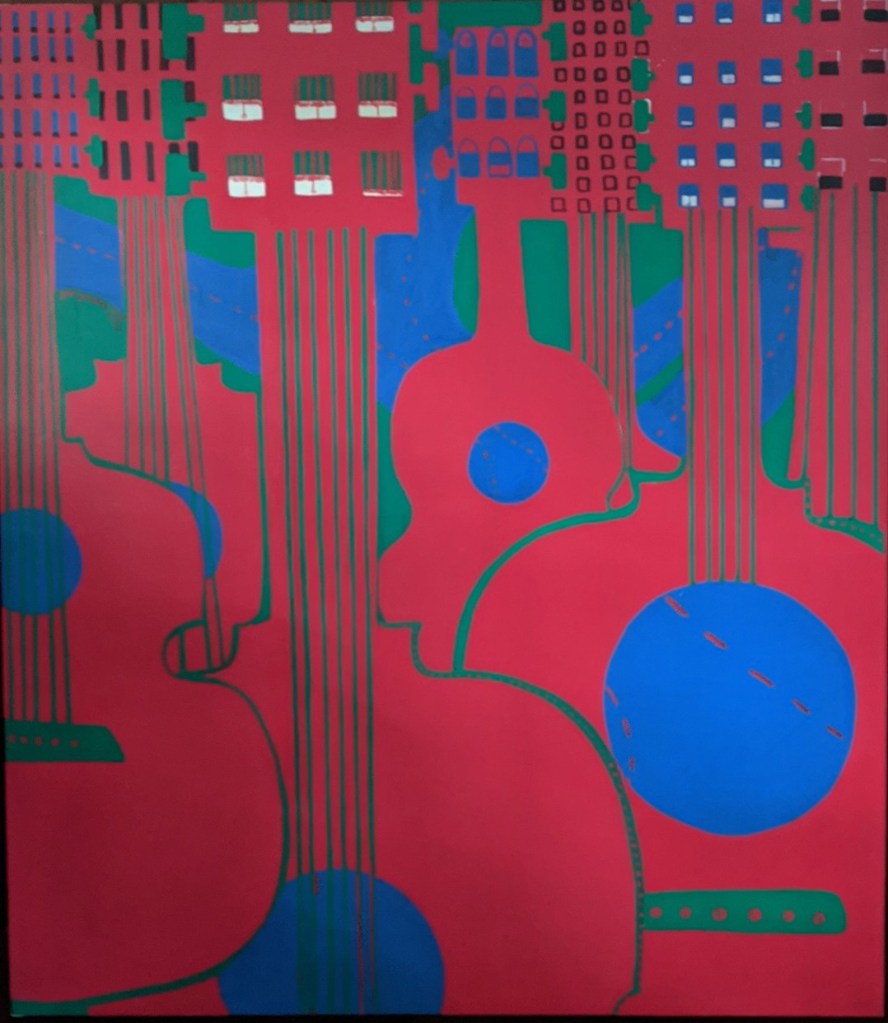
Margaret Ellen Hackl, City Sounds, 1981, latex house paint on canvas, 60″x57″ in.
Firstindigo&Lifestyle: What are your influences in different arts of technology, and the systems, which have an impact on your creation?
EHF: For me, Color Field suggests an immersive experience of deep looking. Color Field has been a part of my development as a painter since 1981these paintings from 1981 are both full body size, which put me in full contact with responding to these contrasting colors when painting them, they literally would throw me off the easel as my eyes were having ocular severe reactions. I nicknamed them “retinal eye bouncers” for the punk era, these were a sympathetic relative to the music I was seeing live so colors spoke of sound, from the moment I began working in a flat, graphic style. Pop Art and Punk graphics were also a major influence at this time.
EHF: My influences from technology all source from music since 1981. I have referenced punk music, early pioneers of abstract, electronic music like Morton Subotnik, the fluxus influences dating back as early as Dada and Schwitters to John Cage, to Frank Zappa, to Brian Eno and David Byrne. The systems tend to be based in the arts, but many have application in the sciences as well.
Firstindigo&Lifestyle:How about the collaborations you have created with musicians and composers?
EHF: These collaborations have come to me since 1981 as well. Most composers/creators of music, see a relationship in my work to sound and are always eager to join me in my projects, musicians are natural collaborators, so it has been a path rich with artists to work with.
Firstindigo&Lifestyle:I remember you having an installation at the New York Public Library, how did this project succeed in terms of audience response?
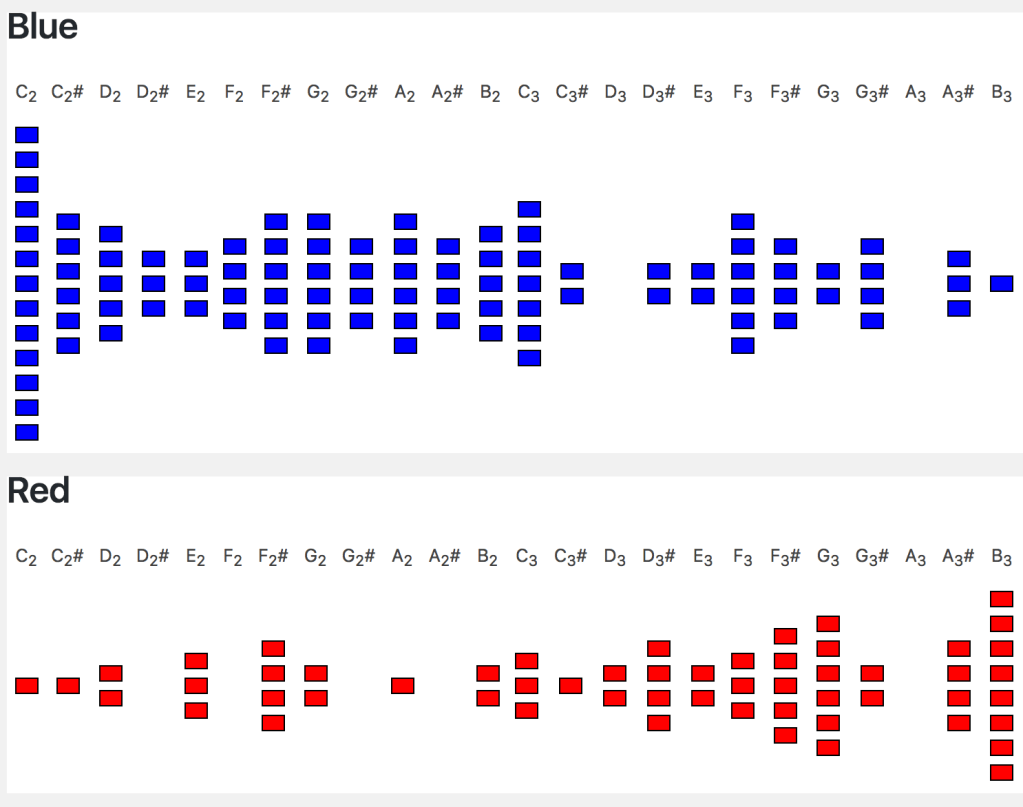
EHF: I was invited to share a panel with two guest artists, of my choosing. As we all focused on the relationship of sound to color, and vice-versa, I asked the audience to play the Reverse Color Organ all together. We focused on blue and their responses when asked to pair a sound to the color looked like this, then I asked for red. You can see their results pretty much feels like common sense. I would like to collaborate with an institution or a person to gain a lot more viewer input for the Reverse Color Organ.
Ellen Hackl Fagan, Riverse Color Organ.
Firstindigo&Lifestyle:Your interest is very much also in the musical and sound aspect of the work. The blue color can have almost symphonic qualities. Do you feel this way?
EHF: Yes, I am a product of a long history of rock and roll, punk, and some dabbling in jazz and world music especially growing up seeing punk bands and following certain bands over the past three decades. Music is a direct influence in my work.
Firstindigo&Lifestyle:Could you tell a little more about your recent exhibition, and a project called Helpless?
EHF: I was thrilled to be invited to create a solo exhibition for Five Points Centerfor the Visual Arts. I was asked a year ago. As COVID-19 took over our lives and the galleries and museums all closed, it wasn’t certain when this exhibition would open. I give them a ton of credit for staying on time with their programming during all this chaos. It has been a great experience working with them.
For Helpless, I began working in the studio in early May in the early night sky there was a congruence of Jupiter, Saturn, and Mars. This was visible to me when we took a Mother’s Day hike in a local park where we were finishing up as it grew dark. We all talked about which planets these might be, etc. These burned in my visual memory as I was painting, and then the song Helpless flooded my mind as well. It became a meditation of sorts, and the title felt right for the exhibition. I’m a real fan of Neil Young’s music, since my teens, it was comforting having his voice in my head.
Firstindigo&Lifestyle:COVID-19 has changed a lot of the daily practices. How have you experienced this time in your life?
EHF: I run a gallery, which has now morphed into three distinct new projects, in addition to my solo work. If given a full time assistant, I’d really get on top of my work load. Mainly, I miss having the freedom to get together with family without a litany of interview-like questions but we’re working it out. I’m finally going to see my mother, who lives in the Midwest, and I continue my work commitment in and out of our recent quarantine periods. Otherwise, I’m staying healthy and patient that we will get through this pandemic. I paint in my garage, and am happy to have carved out this work space last summer. It is my source for happiness, the studio, and I’m thankful for this.
Ellen Hackl Fagan Studio view. Seeking the Sound of Cobalt Blue, Big Blue, 2020, pigment, acrylic, museum board, FV, 108 x 60 in.
Featured image: Margaret Ellen Hackl, The Floozies vs the Force, 1981.






 Firstindigo&Lifestyle