Almost thought, that I wouldn’t visit The Armory Show, which took place in the first week of March. The art fair’s tiredless self-promotion worked, however, and the show on Piers 92 and 94 didn’t disappoint. Next time, The Armory will move to a new location, providing also different dates. New York’s Javits Center will host the show in September 2021.
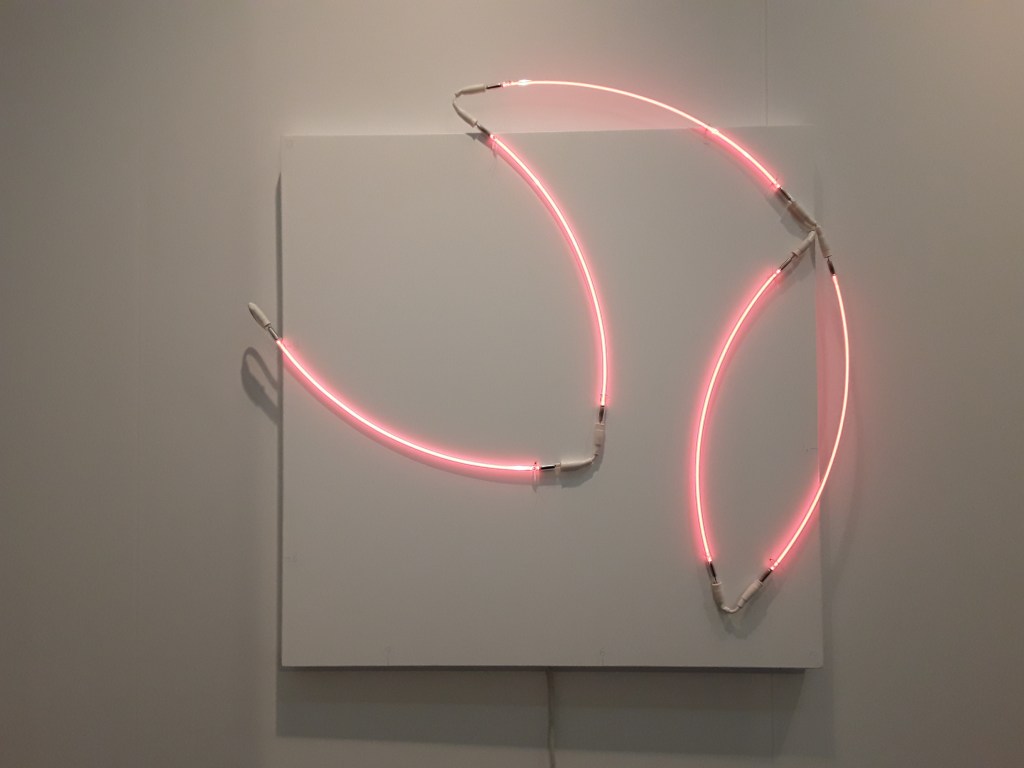
Exhibitions of delicate, poetic, musical, and folding works, that create beauty in a world full of turmoils, took a center stage. One could pick the art with rose colored glasses. The Women’s History Month approved to be relevant. I immediately fell in love with Francois Morellet’s red neon work “Contorsions” (2007), at a Milanese gallery A Arte Invernizzi’s beautiful and minimalist booth.
Shahzia Sikander, Double Sight, 2018, glass mosaic with patinated brass frame mosaic. Sean Kelly, NY.
Shahzia Sikander’s“Double Sight” (2018), is a mosaic work that draws from classical miniature painting traditions of Indo-Persian origins. The Pakistani-born international artist has experimented with the medium, and employs multiple perspectives to her works, including those of South Asian, American, Feminist and Muslim. The topics the artist explores are globalisation, languages, trade, empire, and migration.
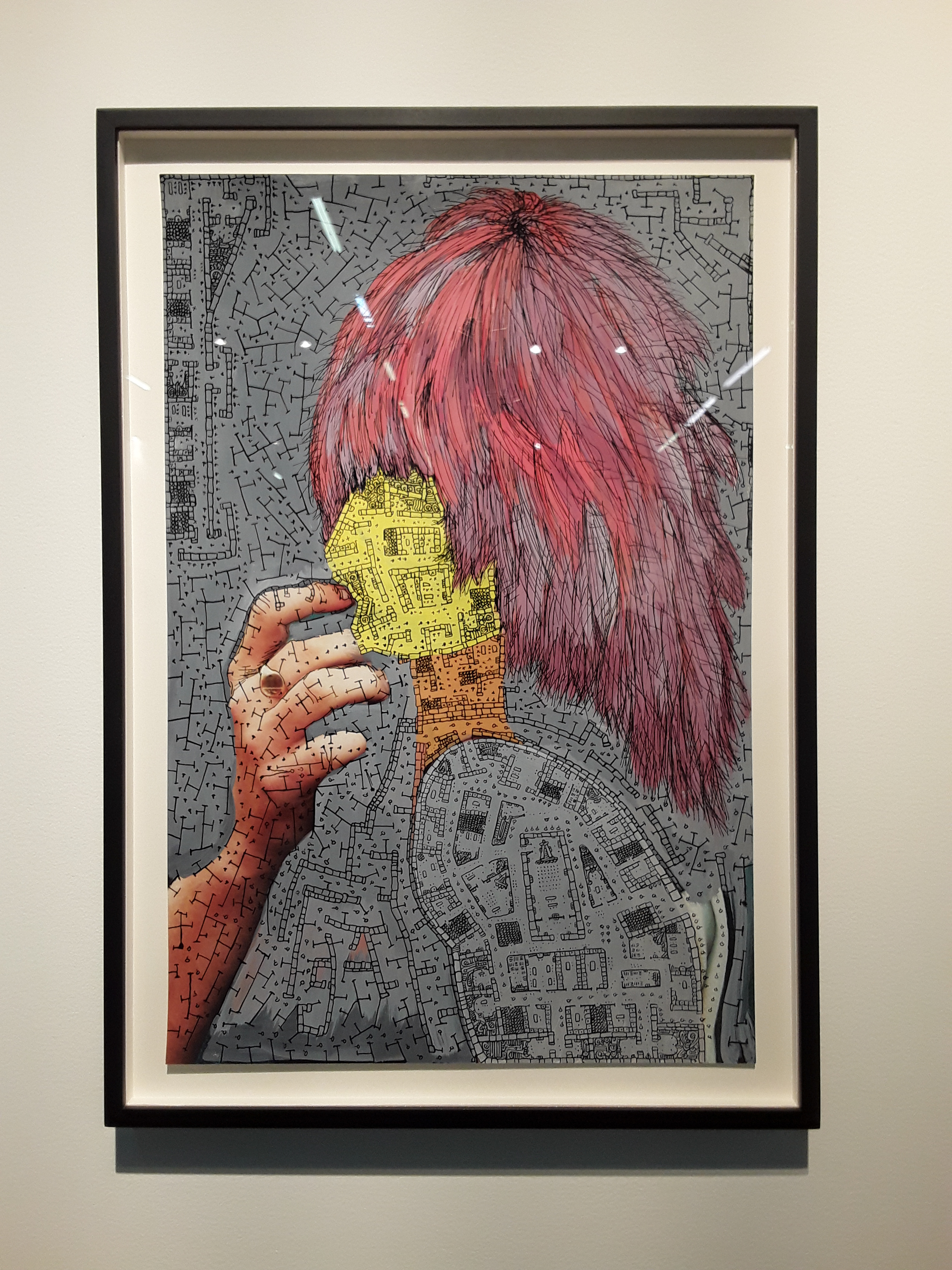
Kim Jones, Untitled, 2003-2009, acrylic and ink on colour photograph. Zeno x Gallery, Antwerp.
Artist Kim Jones’photograph has texture. In the one above, the hair is covering a face, while his other works on display were installations made out of wigs. The life of an artist includes time spent in Vietnam War, making his world appear as creating asymmetry, or holding a point of view that is more hidden.
Rosa Loy’s painting, on the other hand, creates different magic with narratives, in which unknown looms in the air. The Leipzig-based painter makes compositions, in which women perform in seemingly weird and ritual-like settings.
Rosa Loy, Tu das nicht, 2020, Casein on canvas. Kohn Gallery, LA.
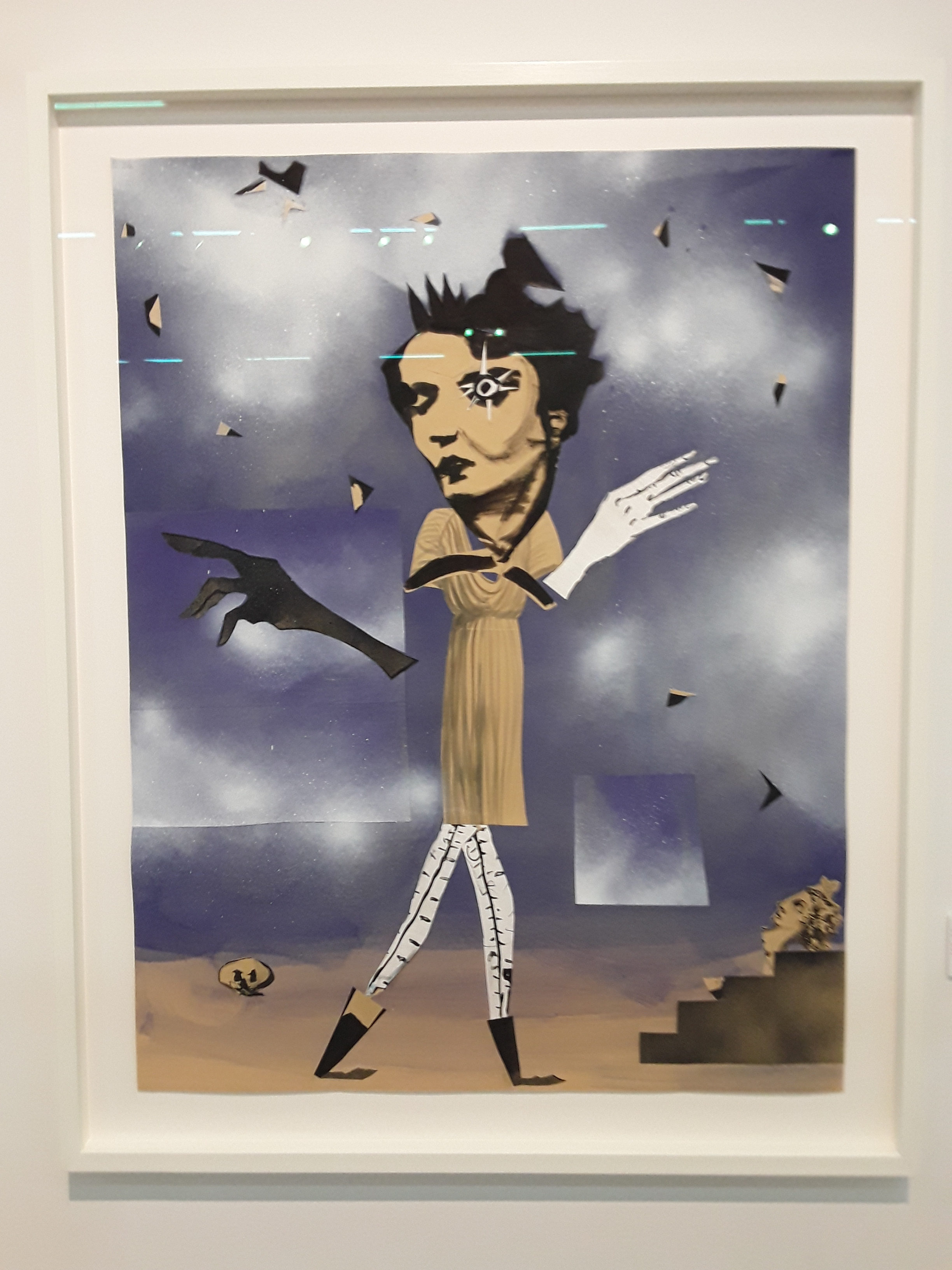
Moyna Flannigan’s new works include paintings and collages. They draw from art history, mythology, and popular culture to explore issues in the contemporary society. She is interested in the representation of women in art. The figures in her works, have ambiguity in mind. The dark tones are discovered with humor and irony. She is at The Armory with the Ingleby Gallery from Edinburgh.
Moyna Flannigan, Tear 52, 2019, ink, gouache, spray paint and collage on paper. Ingleby Gallery, Edinburgh, UK.
These artworks remind us of the fact that the life is in a state of suspension. The everyday life feels more as if we face it in a raw spacetime continuum.
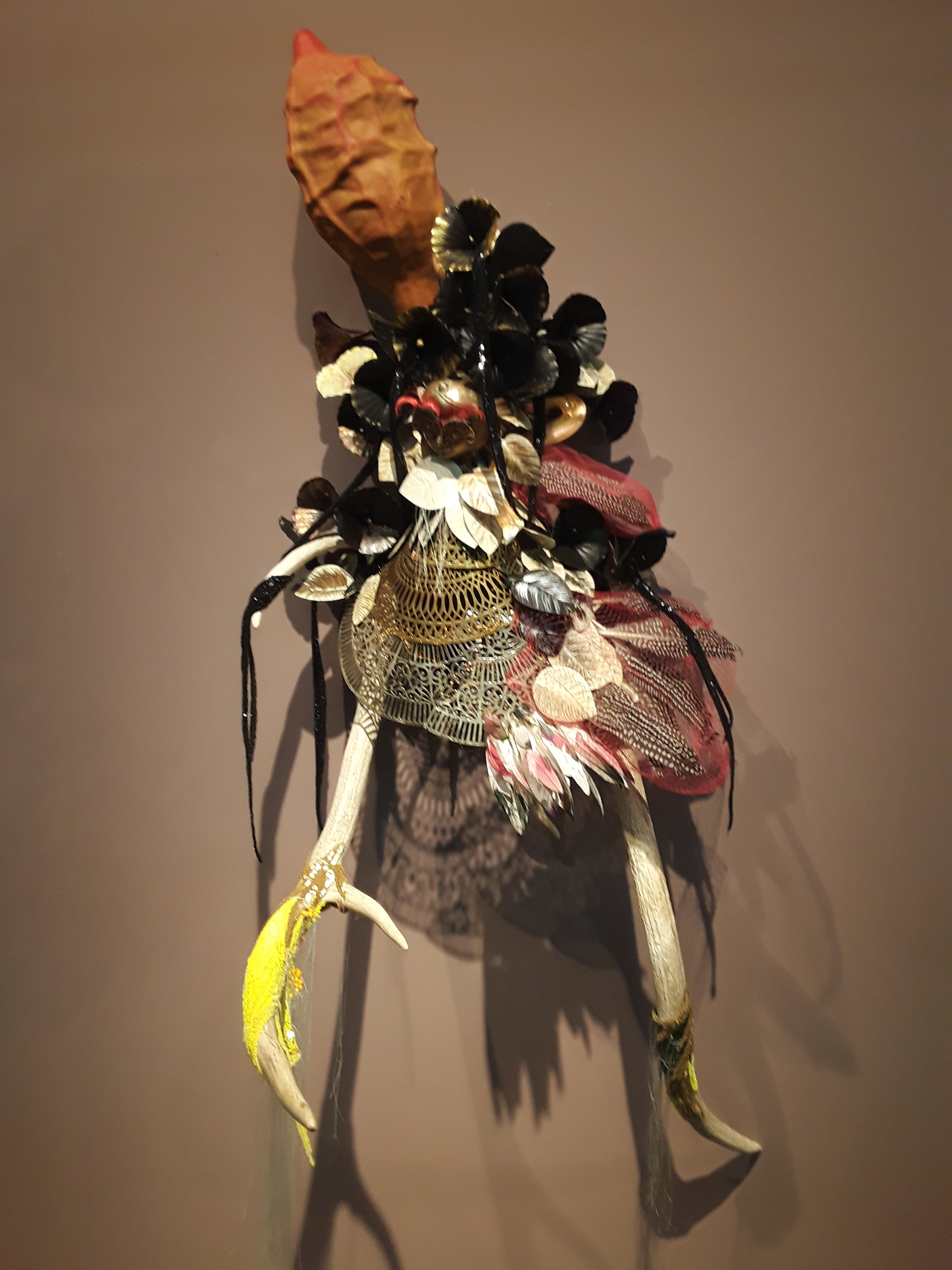
Rina Banerjee’srecent sculptures are part of her concept of ‘irresistible earth’, that can be described as something uncontrollable and unconditional. In it, our senses play a central role in a process of figuring out, what is right and what is wrong in the migrating destinies of our lives. Banerjee is an Indian artist who lives in New York City, and is represented by GalerieNathalie Obadia in Europe. Of her new sculptural work, she writes poetically.
“Fastened to two walking sticks and lopsided imagined she in a world without opponents, unburdened by squabble and masonary bricks, she a prop propped up man from man not capable of understanding the parts that ripped and torn like partition, camps, detention pockets and passport tangles bottled black glory and tangerine blossom.” (Rina Banerjee, 2020)
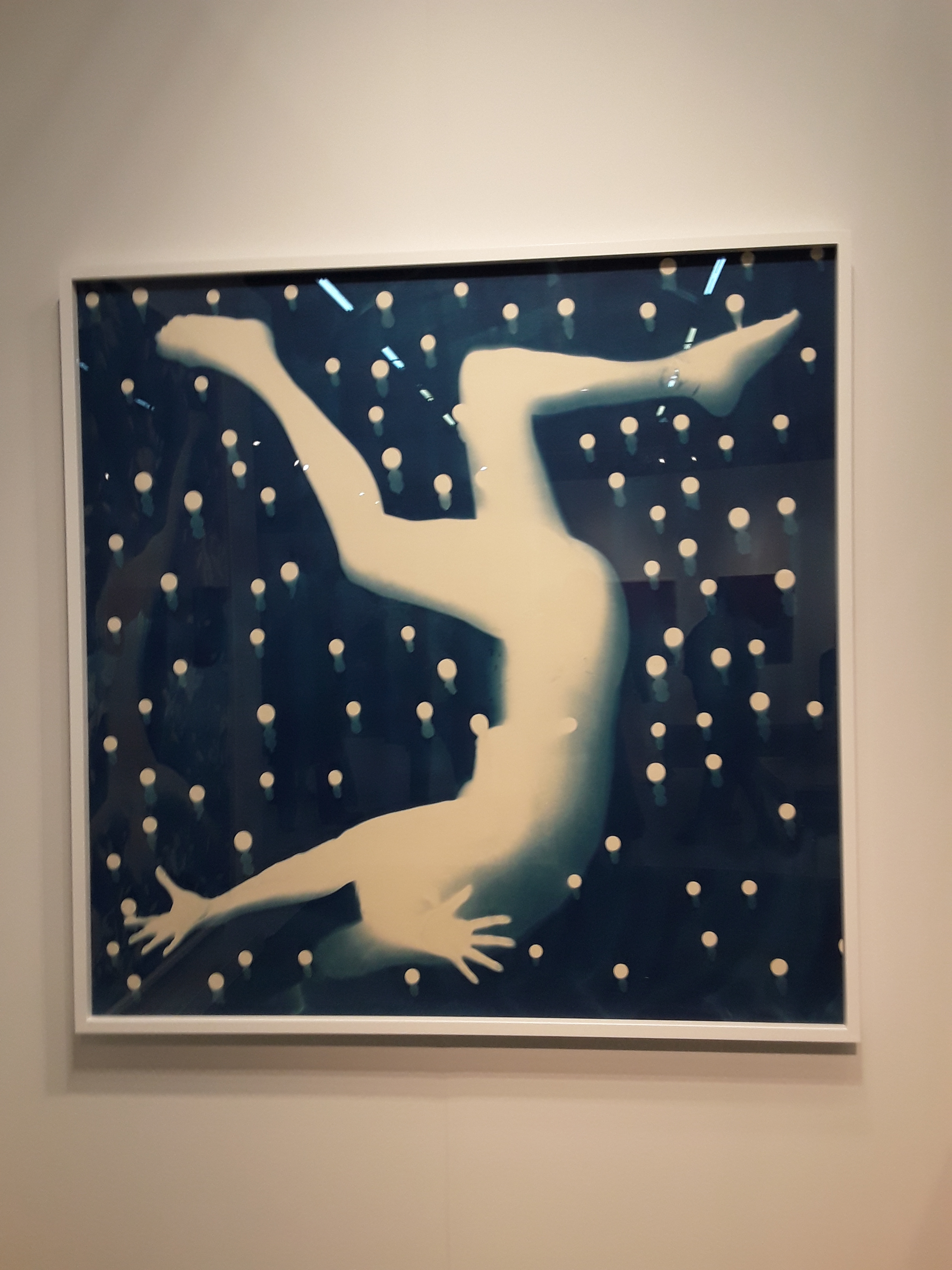
Nancy Wilson-Pajic, Falling Angels, 1996, unique cyanotype photogram. Robert Koch Gallery, SF.
For the Women’s History Month, Nancy Wilson-Pajic’sfeminist cyanotype photogram recalls the time, in which women artists were not accepted to the canon of the art world. Therefore, the radical expression of her art developed into significant styles that she became known for. Her multidisciplinary art was aiming, “to create mental spaces within which creative reflection may take place.”
These artworks remind us of the fact that the life is in a state of suspension. The everyday life feels more as if we face it in a raw spacetime continuum.
Finnish contemporary composer, oboist and music pedagogue Riikka Talvitie is an artist greatly influenced by her audience. She believes that the audience and community have an impact so important that there is a need for new notions of authorship and agency in music. Her compositions are brought into practice in performances, and so the discussion of the community’s role in collaboration is relevant. As a woman composer, Talvitie also wears an activist hat in society. Women are still in the margins as art music composers.
There are topics and ideas that Talvitie is ready to discuss more, and she collaborates with artists of many genres. She is currently in the process of doing her artistic doctorate in music at the Sibelius Academy, University of the Arts in Helsinki.
Firstindigo&Lifestyle: How did you pick oboe as your instrument?
Riikka Talvitie: As a child, I lived in Kerava, in a small town near Helsinki. When I was seven years old I started to play piano in a local music school which was founded in those years. (This autumn I am composing a piece for the 40-years celebration.)
When I was around 14-years old I asked our music teacher if I could start to play oboe in a school orchestra. In the orchestra, there was also an older student, oboist, who started to teach me. I didn’t know how difficult it was to start the instrument.
Later after school, I did entrance examination for Sibelius Academy with both instruments. I got in with oboe, which was a sort of coincidence. I also started to read mathematics at the University.
Firstindigo&Lifestyle: How much did your own instrument define and influence your creations in the early face of your career?
RT: I just did a video work Self-Portrait which is dealing with this question. The main thematic issue of the work is a relationship between a composer and a musician. I am performing both persons at the same time, so I am discussing with myself. I am also improvising some bodily exercises with the oboe. (See the video here https://fmq.fi/articles/composer-at-work-a-critical-self-portrait)
Firstindigo&Lifestyle: What else in your musical training and background created who you are, and what made you choose composing?
RT: I chose a high school, which was specialized in performing arts. All my friends had something to do with theatre, cinema, literature or dance. So while I was studying oboe playing I composed and improvised music to theatre plays and short movies. I was quite enthusiastic with these projects so I took composition as a secondary subject.
I was also quite interested about contemporary music in general. I played myself a lot and I was visiting many festivals.
Firstindigo&Lifestyle: How many years ago was this, and how has your career path evolved?
RT: I had my first composition lesson in 1994 in a summer course with Jouni Kaipainen and Magnus Lindberg. At that time I had lots of ideas and plans but no craftsmanship or technical skills. After the course I started to study really seriously.
The world might have been a bit different place in the 90’s because I was able to study composition quite long at the Sibelius Academy after I had graduated with oboe.
I have also been twice in Paris. First time I was studying oboe and composition at the conservatory of Paris. And the second time I was following one-year-course of music technology at Ircam.
Finally when I got my first child, in 2004, I stopped playing oboe because I didn’t have time to practise and travel anymore. In the video work I am quite strict to myself and ask: why did you stop playing? You did not think about your career? The answer is not that simple. This autumn I have some oboe performances coming so I am still dealing with the same question.
Firstindigo&Lifestyle: What words describe your music?
Firstindigo&Lifestyle: What kinds of themes do you usually develop in your compositions?
RT: Many themes and interests have changed during the years. When I was younger I got excited with mathematical ideas. Abstract world without social intrigues fascinated me in many ways. Then I have worked a lot with texts – poems, plays etc.
Nowadays, I am more into political and critical themes. I have a feeling that concert music is repeating some kind of old ritual where the most creative ideas are forbidden. Many things are not allowed, socially and aesthetically. I find this quite contradictory to the main purpose of art.
At this moment, my goals are more interactive and communal. I am preparing an artistic research about shared authorship and communality in a composer’s practice.
Firstindigo&Lifestyle: Are there ways to categorize contemporary music? Do contemporary works differ from modern music, say in tonality, and in aesthetical ways?
RT: I just read an interesting book Music After the Fall: Modern Composition and Culturesince 1989 by Tim Rutherford-Johnson. The writer argues that contemporary music is not anymore so much linked to modernism as we tend to think. instead, it should be analysed in the context of globalization, digitization and new media. He starts the new era from the year 1989. I recommend this book to all composers and musicians who are trying to define the state of contemporary music scene today.
I see some trends among composers. The growing use of video and multimedia is now very common in concerts all over. Also the question of material is changing. In modernism a composer created his/her own material on which the composition was built. Now, there is more liberal relation to musical material which can vary from different musical styles to short samples of already existing music or sound.
One of the most important changes is the effect of social media. All the composers are marketing and presenting their works openly in the internet. It gives composers freedom to find their own paths but on the other hand it feels like a global competition of recognition.
Firstindigo&Lifestyle: Does being a woman composer mean something special to you?
RT: Yes, it means a lot. I am a feminist, in a way. I strongly support equality and diversity in the society and correspondingly in the music field.
These values are unfortunately missing in the project of canonizing composers and art works. I am interested in artists who are left outside the canon. A year ago, I was presenting a work by Ethel Smith, a British composer from the beginning of 20th century. She was not mentioned in our music history classes in my youth. And how many others are there?
While doing my artistic research, I have many times wondered why the different waves of feminism haven’t left almost any imprint on art music composition. In Finnish composers society there are still only 10 % female composers. If we think about what happened in performance and video art in the 60’s and 70’s there were lots of artists participating in the happenings for sexual emancipation. At the same time, among contemporary music we just invented new composition techniques 🙂
I have also considered this question while teaching. What values do we forward to the next generation?
Firstindigo&Lifestyle: Finland has a woman composing star, Kaija Saariaho, who is also well-known in New York City music world. Do you think she has developed a way for others to follow?
RT: Kaija Saariaho has an important role in Finnish music life, for sure, and in that sense her career is a sort of example for woman composers. She is also really warm and gentle person towards colleagues, especially for young students.
On the other hand, Kaija is presenting quite traditional image of a composer. Her career is based on international reputation, large commissions, prizes and so on. This position is actually quite hierarchical, and mythical.
There are plenty of artists who don’t want an individual international status. They want to work in working groups or in a pedagogical field. We are different. In that point of view Kaija is not a role model for all Finnish female composers.
Firstindigo&Lifestyle: What are your key influences as a composer, and how do you conceptually start your works?
RT: Every project is slightly different but I still try to give some concrete examples. I start every composition by discussion with other people who are involved. I try to figure out who is playing, what skills musicians have, what are the interests of a producer, what is the schedule, what else is performed in the same concert, is there a musical theme like era or an ideological theme like protection of seas etc. For me it is really important that musicians and performers are fully engaged in the big picture.
I also collaborate quite a lot with other artists. In those situations I normally wait a moment and listen to others. I feel that I have much to learn because contemporary music has been so isolated in the abstract world for a long time. I am also curious about ideas and opinions of my audience. Also different audiences like non-musicians, children, teenagers etc.
When I start to compose I spend a lot of time looking for suitable material for each situation. I sit at the piano and try out things. I look for certain ”constraints or boundaries” for each project. Almost always, I meet the musicians and give some sketches to play. Lately, I have increased to send demos while I am working, just to open up the process and get feedback.
I consciously think composing as an ongoing collaboration.
Firstindigo&Lifestyle: What is the composition process for you like, how long do you usually develop a work?
RT: I like to work slowly and develop ideas with other people.
Firstindigo&Lifestyle: How many solo instrumental works have you composed so far, how about chamber music and orchestral works?
My works in numbers:
– 4 operas
– 1 radio-opera
– 8 works for orchestra
– 14 choir works
– 18 songs
– 12–15 chamber works
– 5 solos
– 1 radiophonic work
– pedagogical works
– theatre projects
– short movies
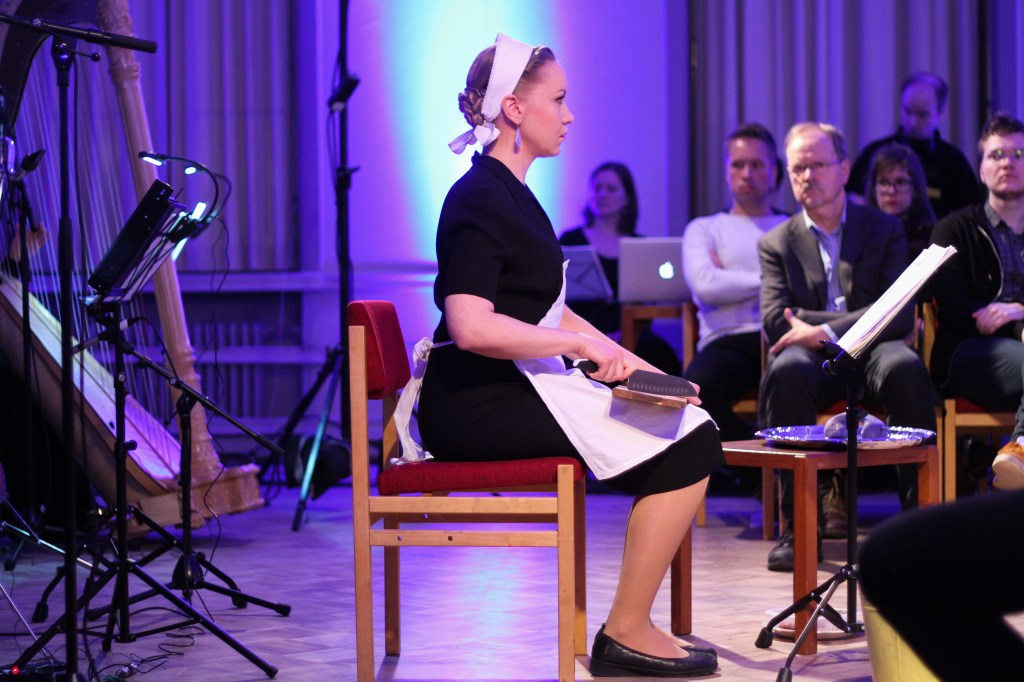
Riikka Talvitie (composer), The Judge’s Wife, Juha Uusitalo as the Judge. Photo Teemu Mäki, 2017.
Firstindigo&Lifestyle: Recently you have also worked with opera. Could you tell more about these projects?
RT: I have recently composed two operas. The first one is called The Judge’s Wife which is based on TV script written by Caryl Churchill at the time of IRA terrorist attacks 1972. The text deals with the power structures of social classes and the difference between terrorism and a revolutionary act.
The opera was carried out as a cross-art performance with some additional text and documentary video material by its director Teemu Mäki. The performance was closer to contemporary theater or live art than traditional opera. It included music, drama, videos, texts, humour and also a meal, vichyssoise soup, which is also written into the libretto (http://www.teemumaki.com/theater-judgeswife.html).
Riikka Talvitie (composer), The Judge’s Wife, Tuuli Lindeberg as Judge’s wife. Photo Teemu Mäki, 2017.
The second opera Queen of the cold land was a radio opera commissioned by Finnish Broadcasting Company (Yle-radio). The libretto is a sort of rewriting of the Kalevala – a present-day version of some abstract life situations. The aim of the working group was to look at the Kalevala from a socio-historical point of view. Kalevala is not qualified as a source of Finnish mythology because the mythical images of folk poems have been transformed and merged into new entities by Elias Lönnrot. Lönnrot’s goal was not only to collect poems and to propose them as a coherent epic, but the goals went together with the nationalist idea to create a common image of the past, customs and culture of the Finnish people.
The opera is dealing with several issues like diversity, sexual identity, nationality and naming. As a composer, I would state that the main theme of the musical narration is nationalism or rather the future of national states. This theme is presented in the musical material.
The music consists of orchestral music, chamber music, operatic and folk singing combined with radiophonic possibilities. The composition is based on a variety of materials. The most extensive material consists of national anthems by different states and people. In addition to these I use folk music, war songs, wedding anthems and lullabies.
Firstindigo&Lifestyle: In Finland, composers like Jean Sibelius are master voices in the classical music world, for their emancipatory approach of voicing national myths, and yet speaking to broad international audiences. Sibelius is a widely known European composer in the United States with his Finlandia, and Violin concerto. Has this tradition created a sense of your own status as a composer who has Finnish roots?
RT: As an answer to this question, I just tell that have composed a chamber opera called One seed, one sorrow – conversations with Aino Sibelius. Aino was a wife of Jean Sibelius. At least it was an other perspective to the question of national heroes.
Firstindigo&Lifestyle: We met in Lapland in 2007, while doing a nature piece in Pyhatunturi. Do you still get inspired while spending time in nature?
RT: I am really worried about nature and by that – also inspired. This year I work with several pieces which are processing nature and particularly climate change.
Last spring, I carried out a project called Heinä (Grass) with playwright Pipsa Lonka. It was performed in Silence Festival in Lapland. The performance contained images that a grass had drawn. I tried to read or interpret those images by composing them for bass clarinet and voice. The performance took place in an old cottage with smoke and a dog. The atmosphere was quite unique.
Riikka Talvitie at the Silence Festival, Hiljaisuus Festivaali, Day3. Photo Jouni Ihalainen, 2018.
Firstindigo&Lifestyle: Are you critical of your own work?
RT: Of course I am critical and I would like to rewrite all my compositions but I just don’t have time for that. So let them be…
As for the future composition, I have challenged myself to ask every time ”why do I do this piece”. I feel that every art project should have a reason or meaning or aim which is something more than a commission, a commission fee, reputation or a course credit. This goal can be both an internal musical idea or external starting point. It should be something that connects our work to the surrounding society.
Firstindigo&Lifestyle: Who gives you the best feedback?
RT: The best feedback comes from my children when they ask ”what on earth are you doing” or ”how awkward”.
Firstindigo&Lifestyle: What is the role of commissions in your work?
RT: The art funding is quite different here in Finland than in United States. Mostly I work with small commissions by different musicians, ensembles, choirs, orchestras or festivals. However, the main income of Finnish composers comes from the working scholarships.
Some of my works are collaborations with other musicians and artists. Then we apply funding together as a working group from different foundations and institutions.
Firstindigo&Lifestyle: Do you have specific plans for the future?
RT: I have plenty of plans for the future. In a near future I will finish my artistic doctorate that is about shared authorship and communality. For that, I still have couple of projects to compose. After that I will devote my time to activism.
Firstindigo&Lifestyle: How about dreams, perhaps international presentations and residencies?
RT: An old image of a composer with a wig is quite outdated. This image contains travelling and prestige. Luckily the world has changed – women and mothers can be composer too and they don’t need to represent ”a plaster composer”.
Mainly, I don’t travel. I work nearby. I am quite often at home in the afternoons when my children come home from school. And in the evenings they have hobbies. My plan – not a dream – is to spend time in residencies after my children are grown-ups. I just need to be patient because it will take ten years still.
I don’t dream about an international career, firstly, because I like my daily local life. And, secondly, because I am at this moment interested in subjects and working methods which are rather marginal in classical music f.e. community art, live art, performance and philosophy. These are not the themes of a grand audience.
I dream about ideological aims. I hope we will see the world where the terms of consuming, owning and competing are less valued. I also hope that there would be a turn in over-consuming that finally we are saved from dystopical eco-catastrophe. I am not that worried about my own career.
RT: I have a small activist inside me who says that we should listen to different voices. So I would recommend you some other Finnish female composers here:
After four decades in painting, American artist Francie Lyshak has a deep knowledge on her practice. A woman-artist who has a lifelong approach to learning, finds nature and it’s varying stages influencing her work. The artist examines nature also with photography. It seems, as if those pictorial notes would transfer into her paintings with subtle poetry and movement. In this interview, she discusses her career, love of painting and the meditative approach to being with her art. Remarkable is how the artist views art as a career, also in psychological terms as a radical act. Francie Lyshak’s recent paintings, which examine movement and gestures, will be on view until April 27, 2017 in the Carter Burden Gallery of NYC.
Firstindigo and Lifestyle: How did you find yourself doing painting? Where did you grow up?
Francie Lyshak: I will share with you two central memories that are at the very early roots of my art career (before it begun):
I am in Detroit, Michigan, in a single family home with a nice yard. I am a small child, somewhere between toddler and latency age. I am sitting in the mud, alone making a mess and enjoying it totally.
In the second memory, I am 18 years old, attending my first art history class. As I watch the projected images of works by modern artists, it is suddenly clear that making paintings is what I need to do with my life. I began to paint was when I went to a summer art school in Paris around the age of 19. I haven’t stopped since that time, except for one year in Boston in the early 70’s. After that point I switched from abstraction to figuration.
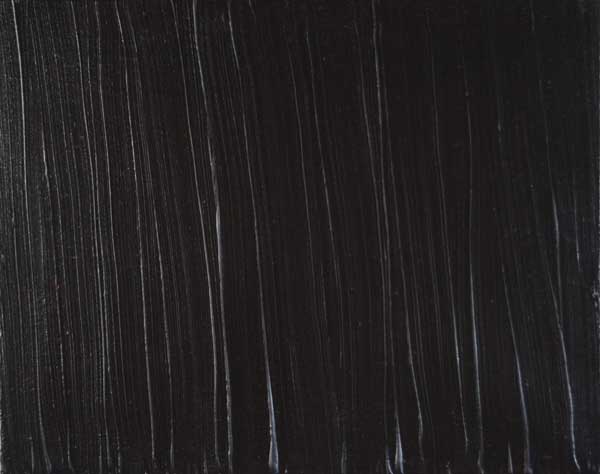
Francie Lyshak, Black Curtain, oil on canvas, 16×20, Courtesy of the artist.
Firstindigo and Lifestyle: You have an exhibition opening now at the Carter Burden Gallery in NYC, tell more about the theme of your paintings in the show?
FL: These paintings focus purely on the physicality of painting, of paint, painter’s tools and the interaction of the painting surface with light. The use of a palette knife can be a violent destructive attack on a painting’s under-layer. A flowing brush mark can be evidence of the painter’s sweeping gesture. The painting then becomes a stop-action image of what was either a waltz or a wrestling match between the artist and the medium. It is painting without any intention other than leaving the physical evidence of its own dynamic birth.
Firstindigo and Lifestyle: What is really interesting is that your career spans for four decades, and there can be so many changes that fit into that time frame. Did you start with figurative or representational art?
FL: In my early work, my visual language was a figurative and a metaphorical narrative with strong feminist overtones. This work lasted for two decades in the 1970s and 80s. Animals, humans, dolls and toys populate these paintings, each one describing the psyche captured in a critical moment of time. Influenced by art therapy theory and practice, their emotional rawness challenged the viewer to contemplate disturbing aspects of life that are typically overlooked or avoided. After years of these explorations, I unearthed evidence of my own childhood sexual abuse. With the support of the late Ellen Stuart and La MaMa/La Galleria, this work resulted in a one-woman exhibition in 1993 narrating my own trauma recovery through my paintings. The series of paintings with accompanying prose was published in a book in 1999 entitled, The Secret: Art and Healing from Sexual Abuse. This exhibition provided me with a release from the narratives of the past. After that show, my work changed slowly but radically, moving towards landscape, then abstraction.
Firstindigo and Lifestyle: How did you choose painting and photography, how are they similar or different to you?
FL: I am a painter. However, I believe that no matter what medium an artist chooses, they cannot escape their artist’s sensibility. That means that we cannot help but consider the aesthetics in our environment. Also, we cannot help but be creative. It is a kind of compulsion that requires an outlet. In that vein, I took up photography. This was in part because I found it offensive that paintings are generally only affordable by the wealthy. I experimented with printing and multiples as a way to make my work more accessible to those with less means.
Firstindigo and Lifestyle: Can you say that what you do is abstract art, and if so what would this kind of abstraction be?
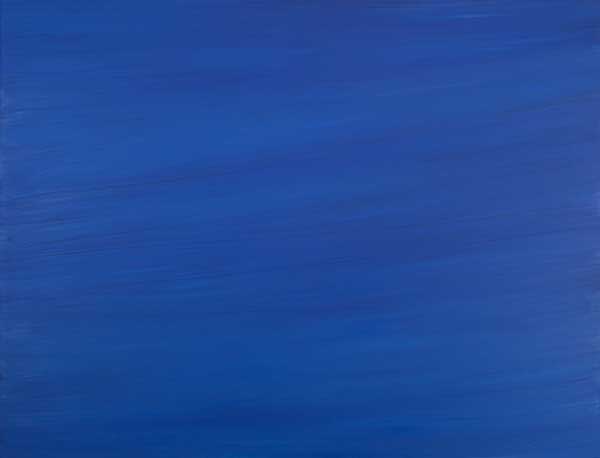
FL: The best way to describe my new work is ‘pre-verbal’. Before words, ideas and memories there is a mental space that is responsive to shape and texture, color and amorphous mood. That is the space that my paintings occupy. My abstract work is not expressionistic, nor is it minimal or conceptual. My newest work has something in common with action painting. Over the long haul, the trend of my work has been increasingly reductive. I seem to be constantly trying to reduce the content of my work to its simplest components. I removed the figure. I removed the narrative. I removed the symbolism. I removed the suggestion of landscape. Then I tried to suggest empty space alone (which made the work illusionist). Now I am just looking at the surface, the medium and the tools of application.
I recently saw a show that was simply lighting in an empty gallery. I understand that.
Francie Lyshak, Brushed Blue, oil on canvas, 34×44, Courtesy of the artist.
Firstindigo and Lifestyle: How do you choose your works for the exhibition, do you ‘curate’ yourself?
FL: No, my dealer is fully in control of the choice of work and the hanging. Of course, it is up to me to choose the paintings from which she makes her selection.
Firstindigo and Lifestyle: The process is of course different with each artist, do you like to add older paintings into the show, or is it mostly recent works?
FL: Mostly very recent works are shown in April exhibition. My first exhibition at Carter Burden had some pieces that were several years old but had never been displayed.
Firstindigo and Lifestyle: You are watching a lot of movies, how apparent is it that those moods or aesthetics you gain from films enter your works somehow? FL: I don’t think that the aesthetics of film influence my work, but perhaps the moods do on a subconscious level. I find great solace in the work of these great, underappreciated independent film makers. They address very important, very real aspects of being human. Hollywood spends mountains of capital selling fantasy worlds to viewers because it is a natural,human inclination to avoid and escape harsh reality. The filmmakers that I love make me look at the challenging underbelly of being human. This gives me courage and support in my effort to stay honest as a painter, to not be fooled by the illusionary rewards of commercial success, to lead my viewers to the challenging aspects of being human.
I have a fantastic list of my list of favorite movies. It is a long list and the titles are unrecognizable to most people. Almost all of the films were borrowed from the New York Public Library which has a treasure trove of great films.
Firstindigo and Lifestyle: What does a notion of ‘zen’ mean to you as an approach?
FL: I am not formally trained in Zen practice. However, I understand that Zen does not have a god head, and is focused on what westerners call mindfulness practices. My mind is constantly racing. I hunger for empty space and quietude. (Perhaps this is reflected in my urge to constantly minimize the content in my paintings.) We live in an overheated, overstimulating world (at least in NYC). I know, however, that it is not the fault of my environment that I am so mentally restless. I reach for ‘zen’ as a pathway towards a quiet mind or to attain full attention. When I paint, I am in a ‘full attention’ mode. In this sense, painting is a mindfulness practice. (Click the link to see a series of paintings that were specifically intended to be ‘meditations spaces.’ http://www.francielyshak.com/archive/New%20Monochromes/index.html)
Firstindigo and Lifestyle: What else do you do to balance with making art?
FL: Not much. I do some Yoga practice, go to the gym, take walks and, of course, watch movies. I would add that there isn’t anything much more rewarding that good conversation with other artists and intellectuals.
Firstindigo and Lifestyle: Where do your influences come from other than abstractions? Do you blend in narrative contents from today’s world and events? FL: My goodness, the political climate has a tremendous impact on the ‘climate’ of my work. There is very little joy in my work these days. On the other hand, I am finding surprising strength and power there. My work is definitely a mirror of my psychological condition. My psychological condition is a mirror of my personal and social life (which in these times encompasses the political environment). A new painting included in this April exhibition is entitled “Silence equals Extinction”. It was clearly a response to the nightmare political situation in the US.
Francie Lyshak, Knifed White, oil on canvas, 34×26, Courtesy of the artist.
Firstindigo and Lifestyle: In your photography there is a lot of nature in them; fog, mountains, trees, moon, and so on. How do you find your photographic subjects, do you just happen to be in those places in the moment?
FL: Yes, everything was done either in Michigan, where my family has a summer home, or NYC. I also did some photography when I did some traveling along the Adriatic, Ionian and Aegean Seas and along the Pacific Ocean shore. I am wild about landscapes.
On influences:
I am not influenced by art theory nearly as much as I am influenced by psychoanalytic theory, philosophy and religion. I have no belief in any religion. However, I find the search for self and meaning to be central to my practice as an artist. I am most affected by any work of art that creates a space for the viewer to engage in this search for identity or meaning. Works by Frieda Kahlo, Mark Rothko and Fred Sandback all succeed at doing this for me; although each uses a radically different method to set a stage for this to happen to the viewer.
On color:
Colors have a strong valence, a kind of personality. My latest pieces have been in various shades of black. I am choosing black because I have always feared it. Black oils cannot be controlled because they are wildly interactive with the light in the environment as it reacts to the surface of the painting. The color black, for me, has much to do with loss, change and the unknown. So colors themselves have a kind of personality and meaning and different oil colors also have a unique physicality, such as color density.
On my use of color in photography and painting:
I think of myself as a painter. I have spent forty years painting. Photography has been secondary to my work as a painter. My photography is in the early stages of development; but is created on a foundation of 40 years of evolved aesthetic sensibility and artistic practice. My photography is mostly rooted in local color or black and white. My new paintings, on the other hand, are each a deep explorations of color, the oil paint medium, the painters tools and methods of application. In other words, my practice as a painter has evolved to a point where I am exploring the very basics of the medium. It is full circle, back to the beginning.
Firstindigo and Lifestyle: Do you find inspiration in your travels to foreign places, how about those leaving an impact on your thinking and aesthetics?
FL: I just traveled to Japan. Their aesthetic and social values were a great comfort to me. The Japanese seemed so much more civilized than Americans. It was heartening to experience their aesthetic and their culture. I felt that my own values were much more supported by the Japanese culture than they are in my own culture.
Firstindigo and Lifestyle: Did you ever come up with a notion, who would be your best art audience, or collector? FL: Probably intellectuals, other painters and psychologically-minded people. It is hard to tell who is most taken by my work because people usually don’t say much. Most of us become a little inarticulate in the face of meaningful visual art. Art takes us to a non-verbal place. I admire people like you who are willing and able to give us language in the face of visual art.
Firstindigo and Lifestyle: With so much insight in the practice, we all want to know, what would you like to teach or say for younger generation artists and painters?
FL: I would like to say to them that it is worth the battle to stay true to their artistic sensibility. This is because, in the long term, losing touch with one’s core strivings (to be an artist, to be creative) has an unbearable cost. I would tell them, however, that they shouldn’t expect to be rewarded. Artmaking is essentially a radical act, because it means turning away from the influence of others and, instead, opening a channel to one’s true self. Being true to one’s core self usually means letting go of many of the rewards of social/commercial success. After all, in the short term we are nurturing ourselves rather than others. Who knows if our art will nurture others in the long term. That is in the hands of the vagaries of the art market.
Achieving commercial success in the art world is a totally different side of being an artist. It takes a combination of ambition, talent, personality, timing, social resources (such as health, social networks, time and money) to make income from making art. To have these resources is often a matter of privilege and other random social events. Artists don’t have control over most of these factors.
Francie Lyshak’s exhibition info:
April 6 – 27, 2017
Examining Movement & Gestures: Jonathan Bauch and Francie Lyshak
· Pratt Institute, Art Therapy and Creativity Development, Masters of Professional Studies, NYC, 9-76 to 5-78
· Wayne State University, Painting and Drawing, Bachelor of Fine Arts, Detroit, Michigan, 1-69 to 5-70.
· Center for Creative Studies, Fine Arts, Detroit, Michigan, 9-68 to 5-69
· University of Michigan, Humanities, Ann Arbor, Michigan, 9-66 to 5-68






 Firstindigo&Lifestyle