Tag: women in art

  • Artist in focus: Sasha Huber

    Artist in focus: Sasha Huber

    Sasha Huber is a multidisciplinary artist who hopes that our world would be a better place for people with different ethnic and racial backgrounds. She is determined to continue her family’s Haitian heritage in the arts, and has challenged the postcolonial controversies left behind by figures like Christopher Columbus and Louis Agassiz. Her artistic career has brought her international merit across continents. Sasha Huber’s art is currently shown in the DNA of Water -exhibition at the Newhouse Center for Contemporary Art in Staten Island, New York City.

    Firstindigo&Lifestyle: You were born in Switzerland with Swiss and Haitian heritage, how did this dynamic and background influence your youth and early artistry? Where did you get your education from, and how did you eventually find yourself living in Finland? 

    Sasha Huber: Being from two such opposite cultures inspired me from the start, although becoming an artist was not my first choice in my professional live. My interest was first in graphic design that I learned in Zurich, Switzerland. I then worked some years as a graphic designer at different studios and agencies and then applied and was accepted for a one year scholarship at the research and design and research centre Fabrica by Benetton in Treviso in 2000. Its a multidisciplinary and international environment that I missed in Switzerland. That is also where I met my husband and collaborator Petri Saarikko who is from Finland. So love brought me to Finland at the first place. There I also graduated in 2006 with the Masters Degree in Visual Culture from the University of Art and Design, today known as Aalto University. One situation that triggered the idea for my first art project that I made in 2004 was related to that I was not allowed to visit my mother’s home country and family in Haiti, due to the political situation there. My mother was especially worried for me, and basically forbade me to go when I was younger. Starting to make my art about Haiti served as a compensation instead, and eventually brought the place closer. As an adult I’ve visited Haiti so far twice and each time within the artist context. First time Petri and I took part in the 2nd Ghetto Biennale in 2011, and the second  time we were invited to make projects at the Le Centre D’Art in Port-au-Prince during one month in 2016. Both visits went very well and allowed us to work collaboratively with multidisciplinary artists. Working with the Centre D’Art was also special for me since my artist grandfather Georges Remponeau was one of the co-founders of the school in 1944.

    Firstindigo&Lifestyle: Could you tell more about in what ways your European upbringing was intercultural. Do you have an opinion that European culture and heritage changed in recent years in relation to migration, and with the impacts of globalization? 

    Sasha Huber: Coming from a rich cultural background with over ten different nationalities, including the joining families through the different unions in our family, made me aware of the differences and similarities in cultures, and broadened my horizon. I think it helped me to feel comfortable in new places very quickly. For me this is a positive experience. Now when Europe is growing, as we can see with the influx of the newcomers and others too, there are also conflicts, and that brings sorrow to the people trying to find safety.

    I would hope there could be other, more human and respectful ways to handle this situation. Luckily there are creative initiatives by grass roots organisations, and individuals who help to contribute to make welcoming people more dignified. Sometimes its forgotten that Europe is also made of very many cultures after all. In a time like this, where racism against the black and brown people is in the rise, and not only in Europe, I’d came to think that it would be good for people to read more such books as James Baldwin’s book I’m not your Negro, or watch the documentary by Haitian film maker Raoul Peck (1953–) under the same name. And read the Orientalism by Edward Said (1935–2003) who founded the academic field of postcolonial studies. Both books were written long ago, but are very relevant in the current climate we live in.

    Firstindigo&Lifestyle: One of your artistic discoveries relates to the historical context of the colonization and cultural imperialism. What did you find out about the subject from your specific study, and how did you translate it into your artistic practice? 

    SH: I would say that the starting point of my career was to deal with the colonialism, and the topic has actually been a red thread throughout my entire practice ever since. In my first project, which was a portraiture series named Shooting Back – Reflection on Haitian Roots, I for instance portrayed people that were responsible of the troubles in Haiti. I started from the beginning and portrayed Christopher Columbus (1451–1506), a figure that has in recent years become more and more challenged; which I find is very important. For instance, in the United States several cities don’t celebrate the Christopher Columbus Day anymore in October as his first arrival in the “New World”. Instead they highlight the meaning as Indigenous Peoples Day. Or, in 2015 in Argentina his statue was replaced with the large statue of freedom fighter Juana Azurduy. We should not forget that some 95 % of the indigenous population in the Americas were killed after his arrival, and the European invasion that followed brought disease and slavery.


    Firstindigo&Lifestyle: Is a question of taking over land and leaving marks on its surface, in the environmental sense perhaps, part of the colonization history as you understand it and discuss it in your artistry?

    SH: I became conscious about this in 2007, when I joined part of the Demounting Louis Agassiz campaign that was launched by historian and political activist Hans Fässler. Until recently, the life and work of Louis Agassiz (1807, Switzerland – 1873, USA) have been intentionally embellished. He has mainly been presented as a glaciologist, scientist, and director of academic institutions, both in his country of origin, Switzerland, and in his adopted country, the USA. The campaign raised awareness that Agassiz was a proponent of scientific racism and a pioneering thinker of segregation and “racial hygiene”. The aim was at removing Louis Agassiz’s name from a 3946 m peak in the Swiss Alps and renaming it Rentyhorn in honour of the Congolese-born slave Renty, and of those who met similar fates. Agassiz ordered Renty to be photographed on a South Carolina plantation in 1850, “to prove the inferiority of the black race”. This initiative began to open the eyes of the Swiss public, and exposed Louis Agassiz’s involvement in the crimes against humanity. Today, there are over sixty places all over the world, and in our Solar System (the Moon and Mars) that bear Agassiz’s name. I call this micro colonialism of a single person marking his existence around the world while ignoring the local perspective.

    My way to react and act through my work as an artist manifested for the first time after I joined the transatlantic committee of Demounting Louis Agassiz, as I started to plan my first intervention to the Agassizhorn in 2008. I airlifted a metal plaque bearing a graphic representation of Renty to the top of Agassizhorn, on the borders of the Swiss cantons of Berne and Valais. In doing so, I took the first step towards renaming the mountain into Rentyhorn. I also started the petition website rentyhorn.ch which is still online. Even though for now, the mountain will not be renamed officially after many years of negotiating with the communes. In New Zealand’s Te Waipounamu – South Island in comparison, I traveled to the Agassiz Glacier with local Māori greenstone carver Jeff Mahuika who performed a karakia (Māori blessing) on the glacier to symbolically de-name the glacier and hens cleanse it from it’s associations to Agassiz’s racism. *

    Prototype of Sasha Huber and Thomas Götz as Louis Agassiz, Wet plate collodion photography by Borut Peterlin, comissioned by Sasha Huber, 2013, 10” x 12”.

    Prototype of Sasha Huber and Thomas Götz as Louis Agassiz, Wet plate collodion photography by Borut Peterlin, comissioned by Sasha Huber, 2013, 10” x 12”.

    Firstindigo&Lifestyle: Your background is in graphic design, and you have also worked with video; how do these mediums and techniques correlate with your artistic vision and outcome?  

    SH: I use a variety of mediums to realize projects. For me the defining reason to choose a specific medium is, first the idea I want to realize and then to decide based on that. I also often collaborate with experts to help me realize a work, such as videographers, editors and photographers.

    Firstindigo&Lifestyle: Do you also work with text, for example, to generate ideas, which then take visual forms and so forth? 

    SH: My artworks are predominately visual, but finding the title of the works is important, and for each project I write a text as well. Sometimes the artwork idea is inspired by text, poem or song as for instance the Strange Fruit poem. I made two projects about this poem that were performed by Billy Holiday and Nina Simone as well. The poem was written by a teacher Abel Metropol in 1937. It protests American racism and tells about the lynching of African Americans.

    Firstindigo&Lifestyle: Do you write about your own art, keep diary, and perhaps discuss it in essays?

    SH: Mostly curators, academics and journalists write about my work. I participate in conferences to speak about my work. As an example, last year I was a keynote speaker at the Archival Re-enactments Symposium arranged by the Living Archive project of the University of Malmö in Sweden. This summer, I will participate in the 6th International Afroeuropeans: Black Cultures and Identities in Europe conference (http://www.uta.fi/yky/en/6thafroeuropeans/index.html) in Tampere, Finland. I’m currently also doctoral student at the Art Department of the Aalto University’s School of Arts, Design, and Architecture in Helsinki, Finland. So far, I’ve published two books as part of my doctoral project, which I started several years before in collaboration with some historians. I edited Rentyhorn published by Kiasma Museum of Contemporary Art in Helsinki. Then, I co-edited (T)races of Louis Agassiz: Photography, Body and Science, Yesterday and Today published as part of the 29th Sao Paulo Biennale in 2010.


    Sasha Huber in collaboration with Petri Saarikko, The Prototype, 2013, installation view.Sasha Huber in collaboration with Petri Saarikko, The Prototype, 2013, installation view.

    Firstindigo&Lifestyle: As a result of your investigations through several years, do you see that your art is influenced by Haitian aesthetics, nature and environment in multiple ways? 

    SH: As mentioned earlier, the starting point of my art practice was inspired by Haiti’s history. As a matter of fact, I developed a technique for myself with metal staples shot with air pressure onto abandoned wood, as for instance in the Shooting Back – Reflection on Haitian Roots (2004) portrait series. For me the staple gun is like a weapon and I use this technique only when the project relates in some ways to the historic trauma. But aesthetically it could perhaps remind of the traditional beading and stitching as for instance utilized in the creation of the colourful Voodou flags. 
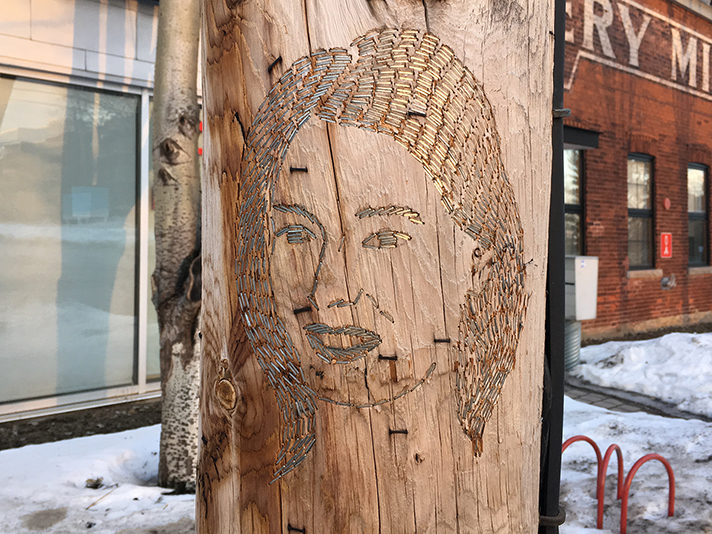
    You Are Missed, is a work in progress project by Sasha Huber, depicting a new portrait series that uses wood and metal stitching. Huber's artist residency at Axenèo7 in Gatineau, Canada in 2017.
    You Are Missed, is a work in progress project by Sasha Huber, depicting a new portrait series that uses wood and metal staples stitching. Started in Huber’s artist residency at Axenèo7 in Gatineau, Canada in 2017.

    Firstindigo&Lifestyle: In the fall of 2016, there was a curated group exhibition titled “Botany under Influence” taking place at Apexart in New York City. Your collaboration with Petri Saarikko was included in the show. How did you get involved in this special exhibition?

    SH: We met curator Clelia Coussonnet in Paris, where I participated in the Haïti exhibition about contemporary and historical Haitian art at the Grand Palais in 2014. When she was planning her group exhibition Botany under Influence I told her about our Australian remedies video that she then included into her exhibition at Apexart (http://apexart.org/exhibitions/coussonnet.php). The exhibition delves into the politics of plants, and explores systems of meaning that have been impressed upon nature, flora, and seeds throughout the eras of imperialism, colonialism, and globalization.

    Firstindigo&Lifestyle: Could you tell more about the video work that you showed in Apexart. The title of it is ‘Remedies Australia’  (2014). Does this work include material from several geographical locations and have different cultural components in it? Is this process still ongoing? 

    SH: Remedies is a series I initiated with my artist husband Petri Saarikko during an artist residency at Botkyrka Konsthall in Sweden in 2010-11. It was inspired by our interest in aurally transmitted family knowledge and remedies that we learned from our own families. Later we expanded the project to New Zealand, Australia, Haiti, Russia, Germany and back in Sweden. The Australian edition of Remedies casted Mildura based inhabitants to contribute eucalyptus tree related unwritten narratives and oral histories for an individual and collective portraiture.

    Firstindigo&Lifestyle: You are currently in New York City taking part in an exhibition DNA of Water, what kind of works do you have in Staten Island?  

    SH: Together with my family we just came from a residency in Canada, and continued directly to our current artist residency on Staten Island. We are participating in the group exhibition DNA of Water at the Newhouse Center for Contemporary Art which is curated by Sasha Dees. I am showing couple projects of which two are portraits from the ongoing Shooting Stars series, which is dedicated to worldwide victims of gunshot assassinations and killing perpetrated for political, ethnic, ideological or economic reasons (http://sashahuber.com/?cat=10040). I will show the portrait of Martin Luther King Jr. (1929-1968). I also made a new portrait of Eric Garner (1970-2014) who was living on Staten Island. At the end of the exhibition in September, I will gift the portrait to his mother Gwen Carr.

     — — —

    The DNA of Water exhibit is open from March 26 until September 3, 2017 on Wednesdays through Sundays from 10;00 a.m. to 5:00 p.m., at the Newhouse Center for Contemporary Art at the Main Hall of Snug Harbour, Staten Island (http://snug-harbor.org/event/the-dna-of-water/?instance_id=3179). 

    More info about the artist: www.sashahuber.com

    *(see: http://www.sashahuber.com/?cat=10046&lang=fi&mstr=4)

  • Amelia Marzec’s Weather Center for the Apocalypse

    Amelia Marzec’s Weather Center for the Apocalypse

    New York city based artist Amelia Marzec has been working on a project Weather Center for the Apocalypse since 2015. The work is presented during Climate Week in NYC, opening taking place on September 20, 2016 at United Nations Plaza. The artist has created an ongoing and evolving Weather Tower installation, which handles a theme of change in the environment and culture where we live in. Weather Center for the Apocalypse is an alert to an uncertain future as it predicts those “changes that could affect the autonomy of citizens in the event of disaster”. According to Marzec, the project offers alternative perceptions to the media-driven forecasts we constantly encounter, and takes seriously the fears and superstitions that we as community may have. Recently, the project was on display at Sixth Extinction Howl at Billings Library in the University of Vermont in Burlington, VT.

    Firstindigo&Lifestyle: How did you find weather? It is there all the time, but to become a derivative and subject for art, do you find it is common at all?

    Amelia Marzec: Currently there are a lot of artists doing work either directly or indirectly on the influence of human activity on climate change. I have seen a few other weather projects since starting the Weather Center for the Apocalypse. Everyone on earth is participating in this story right now, whether they are aware of it or not.

    Firstindigo&Lifestyle: Tell about the background for your project, which will also materialize during Climate Week in New York. 

    AM: The Weather Center for the Apocalypse began during an anxious time when I was in a relationship that was failing, at the same time that my Grandfather’s health was failing. It was a moment of knowing that these things were going to end, while not knowing exactly when that was going to happen. I needed to prepare and put things in perspective: what would be the most outrageous ending? The world could end, of course. With the current focus on climate change, it didn’t seem that far off.

    Firstindigo&Lifestyle: Have you always been future oriented, foreseeing the future, as apocalypse might imply?

    AM: Yes. My current work began a number of years ago, when I lost all of my hearing in one ear due to a tumor. I began to focus on the reality of daily communication failure in my life, and to pay more attention to the physical objects that make up our telecommunications infrastructure: our phones, our internet, our radios, and other devices. I began building objects to avert possible future disasters of communication in our society. The Weather Center for the Apocalypse continues this work by becoming a news media center for a pre-apocalyptic world.

    Firstindigo&Lifestyle: How about the narrative part of your Weather Center for the Apocalypse project, in which the visual implements a strong narrative element, what do you want to say about it?

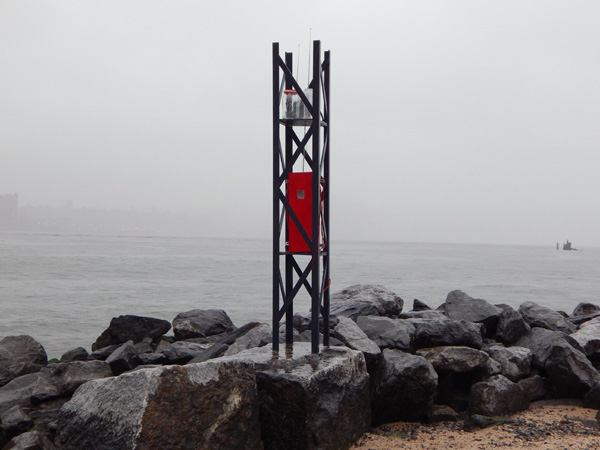
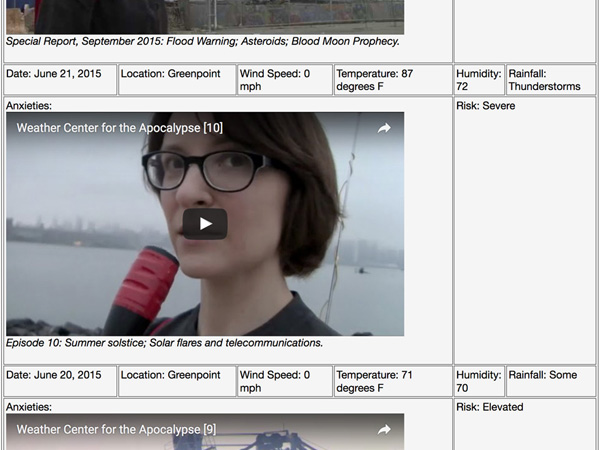
    AM: The story of the Weather Center unfolds over time as the project is built and refined. It began by providing forecasts to STROBE Network, a news network that was broadcast from Flux Factory in 2015. News and weather reports that were both practical and fantastical fed a daily apocalypse warning system. However, it has become clear that the Weather Center needs to be prepared for complete telecommunications failure, so the Weather Tower, which is a functioning weather station, was built mostly from salvaged materials that I gathered in my neighborhood. It collects local weather data so we don’t need to rely on major news sources. Predictions, fears, and anxieties are collected by interviewing local residents, and severe warnings are broadcast over a short distance with an FM radio transmitter.

    Firstindigo&Lifestyle: Where did you install the Weather Tower before, and how did those environments alter the direction?

    The Weather Tower has traveled to different locations in New York to collect weather data and predictions from residents, including Industry City with Creative Tech Week; Governor’s Island with FIGMENT festival; Sag Harbor with Wetland, a fully sustainable houseboat; and Long Island City with Flux Factory and the Artificial Retirement exhibition. Being outdoors tends to trigger people’s memories more of changes that are happening on the earth. I’ve been caught in the rain a few times now, which has forced me to become better at weatherproofing the work.


    amelia-marzec-weather-tower
    Amelia Marzec, Weather Tower, part of the Weather Center for the Apocalypse -project.

    Firstindigo&Lifestyle: Since you will have the UN presentation, what expectations do you have for it. Is it possible that the work will gain more global visibility with the location?

    AM: There are some meetings that week at the UN about climate change, so it would be really nice to continue those conversations in a public place, as it affects all of us. I would also let passers by know about Climate Week. This type of artwork tends to happen one conversation at a time, so I don’t expect it to be a global phenomenon. Hopefully I can collect some interesting predictions.

    Firstindigo&Lifestyle: Does the work read a label climate change art, do you think that art can be a vehicle towards a better understanding on what is happening?

    AM: Yes, climate change is one of the major themes of the Weather Center for the Apocalypse. I do think art is a vehicle towards better understanding of the issues, and I also think that is one of the responsibilities of an artist.

    Firstindigo&Lifestyle: You have been connected to Eyebeam in New York City, what has this education and community meant for your creative thinking?

    AM: I’m currently an Impact Resident at Eyebeam, working on our conference Radical Networks. The conference brings together artists, educators, and technologists to discuss the future of alternative networks in the context of community. This could mean experimental social computer networks, local community and rural networks, network security, uses of networks for activism, and the overall question of who owns the network. The community at Eyebeam is made up of some of the most forward-thinking people on the future of art and technology, and it is an honor to be among them. Seeing how other artists live and get work done has given me the confidence to pursue these projects, in addition to expanding my thinking about the work itself.

    Firstindigo&Lifestyle: What do you think a notion artistic research designates, a process that goes beyond a merely presentation to include research on a specific subject?

    AM: It depends on the context, sometimes it simply means searching for images or text to be used in a project. But it should mean practice-based research, which has more depth in that the projects are leading a conversation, which happens in the context of previous writers and theorists. There’s other types of research where you’re mostly talking about artwork, but not making it. I’m a very hands-on person so I’m letting the work lead for now.

    Firstindigo&Lifestyle: It is so interesting how you relate to technology with a nostalgic wibe. There seems to be also a feature of old electronics and low tech involved in the making. How do the objects make you inspired?

    AM: My previous project, New American Sweatshop, is a working model of an electronics manufacturing factory for a post-industrial economy, using our trash as a natural resource. I had gotten frustrated with building activist projects that were only possible for very privileged groups of people: people who could afford to buy technology, and had the education to know how to build it. I was also getting parts from international companies. During hurricane Sandy, there was no way to get supplies, as the roads were closed. So I started the New American Sweatshop to source parts locally from the resources that we had, which turned out to be our trash. It’s not so much nostalgia as necessity, knowing what we’d have to do to build communications infrastructure in a disaster scenario.

    Firstindigo&Lifestyle: You have discussed a role of the digital as something that might alienate us from connecting to one another. Should we go back in time, beyond the internet in our human communication, or do you think there is something else, which is a possible way to go?

    AM: We need to use the current digital technology as a tool to organize and meet up in person. We need each other as human beings, and we will never be able to duplicate the experience of being together in the same space, despite advances in technology.

    Firstindigo&Lifestyle: What are the philosophies which you rely upon, and make references in you work?

    AM: I’ve always been very much into DIY culture, having grown up in the 80’s and 90’s.

    Firstindigo&Lifestyle: One strong sensibility which comes across in your approach is feminist art, or a community of women making societal art. You have been featured in conjunction to A.I.R. Gallery in Brooklyn that promotes the women’s voices. Would you like to say something about this special connection?

    Women are not on equal footing worldwide, so anything that serves to amplify women’s voices and give them confidence in their work is something I appreciate. Being together to have this discussion and forming our own networks is key. It’s possible that I’ve gotten more opportunities through connections with other women than with men. The idea of women competing with each other is outdated; we are more effective when we collaborate, and that is something that I see younger women doing more and more.

    Firstindigo&Lifestyle: Does VR resonate with anything you are interested in? Can we save the world with the idea of VR offering alternative perspectives?

    AM: I’m both fascinated and frightened by VR. I don’t believe it will save the world. Having different perspectives is always helpful, but people have to be open to them. Whatever happens, we have to keep working on our own morality.

    amelia-marzec-forecast-portal-from-weather-center-for-the-apocalypse-2016
    Amelia Marzec, Forecast Portal, from the Weather Center for the Apocalypse.

    Firstindigo&Lifestyle: Where do you wish yourself going next in terms of plans?

    AM: I’d like to build out more of the Weather Center, and I’m looking for support in order to do that.

    ***

    Amelia Marzec was born in Red Bank, New Jersey, and went to college at Mason Gross School of the Arts at Rutgers in New Brunswick. She came to NYC to attend the Design and Technology MFA program at Parsons in 2003, and has lived in the city ever since.

    Check out artist website: http://www.ameliamarzec.com/

  • Aimee Lee about sound, art books and hanji

    Aimee Lee about sound, art books and hanji

    Aimee Lee is an artist, papermaker, writer, and the leading hanji researcher and practitioner in the United States. With paper, she makes thread, sculpture, books, drawings, prints, garments, and installations. Aimee Lee’s background as a performing artist and musician carries traces of paper as sets and costumes. Her installations are artistic research on paper and sound. She has pursued a career with traditional Korean hanji, coming up with new aesthetic concerns and techniques for her artistic practice.  As a scholar, she is author of award-winning book, Hanji Unfurled (The Legacy Press).

    Firstindigo&Lifestyle: You are a musician, a performer with live violin. How did you start creating performances onsite, including your own installations, manifesting set designs and creating costumes? Did everything start with music?

    Aimee Lee: My early aspirations were to become a concert violinist, but I learned in college that I was not serious enough to devote the requisite hours of practice and study. However, I still loved music and wanted to stay close to musicians, so I continued to play and my first jobs were in music administration—bringing music to people who did not have access, or bringing people together through music.

    When I moved to Chicago for graduate school, I entered an interdisciplinary program that encouraged combining different media, especially performance. It was a book and paper program, but I was interested in the intersection of books and performance. Once I began to make paper, the connection between paper and performance was so compelling that I created installations that were dependent on paper that I made. The performances, which almost always included sound from my violin, activated the installations.


    Firstindigo&Lifestyle: Some of the live performances, which you composed and put together implement almost haunting kind of sound that responds back from the architecture of the venue, and then audience is stretched to interactive listening and feedback, where did you get the ideas to make these works?

    AL: Mostly, I studied classical music, but later learned improvisation and jazz. The heart of what I have always loved to do is rooted in improvisation, whether or not I was aware of it. Human communication, which sound and music are, has always fascinated me, so I wanted immediate feedback and interaction with my audiences. In Chicago, I was influenced by performance residencies with Aaron Williamson and Greg Allen, and by Julie Laffin.

    Firstindigo&Lifestyle: Now, we can perhaps say that you have become a master of hanji, the Korean traditional paper making. Where did you find the enthusiasm to start exploring it, and how did it come about?

    AL: While I studied papermaking history in the graduate school, I noticed that it began in China, moved to Korea, and then traveled to and flourished in Japan. Most of the existing research in English on East Asian paper was based in Japan, and I was unable to find much about hanji (Korean paper). I grew up at a time and place in the US where people always tried to guess my heritage, but they could only imagine that I was Chinese or Japanese. This sense of Korea being overshadowed affected me deeply, so I felt a curiosity about Korean paper history. My Fulbright research in Korea uncovered an entire history and culture that fascinated me on all levels, as an artist, a researcher, a Korean American, a person in the world. After my return to the U.S., I felt a strong responsibility to share what I had learned. I would never call myself a hanji master, but will always be a steadfast hanji ambassador and artist (read Aimee Lee’s exhibition review in Firstindigo&Lifestyle)

    Firstindigo&Lifestyle: Is the knowledge of making hanji widespread in Korea today, how about the new generations and passing down this historic form that goes back hundreds of years?

    AL: Korea has similar issues to the U.S. and other cultures where the current knowledge of traditional craft by the general public is quite limited. It is not a priority in contemporary life, so not many people in Korea are aware of the process of making hanji and its impact on Korean history. There are less than 25 paper mills remaining in Korea, and very few have serious apprentices, because it’s not an easy living. In a world where you could live and work in an urban center with all the amenities you need, why would someone decide to live in a rural area doing manual labor for very little money? There are no good incentives to do the work, even if you believe in continuing an ancient and important tradition.

    Firstindigo&Lifestyle: How sustainable is the process, could you tell about the ecological aspect of the paper making?

    AL: Papermaking on a small scale (meaning individuals or families who are in business) in Korea is ecologically sustainable, though it may not be financially so. The main raw material is the paper mulberry tree, which is cut each year. This coppicing practice encourages the plant to grow back every year, so the same plant can produce material for over 20 years. These are not trees in the way Western minds think of hardwood lumber: they are tall and skinny, almost shrublike, and cutting them down does not kill the plant. The traditional methods of processing always used plant materials so that production byproducts were easy and not toxic to dispose of or reuse. The bulk of the energy that goes into making hanji is human energy, which means that the process is very labor intensive but has a very light ecological footprint.

    Aimee Lee discussing hanji at the Korean Cultural Center, NY, March 2016
    Aimee Lee discusses hanji objects at the Korean Cultural Center in New York, March 2016

    Firstindigo&Lifestyle: Is it correct that Hanji derives from nature, or implies a closeness to it?

    AL: Hanji is made from plants, and could never have been invented without a human closeness to non-human nature by observing the possibilities of certain species and experimenting over time. Dorothy Field, artist and author (my favorite is her book Paper and Threshold) writes beautifully about how certain plants long to become paper, and all they needed was the human hand to let them reach that state.

    Firstindigo&LifestyleCan Hanji accessories, or clothing, be compared to textiles, or is it irrelevant?

    Paper and textile have a very strong connection, aside from each being able to be transformed into the other. The first paper was made from hemp cloth, and hanji can be cut, spun, and woven into cloth. Hanji has been used to make clothing, and today’s contemporary designers and manufacturers are including hanji into their textile production.


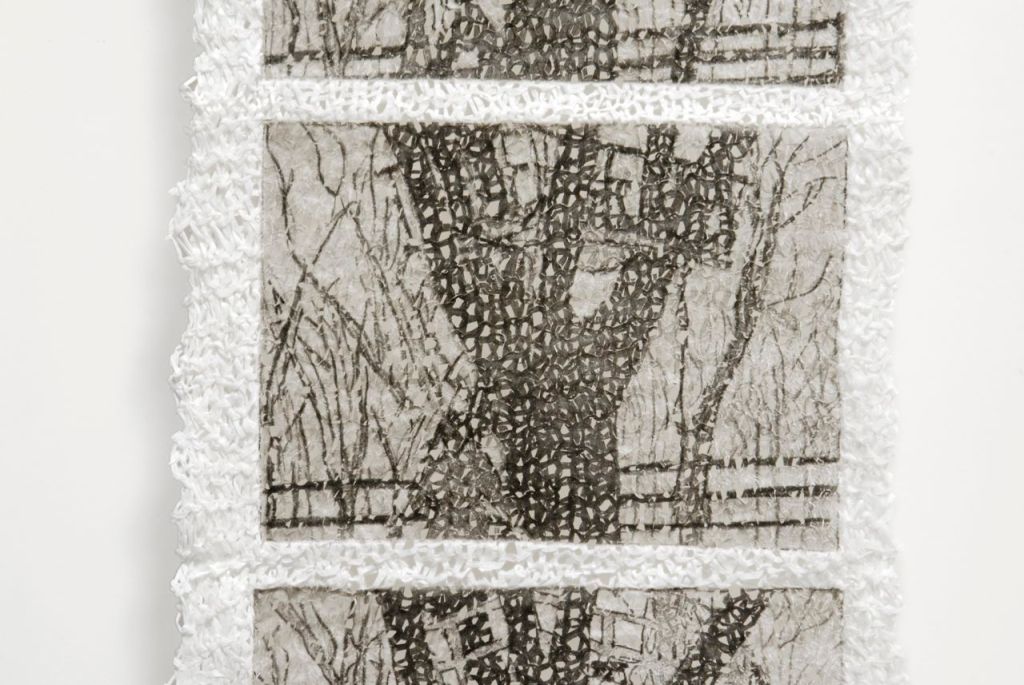
    Aimee Lee, All there, 2016. Dye on paper, thread. 11 x 11.5″. Private collection.
    Aimee Lee, All there, 2016, Dye on paper, thread, private collection.

    Firstindigo&Lifestyle: You are teaching as well, could you tell about the workshops and education aspect?

    AL: I mentioned before that sense of responsibility to share knowledge about hanji to a much wider audience. Part of this is from a conservation instinct, out of a fear that hanji is disappearing. But most of it comes from a joyous instinct, out of my love for this material that is so endlessly versatile. I always knew that handmade paper had great range, but even after almost a decade, I continue to find possibilities for hanji. If the substrate was not impressive, I would not feel compelled to promote it. However, I want people to know about hanji as an option, so that they can have another tool in the toolkit. This means that I teach a range of workshops, from preparing fiber to making hanji to manipulating it by hand. I travel continually to spread the word, in the hopes that eventually hanji will become as familiar as other papers, and that paper itself can be regarded on the same level as canvas, clay, metal, glass, wood, and so on.

    Aimee Lee, Beating fiber to make hanji while teaching students at Paper Book Intensive 2016 at Ox-Bow in Saugatuck, Michigan.
    Aimee is beating fiber to make hanji while teaching at Paper Book Intensive 2016 in Saugatuck, Michigan.

    Firstindigo&Lifestyle: The aesthetic form of Hanji art and folk art influences your making, how do people receive these traditional objects, which you are making today?

    AL: Most people don’t know about the lineage of the objects, so the responses are mostly of wonder—they are amazed that my pieces are made of paper in the first place. This provides an opening to share the stories of their historical use, and illuminate the ways that humans have always made objects that are not only useful, but embedded with meaning. Some have asked if I am interested in using the techniques to make much more contemporary ‘looking’ art. I have wanted for years to extend crafts like jiseung into installation and larger work that goes past the original shapes and functions of their predecessors. The issue is that the time and labor that it takes to make one piece is so great that I could only go in that direction if I had a very long and uninterrupted stretch of time to work. However, I am gratified to see that some of my students are moving in that direction after learning about hanji and its applications.

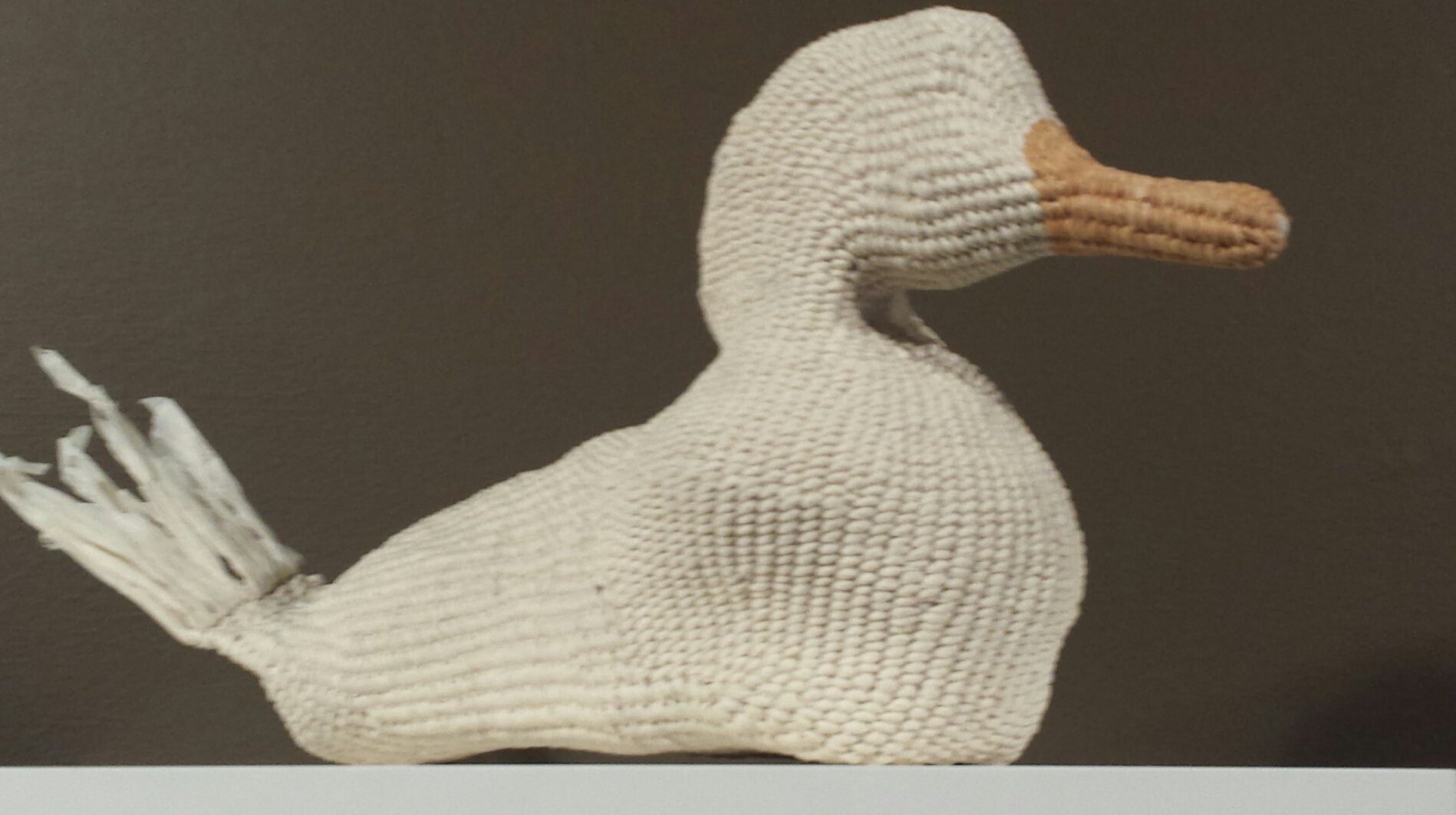
    Aimee Lee, hanji duck, Korean Cultural Center, March 2016
    Aimee Lee, hanji duck, exhibition at the Korean Cultural Center, NY, March 2016

    Firstindigo&Lifestyle: What other materials do you use today in the making of your art?

    AL: For the longest time, I have been very strict about using hanji whenever possible, or other handmade papers. My thread box is always full of different paper threads I have made, though I use cotton, linen, and silk thread to sew my hanji dresses. I also use the raw materials that make these papers, such as the cooked bark before it is beaten to a pulp. I use mostly natural dyes and finishes, which add color, structure, and protection to the paper. Last year, I collaborated with Kristen Martincic on a paper and ceramic installation, and recently had a couple of jewelry metals artists help me with additions to my paper ducks at Haystack Mountain School of Crafts. I’m interested in continuing this last investigation further.

    Firstindigo&Lifestyle: What is fascinating about your use of paper is its multiple dimensions from small objects to books. Your own writing and art (illustration) is sealed into these art books. Tell about the books, which you have made, how did the stories develop?

    AL: Books came first for me, before paper. I was making artists’ books at Oberlin College while studying with Nanette Yannuzzi Macias, which was a game changer. It was a way to combine writing, drawing, storytelling, and all kinds of other media into a form that felt very familiar and yet new. I don’t remember when I started to draw comics, but like improvisation, it was something that came naturally to me. I always thought that the point of being able to make my own books was the ability to create all of my own content. Most of my books contain original writing and stories that come from my own life experience, literature that I love, and the immediate present moment—whether an emotional space or an actual time in history that could be marked in the news cycle.


    Firstindigo&Lifestyle: Do you travel to Korea to get new ideas and exchange?

    AL: I am able to get back every several years, whenever I am funded. However, because of the distance and difficulty of making enough time to visit (I prefer going for longer periods of time), it’s not a journey I make often. Certainly it is inspiring, but it is a challenge as well because the expectations of me as a Korean American woman can be stressful.

    Firstindigo&Lifestyle: Often you hear that there is a division of thought between Eastern and Western approaches or philosophies. Do you feel you are bridging the gap between east and west in your practice, or do you think about these questions?

    AL: This idea comes up often and much of my work can be seen as bridge building between cultures. However, I do my best to stay away from the reductive nature of “East/West” because it sets up an automatic “Us/Them” mentality that can become dangerous. My life experience of feeling reduced to a single word, automatically, because of how I looked, keeps me aware of the unconscious instincts we have to categorize everything. I prefer to present my scholarship and artwork as being rooted in and inspired by many different traditions and cultures. It’s impossible for me to work any other way because I was born to immigrant parents and always lived between at least two disparate cultures.

    The “east meets west” cliché is one I particularly dislike, as if it has just happened, and as if there are only two monoliths in the world. It also comes from the point of view of a certain place being the center or more superior, which is problematic. Most cultures around the world have been in contact with each other for centuries, so cross-cultural understanding is not a new thing or an anomaly. Rather, it’s the norm.

    Firstindigo&Lifestyle: Where do you see yourself as an artist and educator in the future?

    AL: My goal is to build a new hanji studio for myself, where I can work, make paper, and teach independently, while continuing to travel to teach and exhibit. I want to train apprentices in this new space so that I can increase the number of people who can support hanji. There’s at least one more scholarly book left in me as well, so I look forward to finding the ideal setting to properly research and write it. All of this will be unlocked, I think, once I find the right place for myself to be.

    … … …

    Check out Aimee Lee on web: http://aimeelee.net/

    Her artists’ books can be found under the Bionic Hearing Press imprint from Vamp & Tramp.