Painter Teresa Dunn has her new exhibition Motherload on view until June 18 at the First Street Gallery in New York. Her current show depicts recent oil paintings and mixed media works on paper and canvas. For this exhibition, the artist who masters the Renaissance school of nature and human portraiture to the fullest forms has adopted new richness of palette. Her repertoire has gotten fuller, perhaps partially due to the size of the panels, paper and the use of triptychs, which allow larger developments and almost surgical dimensionality. Now the center is the body as tissues and palpable beats. In these new works, the body is joined with the amounts of vegetation, which makes the skin appear as fruitful foliage. Painter Teresa Dunn is making serious rising; she is represented by the Hooks-Epstein Galleries in Houston, Texas, and by Galerie l’Échaudé in Paris in France.
Teresa Dunn at her Motherload show in First Street Gallery.
Teresa Dunn, Birth of the Pink, Oil on paper, 60×45, 2016.
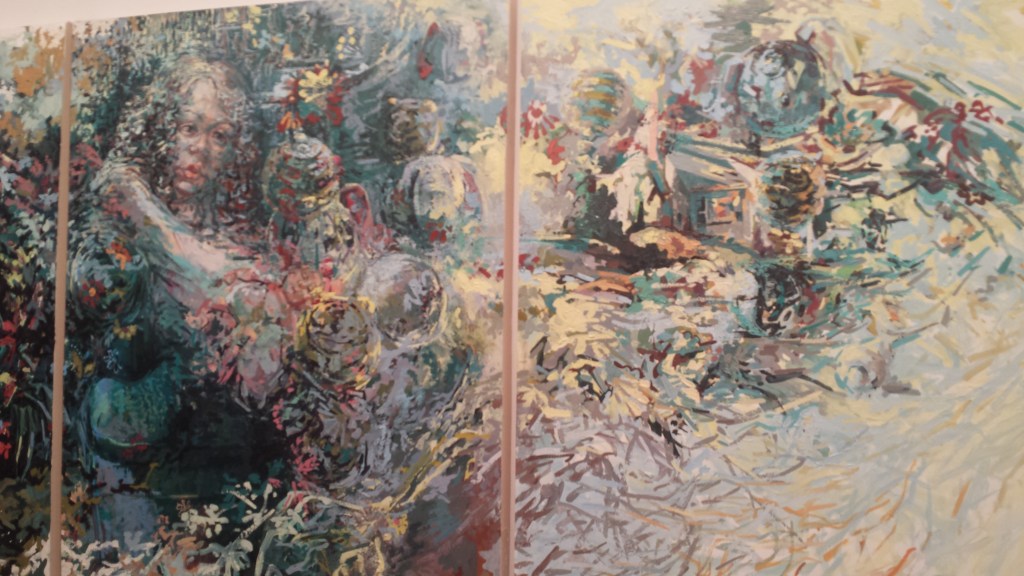
Teresa Dunn, Interlaced, Oil on paper mounted on canvas (triptych), 60 x 120, 2015.
In an action packed painting there was a pause, when Teresa Dunn imagined communities within narrative landscapes full of thick Renaissance color and light. The water rose through the images, leaving behind people on their isolated islands, together, alone, breathing air, figuring the scenes of us existing on the planet. The scenes were almost apocalyptic, borrowing from Biblical and mythological imageries of human drama and emotion. And it all made sense, as her paintings were influenced by the Venetian school, especially by the works of its great master Titian. Drama and poesia in the same theme, when color and light create unparalleled resonance.
Now, the next pause was different. Teresa became a mother. From artistic point of view, the dreaming in her works became increasingly about the simultaneously occurring events. These happenings were seemingly not relating, but arbitrarily meeting in the same future. This time the fragments of narration made sense as islands of vegetation. The theme of water from previous paintings had changed into the vegetation. Or the water had become an overflow, which got mixed into and within the vegetation becoming moisture, as palpable like a touch of mist on the skin. An underpinning, a reflection on canvas. Like her inspiration of the magical realism, Colombian novelist Gabriel García Márquezimagined fog. Can you see distances through the fog. Or how a distant place somewhere far resonates here in this place. How everything connects and makes a reason, but not as univocality. The story is about bringing together universal fragility of existence and our mortality.
In the new works, the colors have become evidentially subtler with more visible brushstrokes, with circular patterns of movement. The palette is lighter, and the narration seems to be settled in the background in the midst of a natural flow and overgrow of things; more than objects. The natural life and still life has found a lingering attachment inside the palette, showing that humans as actors play no longer the central role. In a triptych ‘Interlaced’ (2015), a loose tire rolls through the canvas, as if being a sign of an uncontrolled human motion. In another triptych, ‘Slippage’ (2015), a woman is growing out of a bush representing the nature herself and our origin. In this triptych, the panels together seem to be cumulating as a force, which becomes a wave. A water splash is running from one panel to the other in ‘Slippage’. Teresa Dunn’s triptych form borrows from the Renaissance art. In her paintings, the occurring shapes are creating new terms to reinvent the classic.
ruby onyinyechi amanze embeds a notion of scholarly artist in a true sense. Next to her large drawings on paper stands a mind that is influenced by spatiality in a geographical sense. The artist employs a design sensibility that gives her drawings variable perspectives. ruby amanze completed her art degrees, worked in art institutions, and as the Director of Education at the Museum of Contemporary African Diasporan Arts (MoCADA). She was a Fulbright Scholar teaching art at the University of Nigeria, Nsukka in 2012-2013. Currently, while still teaching art, her artistic practice evolves in a studio located in Brooklyn, New York City.
Firstindigo&Lifestyle: It is fascinating how you translate the theme of hybridity into formations with so much vivid color and fluidity. Do you think this resonates with the fact that you were transferring between various continents?
ruby: Most definitely. There is a way of being and moving in space, that I feel is unique to the experience of having come from many places. Automatically, there is less permanence associated with land (geography) or a sense of home. My understanding of home was that it changed a lot. So I adapted into a shared consciousness that home equates fluidity. Also, that my physical body had the right to claim space wherever I was- nothing felt off limits. I started to identify myself as a hybrid and to recognize that there were many narratives of hybridity. Initially, there was an idea that people who moved in that kind of way didn’t belong anywhere- that they had no home and somehow weren’t “authentic”. Or that they lost something…something they would always search for. I disagree.
I feel that my life is enriched by these multiple homes. I meet people from all over the world who have had similar transcontinental experiences, and I know I’m part of a borderless, expansive “country”. We don’t have a landmass. But the space is a legitimate one. A lot of this informs my spatial decisions in the drawings.
What does being ‘African’ mean to you personally, was there a strong sense of a Nigerian community in England where you grew up?
ruby: Being African for me can mean many different things, depending on the context. Generally speaking, I think it’s far too broad and simple of a “classification”. What I know of Africa is miniscule compared to its vastness. And that goes for any of us, who refer to the region so lightly…the truth is we know next to nothing. Even to zoom in to Nigeria, where I’m from- the same sort of complexity exists. Non-African colonizers, as is the case for many – if not all African ‘countries’ – arbitrarily decided the country’s borders. The writer Taiye Selasi said in a Ted Talk, “nations are concepts”. They’re inventions. She said that what makes more sense, is to think about where you are ‘local’ of, as opposed to a ‘national’. I think this is true, so while I was born on the landmass we call Nigeria, what is more accurate to say right now, is that I have a relationship with the city of Lagos. That’s what I know most of Nigeria. That’s where I have friends and routines…where I invest time and spirit. That’s where I am at home. Yes, there was and still are, large communities of Nigerians throughout England. Growing up there, my family was part of a circle of families that emigrated around the same time, some of whom had known themselves in Nigeria prior to relocating. My generation of this circle is still close. We grew up essentially as cousins.
When did you start making art, how did your career path take direction?
ruby: I’ve been making art, and identifying as an artist, since I was a small child. It has always been, everything I’ve wanted to do and be. My pursuit of it was single minded. At every point that there was an option, I chose art. Coming from a family of Nigerian immigrants, who had grown up with the societal framework that art is not a career, I had to be quite stubborn and relentless in advocating for it. To my favor, I excelled in all academic areas, so my parents didn’t fight me too much, and perhaps took the mentality of ‘waiting it out’ to see if it would pass! It didn’t pass and here I am today, as I knew I would be. All of my life choices have been around art. I did my B.F.A and M.F.A worked in art institutions, taught art (and still currently do)…The turning point for my career was when I decided to leave the best job I’d had, as the Director of Education at the Museum of Contemporary African Diasporan Arts (MoCADA). I left to do a Fulbright on contemporary drawing in Nigeria. It was a year commitment primarily to the studio. When I returned, there was no going back to anything other than a full time dedication to my career as an artist. This was the best decision I ever made…
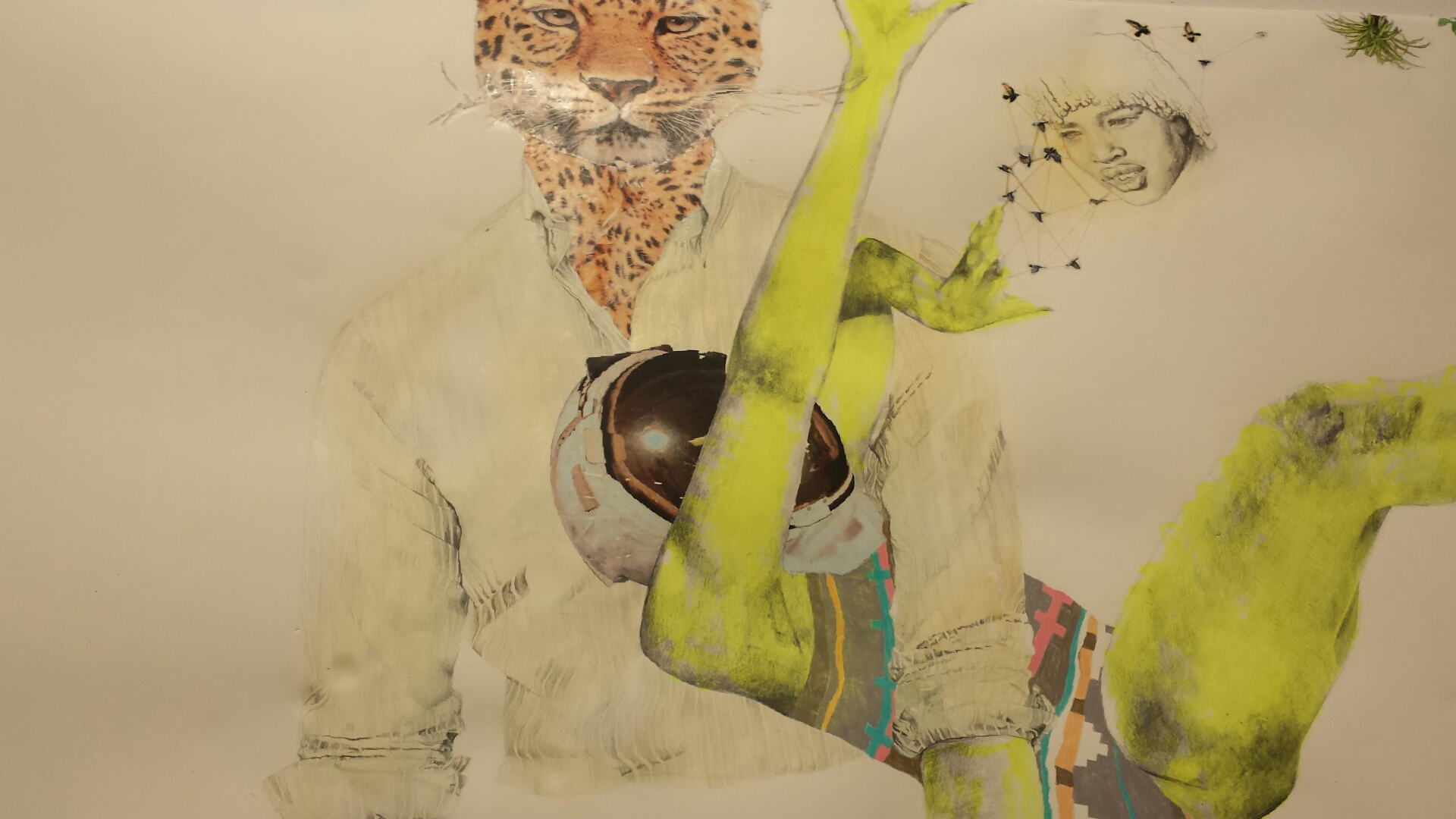
ruby onyinyechi amanze, mixed media works on paper, detail. Mariane Ibrahim Gallery, The Armory Show, 2016. photos: FirstindigoandLifestyle
Can you recall your aesthetic language? Somewhere in the drawings/paper, the characters dance, move, and seem to be very mobile?
ruby: Funny that you say that, as I’m influenced a lot by dance, performance and movement languages such as Gaga (that I recently discovered and have since incorporated into my extended ‘studio’ practice). Also films…slow moving, non-linear, beautifully ‘choreographed’ spaces and exchanges. I go to the cinema every other week if I can, and am completely absorbed into the imagery. It’s like going to library and collecting books for research. I collect images, not knowing when or how exactly they’ll resurface. Architecture and design influence my imagery a lot.
In hindsight, I’m aware of many instances where I aligned myself with design conversations and practices. I don’t think I had the language to make the connections before…to talk about my drawings as design. It just was a pull that I kept following. After my M.F.A, I contemplated returning to school to study architecture. I think architectural drawings are so beautiful. And the ways they think about space, as something malleable that can be shifted or constructed, is fascinating to me.
Your drawings on paper seem to be narrating things, and yet say something very poetic in their way of leaving lots of white space around the figures and colors. How about, are any of these patterns and colors influenced by some African aesthetic traditions, and folk features?
ruby: I think of the drawings as non-linear narratives. Story telling is a fluid art, and even when it’s ‘true’, there is always an element of fiction in it. I’m a storyteller. And I leave space for the viewers to insert themselves or participate in constructing the narrative. There are clues- some of which come from actual experiences (mine or sampled), some of which are entirely fabricated. I don’t feel any obligation to give the viewer everything. Nor do I feel that art is a platform solely for me to communicate a particular and clear ‘message’. That’s not my job as an artist.
While spending time in Nigeria, what did you learn and study? How was the experience like; did it feel foreign at times, or was it more like returning home?
ruby: I’m sure I learned many things…but mostly from the normal day-to-day living, as anyone would wherever they found themselves. There were no grand epiphanies. Generally speaking, there was no “adjusting”. I wasn’t there as a student, but in the position of a professor, I think there’s always a reverse learning that happens in the classroom- if nothing else, how to be a better professor. I was there and it was my home, my life- it felt familiar. Of course, there were things that were different. But the only thing that really rattled me were social attitudes that seemed antiquated when it came to gender or sexual equality. Let’s just say, I got into a few fights!
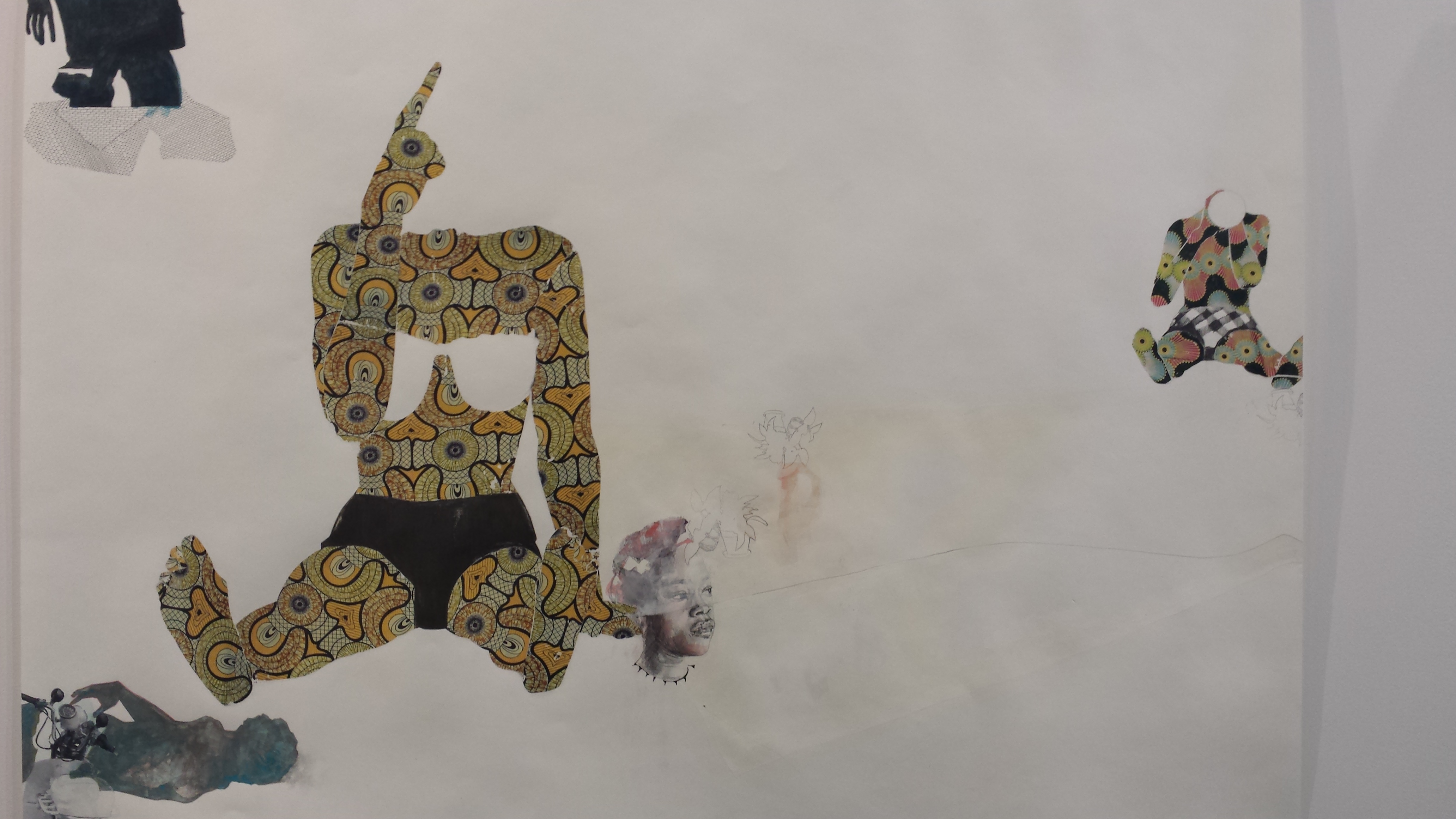
ruby onyinyechi amanze, mixed media works on paper, detail. Mariane Ibrahim Gallery, The Armory Show, 2016.
Do the paper works without borders or frames imply different moods than the ones with frames?
ruby: No, it’s just a different presentation. I like that paper does many things.
Could you tell a little about the experience and feedback you received at the Armory Show, you were there with Mariane Ibrahim Gallery during the first week of March?
ruby: I’m happy to have had the opportunity. It can be a complicated space for an artist to navigate, because it’s a market. There is little conversation about practice or curatorial interests. I had to separate it in my mind from the studio. In making the work, I was very intentional about maintaining my integrity. Time wise, the work was shown at the Armory, but in a different time, it could have been shown anywhere. In other words, showing at the Armory didn’t change anything for me in terms of what I’m interested in exploring in the studio. More than sales, what I’m most excited about is the visibility…the introduction to museums and such.
Where are you heading next, artistic plans for the future?
ruby: I look forward to many things in my career as an artist. But the number one joy in all of this is what happens in the studio. That’s where I’m heading next…
ruby onyinyechi amanze, I sent you to survey the world, and when you did not return, I came, 2016.
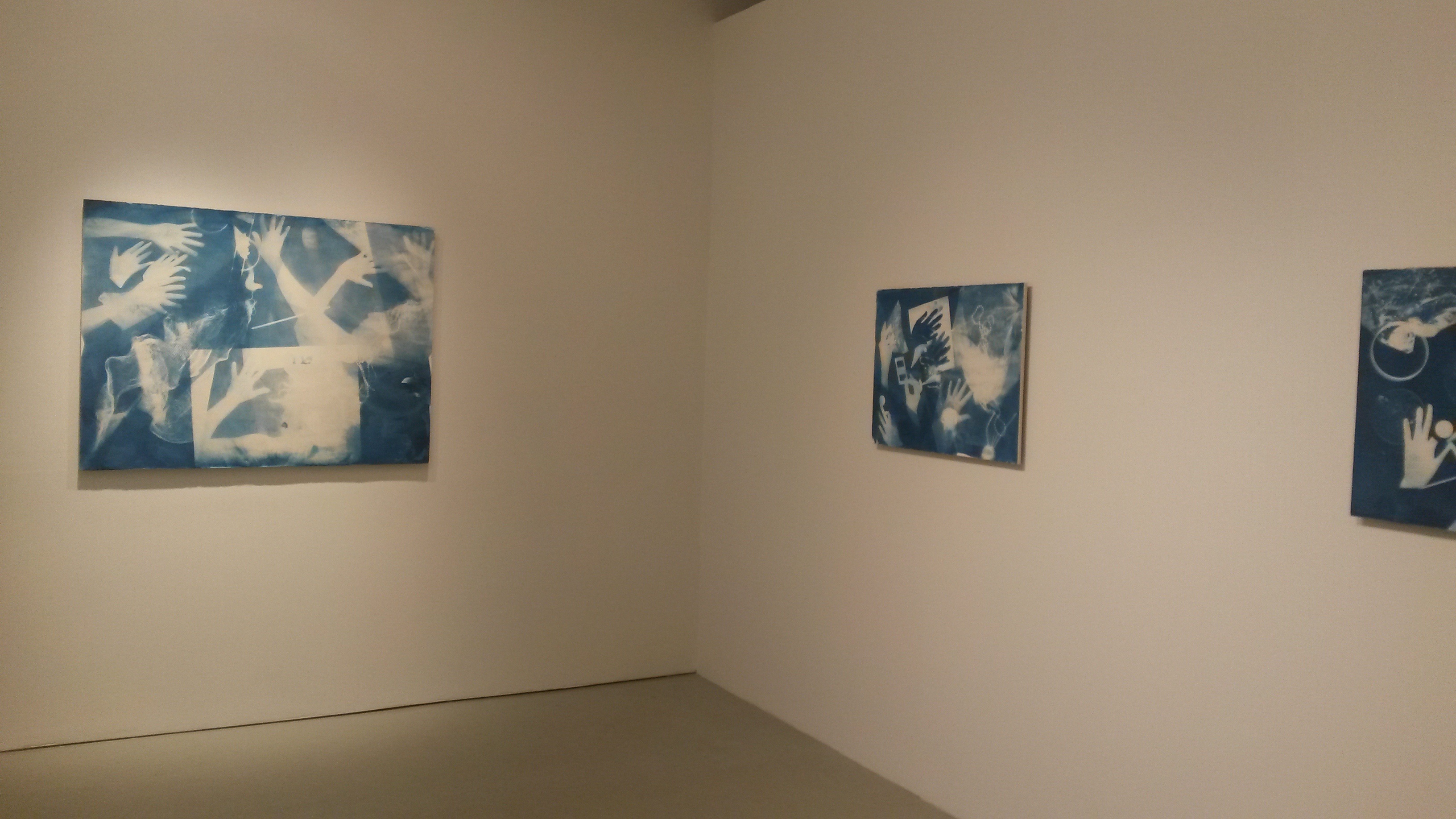
Artist Ofri Cnaani has created a new photography exhibition consisting of prints and a performance piece at Andrea Meislin Gallery. Photographies on display echo ideas deriving from Xerox art of the 1960s simultaneously connecting with the visual world of the mesmerizing early photography of the 20th century. The exhibition ‘Wrong Tools’ will be on display until October 24, performances taking place on Wednesdays, Fridays and Saturdays. Cnaani’s Blue Print photographs are like intuitive maps constructed of performative ideas that associate with artist’s own body. With both of her performance and photographs, she creates a presence. The works are building up from fragments, and the pieces are put together in a compelling logic. These could be like ruptures built on the Internet surface, where constant image flows create new associations. Here is Ofri’s interview.
Firstindigo&Lifestyle: Your ongoing solo exhibition ‘Wrong Tools’, at the Andrea Meislin gallery speaks a strong esthetic and spatial approach with performance element added to the photography gallery. The performative element also looks back from the blueprints, which display hands in various positions doing tasks, perhaps. Are these prints your hands making the past performances, or projects?
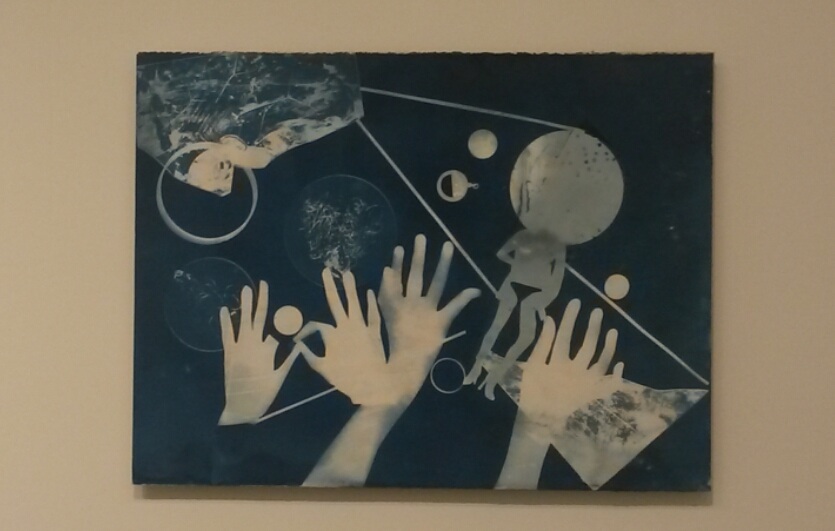
Ofri Cnaani: In the cyanotypes I’m using my own body. I’m using the special qualities of one of the earliest photo techniques to promote some sort of performative photography. In a way, it is very similar to what I do in the performance: I’m creating an image in a limited amount of time that is constructed from found objects, made objects and my own body. Like in the personalized ‘image maps’ I’m creating in the performance, here too, I have a limited control of the final result. The process is always between failure and magic.
In your actual performance that I observed taking place during the opening night at the gallery’s foyer with windows, you encounter audience member on a participatory table setting, where each unique guest sits opposites of you. The scene comes out as very intimate and poetic; we are simultaneously looking at the wall where the reflection of the table surface is displayed with your real-time construction of objects and images on it. And, we are grasping the exchange between you and the other person embodying the performance. Quite interesting, a guest was taking pictures with her phone of the very situation as well. What is taking place in these moments? How do the photographs and the recording of the event resonate in the doing of the performance physically?
OC: When someone sits with me, I first offer him or her a ‘reading’ of his or her visible future. I used a tarot-like deck that I designed titled ‘future business’. I also ask them to give me one personal item and to choose two items from my collection of small objects. I’m using the message on card they chose and the three objects they selected and gave me as a starting point, to create a live collage-like image. I called it ‘image map’. This image is captured and printed using a special apparatus I build for the show. Lastly I stamped it with a ‘Copy’ stamp and signed it with red ink, handing the Original Copy to my visitor.
Ofri Cnaani’s performance taking place at Andrea Meislin Gallery
During the performance, the process is projected on the wall
As the title ‘Wrong Tools’ already implies so many interesting visual connotations, could you tell more what is the idea or meaning behind it, is it metaphoric with a larger idea and also coming to the performance? Does it resonate solely with ideas, which derive from computing?
OC: My husband, who is great in building things, always says everything is very easy if only one is using the right tools. I realized I’m always using the wrong tools. My studio is a mess and I’m always using the tools that are wrong for the job. I like to think about my method, using the collections of two and three-dimensional objects in my performance, as ‘endless metabolism’. I’m using the same little objects for different performances, as well as for the cyanotypes and other photos. The same objects travel between many of my projects, always been used in different ways, but never used as they were originally meant to be used.
Ofri Cnaani, OC real and fake-series, Cyanotypes, at Andrea Meislin Gallery
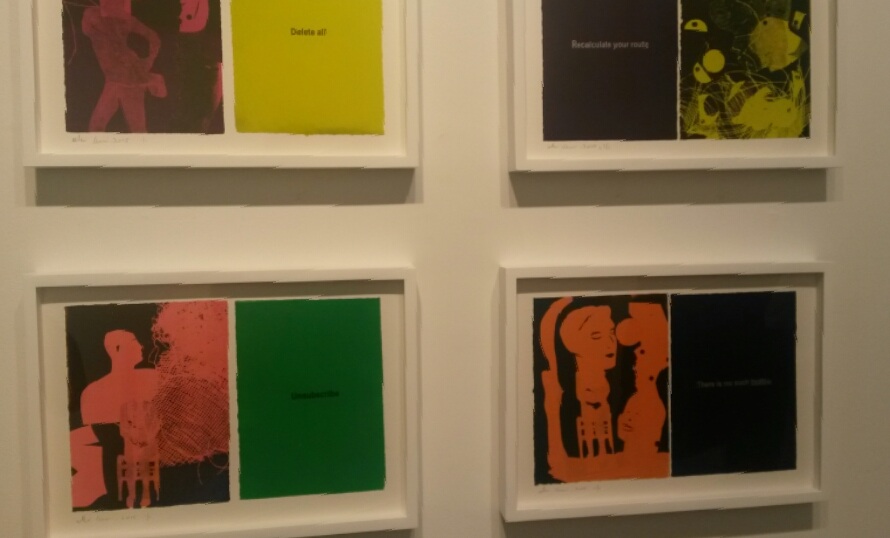
Then, your exhibition at the gallery has these colorful images called ‘future business’, that have a short message embedded in them. It seems that they relate to the performance, do they have an element of time in them as well?
OC: The monoprints are also ‘one of a kind’ and were made in a similar way. I’ve been using cut-outs and flat objects, placed them on paper and rolled them under the press, so each one is a different arrangement, although some of the cut-outs appear more than once. The texts are the same texts on the special edition tarot deck I produced and then use in my performance.
On each card there is a message we get regularly as an online user like ‘Delete All’ ‘Unsubscribe’ or ‘Change Your Profile’. These lines are charged with a very different meaning when we receive them as messages in a one-on-one ‘reading’ session where we all are so vulnerable.
Adi Puterman curated your exhibition for Andrea Meislin Gallery, what do you wish to tell about the curating exchange and process, do you know each others tactics well?
OC: Adi and I worked on the show for over a year and she was very involved with each step: from the concept of having an on-going 6 weeks performance in the gallery, to the selection of the pieces, and communicating my ideas in a written text.
I have noticed that your artist career includes plenty of performance works, such as the ‘Seven Words’ at the Metropolitan Museum. This past work is also very interdisciplinary. Is a question of the different art forms relevant to you in your own art making, or are all forms closely related?
OC: I’m driven by concepts and often by time constraints (like a different space I’m working in or a different collection or archive I’m using). I’m less driven by a specific medium or style.
As an educator of the arts, how do you teach time-based process to your students, do you have guidelines for that?
OC: We see many projects and discuss them, we read texts and using mind-mapping method in order to understand them and connect them to other ideas, texts and art works.
I often think that New York city is such a creative hub with so much international potential gathered in one place. Do you consider that as an international artist based in the city you have a specific role or identity, which is perhaps one here, and another that goes back home in Israel communicating and identifying with the contemporary art scene there?
OC: I’m not sure what do you mean by that but once you leave the place you were born and raised, your identity is always ‘more than one’ and in a constant negotiation.
You have created public artwork, do these works imply a different kind of activism or sensibility that comes with the public space, or are all ideas you are doing basically interrelated?
OC: My work is context specific. When I work in the public realm I work not only with a specific building and its specific history. The process always involves a community or a group of individuals. The process in those projects is part of the final piece. The final images are never known when I start working on a public piece.
Can you tell a little what are your next steps going to be like?
OC: Next week I’ll be doing a performance that is similar to the one in the gallery at Dallas Aurora. My project is part of ‘Altered States’ exhibition, curated by Julia Kaganskiy. Next month I’m going to Inhotim in Brazil to work with the park employees to create a participatory performance titled ‘Frequently Asked’ that will be then presented in Inhotimon early December.
Ofri Cnaani, Blue Print, 38.5×49.5, on display at Andrea Meislin Gallery. Images by Firstindigo&Lifestyle







 Firstindigo&Lifestyle