Category: asian art

  • Why to love Hokusai

    Why to love Hokusai

    The Japanese artist Katsushika Hokusai (1760–1849) is usually recognized for a single image—Great Wave Off the Coast of Kanagawa, which is an icon in the global art world. When we recognize the work, it is as if the unpredictability of the sea holds our attention when a mighty wave breaks against the beach. We are lucky, since The National Museum of Asian Art has had a commitment to build its Hokusai collection. The institution is now showing an exhibition Hokusai: Mad About Painting in the museum’s Freer Gallery of Art.

    In commemoration of the centennial of Charles Lang Freer’s death in 1919, the Freer Gallery presents an exploration of the prolific career of the artist Katsushika Hokusai. Freer himself recognized the richness of the artist’s works assembling the world’s largest collection of Hokusai’s paintings, sketches, and drawings.

    Like the Great Wave, many of Hokusai’s paintings convey his interest in the every-chancing ocean in motion, including its fishermen and sea creatures. The artist created thousands of works throughout his long life. He worked mainly in Edo (modern Tokyo) period with a proximity to the Pacific Ocean.

    Above on the left, we see one of the wave paintings Breaking Waves (Edo period, 1847), created by Hokusai. It is apparent how the rough curving motion really brings the sea to life. The artist was able to masterfully capture the ocean’s free spirit making it the focus of his works. On the right, another Japanese artist of Edo period, Utagawa Hiroshige (1797-1858) depicts Edo landspaces in his work consisting of six panels. A detail of his work Famous Sites of Edo, spreads in the screens in which each panel has a separate painting that is mounted to one panel of the screen. The coastline and sea are visible through these panels illustrating landscapes. Interestingly, during the life of the two artists, by the early nineteenth century, the city of Edo had grown to a metropolis with a population of more than one million.

    Hokusai, Egret on a Bridge Post
    Edo period, ca. 1801-1802
    Japan
    Ink and color on paper
    H x W (image): 85.8 × 25.5 cm (33 3/4 × 10 1/16 in)
    Gift of Charles Lang Freer
    Freer Gallery of Art

    Hokusai showed interest in nature through many of his works. One of them, Egret on a Bridge Post, shows a white egret at night with moonlight illuminating the bird’s pale form. He illustrated the bird on top of a bridge post. Egrets are still seen in Japan’s rivers looking for food.

    The works in the exhibition, including Hokusai’s humorous manga about the everyday life, activities and faces of Japan, shows the vastness and the creative mind of an artist, who thought he might achieve a true mastery in painting, if he lived to the age of 110.

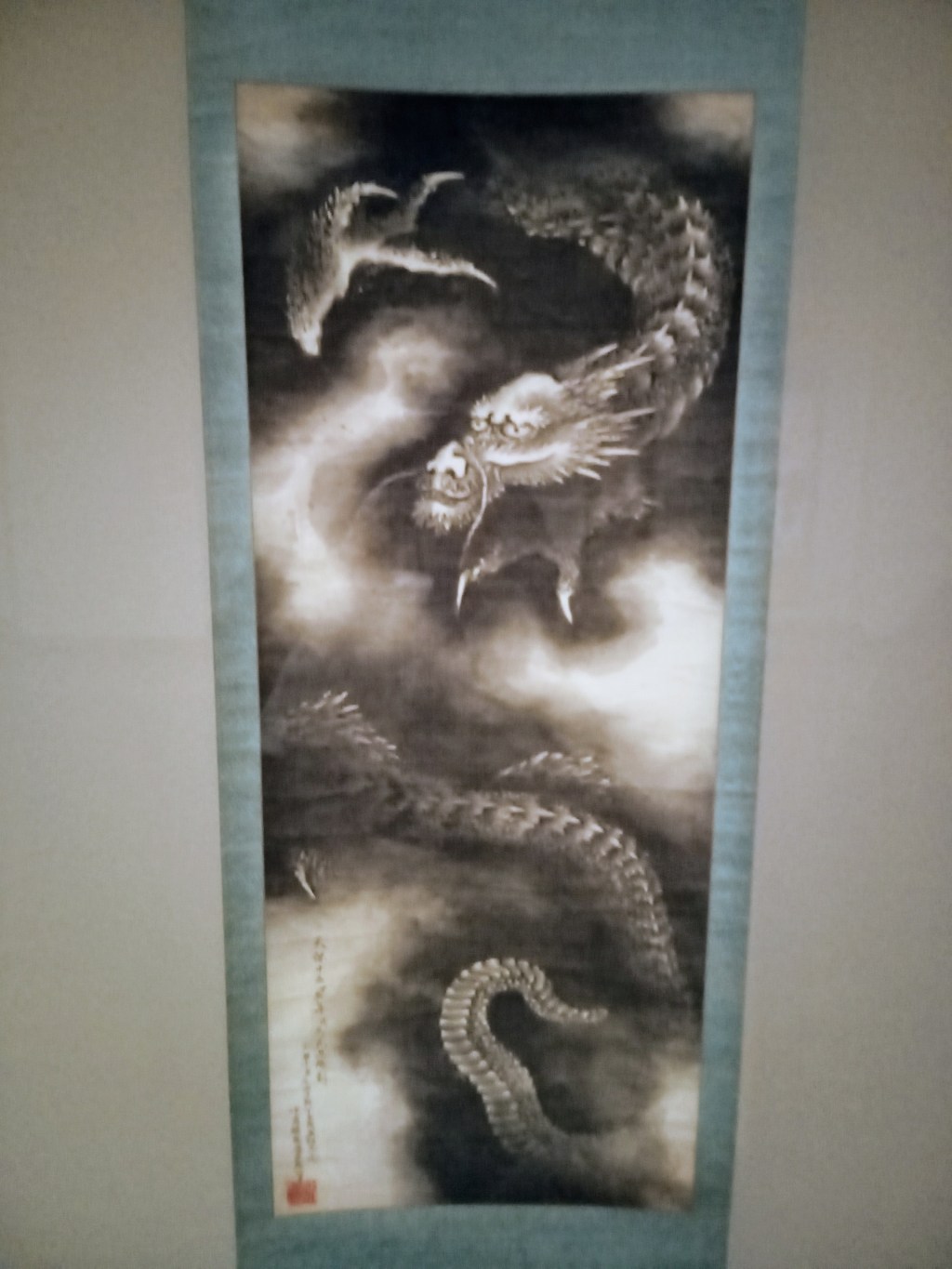
    During his eighties, Hokusai painted several mythical creatures known as dragons. The ultimate interest for him might have been in the character’s energy as the artist himself was ageing.

    One of these works, Dragon and Clouds (Edo period, 1844), was painted when he was at the age of eighty-five. The painting shows energy and vibrancy in the form of mighty mythical creature. The work is an important addition into documenting Hokusai’s life and art.

    Hokusai, Dragon and clouds
    Edo period, 1760-1849
    Japan
    Ink on paper
    H x W (image): 88.2 x 35.6 cm (34 3/4 x 14 in)
    Gift of Charles Lang Freer
    Freer Gallery of Art

    Visit and explore more about the exhibition: Hokusai: Mad About Painting

  • Asian Smithsonian: Bells, buddhas and the meditation

    Asian Smithsonian: Bells, buddhas and the meditation

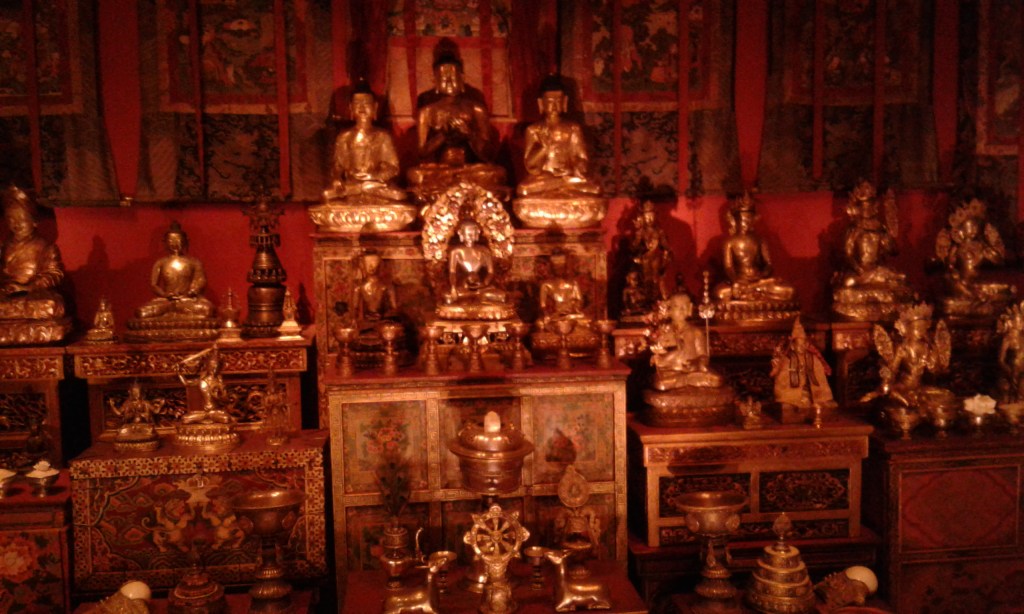
    Bells, tools and meditation are all ancient. When it has been confirmed by historic research, that tools and weapons were among the earliest bronze objects in China, the bells also now belong to this bronze age era. The meditative component has eminently added value and appreciation among the Asian arts. People are looking for nurture from art, and statuesque buddhas seem nurturing, even healing with their meditative poses. Massive sculptures are surrounded with the calm that is often lacking from the demands of the everyday life. The journey inwards requires little more participation.

    Chinese bells have a special form that calls for a closer investigation. They are emblems of music, and when tried, the sound can be interestingly different from the Western terms of bell-sound. The church-bells have varying melodies, yet Chinese bells embody tones that are thousands of years old. It is believed, that the sound has not changed since they were casted. Bells still narrate of ancient technology as a soundsystem.

    Chinese bells in the Sackler Gallery.
    Chinese bells Free Gallery of Art & Arthur M. Sackler Gallery

    With the global travel, the world has shrunk, and meditation practices have become increasingly popular. We are at the moment pushed to scrutinize ourselves into increased indoor dwelling, so discovering new possibilities of meditative practices might be useful. Sound is one way to go, listening to music with new awareness, concentrating fully into music or sound may turn the focus into a particular matter. A ‘look’ inwards may be rewarding.

    Meditation is a bodily practice of a mind as operator. A word techne would also fit with its stance of the world. Techne is a philosophical term, which includes knowledge at its core. By using it in reference to bodily practice, it might as well connect to understanding your meditation approach. Learn to meditate by meditating, gain knowledge of meditation by doing it. Knowledge is coming from the act and art of doing.

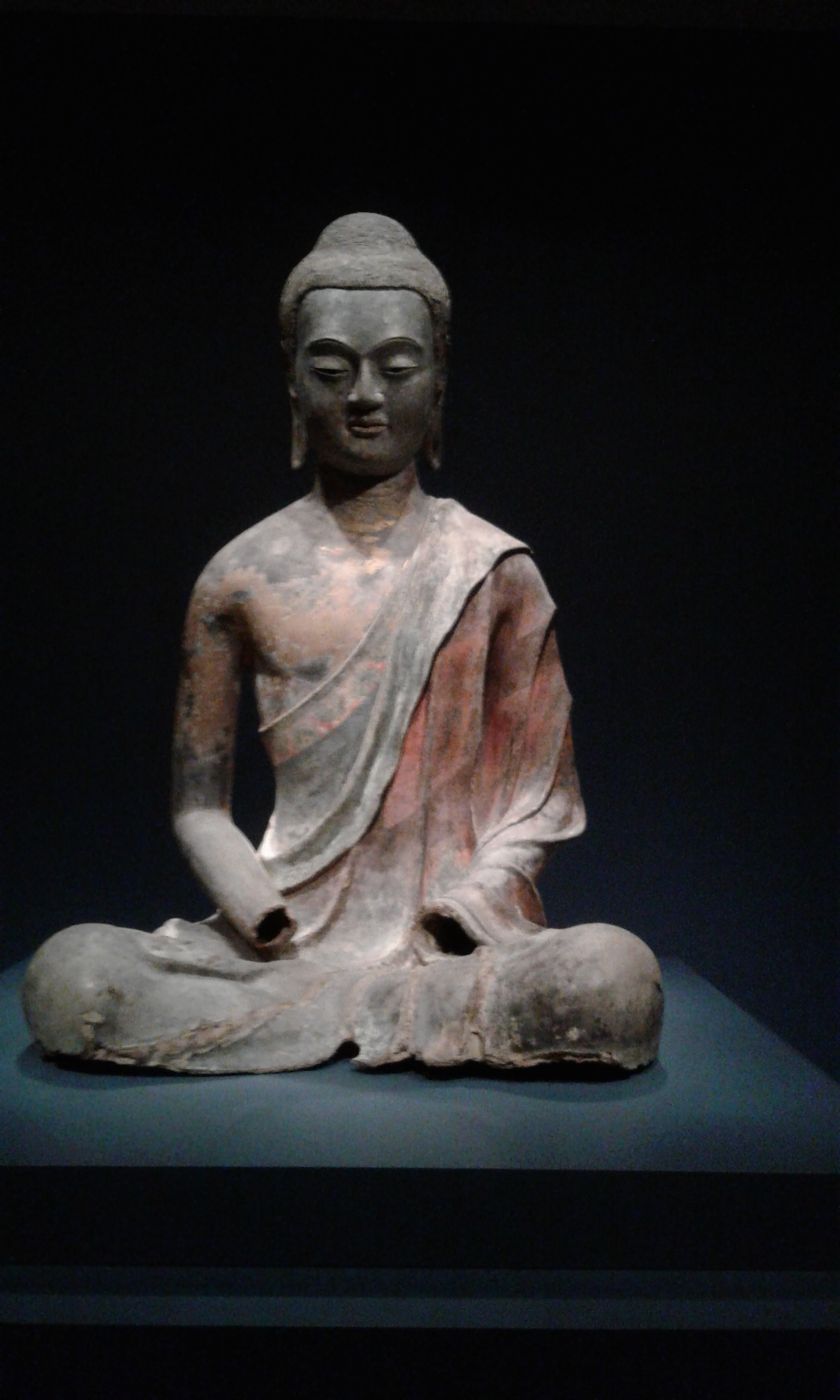
    Sitting buddhas are art works that meditate, giving out a pose with a silent approach that is almost demanding us to participate in a technology of looking inwards, of stopping our other activities, breathing with the sculpture. The art stimulates the senses into a sole pattern of sitting with a more disciplinary attitude.

    Buddha sculpture at the Sackler gallery.
    Buddha sculpture at the Free Gallery of Art & Arthur M. Sackler Gallery.


    Resound: Ancient Bells of China – exhibition on view at the Free Gallery of Art & Arthur M. Sackler Gallery in Washington DC.  

  • Patricia Chow and the meaning of ultramarine

    Patricia Chow and the meaning of ultramarine


    By Patricia Chow

    I moved to Los Angeles in 2014, after 11 years as a New Yorker. During those years, I went to graduate school, began and finished a career, learned to love opera, and mounted my first fine art exhibition – a crowd-sourced photography group show that was simultaneously a fundraiser for the nonprofit where I was a board member. What I never did in New York City was paint. At the time, my relationship to painting was purely as a viewer, standing a respectful distance away, wondering how in the world they did that. Who would have thought that three years later, at the instigation of my Los Angeles painting professor, the indomitable Barbara Kerwin, that I would find myself pursuing a graduate degree in painting?


    Our first-year MFA group show was titled “Twelve,” for the 12 of us that started the MFA in Art program at Claremont Graduate University this past August. The works I created for the show were made with oil pigment sticks, built up into a thick impasto texture by smashing them onto the canvas with a palette knife and mixing colors alla prima. The paintings are about the loss of meaning and culture through the generations and across the seas. Words, behaviors, rituals become hybridized, sometimes beyond recognition, when transplanted to a different environment, just as language and writing change over time, eventually past the point of intelligibility. Each of my paintings starts with a Chinese calligraphic text, drawn in black, that becomes obscured through layers of superimposed texture and color, ending in a very different visual experience compared to the black and white text that “birthed” it.

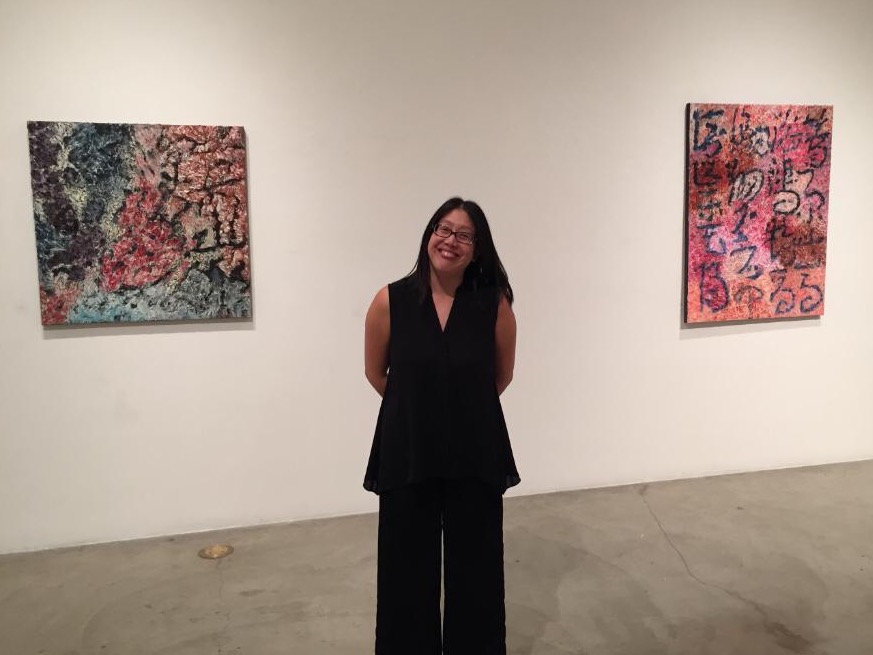
    Patricia Chow in the MFA-exhibition.
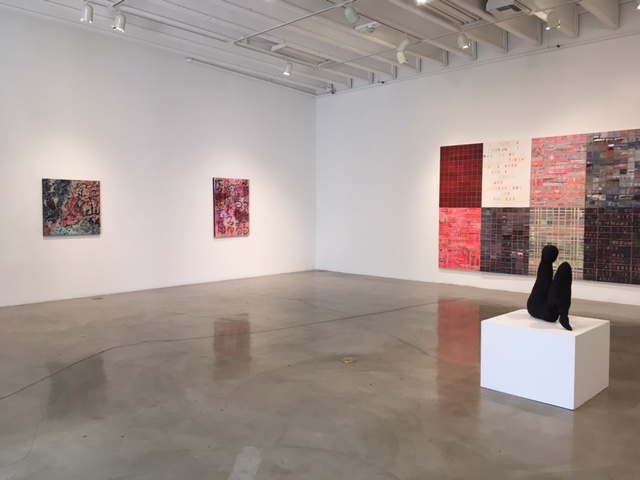
    Patricia Chow’s two paintings pictured left in the Twelve-exhibition at the East and Peggy Phelps Galleries.

    The largest painting (60 x 48 in.) is titled “Outremer” (French for “ultramarine”). The cool colors and coral-like shapes evoke underwater life, but the title also refers to the French territories in the South Pacific (called “outre-mer” in French, meaning “overseas”), that were visited by Gauguin and others interested in the decidedly un-PC idea of “primitivism,” and also where France has conducted a large number of controversial nuclear tests. Thus, in addition to the Chinese text being washed away “underwater,” the painting’s title also alludes to aspects of modern world history that some might prefer to be swept under the rug.

    Patricia Chow with her paintings.
    Patricia Chow with her recent paintings.


    Each of my paintings starts with a Chinese calligraphic text, drawn in black, that becomes obscured through layers of superimposed texture and color, ending in a very different visual experience compared to the black and white text that “birthed” it.


    Patricia Chow is a Los Angeles-based artist whose abstract paintings engage the intersection of Eastern and Western cultures across time and space, and the hybridization and reinterpretation of meaning. She is currently a first-year MFA student in Los Angeles, CA.

    Twelve is on view at the East and Peggy Phelps Galleries, Claremont Graduate University, through October 20, 2017.