Category: performance&dance

  • Anna Nykyri and the transient bodies

    Anna Nykyri and the transient bodies

    Pandemic has left many cities different, as if touched by invisible forces that folded a new narrative in front of us, for what is here now, and what might be more common in the future. At least, it is true to New York City. Finnish film director, visual artist and choreographer, Anna Nykyri created a short film “In-Between”, 2020 (2’51), to capture cityscapes during the pandemic. The artist collaborated with the photographers Aukusti Heinonen, Juan Pablo de la Vega and Griselda San Martin in Helsinki, Mexico City, and New York, respectively, to show relationships of the transient bodies that avoid contact with each other in these cities.
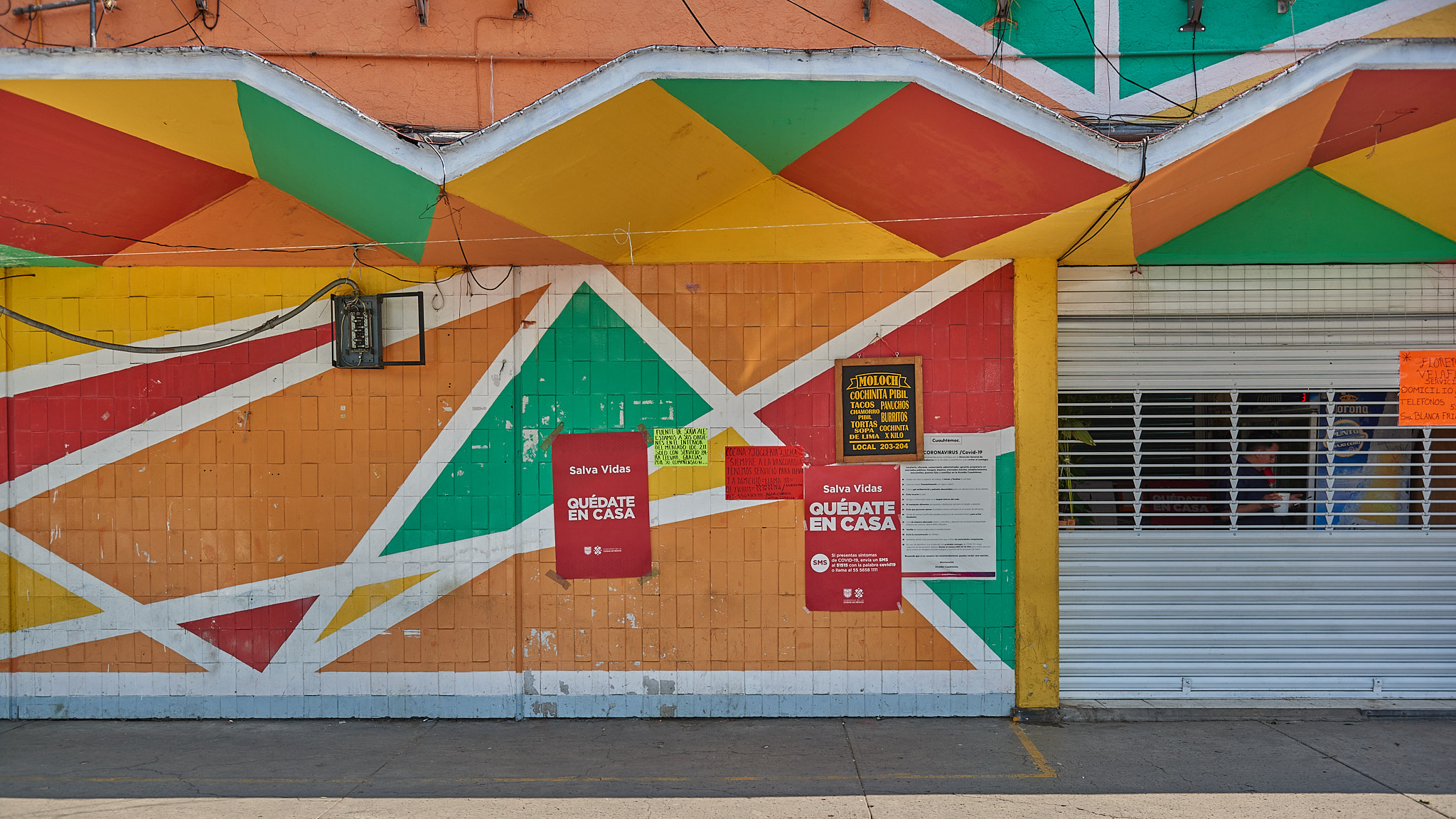
    From short film, In-Between (2020). Image: Juan Pablo de la Vega

    The documentary film curated by Andrea Valencia, is conceived as a montage that compiles photography and moving image to grasp the results of social distancing in the three cities, which are connected by the shared experience of the pandemic. By capturing details and fragments of the spaces and the moving bodies, “In-Between” suggests that, while movement and touch are being restricted, we are living an emotional collective experience.*

    Firstindigo&Lifestyle: As an artist, your practice is quite multidisciplinary. What is interesting is the way your dance and choreography, and film-making, communicate fresh angles to these fields. Maybe there is a level of interconnectivity between these artistic disciplines. Can you tell, how did you eventually pick your artistic practices?

    Anna Nykyri: My intention as an artist has always been trying to create an artform, that would bring together my artistic interests at the time. So, I never tried to be a director, screenwriter, visual artist or choreographer. The current piece that I’m creating matters the most. My definition as an artist can be defined through the piece.  

    Firstindigo&Lifestyle: Where we come from, to some extend defines what becomes of us, or let me put it this way. I think that sometimes we dream very early on, what we want to be doing when we grow up. Where did you grow up and go to school?

    AN: As a 4-year-old, I told my parents I wanted to be a dancer. We lived in the rural countryside and the ballet classes were too far away to attend multiple times a week. Kaustinen, where we lived in, is famous for it’s folk music tradition. So, music it was. During the ten years I played violin, I almost never practiced, was really bad at it but somehow managed to get along with the others to an American tour (twice) and understood what it meant and took to be an artist.

    Later on I started singing and playing piano. After a college of music I went to Kemi-Tornio University of Applied Sciences to study my BA in media, started ballet classes and continued to MA-studies in Finnish Academy of Fine Arts specializing in moving image (MFA). I was lucky to have Eija-Liisa Ahtila, Veli Granö, Salla Tykkä and Liisa Roberts as my professors. They were great teachers and certainly had a great impact on my working processes. During the Academy of Fine Arts I also studied pedagogical dance studies in Jyväskylä University & later MA Choreography studies in Trinity Laban College of Music and Dance in London. I guess I have just always really loved learning new things.

    Firstindigo&Lifestyle: Trinity Laban is a dear place in my own artistic history. When I was a student there, it was a place to find interdisciplinary approaches. You are a recent graduate. Did you find that the choreographer training supported multiple directions and platforms?

    AN: Yes, I absolutely think it did. Still, after attending the MFA studies in Finnish Academy of Fine Arts with an unlimited number of courses to attend with a huge number of supportive one-to-one meetings with teachers & curators, studying in MA Choreography studies in Trinity Laban was much more self-lead. Also, the system of art grading is a different kind of process there, and I feel that being judged by juries was certainly the opposite of the pedagogical angle I had been used to. Of course the school had great teachers, and they are known for having creative professionals doing and implementing the curriculum. But, I personally felt that the system was partly old-fashioned. So, I struggled with disagreeing with some of the principles the system is built on, but fought my way through it, eventually. And learned a lot for sure.

    Sonic Presence of an Absent Choreography

    Firstindigo&Lifestyle: Sound is an important part of your choreographic and creative work as well. In choreography, sound often comes together with the moving bodies. But, how do you compose a dance piece without choreography being visually present on stage, relying solely on sound? 

    AN: I have had the joy to work in artistic collaboration with many great sound designers, sound artists and composers, to mention a few: Petri Kuljuntausta, Olli Huhtanen, Mikko Joensuu, Antti Nykyri and Félix Blume.

    Immersive sound installation and choreographic environment “Sonic Presence of an Absent Choreography” is an artistic collaboration between curator Andrea Valencia (MEX/US), sound artist Félix Blume, choreographer, dancer Veli Lehtovaara and me. The installation was made for Prague Quadrenniale 2019, Finnish ECR Exhibition Fluid Stages and was curated by KOKIMO. The piece consists entirely of recorded sounds of a dance. Through the installation, we aimed to reveal the ephemerality of the body on the stage through the immaterial media of sound.

    In this particular artistic collaboration, the choreography was based on a visual score, an image I brought to the rehearsals. The image is a picture of an empty advertisement board, filled with strands of old, ripped posters. I took the picture during a nighttime in Tampere, while passing by. For some reason I just felt like the empty advertisement board in the silent city environment had all the sound and choreographic elements in it. Choreographer, dancer Veli Lehtovaara looked at the image for a while and then started dancing. Sound artist Félix Blume recorded Veli´s dance and did a great job by creating a sound score for the piece and further mixing the sounds for the installation in artistic collaboration with me and Veli.

    Video documentation from the recordings of the piece, by Félix Blume (6min 41sec):
    https://vimeo.com/289907108

    Firstindigo&Lifestyle: The all encompassing subject at the moment is of course the Covid pandemic. You created a film that was based on the pandemic in different locations of the world. Can you shed some more light on the process of making this short film?

    AN: The short film “In-Between” (2020, https://vimeo.com/432870117 ) is a second work, which I had the chance to work with the great New York/Mexico City based curator Andrea Valencia. I met Andrea whilst working in ISCP residency, New York in 2017 and we instantly bonded, sharing the interest for empty spaces in the cityscape, for instance. Aukusti, who is specialized in photographing architecture, I knew from beforehand and had wanted to work with for a while already, but Juan Pablo, who especially blew my mind with his photos on the cityscapes and Griselda, who is and amazing portrait photographer (for example for New York Times magazine) were introduced to me through our curator Andrea Valencia.

    The documentary film is conceived as a montage that compiles photography and moving images to grasp the results of social distancing in the three cities, which are connected by the shared experience of the pandemic. By capturing details and fragments of the spaces and the moving bodies, In-Between suggests that, while movement and touch are being restricted, we are living an emotional collective experience. -Andrea Valencia

    Firstindigo&Lifestyle: How do you think the collaboration taking place between multiple countries came together from the point of view of editing and bringing the entire visual material together?

    AN: The working process, first of all, included people from various time zones during the pandemic, which created certain restrictions for timing our online meetings. Also, in Helsinki, the Covid situation during the late springtime 2020 was comparably easy, but in New York City and Mexico City, I guess no one really knew the magnitude of things at that point. So, we had to be really strict about the safety of the photographers participating, some of them having small children etc.

    I felt that my main task as director in this particular project was to suggest ideas of the angles from which to shoot the world during pandemic. So, we had long talks with the photographers on the themes of the film, but still wanted to give them a lot of freedom and it was a surprise for me, how they would approach the subject. Editing the photos and videos together was an important part of the process, and reminded of editing an archival montage. During the summer 2020, we edited the film in Helsinki with Jaakko Peltokangas. Sound design of the film was made by Olli Huhtanen, whose work I deeply admire. We wanted to publish the film online so that it would be possible for everyone to access. At the same time, the film was made really fast, the clock was ticking and we knew it would stay online however it would turn out to be, there would be no going back.

    Firstindigo&Lifestyle: It is very inspiring that you are an artist between two or many artistic endeavors. It could also be challenging, but at the same time it seems to be rewarding. What obstacles can you recall having while finding parameters in your career?

    AN: Working as a multidisciplinary artist within film, fine arts, contemporary choreography and sometimes also television, for me the most challenging part has been accepting the fact that it’s OK not to be good at everything, learning as you go. For example, in Trinity Laban, I was surrounded by amazing dancers. Dance has been a part of my life as a hobby and part of my practice for a while already. Still, there were MA Choreography students with amazing talents in that section, while my background was mostly in film and visual arts.

    Visual Score by Anna Nykyri

    Firstindigo&Lifestyle: Can you say that you are more of a choreographer than filmmaker, or is it a completely irrelevant question? 

    AN: I define myself as a visual artist, working with moving image, film, cinematic installations and choreographic environments.

    Firstindigo&Lifestyle: How did your everyday life and work life balance shift, and change during the pandemic so far?

    AN: It certainly changed a lot. Basically, all my artistic collaborations turned into remote work – into zoom meetings etc. During the late fall, I was screenwriting and directing a pilot episode for a documentary television series for YLE. Shooting documentary footage during the pandemic was hard work for all of us – mostly with the extremely tight safety restrictions to keep everyone safe. For the past 1,5 months I’ve been lucky enough to work remotely from a cabin at Iso-Syöte, which is the southernmost fall of Finland.

    My weekly dance classes shifted into online classes (mostly Gaga movement language, developed by choreographer Ohad Naharin, which I can warmly recommend to everyone: https://www.gagapeople.com/en/) and gym training into home workouts. I really am grateful for all the dance & sports practitioners, who have continued teaching online! The online classes and workshops have saved me during these unexpected times.

    Firstindigo&Lifestyle: This year, you are going to be participating in WRO Media Art Biennale in Poland. It is so interesting, as it also consists of a collaboration that you started at the new award-winning Oodi library in central Helsinki?    

    AN: I’m super excited about the WRO Media Art Biennale opening in Wroclaw, Poland, May 12-15, 2021! I’m currently developing a new piece consisting of moving images in collaboration with visual artist Kaisu Koivisto, Helsinki Artist’s Association (project coordinator Anna Puhakka) and curator Agnieszka Kubicka-Dzieduszycka from the WRO Art Center.  The collaboration project, called “Synthesis”, began in Autumn 2020 with a shared exhibition in Central Library Oodi and includes, on top of the WRO Biennale, a following exhibition at Oodi in November 2021. Our interactive video installation will be presented in Wrocklaw in late autumn 2021 as well as in Helsinki, but we will already have an open talk during the opening week of the biennale: https://wro2021.wrocenter.pl/en/works/synthesis/. In the talk we will be reflecting the starting point for our work, Polish artist Pawel Janicki’s algorithmic structure “Synthesis”, and where has it led us.

    The theme of the biennale is “reverso”. Me and Kaisu are at the moment gathering footage from our personal archives and filming some new footage. With this kind of theme, I think it has been a lot of fun to think of, what actually matters to us as artists, going back to the “roots”. Currently we are digging into the possibilities of MaxMSP program, testing the possible outcomes of an interactive installation, a choreographic environment.

    Firstindigo&Lifestyle: There is a lingering feeling that pandemic left us with some new ideas of how to connect and collaborate. Did you have any time to think what you want to do next?

    AN: The year 2021 will be busy with the upcoming exhibitions and a screenwriting process of a fictional short film and a feature length film. Luckily, with the upcoming film works I’m collaborating with an experienced producer, Markku Tuurna and an established dramaturge Tarja Kylmä with both of the films. In 2022, I will also present an installation at the façade of Gallery Forum Box.


    Also, for years already, my dream has been to have the time to focus on a research plan, apply for PhD studies, continuing my artistic research in relation to the choreographic environment within post graduate studies.

    Who knows, what’s going to happen? There’s always a new adventure waiting around the corner.

    — — —
    *‘In-Between’ was supported and commissioned by The Finnish Cultural and Academic Institutes’ Together Alone project and supported by Arts Promotion Centre Finland.

    Directed & screenwritten by: Anna Nykyri
    Photography by: Griselda San Martin, Juan Pablo de la Vega, Aukusti Heinonen
    Edited by: Jaakko Peltokangas
    Sound designed by: Olli Huhtanen
    Curated by: Andrea Valencia

    Featured image:

    Short film, Passing by:
    Passing by (2020)
    Documentary short film 1’50”
    Passing by shows a carcass of a young roe deer slowly decomposing in a forest, whilst cars are fast passing by on a nearby highway. The film creates a strong emotional charge of passing by; moving from the highway into the forest, details of fur, flies, a carcass – then distancing again, leaving the calf to be covered by the forest.

    The film was supported by The Promotion Center for Audiovisual Culture AVEK / Media Art and Arts Promotion Centre Finland.

    Directed and screenwritten by: Anna Nykyri
    Cinematography by: Italo Moncada
    Edited by: Jaakko Peltokangas
    Music by: Mikko Joensuu
    Sound designed by: Juuso Oksala
    Color correction by: Juuso Laatio
  • Olena Jennings: THE MEMORY PROJECT

    Olena Jennings: THE MEMORY PROJECT

    In 2018, a New York City poet Olena Jennings created poetry based on her family’s stories, attempting to visualise photography with words. The poems that resemble photography, carry them as frameworks of memory. In Olena Jenning’s THE MEMORY PROJECT: The memory comes before the poem. The poem comes before the art.

    “I chose ink and paper for the poems. I chose fabric for the art. The poems are a small slice of time in which I experienced memories, many based on photographs in my grandparents’ photo album. I experienced the memories in 2018 and they were embellished by memories I was creating as I lived.” 

    The project was presented in various incarnations at Queens Farm, the Red Barn, and Bliss on Bliss Studio.

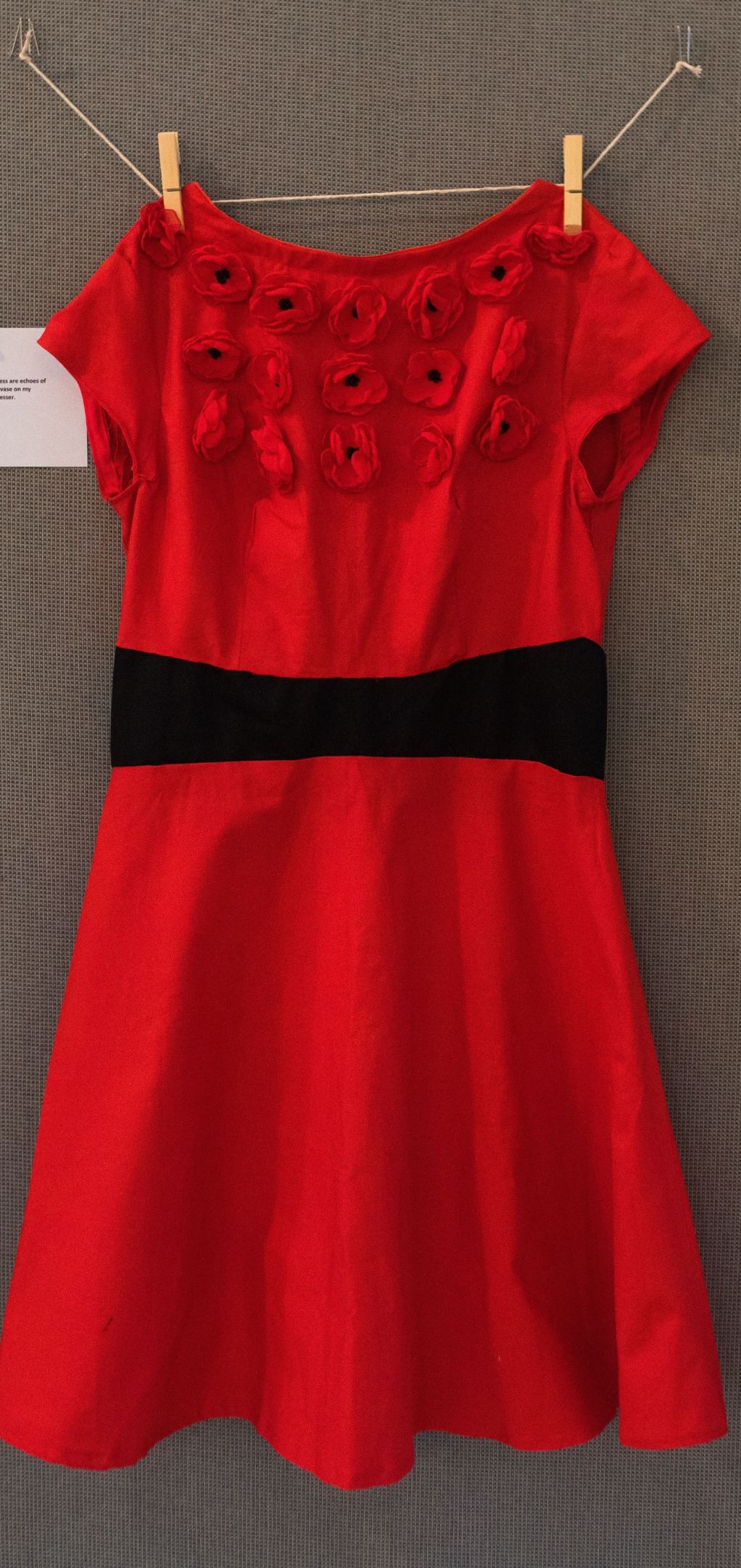
    POPPIES        Olena Jennings 

    Red and blue on the dresser,
    dust in the folds,
    stretching towards the dim lamp.
    Click of lipstick cap,
    spritz of perfume,
    snap of purse,
    and she will turn the light off.
    The flowers will wither
    into their dreams
    and I will put my lips
    into their centers,
    ready to blow away pollen.
    The yellow dust caught in my eyes,
    when I see for a moment
    from her perspective, I look out
    onto the yard. I see myself
    throwing a rubber ball into the flowers,
    crushing their petals,
    the place where I convinced
    my little brother there was a snake,
    there was something to fear.
    To make up for my deception,
    I gave him one of the plastic flowers,
    deceiving him again, pretending
    I bought it at the corner gas station
    from which we had collected all
    of our dishes with the points we got
    from pumping gas. I want to make up
    more than that now—absences
    when I would become like that yellow dust,
    a quiet star.

    Olena Jennings, Map Dress, installation view. Photo: Elvis Krajnak.

    PAPER MAPS        Olena Jennings

    Even flat maps have texture.
    They carry with them
    someone’s memory of the streets.
    I will walk near the water
    to draw the places off the map
    on the palm of my hand.

    We used to make paper
    out of recycled letters,
    rough, imperfect,
    for a moment – wet,
    on our knees
    ripping

    We mark our way to the castle
    with the handle of a shovel.
    We could live inside
    our fairytale, find our way
    despite the sand
    in our eyes.

    Poems and dresses by Olena Jennings. Photos of the dresses by Elvis Krajnak.

    https://www.olenajennings.com/

  • Sirkku Ketola: The artistic process of performing Paula

    Sirkku Ketola: The artistic process of performing Paula

    Finnish artist Sirkku Ketola had her performance project A Body Called Paula at the NARS Foundation Gallery in Brooklyn in November. In Finnish the word paula means a ribbon, something to tie or to be enchanted with. It is also a synonym for a trap. Globally Paula is known as a female name, originating from the Greek word ‘Paulus’, which means small.

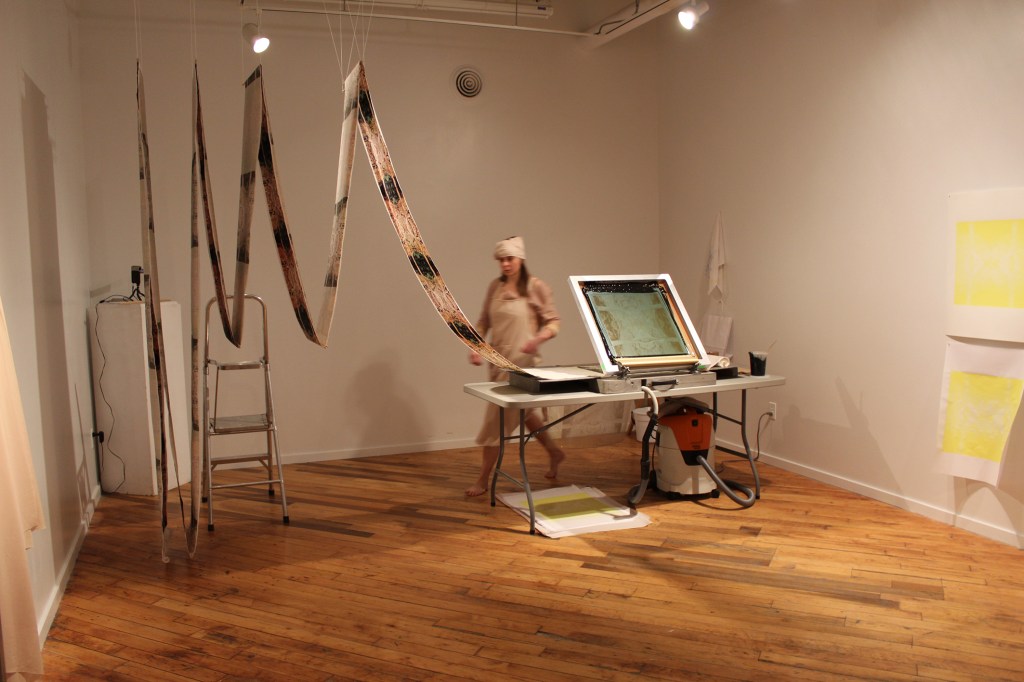
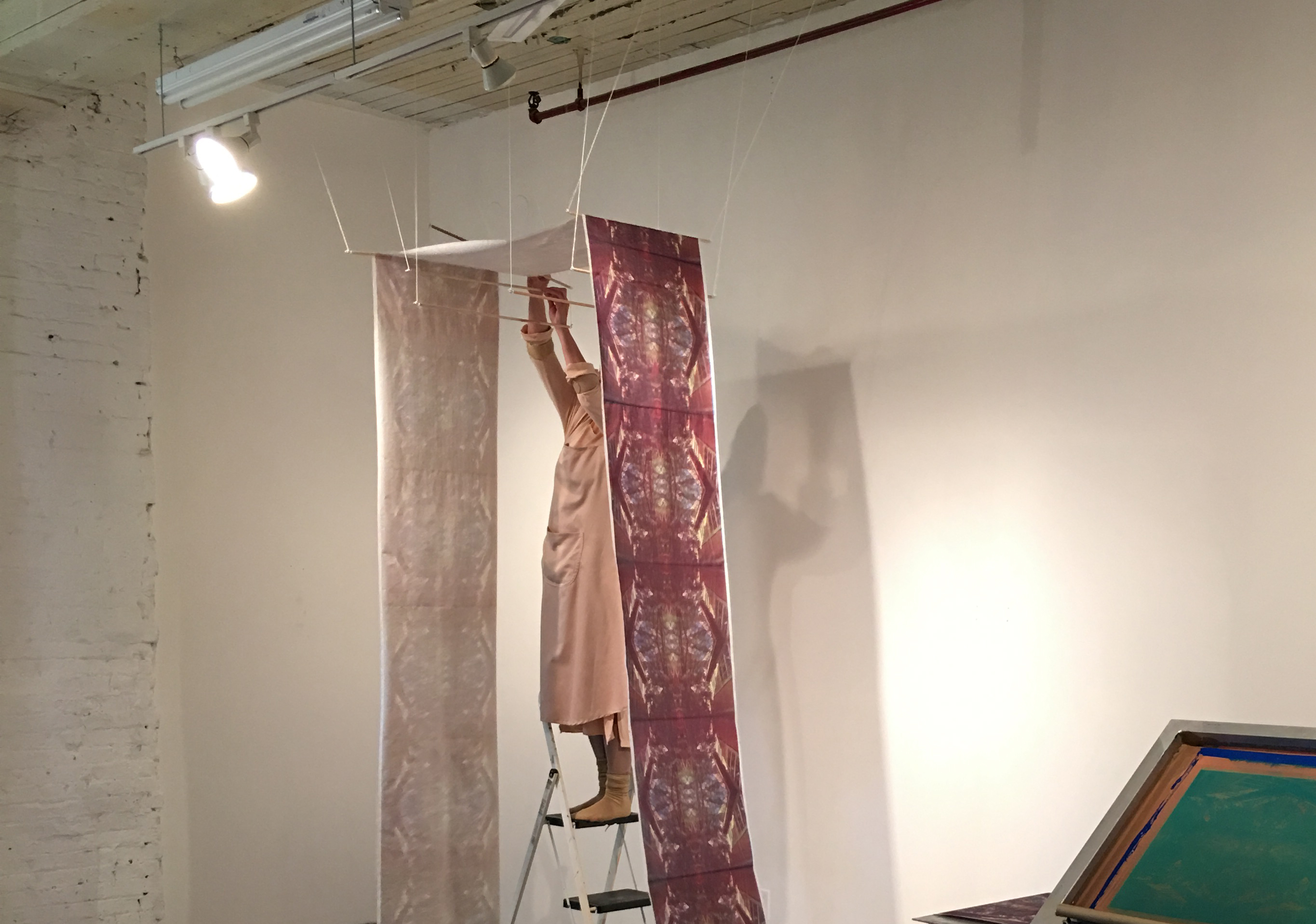
    In her current project of ten years, Ketola creates an installation that mixes screenprinting with performance. Part installation, part performance, A Body Called Paula is a piece that develops over the days of the installation through long-duration printing sessions. The movements and their soundtrack create an enchanting, sensual machine with the main themes of time and temporality, pleasure, and the meditative process of working.

    The narrative story behind the performance hunts beauty through the themes of light, passion, knowledge, reality, and depth, finally balanced out by darkness. What is the measure of time? Ornament is a universal form of visual art in every culture. The installation at NARS is part of Sirkku Ketola’s long-term project. For the duration of ten years ‘A Body Called Paula’ produces hand printed ornaments, or ribbons.


    Paula prints by Sirkku Ketola.
    Paula prints by Sirkku Ketola.

    Firstindigo&Lifestyle: What comes to mind, when you think about your project Paula is that it is so clearly beyond the visual practice, or enhances the physicality of the practice. What is so intriguing is how you dive into the embodiment and stretching of the paper. Is it that the body becomes a continuation of the paper in the printing process, as if being one with the paper? What kind of metaphors would you like to highlight, or are being evoked in the process?

    Sirkku Ketola: I guess I need touchable material to support thinking and understanding. In this case the handling of color and paper together with challenging technical crafting, tune us as one organism, where the tempo is being set in the cohesion of the qualities of the all included matters. The strength of the body, the sensitivity of the hands and the exactness of the eyes, are sensing constantly the fragility, stretching, moistening and drying of the paper, and the consistency and volume of the ink. The local, or should I say site-specific humidity and temperature effect strongly to the functioning of this paper/colour/body formed sensual machine. Also the instant substance of the body, the general vitality, the emotional ambiance, and for example the daytime, give all some special marks, first to the performance, and second to the visual appearance of the ribbon in progress. Imprint is different during mornings and evenings, also in the beginnings and the ends of the ribbons. I have chosen the long and fragile paper to be forced to lose control. The process is too tiring to hold on it. During the series of the performance the same paper roll goes by my hands 12 times so it is impossible to dominate the quality or the crossing effects of different layers. I just must be humble, and let the ribbon teach me. Maybe the greatest thing is that the ribbons still surprise me even though I’ve been working with the same materials for years. The major errors have been avoided, but the danger of errors are constantly present – everything can be irreversibly spoiled even in the last round of printing.

    Sirkku Ketola performing Paula.
    Sirkku Ketola performing Paula in Cable Factory, Helsinki, August 2017.

    Sirkku Ketola: The ornament arises on paper in stages from light to darkness. The colours (yellow/magenta/cyan/black), except being common from every home printer symbolize light, passion, knowledge, reality, depth and darkness. Step by step these colour layers, as named the elements of beauty, while mixing and uniting approach the truth, the code of life or would I say the mystery.

    The hand printed ornament reminds somehow of the DNA. Basically with the repetition of same patterns, the motif is being affected continuously by the changes of the circumstances. All the variations show together endless amount of visual possibilities and diversity. At the same moment the so-called mistakes come part of the entirety and open up routes for the new beginnings.

    Today we talk a lot about unmaterialized art, light and it’s different digitalized reflections. I am blown away by it also, the transfer of energy from one equipment to another accomplishes wonderful outcomes. In my own work process the need of touch, the acception of the tardiness of the body as the part of the thinking self, in other words handling with hands, have so far helped me to the deeper knowledge. I choose to cherish this special bodily tempo – it might be good for human species. When one forces oneself to stop by the slow repetition, one might also have time to understand something essential.

    Sirkku Ketola performing Paula in New York, November 2017.
    Sirkku Ketola performing Paula in Helsinki, August 2017.


    Sirkku Ketola: To be able to do the metamorphosis to become a sensual machine I had to create a role. My character Paula is simultaneously enraptured and trapped (in Finnish there is a sentence with both meanings, derived from the word ‘paula’ which also is a ribbon). She is a metaphor of a small human in cosmos. The name Paula comes originally from the Greek name Paulus which means small. So my Paula works with paula, with her special ribbon. Her job is to communicate visually by printing this repeating and overwhelmingly beautiful ornament. She wanders globally and communicates of the seen beauty. The previous place sets the next pattern, for example the New York effects to Paula will be seen next spring in Helsinki, Finland.

    The machine is slow and time bending. It is a factory that is able to work without problems approximately four times per year. The doctor’s order has set the limit. I forget the rules always in the beginning of the new project, but now, when the Brooklyn ribbon has been finished, the pain in my hands is there and that makes calming down easy. By respecting this manual of the project, it will be possible to enjoy after ten years from now about the yet unknown massive installation, which is made of these forty different and international printed ornament ribbons.

    I feel extremely privileged to be able to define the speed of the assembly line. For that reason the pleasure is an important part of the performance. Paula enjoys her movements and the choreography set by the printing process. The ink flows and the paper glides with the hands accepting to follow the weight of the body. The touch varies from strong to gentle and the rhythm beats with the working steps. The birth of the image feeds the will to come along to the anonymous destination. The possibility for sudden challenges forces the printer into the extreme concentration and to overcome difficulties and accept the errors. With the physicality, the mental part is also reacting all the time to the present. The chosen repetition grows thinking and developes strong pleasure.

    Sirkku Ketola: Feedback, 2016. Handprinted silkscreen on wood. 81 x 105 cm. Process picture.
    Sirkku Ketola: Feedback, 2016. Handprinted silkscreen on wood. 81 x 105 cm. Process picture.

    Firsindindigo&Lifestyle: How do you prepare for the performance of this scale, which is almost a marathon? What is the preparatory phase like, and what happens during the performance aftermath?

    Sirkku Ketola: During the performing period I take specially good care of myself. I try to do the outdoor activities daily, sleep enough and eat healthier. I try also to avoid the evening happenings and alcohol. The preparation for the performance takes mentally the whole day, but the most intense are the two hours before the show. The soundtrack of the performance follows me since morning. I’d like to highlight, the sound scape of my music and the noise of the printing table are essential elements of the performance. When arriving to the show space I tend to eat lightly and drink a lot of water. After it is time to check all the technical equipments and to mix the printing inks, the hue and the saturation needs to be done carefully. I have a special ritual order to do this. After this, I isolate myself, warm up and slowly become my transformation to the role. Thirty minutes before the show it is time to change the costume and become Paula. She doesn’t speak. The aftermath of the show is quick, washing the make up and changing the clothes are rapid, so I’m soon ready to communicate with the world again as myself. Before leaving I clean the colours and check all the technical details for the next day. When arriving home I stretch well and take a warm shower, except in Finland my choice is sauna.

    Paula performance in Nars foundation Photo Nov 17, 3 38 57 PM
    Ketola performing at the NARS Foundation in New York, November 2017.

    Firstindigo&Lifestyle: How is New York as a place different, and this performance venue special, in terms of what is their impact on the quality and outcome of the work? How is the location different from the rest, say, Canada or Finland where you also created this performance piece?

    Sirkku Ketola: The place impacts mainly how the performance is being installed. I like different spaces because they challenge the art work and keep it impossible to predict. The space in NARS in Sunset Park in Brooklyn is many ways special. First, it is near the Finntown, where there was a strong community of Finnish emigrants. During today’s new emigrations flow it felt important to mark the difficult roots of my own country. Second, the size of the gallery was perfect for the project. It fit there well, both visually and functionally. Third, the space is in the building, which is full of working artists, situated in the middle of the industrial Brooklyn. Where else should the sensual machine be? I came to New York as a visiting artist-in-residence of Finnish Cultural Institute for two months. My main goal was to research the structures of the money and power in the contemporary art scene. Beyond A Body Called Paula –project I started to sketch the new large-scale print installation referring to this research theme. The work will be produced during next three years. My colleagues in Brooklyn taught me a lot about independent artists’ living at the capital of contemporary art (NYC).

    Paula, NARS foundation.
    Paula performance, NARS Foundation in New York, November 2017.

    The physical dimensions and the quality of the NARS space gave the rhythm for the installation when growing during the performances. The intimate gallery of the Sunset Park made possible to the paper ribbon to take a shape of a visually fine zig zag when it landed to dry to the perches I mounted. Also the rest of the visual elements of the performance found their places to create a dynamic composition. There was space for Paula to move and the audience was able to have several standpoints. The space was also photogenic with A Body Called Paula – and that’s important in our social media time.

    This was the fourth time and the fourth place for Paula. In Toronto it was seen in a gallery with the long hallway. There the magic of Paula worked like in the story of the Pied Piper, when people saw the action from far, they just had to reach to the space. In Helsinki Paula measured the huge hall in Cable Factory during the five hours marathon performance. And in Turku, Finland she worked behind the lightened window in the darkness of the first autumn evenings by the riverside. And in Brooklyn she captured the industrial space around the other artists. I believe that during the next ten years, Paula can capture many different structures and spaces as rich as she has done in her first year of the process. The big scale quality will be seen in the end of the whole process. All in all, these places are valuable treasures for me, and will affect the final installation.


    — — —
    Next time A Body Called Paula will be seen in Helsinki in March 2018. After that Sirkku Ketola travels mostly in Central Europe. She will be back in New York City during autumn 2019.

    — — —

    The screenprints made in New York have been prepared at the Robert Blackburn Printmaking Workshop: http://www.efanyc.org
    More information:

    Introduction: http://sirkkuketola.com
    Previous exhibitions: http://www.la-bas.fi/ketolaeng.html