Category: performance&dance

  • Interview: Marina Celander explores theater with intention

    Interview: Marina Celander explores theater with intention

    New York City based performer Marina Celander crosses boundaries in her artistic practice, which combines a variety of genres and approaches to making art. Her solo performances echo authentic voice, and her deep participation on stage with theater groups comes across as statuesque, moving, gentle and charismatic. Marina Celander is born as Swedish-Korean, and is a recipient of 2014 Lilah Kan Red Socks Award for her outstanding contribution to the Asian American professional theater in New York City.

    Firstindigo&Lifestyle: What choices did you make to become an actor, what is your background in the field?

    MC: I started out as a modern dancer. After I graduated from London Contemporary Dance School I moved to New York and danced for a bit with various companies and choreographers. At one point I decided to take acting classes, which was something I had always felt I wanted to try but was afraid to do, and started studying with Gene Frankel at the Gene Frankel Theatre Workshop on Bond Street. Despite my fears, I took that first class with Gene and I remember feeling so elated and high, almost, as I stepped out from the darkness of the theater and in to the sunshine on the street. From that moment on I knew I had found what I needed to do with the rest of my life.

    Firstindigo&Lifestyle: Where were you born and raised, at least Sweden is on the map?

    MC: I was born and raised in Sweden. I grew up in Malmö which is in southern Sweden, right across the strait from Copenhagen, Denmark. I lived in London for three years while I was studying dance, and then I moved to New York when I was in my early twenties. I have been in New York ever since! I go back to Sweden every other year or so to visit my family.

    Firstindigo&Lifestyle: You have performed with Yara Arts Group that is based in La MaMa Theatre for many years. How did you find yourself part of the company?

    MC: I auditioned for a show that Virlana Tkacz, the artistic director of Yara Arts group, was putting up at La MaMa in 2000, called Circle. This particular show was special in that it had actors and musicians from Buryatia and Mongolia, as well as us New York actors. We had the chance to learn to sing these hauntingly beautiful Buryat songs from the Altai mountains. Two years later I traveled with Yara to Ukraine to sing Ukrainian folksongs, and visit Babushki, the grandmas, in the villages of Kratchkivka in Poltava and Svaritsevichiy in Polissia, and then we performed in Kyiv. This trip was also lead by Ukrainian singer, Mariana Sadovska, who was the musical director for our performance. Ever since then I have come back to work for Virlana in various poetry readings and events that she hosts, as well as being part of some of her theater productions.

    Firstindigo&Lifestyle: Virlana Tkacz, one of the founders of Yara, and the director of the company, and many company members have a Ukrainian cultural background, But Yara is appreciated as multicultural in its productions echoing ideas of a World Theater. Did you find this conception as a great home for your own performance identity?

    MC: Yes, I am really attracted to the idea of World theater. It is very fitting that Yara Arts Group is a resident theater company at La MaMa, because it is the home of World theater. Ellen Stewart, the founding mother of La MaMa Experimental Theatre, bravely and courageously invited individuals and companies from all over the world to perform and work at La MaMa.

    Yara is an exciting company to work with, because of the always multi-lingual performances and multi ethnic cast. Lately, Virlana has been working with Ukrainian artists, but in the past she has worked with artists from Buryatia (in Siberia) and Kyrgyzstan. As a woman of color and a theater artist, I always deeply appreciate directors who are not type-casting based on ethnicity and race. In downtown theater in general, but at La MaMa in particular, I have always been given opportunities to act in a myriad of roles where my ethnic make up is not important. Virlana has given me and many other actors of color opportunities. I believe that putting a minority actor on stage for no other reason than the fact that (s)he is a good person to have in the show, is always a strong choice against the established order of theater in the West.

    Firstindigo&Lifestyle: In 2015, you were part of a production that directly was touching Ukraine and the war that was happening on a huge crisis level there. Yara’s production premiere ‘Hitting Bedrock’ took place in La MaMa, (it was conceived and directed by Virlana Tkacz, set & light by Watoku Ueno, music by Julian Kytasty, assistant director: Wanda Phipps). Your role in the work was central. Tell more about your role and how it shaped in the context?

    MC: The production Hitting Bedrock, was an important production as it addressed the war in Eastern Ukraine. My character was The Refugee, and her significance in the piece was that she represented all of those humans, women, children, men, the elderly, that have been rendered homeless because of the war in Ukraine, and elsewhere in the world. She represented all of those that have had to leave something important behind, a memory, a treasure, a family member, a secret, a lover, old letters, a photograph… It was a role that moved me deeply. As a result, that summer (2015) I went on a self financed, crowd-funded trip to face paint and give dance workshops to children in refugee centers in Ukraine.

    Firstindigo&Lifestyle: In this play, the audiences had a participatory role. At one point, we were asked to give our belongings away, and were offered big tote bags instead, to put our coats and personal items in them. This was altering a perception from an audience member’s point of view into the experimental, perhaps reminiscing the point of view of people in the war. In what ways did being a central actor discussing your war losses while audience is so close to you, alter your own performance? Did this event change you?

    MC: Yes, the audience were forced to walk through a long corridor in the basement of the theater, and thereafter they were asked to give away their personal belongings only to have them put into bags. The audience immediately got those bags back to hold for the remainder of the show, but many felt uncomfortable and some refused to give up their belongings even for a second. We had brusque and insistent “guards” in uniforms commanding people to go here, put their stuff there, go up, sit down, etc. When the audience had finally arrived in a “holding area” after having been shuttled around with their big bags, they had to witness the guards doing the same to me. The guards demanded to see what was in my back-back, and I showed them my toothbrush and my papers. At this point the audience is really right next to me in the holding area. Having the audience being so close to me, being one of them, really does something to the performance. As an actor I loved feeling them so close, feeling their reactions to me, their doubts, their fears, and them feeling my fears. It was also a little intimidating when on one occasion we had a lady who was a little drunk in the audience, and she was shouting quite aggressively at the stuff I said. That was worrisome, because she was so close.

    Firstindigo&Lifestyle: Besides being an actor and performer, you handle multiple different roles. How did you come to dancing and performing Hula?

    MC: Yes, I handle multiple different roles in my life on a daily basis. I am a mother, and an artist, a teaching artist, performer, face painter, a freelancer. I wake up every morning thinking, what am I doing today?

    I started dancing Hula, traditional Hawaiian dance, in 2000, after finding an organization that gave beginner hula classes. I was very fortunate to stumble upon the Hawaiian Cultural Foundation (HCF), and there I studied with Michelle Akina, Janu Cassidy, Keo Woolford and kumu hula June Tanoue. I have since been involved with a hula halau, hula school, Pua Ali’i ‘Ilima o Nuioka, under the leadership of kumu hula Vicky Holt Takamine.

    Firstindigo&Lifestyle: What is your connection to the hula/Hawaiian community in New York?

    MC: It’s a small, but growing, community of Hawaiians, and Hawaiians at heart, hula lovers, and Hawaiian language and music lovers and enthusiasts. It is a beautiful and loving and inclusive community of people from all over. My connection is through hula.

    Firstindigo&Lifestyle: A very interesting part of your practice is also face painting. That is a skill that requires another set of imagination and sense of personality in people. How did you start?

    MC: I started face painting for my own children’s birthday parties, and it grew from there. Now I do other kids’ birthday parties. It’s a small side business, and I get clients usually through word of mouth. I really enjoy the face painting, and it makes me happy to paint kids’ faces.

    Firstindigo&Lifestyle: In 2016, you created a solo work for yourself that was performed in Sweden. The work titled Mermaid’s Howl, handled a theme of you mother, and her Korean identity. How did you experience the project from the point of view of her identity, and your own, adding into the narratives that are so personal?

    MC: I created a solo show called Mermaid’s Howl and performed it at the Stockholm Fringe in 2016. The story had been a long time in the making. As early as 2013, I had talked to my friend and mentor, Fred Ho, about my idea of writing a solo show. He quickly said, in typical Fred Ho style “Write it, I’ll produce it. Here is your deadline, use it.” He unfortunately passed away before that came to fruition, but I stayed true to my promise to myself and to Fred, to finish writing that piece. I am grateful to the Stockholm Fringe Festival for inviting me and giving Mermaid’s Howl its premier.

    The story is about me growing up in Sweden and finding out who my mother was, and finally being able to connect the dots in my adult years. Connecting the dots from me, to her, to all of our maternal ancestors. The play is part dream, part real memory snippets, part madness and part immigrant mother-daughter story. It was a deeply personal process, of course, to write this play, which delved into questions of what is must have been like to an immigrant woman, all alone in a completely foreign country, without family, to raise a child on her own, have her dreams crushed or set aside. It also explores the question of women and madness, and what it means for women to not be able to fully express themselves as artists and human beings in a society that sees women as less valued than men.

    (For a little more detail to this story and an except of the play you can go here: http://riksha.com/mermaids-howl-an-excerpt/)


    Firstindigo&Lifestyle: Was the theme of mental illness and it’s feminine counter-narrative hard to project into a play?

    MC: Mental illness is a topic that is still not openly talked about, it’s a little taboo. I wanted to bring it to the forefront and not skirt around the issue. Without glorying mental illness, I wanted to shine a light on it from a different angle, to let people see that there may be a societal value to possessing a different sight and different viewpoint from what is deemed “normal”. Normal is a societal rule, and normal is different in other cultures. In the West there is absolutely no point to mental illness at all. It is just a nuisance, a bother, a hindrance, a difficulty, something to be shunned and stowed away, far far away. I am not saying that it is not utterly devastating when serious mental illness occurs in a family, but I am saying that there are options as to how you would view someone with a divergent view of the world. Those with divergent behavior can actually have value in society, their divergence is seen as highly creative as well as highly unusual and abnormal. At the same time, madness in women have always been a tool to belittle and demean women, to incarcerate “difficult” women, and put women in their place by the patriarchic machinery.

    Firstindigo&Lifestyle: The play also involved projections as part of it, tell more about the visual and performance collaboration?

    MC: I had three amazing collaborators. The electronic score was composed by Dåkot-ta Alcantara-Camacho. The costumes were designed and made by Jane Catherine Shaw, and the projection design was made by Youn Jung Kim. Youn Jung knew my play very well. She was a student of Fred Ho, that is how we met. In the beginning of the writing process she and I used to meet regularly and have our little mini-writing labs, where we shared, read and discussed our work. Because of her connection to the piece from the start, she really knew the flow, the pace, the colors, the feelings of the piece. The projections grew out of her intimate knowledge of the story I wanted to tell, and her receptiveness to my suggestions made the working process so easy.

    Dåkot-ta created a score that was so sensitive and evocative, and reminiscent of water and forests and shaman drums. His sounds were instrumental in setting the scenes for particularly relevant moments in the piece. It really was amazing to hear the music loud, with real speakers, for the first time! Goosebumps moment! Cathy made these amazing creations that felt magical to wear, and helped me grow into the characters I was portraying in the various environments.

    Firstindigo&Lifestyle: What would you like to say about the performance experience in Sweden, did you feel you were at the crossroads of cultures while bringing the work there?

    MC: I didn’t necessarily feel I was at a cultural crossroads in Sweden, but my piece, Mermaid’s Howl, is an exploration of my cultural heritage, so it was very fitting to have its premier in Sweden. Performing in Sweden was a homecoming of sorts. Being bi-racial I guess means you are a hub for cross-cultural activities within you.

    Firstindigo&Lifestyle: This play involved also a Kickstarter- fundraising, and the audience was able to have a glimpse into the concept and to you as a person. What was this campaign process like?

    MC: Yes, I decided to crowd-fund with Kickstarter as it seemed as the most reputable and an easy way to go. The opportunity to go to Sweden came up very quickly as I was invited to perform with Mermaid’s Howl just a couple of months before the festival started. I had to come up with the funds to go very quickly.

    Youn Jung Kim is a great conceptual artist and photographer and film artist. She has a great eye and a great feel for what works and she listened to what I wanted to convey in my little promo video. From the short interaction we had on camera she created a little gem of a video for my Kickstarter campaign.  (You can view the campaign here: https://www.youtube.com/watch?v=pq4-2zW7GZ0)

    Firstindigo&Lifestyle: You are an activist in social platforms. You have performed radical acts in public places, closing yourself in a body-bag for instance. Tell more about the involvement. Do you think activism can change the dominant narratives in crisis? Are you an optimist?

    MC: Yes, I’m always an optimist. The particular event you are mentioning was Belarus Free Theatre’s demonstration in NYC against Capital punishment in Belarus, where young people disappeared and their families were not notified of their deaths, and never received their bodies back. This was an event planned together with La MaMa. We gathered by City Hall, and then walked over to Foley Square, where we crawled in to body bags, zipped ourselves up and laid still for 30 minutes to raise awareness of the issue. We had monitors who were watching us to make sure nothing came to pass as we were inside the body bags, or in case anyone would freak out they could quickly zip us open again. It was a very intense experience, I have to say.

    As artists we have an obligation to tell stories where we stand up for the underdogs, speak up for those weaker than us, for those who do not have a voice or platform with which to tell of their story.

    Firstindigo&Lifestyle: What new adventures do you have planned?

    MC: I performed a first draft, a first work-in-progress version, of a new solo show called Shakespeare’s Sisters at Dixon Place in NYC in January of 2017. My plan is to perform it again in a larger venue and to see the piece grow. Mermaid’s Howl will also be traveling to Massachusetts sometime in the near future. We are working out the details now, so I will tell you more when I can reveal more, but I am very excited that this show will have a future life.

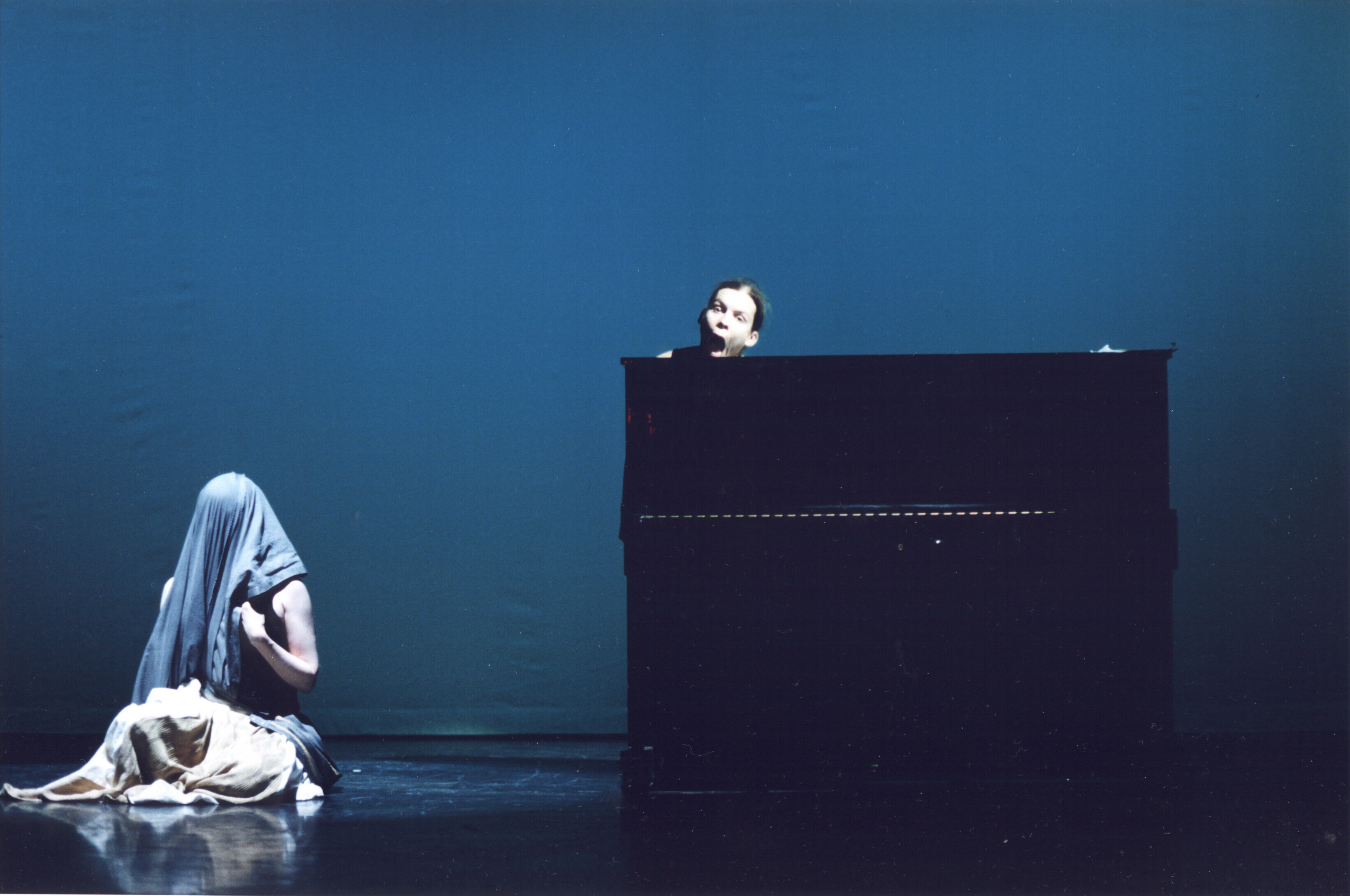
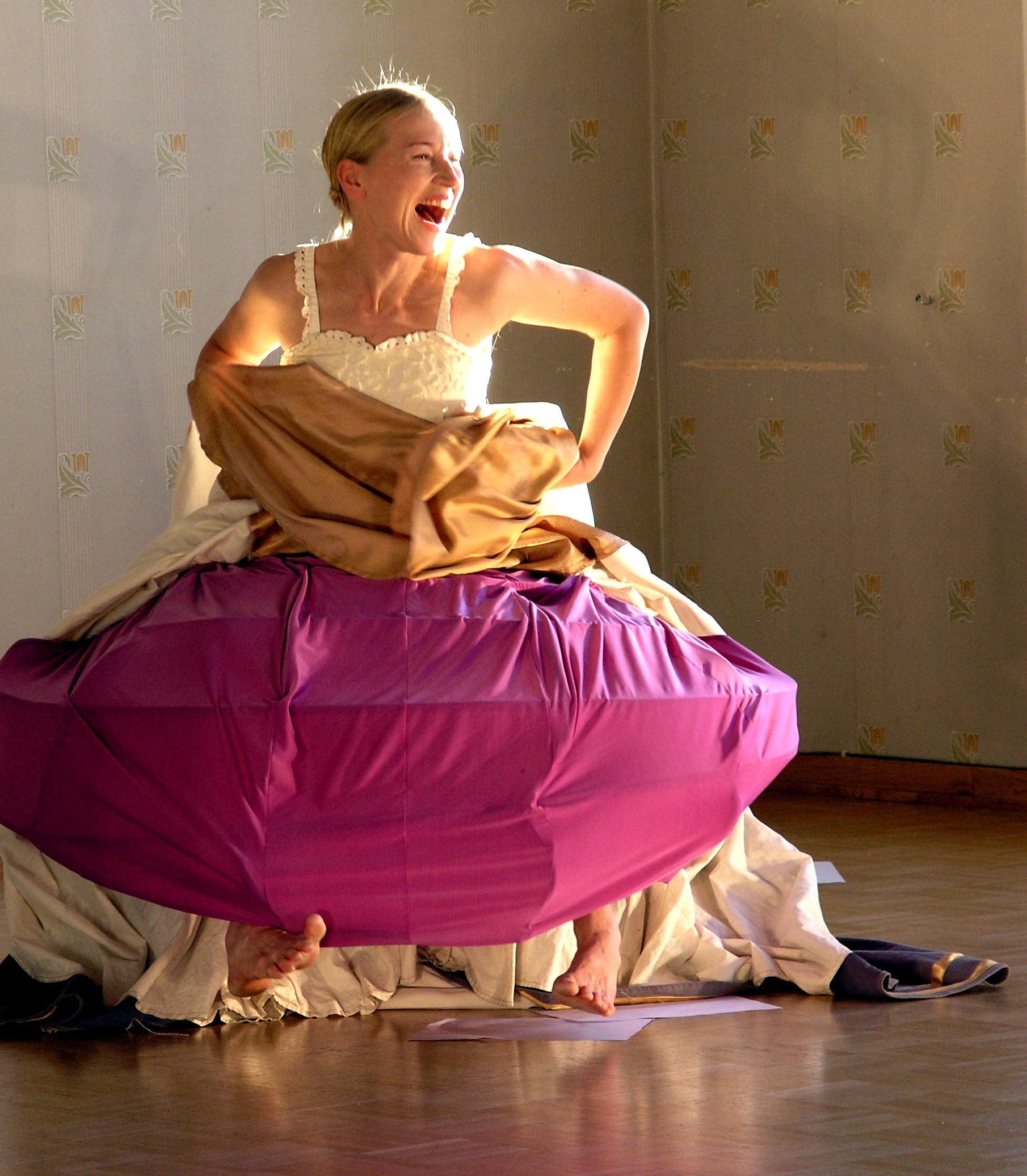
    MARINA CELANDER, SHAKESPEARE'S SISTERS, DIXON PLACE, NYC 2017 - PHOTO SALLY MINKER
    MARINA CELANDER, SHAKESPEARE’S SISTERS, DIXON PLACE, NYC 2017 – PHOTO SALLY MINKER.

    Firstindigo&Lifestyle: You are also performing with Yara in their new production?

    MC: I’m currently performing with Yara Arts Group’s new show at La MaMa called 1917-2017: Tychyna, Zhadan and the Dogs. Again, it is a project based on Serhiy Zhadan’s poetry. It was shown this spring in Kyiv, by a Ukrainian cast, and now it’s our turn to put our spin on it. Serhiy and his punk-rock band, The Dogs, are in New York performing with us. It’s an exciting show! It’s always very special to perform with a live band. Other musical elements in the show are Julian Kytasy’s bandura compositions.  This piece makes us reflect on the concept of tyranny and how easily it arises – it did in Europe in 1917, and now in 2017 we are currently in danger of allowing it to rise again. The show opened on Friday June 9 and runs at LaMama ETC until June 25, 2017.

    ***

    Information about the Yara’s 1917-2017: Tychyna, Zhadan and the Dogs at La Mama here: http://lamama.org/tychyna/

    Marina Celander on vimeo: https://vimeo.com/user26138773

  • Favela Vera Ortiz: Choreography unplugged

    Favela Vera Ortiz: Choreography unplugged

    Favela Vera Ortiz is a Finnish-Argentinian choreographer based in Helsinki, Finland. The choreographer has recently been celebrating her artistic anniversary. She is currently finding herself with compositions that extend the boundaries of the body, self, and the space. Vera Ortiz is well known as an inventor of Choreographer’s Appointment, in which participants find their solo movements with the choreographer, and engage in a social form of personal choreography with a performance. The choreographer has worked with multiple themes in her native Finland, in Stockholm, Buenos Aires, Paris, and Melbourne, Australia, to name a few locations.

    Firstindigo&Lifestyle: Your career spans over 15 years, and in fact you just celebrated your artistic anniversary. Starting from the time you went to study at the Danshögskolan in Stockholm, how did you end up choosing to go there?

    Favela Vera Ortiz: Actually I had tried to get in to some schools already earlier, but always seemed to be the one who almost got in. But I continued dancing all the time and became more and more interested in making choreography. I chose to apply to Danshögskolan because they had a choreography program. I got in on first attempt and was very happy about it.

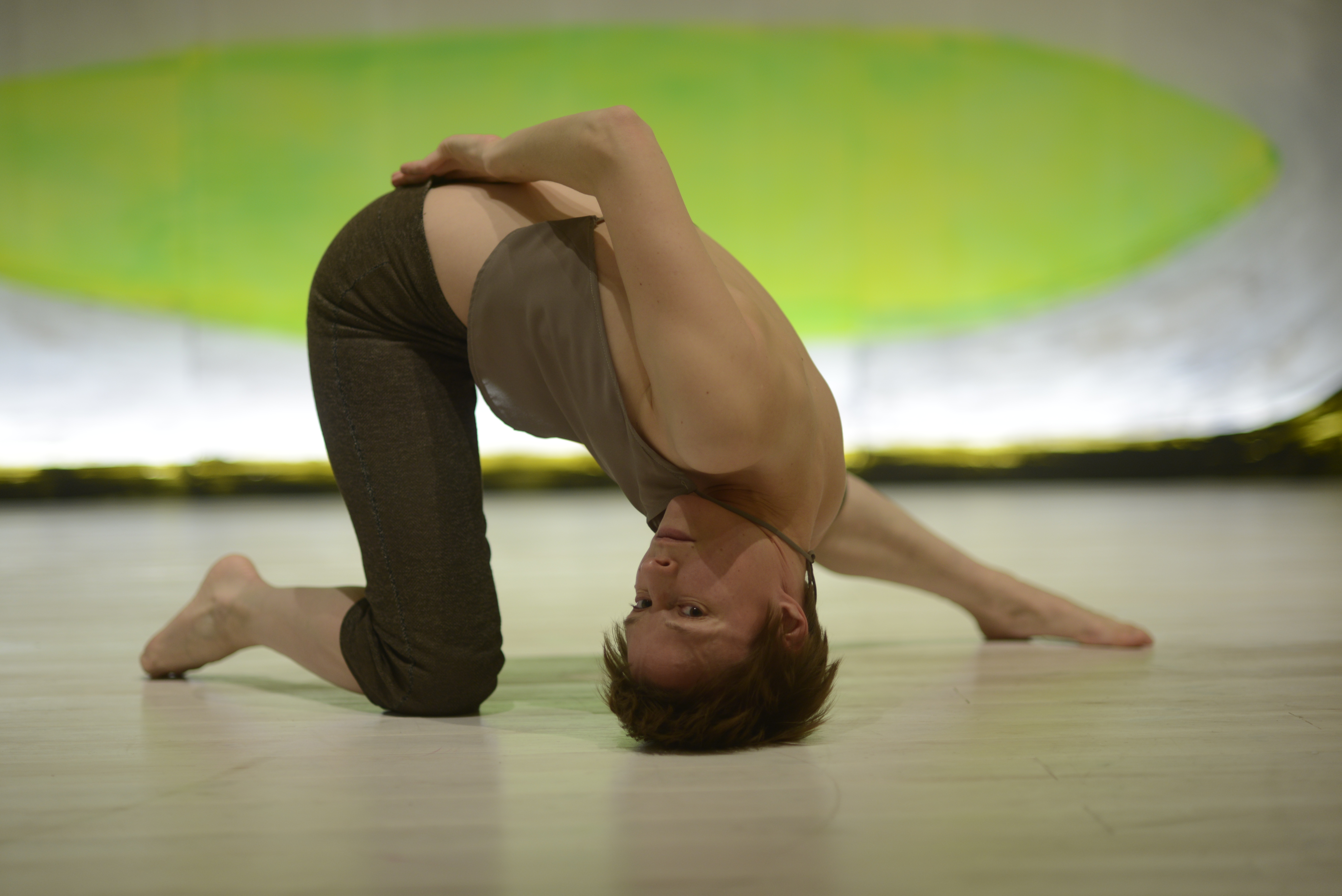
    deux2-choreography-favela-vera-ortiz-photo-anna-diehl
    deux2, Choreography Favela Vera Ortiz. Photo Anna Diehl.

    Firstindigo&Lifestyle: What are the key ideas and modes of working you learned while studying choreography in Stockholm, and have they stayed with you?

    Favela VO: During the 3 years of education, I learned many tools from several visiting teachers. We were 3 students at the choreography program/education, and one of the learning processes was to be able to follow how the 2 others did their compositions when the starting point was the same for all. For example, professor Örjan Andersson gave a task to use certain compositional tools with 9 dancers and the result was interesting to see how different the works were.

    I also invented a method of trying to be free of judgement while making the movement, this was kind of a brainwash that was supposed to get the body to produce material earlier unknown. I am a curious chameleon and tend to try out new things which leads to different works. I’d say styles in my works vary a lot. Similarities tend to pop up afterwards, but it is not intentional.

    One example is the question of how to use time. I am very interested in the concept of time being round instead of linear. This shapes the movements and music choices I make, and it has stayed with me from the first work with this “round time” that I did at school. It was a choreography of 15 minutes with several black outs cutting scenes, the shortest scene was only 4 seconds. Work with playing visibility, repetition and strong visual images.

    Firstindigo&Lifestyle: Looking back, does it feel that so many elements have changed over this time?

    Favela VO: It is a long time – 15 years – and certainly a lot has changed. But it is hard to put a finger on it and say here is a changing point and then something happened. Mostly change comes slowly with several try-outs and when there is a new direction it grows from a process and forms new frame. This overlapping process is a living creature in itself. The old and the new exist at the same time. During the past five years I have done some collaborations with visual artists which is new for me.

    Firstindigo&Lifestyle: Many of your works have a strong visual element in them. You have worked with costume designers, in which a dress, costume and also architectural and spatial elements are conducting the narrative, or directing the movements in a way. Is doing choreography sometimes like being a composer with a certain thematic?

    Favela VO: I’d say the thematic sometimes brings the costume or other visual elements conducting the movement. I have often done costume, lights and stage design by myself as it feels they are so closely linked to each other and push the movement to what it is. Last year, for example, I did a site-specific work L’AUTRE in a bomb shelter where the strong  visuality comes with shadows on an uneven wall and laser light. I did the lights with five torches. What the photos don’t show very well was the glitter on the body of the dancer, she was covered in gold shiny glitter, very thin layer of it though. (Check the photos of this work here: www.photoslautre.tumblr.com)  I also enjoy working in a group with visual artists who bring their ideas to the common table. It is always an adventure to see how the process goes forward and which elements grow to be presented. My latest work OPUS CORPUS III is a beautiful example of this.

    opus-corpus-iii-choreography-favela-vera-ortiz-2016-photo-valdis-jansons
    Opus Corpus III, Choreography Favela Vera Ortiz, 2016. Photo Valdis Jansons.

    Firstindigo&Lifestyle: While working in Buenos Aires, you also started working with plastic wraps or bags that evolved to be headpieces for the performers. Tell about this choreography, which was created in a local park?

    Favela VO: This work I made for three dancers, the inspiration was Greek mythology so the dancers were sort of goddesses. Even the name for the piece is MOERAE which are the three sisters making and cutting the line of life. But it was not a narrative work, merely the inspiration gave some movement ideas. It was made for Villa Ocampo, a cultural house in Buenos Aires. We used the terrace of the house and the park. The idea of using plastic bags to make costume was fabulous, it worked well. I did the wigs and tutus of thin white plastic. We also planned a stage version of the piece and filmed it while I still was in Buenos Aires. Later it got invited to Chile to a dance festival, so there are two versions of this work.

    Firstindigo&Lifestyle: Does word intercultural resonate in your personality, or multicultural, and how?

    Favela VO: I am half Finnish, half Argentinian. I have lived a nomad life for several years while working in different artist residencies. I was born in Helsinki and I am still based in Helsinki, but this year is the first full year that I have actually spent here entirely.

    Firstindigo&Lifestyle: You have created solos for dancers, for example, for Finnish dancer Riikka Kekäläinen. How much does a dancer direct the development of the work with her personality, and how do ideas come together in the end?

    Favela VO: The dancer has an enormous impact for the work. I often use different improvisations to search the movement so it is essential for the dancer. I choose the dancer who I believe is the best for the theme I am working with. The frame for the improvisations come from the vision I have for the theme, but then I choose the material from what comes out while working with the dancer and develop it further with the dancer. It is like a puzzle building the body of the work. One solo for Riikka, which I enjoyed a lot to do was called LA SEULE. It was seen in Finland but also in Paris at the Finnish Institute and in Düsseldorf Tanzmesse. The theme is the history of hysteria.

    OLYMPUS DIGITAL CAMERA
    LaSeule, Choreography Favela Vera Ortiz. Dancer Riikka Kekäläinen, Photo Vilma Niskala.

    Firstindigo&Lifestyle: Tell about the work in STOA Cultural Centre in Helsinki, in which the floor had mirrors all over, and the audience was sitting in a tight setting looking at the performer from a close distance?

    Favela VO: The work is called 21 notations on human. We had visitors in our rehearsal space. They were 20 persons who each came to share one rehearsal day with us. My question for them was “What is it that interests you in humans?” So, it was very wide question with personal answers. We created movement material with the visitors during the day with the dancer Hanna Ahti and got kind of a movement bank. The work is a selected composition of these things, as the material was several hours of material on video. The 21st notations on human (https://vimeo.com/35870033) is our version. The mirror floor reflects the dancer as many and brings also a visual element with light reflecting to the walls. It is a tender piece with the dancer having a conversation with notations on the body and the surface.

    21-muistiota-2011-choreography-favela-vera-ortizuupi
    21 notations on human, Choreography Favela Vera Ortiz, Dancer Hanna Ahti. Photo Uupi Tirronen.

    Firstindigo&Lifestyle: Somehow there is a sense that dancing for you carries several elements that might be also called as non-human, such as animal like, or vegetal, or spiritual; are these definitions closer to what you are aiming or thinking?

    Yes, there is an idea I’ve been working with for some time now where the body is half human, half animal. Like a hybrid body. This creature was more animal in the work Myoclonic (year 2013) and more human than animal in L’AUTRE (year 2015). This year (2016) the work OPUS CORPUS III was asking the question of where is the human, where is the animal, where does it start or end? The whole work seems to be a question so there is no answer. This hybrid is also an alienated body and represents the other, the strange, the weird in each of us.

    Firstindigo&Lifestyle: Your time spent in Australia, and doing the piece with yet another visual component, reminds a lot of the spiritual elements that are perhaps inherent to the aboriginal heritage, with the embodiment of place and environment and the essence of the human body in the entire life cycle. Could you tell more about this work?

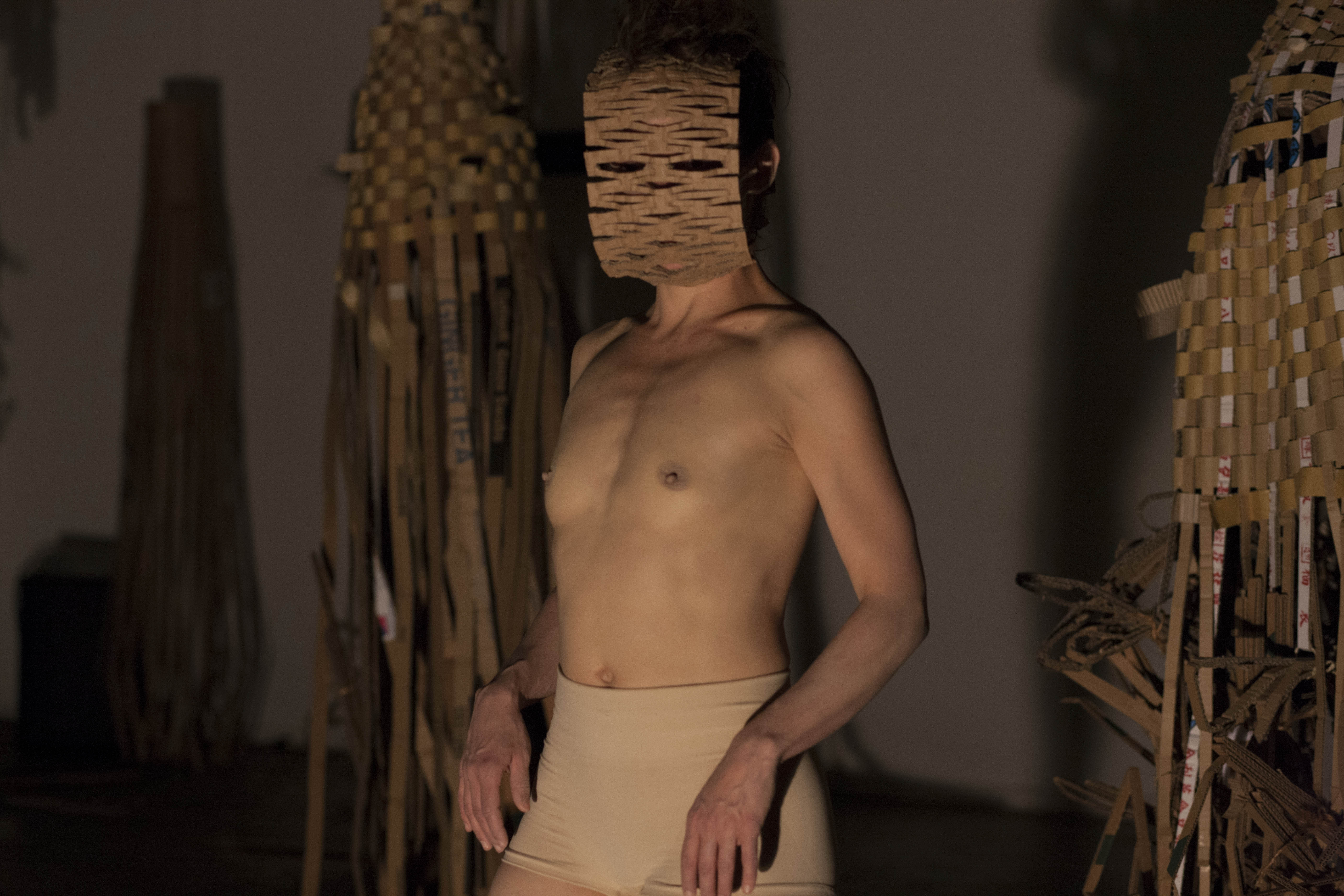
    Favela VO: This work started as a collaboration with Annee Miron, a sculptor and visual artist from Melbourne. We met in Paris in the Cité Internationale des Arts residency in 2010. The meeting and our discussions and sharing knowledge of our previous works made both of us interested of a common project. It took some time in between until it happened. I was working in Melbourne with Annee in 2013. The collaboration started with Annee’s project of sleepless, which developed into a performance MYOCLONIC (https://vimeo.com/66894548). Annee built a huge installation at the Yarra Sculpture Gallery, it worked as its own piece but also as a scenography for the dancer. I consider it is some kind of a jungle of mind. Annee used cardboard as the material and we used cardboard mask for the dancer. The performer, Sanna From is a Finnish dancer who came to Melbourne to work with this project. In our working group was also a local artist Anna Brownfield making the video. The work grew with visions of subconciousness and muscle tension of extremes, forming the body of being awake and alert. The name comes from Myoclonic jerks often appearing when falling asleep. The creature grew during the process and became more animal than human. It is as if this animal, creature is a relative to the hanging installation. The idea of animal body gave a strong impact to the piece. The hands were as kangaroos keep them, this certainly came after me seeing kangaroos in live for the first time. I was not thinking of using the aboriginal heritage.

    myoclonic-choreography-favela-vera-ortiz-dancer-sanna-from-photo-kelly-russ
    Myoclonic, Choreography Favela Vera Ortiz, 2013. Dancer Sanna From. Photo: Kelly Russ.

    Firstindigo&Lifestyle: Finland has a rich contemporary dance culture. How would you describe Finnish contemporary dance scene from your own point of view, and experience, how has it changed over the years?

    Favela VO: It has grown a lot during the past 15 years. It has grown hugely since I started to follow contemporary dance as that is about 29 years ago. Now we have more dance artists than ever, which also brings more voices, more variations of how to use dance as an art form, and gives more lively platform to all of us.

    Firstindigo&Lifestyle: What are your favorite places to work?

    I have enjoyed working in residencies as I enjoy of impulses each place resonates concerning space, energy, people, it is the whole world around – colours, light, different languages, working with local artists and getting other visions. But the absolutely best place to work is whenever the working group is working well, despite in where it is.

    Firstindigo&Lifestyle: Who are your greatest mentors or influencers?

    Favela VO: During the school I had a strong experience being thought by Hilda Hellwig, a theatre director. I liked her methods of thinking of the working process and leading it with great intuition. I suppose I have tried to keep that knowledge as one base while working. I do not tend to have idols, most of the time, I consider it is more some works that make a strong influence, so it is more one work per each artist I know that I admire. Some of the latest are works by Sophie Calle and Bill Viola. I get inspiration in books, films and exhibitions. Films having strong feeling of movement are special for me, it feels that they fill a dwell in my mind with visions and movement combined, and these strong images bubble and some day grow to live in yet another form. Margaret Atwood is one of my favorite novelists, her latest books with dystopia visions have given inspiration for my work with human/animal/alienated body.

    Firstindigo&Lifestyle: Where are your plans for the future, you have a one-year scholarship starting now, where do you think it could take you?

    Favela VO: That’s what I am planning at the moment! Not sure yet where it will take me, but I am definitely planning a new residency far away from Helsinki. I also want to continue with my latest working group in Helsinki so surely part of the year I will be spending at home.

    ***

    Artist website: http://favelaveraortiz.tumblr.com/

    Check out video about CHOREOGRAPHER’S APPOINTMENT https://vimeo.com/14337885

  • Artist in focus: Laura Anderson Barbata on art and community

    Artist in focus: Laura Anderson Barbata on art and community

    Laura Anderson Barbata is a transdisciplinary artist known for her onsite projects in Mexico, Venezuela, Trinidad and Tobago, the United States and Norway. She is currently working on participatory, collaborative works that combine performance, procession, protest, movement and wearable sculptures to convey a message. In this interview, Laura discusses her recent artistic work and collaborations, giving a sense of the issues that matter in our current society.

    Firstindigo&Lifestyle: Where do you live and work now, it seems you have multiple engagements across different continents at the moment?

    LAB: I work in NY and Mexico, my home country, but I am based in Brooklyn, New York although many projects often take me to different countries such as Jamaica, Venezuela and Norway to create and present projects. The work for each project is developed in my studio and onsite.

    Firstindigo&Lifestyle: You work with an exotic art form, stilt dancing, what is the story behind, how did you become interested in this culture?

    LAB: I became involved with stilt dancing communities in Port of Spain, Trinidad and Tobago in 2001 when I was invited to Trinidad by Caribbean Contemporary Arts CCA7 for an artist residency in Grand Riviere, a small community on the north of the island. As part of the residency I began a community papermaking project in the village of Grand Riviere and while we were working on the project I wanted to expand my work to the urban areas of Trinidad and learn from the rich Carnival traditions practiced there. I had initially wanted to work with Peter Minshall, a brilliant carnival designer who I have a great admiration for, but life took me in a different direction. Through a friend of CCA7, I was introduced to Dragon, the founder and director of Keylemanjahro School of Arts and Culture in the neighborhood of Cocorite in Port of Spain. Dragon has set up in the patio of his house a place where the youth from his community after-school could learn the art of stilt dancing. This is a community project that serves his neighborhood and is open and free-of-charge for all kids in the neighborhood. The primary focus is to keep kids off-the-streets and engaged in the cultural tradition of stilt dancing as it was passed down from West Africa to the West Indies, with the objective of having the group participate in the annual Junior Carnival Parade. The group worked with little to no resources and exclusively with the help of parents in the neighborhood. I was immediately attracted to the project, the objectives of the group and the cultural tradition, and felt that we could initiate a collaboration in which each could bring forth our skills, exchange knowledge and enrich each other´s practice. I asked Dragon if he would accept me as a volunteer and he immediately accepted me into the group, I worked with Keylemanjahro for 5 years creating alongside the kids and parents, costuming and thematic development for their Carnival presentations.

    This collaboration made a great impact on both of our lives and work, and to this day I continue to work with stilt dancers. I always understood that working with Keylemanjahro was for a limited time, the experience had enriched both parts equally and it was also necessary for me to work close to home. Around this time, my gallery in New York invited me to have a solo exhibition and I proposed that we turn the gallery into a workshop for kids and teens and apply what I had learned in Trinidad and to show some of the work I had made in Trinidad and Tobago and they liked the idea.

    Next, I had to find partners and collaborators, I had heard about the Brooklyn Jumbies, (a group of stilt dancers from the West Indies and West Africa), and approached them with a project in which we would have weeknight workshops in the Chelsea gallery and the street to train young stilt dancers and prepare a presentation for the group for a street performance on 23rd Street in Chelsea and then for the West Indian American Junior Carnival Parade. The project was titled Jumbie Camp and it was what launched my collaboration and relationship with the Brooklyn Jumbies, and to this day we continue to work together. To date, we have presented a number of projects together such as Intervention: Wall Street, 2011,  (https://youtu.be/84E877vGkpc); Intervention: Indigo, 2015, (https://www.youtube.com/watch?v=-m0wLE7dSbY), performed at MoMA in 2007; and the project for TBA21The Current titled What Lives Beneath that was performed in Kingston Jamaica this year (https://www.youtube.com/watch?v=gs72qGXI3GU) among others.

    Laura Anderson Barbata_Intervention_WallStreet
    Laura Anderson Barbata, Intervention: Wall Street

    Firstindigo&Lifestyle: The community aspect in the making of stilt dancing is evident, loud even. In what ways do you capture that essence in your own work within the subject, and in relation to its multiple contexts?

    LAB: My interest is to integrate into my work the various traditions and customs that surround us and with an artistic lens insert them into a familiar space. Stilt dancing brings forth numerous ways of performing that include procession and carnival arts. My work brings together these different forms and, depending on the narrative, can integrate protest into the unfolding of the performative work.

    Firstindigo&Lifestyle: How does stilt dancing appear to you first, as performance, as costumes, action, identity, visual art, or combination of all those things?

    LAB: Stilt dancing for me combines many things. To start, we are working with scale– larger-than-life characters that have the possibility to capture our attention. The movement vocabulary of a dancer towering over us expands in space. They are accentuated and can extend themselves through their use of textiles and different materials. This is where costuming is essential to the performance visuals and the message. But also very important to me is the symbolism and tradition that is embedded into this practice.

    Traditional Moko Jumbies are spiritual beings, whose purpose in West African communities is to protect their villages against evil or misfortune. We cannot look past the social role of the Moko Jumbie stilt dancer, and the metaphor is quite clear: to see the world from an elevated perspective. For me it is very important to always honor the historical function and cultural importance of a Moko Jumbie and to integrate that purpose into the work. So yes, it is about dance, procession, performance art, ritual, and also a vehicle for communicating a message through contemporary art.

    Laura Anderson Barbata, 7 king nyame, 2005
    Laura Anderson Barbata, 7 king nyame, 2005

    Firstindigo&Lifestyle: Do you feel there is a line, which you cross in the making of community arts, in which the discussion turns towards the subject matter rather than the artistic medium?

    LAB: I would hope that by working in this way we do away with those boundaries. Lines are usually drawn to divide and set limits, and my approach is to bring together diverse perspectives and traditions, where each one maintains its individual knowledge while at the same time exchanging and sharing diverse ways of seeing through our work together. Also, I aim for that moment when the spectator and the participants see and experience the totality of the work without disengaging the subject matter from the way it is presented. For example in Intervention: Wall Street, there comes a point where it is absolutely clear that through stilt dancing we are addressing the corporate and financial giants of Wall Street, but there is no effort in perceiving the message, they are intertwined. The metaphor in this case works off of all the layers of meaning embedded and the form through which it is expressed.

    Firstindigo&Lifestyle: You have recently been participating in the making of environmental art project titled The Kula Ring. Could you tell about the expedition that took  you to the Pacific Island with the group of artists and scientists?

    LAB: The environment has been a continual concern and interest of mine from the beginning of my career. I began my practice making works in the studio that addressed nature and the environment through drawings on paper, sculpture and outdoor installations. I also initiated community projects in the Amazon of Venezuela that combined environmental protection and the preservation of oral history in the communities through paper and book making with local materials. This background and experience is the reason I was invited by the curator Ute Meta Bauer to become a fellow of The Current by TBA21, Thyssen Bornemisza Contemporary titled The Kula Ring. (https://www.tba21.org/thecurrent)

    The project is an ambitious and innovative approach to explore and find solutions to environmental issues such as global warming and the protection of the oceans. The project brings together scientists and artists and together we embark on a number of exploratory trips by sea to different areas of the South Pacific. Along with researchers, curators and artists, I participated in expeditionary trip that took us to Papua New Guinea.

    There have been subsequent exploratory trips to other areas of the South Pacific with other participants and curators leading those groups. As part of the project, The Current brings us together after our trips for a convening to exchange ideas and share our experiences and findings with different communities, and to listen to their own experiences and responses to our work. The first convening took place in Jamaica this year–in Kingston. We met, discussed and presented our work and findings not only amongst ourselves but also with the local community. For this convening I created the performance What-Lives-Beneath in collaboration with the Brooklyn Jumbies, custodian of the Jamaican oral tradition Amina Blackwood-Meeks, choreographer Chris Walker and members of the National Dance and Theater Company of Jamaica informed by scientists, environmentalists and activists. This work integrated into one performance: dance, procession, science, text, spoken word, scientific research, music and wearable sculptures created with craft elements originating from Papua New Guinea and other materials to portray sea life and the elements.

    Firstindigo&Lifestyle: The Kula exchange or Kula ring, is a classic anthropological theme, its core idea is formed around gift and commodity exchanges. Perhaps our contemporary society and times can learn from this indigenous practice originating in Papua New Guinea? Do you personally relate to this theme, or does it have relevance to you as a principle? 

    LAB: One of the key tenets of my practice is reciprocity. My methodology combines an intuitive exploratory approach with a strong focus on listening. This means that I want to receive information through all my senses as well as intellectually and to find ways in which we can establish relationships built on the principles of reciprocity. So it is important for me to integrate conversations with collaborators and participants in every step of the process. The Kula Ring Exchange, as you say, is centered around gift and commodity exchanges. But there is also a secondary but equally important intention: to forge long-lasting relationships that are maintained and supported by the exchange of goods. On a personal level, this relates to my understanding of reciprocity and the value in creating kinships that transcend borders and ideologies beyond our everyday associations. I feel that contemporary society needs to focus greater attention to these forms of community building which demand personal involvement. These forms of exchange are capable of expanding our knowledge and can also bring a deeper meaning to our everyday lives, so that growth is not only personal but also expands to benefit the communities we live in.

    Firstindigo&Lifestyle: Do you consider yourself to be an environmentalist, if so, how do you think art serves the topic of environmentalism, and brings forth embedded action?

    LAB: Through the project The Current, I have had the privilege of meeting extraordinary world-renowned scientists, thinkers and activists that have devoted their careers and lives to environmental issues and conservation. I know what a true environmentalist is, and for this reason I would hardly call myself an environmentalist in the formal sense of the word. But I can say that I am deeply concerned with the environment and committed to learning all I can and through my work as an artist address these issues, in order to contribute on both a personal and professional level. In that way I might be considered an environmentalist.

    I believe that joining artists and scientists who are focused and concerned about the environment can bring us to a better understanding of the problems we are facing, to enable us to communicate these concerns and findings more effectively to our audiences in innovative, inspiring and thought-provoking ways. I believe that every person on an individual level can create change, and if more people are inspired to join in these efforts there can be a significant positive impact.

    Firstindigo&Lifestyle: Are there specific ways your art is bringing into cultural exchange, in terms of communicating between different people, and perhaps transmitting something unique into our society at large?

    LAB: As I mentioned before, at the core of my work is the concept of reciprocity: the balanced exchange of ideas and knowledge. For this reason, my work methodology combines an intuitive exploratory approach with a strong focus on listening with the intention of bringing mutual benefits to all participants. It is very important to me that the bridges built between communities–the personal ties and experiences gained–continue far beyond each project. Art is the vehicle, the pretext for a conversation and for an exchange of ideas that incorporate the material as well as the personal for its execution.

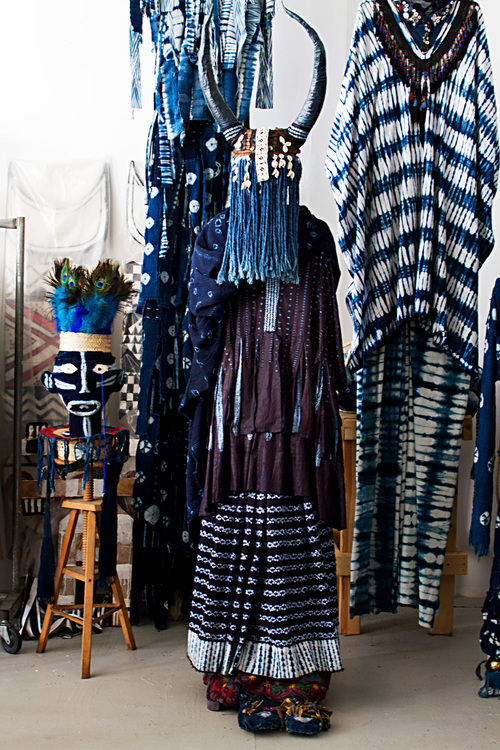
    Laura Anderson Barbata's art. photo by Dora Somosi
    Laura Anderson Barbata’s studio photographed by Dora Somosi.

    Firstindigo&Lifestyle: Your knowledge about cultures and traditions is reflected in your artistic applications. From a more philosophical point of view, are there motivational approaches that resonate through your artistic lens? 

    LAB: I am strongly motivated to address through my work as an artist the challenges that face our current society. I feel a sense of urgency to delve into issues of human rights, women´s rights, indigenous issues and the environment.

    Feminist artists and writers are a source of great inspiration and guidance for me, Judith Butler, Carol Adams, and artists Mierle Laderman Ukeles, Melissa H. Potter and Monica Mayer, to name only a few of the women whose work always has the capacity to teach me something new no matter how many times I read or see their work. Also on my usual go-to list are Jacques Ranciere and Paulo Freire. Theater is an art form that I love and always learn from. The Wooster Group, for example, always presents challenging works in innovative formats that are thought-provoking and executed in ways that combine various techniques, all of which teach me something new. I try to find community groups, activists, artist collectives, urban dancers and performance artists that work outside of the mainstream that are expanding and challenging the concepts of community dynamics, education, dance, performance, music, and proposing ways in which to see, live and engage with each other and the world around us.

    Firstindigo&Lifestyle: It would be interesting to hear about your future, what projects are you continuing, and what topics are you exploring further?

    LAB: I am working on a number of projects, as we have discussed earlier, one very exciting project I am working on is with TBA21 The Current, coordinated by Thyssen-Bornemisza Contemporary Art, in which scientists and artists are brought together to address the urgent issues of climate change and the oceans. This project is in its first year and my involvement will be for three years. I will be creating new works for this project in the form of performances and wearable sculptures which are still in progress.

    I am also continuing my work on the Julia Pastrana project. For this project, I am further working on the topics related to her story, the injustices that she lived and how these are still relevant today. I am working on a performance piece presented as a work-in-progress that is continually evolving, a series of zines that address different topics related to Julia Pastrana such as: repatriation of human remains, museum ethics, exhibition practices, the objectification of people and women, human traffic, beauty and the commercialization of women´s bodies, feminism, animal rights, love, circus arts, and more. I am publishing a book about Julia Pastrana with contributions from scientists, scholars and art historians to address the story of Julia Pastrana from different perspectives that also includes art works. And for 10 years now, I am working on collaborative project with the artist collective Apparatjik and Concha Buika to create an Opera about Julia Pastrana, which will premiere at the main stage of the Norwegian National Opera and Ballet in Oslo, Norway in 2019.

    Artist Website: http://www.lauraandersonbarbata.com/

    Julia Pastrana projecthttp://www.lauraandersonbarbata.com/work/mx-lab/julia-pastrana/1.php