

Sasha Huber is a multidisciplinary artist who hopes that our world would be a better place for people with different ethnic and racial backgrounds. She is determined to continue her family’s Haitian heritage in the arts, and has challenged the postcolonial controversies left behind by figures like Christopher Columbus and Louis Agassiz. Her artistic career has brought her international merit across continents. Sasha Huber’s art is currently shown in the DNA of Water -exhibition at the Newhouse Center for Contemporary Art in Staten Island, New York City.
Firstindigo&Lifestyle: You were born in Switzerland with Swiss and Haitian heritage, how did this dynamic and background influence your youth and early artistry? Where did you get your education from, and how did you eventually find yourself living in Finland?
Sasha Huber: Being from two such opposite cultures inspired me from the start, although becoming an artist was not my first choice in my professional live. My interest was first in graphic design that I learned in Zurich, Switzerland. I then worked some years as a graphic designer at different studios and agencies and then applied and was accepted for a one year scholarship at the research and design and research centre Fabrica by Benetton in Treviso in 2000. Its a multidisciplinary and international environment that I missed in Switzerland. That is also where I met my husband and collaborator Petri Saarikko who is from Finland. So love brought me to Finland at the first place. There I also graduated in 2006 with the Masters Degree in Visual Culture from the University of Art and Design, today known as Aalto University. One situation that triggered the idea for my first art project that I made in 2004 was related to that I was not allowed to visit my mother’s home country and family in Haiti, due to the political situation there. My mother was especially worried for me, and basically forbade me to go when I was younger. Starting to make my art about Haiti served as a compensation instead, and eventually brought the place closer. As an adult I’ve visited Haiti so far twice and each time within the artist context. First time Petri and I took part in the 2nd Ghetto Biennale in 2011, and the second time we were invited to make projects at the Le Centre D’Art in Port-au-Prince during one month in 2016. Both visits went very well and allowed us to work collaboratively with multidisciplinary artists. Working with the Centre D’Art was also special for me since my artist grandfather Georges Remponeau was one of the co-founders of the school in 1944.
Firstindigo&Lifestyle: Could you tell more about in what ways your European upbringing was intercultural. Do you have an opinion that European culture and heritage changed in recent years in relation to migration, and with the impacts of globalization?
Sasha Huber: Coming from a rich cultural background with over ten different nationalities, including the joining families through the different unions in our family, made me aware of the differences and similarities in cultures, and broadened my horizon. I think it helped me to feel comfortable in new places very quickly. For me this is a positive experience. Now when Europe is growing, as we can see with the influx of the newcomers and others too, there are also conflicts, and that brings sorrow to the people trying to find safety.
I would hope there could be other, more human and respectful ways to handle this situation. Luckily there are creative initiatives by grass roots organisations, and individuals who help to contribute to make welcoming people more dignified. Sometimes its forgotten that Europe is also made of very many cultures after all. In a time like this, where racism against the black and brown people is in the rise, and not only in Europe, I’d came to think that it would be good for people to read more such books as James Baldwin’s book I’m not your Negro, or watch the documentary by Haitian film maker Raoul Peck (1953–) under the same name. And read the Orientalism by Edward Said (1935–2003) who founded the academic field of postcolonial studies. Both books were written long ago, but are very relevant in the current climate we live in.
Firstindigo&Lifestyle: One of your artistic discoveries relates to the historical context of the colonization and cultural imperialism. What did you find out about the subject from your specific study, and how did you translate it into your artistic practice?
SH: I would say that the starting point of my career was to deal with the colonialism, and the topic has actually been a red thread throughout my entire practice ever since. In my first project, which was a portraiture series named Shooting Back – Reflection on Haitian Roots, I for instance portrayed people that were responsible of the troubles in Haiti. I started from the beginning and portrayed Christopher Columbus (1451–1506), a figure that has in recent years become more and more challenged; which I find is very important. For instance, in the United States several cities don’t celebrate the Christopher Columbus Day anymore in October as his first arrival in the “New World”. Instead they highlight the meaning as Indigenous Peoples Day. Or, in 2015 in Argentina his statue was replaced with the large statue of freedom fighter Juana Azurduy. We should not forget that some 95 % of the indigenous population in the Americas were killed after his arrival, and the European invasion that followed brought disease and slavery.


Firstindigo&Lifestyle: Is a question of taking over land and leaving marks on its surface, in the environmental sense perhaps, part of the colonization history as you understand it and discuss it in your artistry?
SH: I became conscious about this in 2007, when I joined part of the Demounting Louis Agassiz campaign that was launched by historian and political activist Hans Fässler. Until recently, the life and work of Louis Agassiz (1807, Switzerland – 1873, USA) have been intentionally embellished. He has mainly been presented as a glaciologist, scientist, and director of academic institutions, both in his country of origin, Switzerland, and in his adopted country, the USA. The campaign raised awareness that Agassiz was a proponent of scientific racism and a pioneering thinker of segregation and “racial hygiene”. The aim was at removing Louis Agassiz’s name from a 3946 m peak in the Swiss Alps and renaming it Rentyhorn in honour of the Congolese-born slave Renty, and of those who met similar fates. Agassiz ordered Renty to be photographed on a South Carolina plantation in 1850, “to prove the inferiority of the black race”. This initiative began to open the eyes of the Swiss public, and exposed Louis Agassiz’s involvement in the crimes against humanity. Today, there are over sixty places all over the world, and in our Solar System (the Moon and Mars) that bear Agassiz’s name. I call this micro colonialism of a single person marking his existence around the world while ignoring the local perspective.
My way to react and act through my work as an artist manifested for the first time after I joined the transatlantic committee of Demounting Louis Agassiz, as I started to plan my first intervention to the Agassizhorn in 2008. I airlifted a metal plaque bearing a graphic representation of Renty to the top of Agassizhorn, on the borders of the Swiss cantons of Berne and Valais. In doing so, I took the first step towards renaming the mountain into Rentyhorn. I also started the petition website rentyhorn.ch which is still online. Even though for now, the mountain will not be renamed officially after many years of negotiating with the communes. In New Zealand’s Te Waipounamu – South Island in comparison, I traveled to the Agassiz Glacier with local Māori greenstone carver Jeff Mahuika who performed a karakia (Māori blessing) on the glacier to symbolically de-name the glacier and hens cleanse it from it’s associations to Agassiz’s racism. *

Prototype of Sasha Huber and Thomas Götz as Louis Agassiz, Wet plate collodion photography by Borut Peterlin, comissioned by Sasha Huber, 2013, 10” x 12”.
Firstindigo&Lifestyle: Your background is in graphic design, and you have also worked with video; how do these mediums and techniques correlate with your artistic vision and outcome?
SH: I use a variety of mediums to realize projects. For me the defining reason to choose a specific medium is, first the idea I want to realize and then to decide based on that. I also often collaborate with experts to help me realize a work, such as videographers, editors and photographers.
Firstindigo&Lifestyle: Do you also work with text, for example, to generate ideas, which then take visual forms and so forth?
SH: My artworks are predominately visual, but finding the title of the works is important, and for each project I write a text as well. Sometimes the artwork idea is inspired by text, poem or song as for instance the Strange Fruit poem. I made two projects about this poem that were performed by Billy Holiday and Nina Simone as well. The poem was written by a teacher Abel Metropol in 1937. It protests American racism and tells about the lynching of African Americans.
Firstindigo&Lifestyle: Do you write about your own art, keep diary, and perhaps discuss it in essays?
SH: Mostly curators, academics and journalists write about my work. I participate in conferences to speak about my work. As an example, last year I was a keynote speaker at the Archival Re-enactments Symposium arranged by the Living Archive project of the University of Malmö in Sweden. This summer, I will participate in the 6th International Afroeuropeans: Black Cultures and Identities in Europe conference (http://www.uta.fi/yky/en/6thafroeuropeans/index.html) in Tampere, Finland. I’m currently also doctoral student at the Art Department of the Aalto University’s School of Arts, Design, and Architecture in Helsinki, Finland. So far, I’ve published two books as part of my doctoral project, which I started several years before in collaboration with some historians. I edited Rentyhorn published by Kiasma Museum of Contemporary Art in Helsinki. Then, I co-edited (T)races of Louis Agassiz: Photography, Body and Science, Yesterday and Today published as part of the 29th Sao Paulo Biennale in 2010.
 Sasha Huber in collaboration with Petri Saarikko, The Prototype, 2013, installation view.
Firstindigo&Lifestyle: As a result of your investigations through several years, do you see that your art is influenced by Haitian aesthetics, nature and environment in multiple ways?
SH: As mentioned earlier, the starting point of my art practice was inspired by Haiti’s history. As a matter of fact, I developed a technique for myself with metal staples shot with air pressure onto abandoned wood, as for instance in the Shooting Back – Reflection on Haitian Roots (2004) portrait series. For me the staple gun is like a weapon and I use this technique only when the project relates in some ways to the historic trauma. But aesthetically it could perhaps remind of the traditional beading and stitching as for instance utilized in the creation of the colourful Voodou flags.
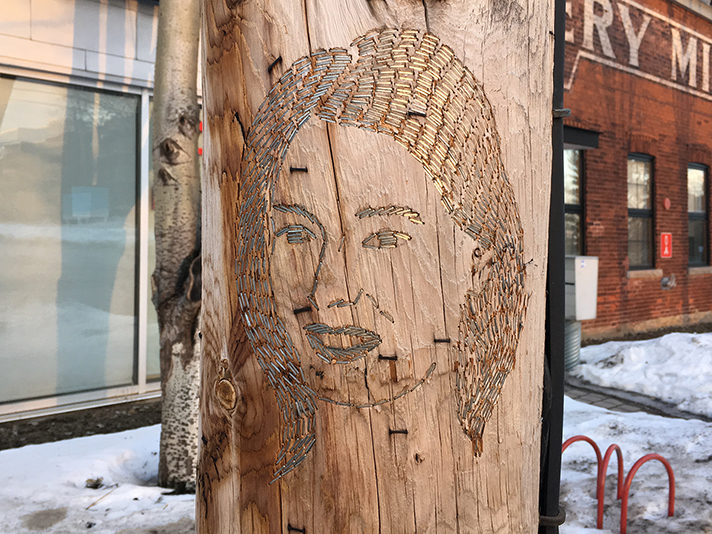
- You Are Missed, is a work in progress project by Sasha Huber, depicting a new portrait series that uses wood and metal staples stitching. Started in Huber’s artist residency at Axenèo7 in Gatineau, Canada in 2017.
Firstindigo&Lifestyle: In the fall of 2016, there was a curated group exhibition titled “Botany under Influence” taking place at Apexart in New York City. Your collaboration with Petri Saarikko was included in the show. How did you get involved in this special exhibition?
SH: We met curator Clelia Coussonnet in Paris, where I participated in the Haïti exhibition about contemporary and historical Haitian art at the Grand Palais in 2014. When she was planning her group exhibition Botany under Influence I told her about our Australian remedies video that she then included into her exhibition at Apexart (http://apexart.org/exhibitions/coussonnet.php). The exhibition delves into the politics of plants, and explores systems of meaning that have been impressed upon nature, flora, and seeds throughout the eras of imperialism, colonialism, and globalization.
Firstindigo&Lifestyle: Could you tell more about the video work that you showed in Apexart. The title of it is ‘Remedies Australia’ (2014). Does this work include material from several geographical locations and have different cultural components in it? Is this process still ongoing?
SH: Remedies is a series I initiated with my artist husband Petri Saarikko during an artist residency at Botkyrka Konsthall in Sweden in 2010-11. It was inspired by our interest in aurally transmitted family knowledge and remedies that we learned from our own families. Later we expanded the project to New Zealand, Australia, Haiti, Russia, Germany and back in Sweden. The Australian edition of Remedies casted Mildura based inhabitants to contribute eucalyptus tree related unwritten narratives and oral histories for an individual and collective portraiture.
Firstindigo&Lifestyle: You are currently in New York City taking part in an exhibition DNA of Water, what kind of works do you have in Staten Island?
SH: Together with my family we just came from a residency in Canada, and continued directly to our current artist residency on Staten Island. We are participating in the group exhibition DNA of Water at the Newhouse Center for Contemporary Art which is curated by Sasha Dees. I am showing couple projects of which two are portraits from the ongoing Shooting Stars series, which is dedicated to worldwide victims of gunshot assassinations and killing perpetrated for political, ethnic, ideological or economic reasons (http://sashahuber.com/?cat=10040). I will show the portrait of Martin Luther King Jr. (1929-1968). I also made a new portrait of Eric Garner (1970-2014) who was living on Staten Island. At the end of the exhibition in September, I will gift the portrait to his mother Gwen Carr.


— — —
The DNA of Water exhibit is open from March 26 until September 3, 2017 on Wednesdays through Sundays from 10;00 a.m. to 5:00 p.m., at the Newhouse Center for Contemporary Art at the Main Hall of Snug Harbour, Staten Island (http://snug-harbor.org/event/the-dna-of-water/?instance_id=3179).
More info about the artist: www.sashahuber.com



 Firstindigo&Lifestyle