• Gigantic cake for a cause/light from recycled bottles

    Gigantic cake for a cause/light from recycled bottles

    What would be more uplifting in the season of the fall with less light approaching us, than to surprise your friends with a gigantic cake to vibrate senses. It is tasting good and creates a visual sculpture with a low cost budget. There is absolutely no reason why not. And it is a great excuse to do some communal action.

    Take this example from Helsinki, a parade of huge cake shared with hundreds of people walking in during one night. The cake definitely creates the performance in itself, and there will be lots to discuss around it. It is a terrific site for some new action plans. How about a theme of recycling, or new energy-saving strategies to create light with the Solar Bottles? The solar bottles is one of the smartest innovation to employ already existing material, namely used soda bottles, and hang them down from the hole in the ceiling/roof. This, of course, fits purposefully in the warmer climates, but one could also think of using them in the summerhouse, or while camping. Most importantly, this is a low-cost solution for the energy problem in South East Asia, where villages suffer from electricity cuts, and where the local areas are over-populated with households. (Go Youtube and search for the topic: Plastic soda bottles become light source…)

    When you start baking your communal action cake, think about solar bottles, recycling, and new design innovations from existing materials. Get involved in creating light. Light is increasing quality of life, it is fighting against depression, sustaining life, engaging our senses.

  • Would I buy a ‘poisonous’ handbag…

    Would I buy a ‘poisonous’ handbag…

    Marketing strategies are sometimes tricky, and techniques of seduction are part of the contemporary branding of products. Putting products out on displays, is then of course part of the entire strategy. We are sensuous beings. Consuming today means taking seriously the product differentiations. We should be paying attention to, how the different products feel, taste, smell, etc… In other words, a questions is, how we as humans experience and imagine objects and things.

    What is the tricky point is that we are after all quite childlike beings when we make our choices to buy something. Hopefully our product differentiation is more in line with the future aspect; what would be good for us in the long run and what would be a more sustainable aspect in our buying of new things. This relates to, what is good for the environment and does not poison our bodies.

    It is important to emphasize couple of questions: how much of the seduction in the advertisements, and in the product differentiation is based on the use of different color-combinations? How do the various techniques of branding speak to our sense of nostalgia aiming at reminding us of our childhood experiences, the shapes, designs, colors and patterns? I noticed something based on this idea.

    There was a handbag, which was on display on a ‘poisonous mushroom’. Think of the red-white spotted Amanita. The color combination would be just so inviting, so deliciously right. The color and shape is full of associations, which can be traced to children’s books and other childhood designs…Just imagine Alice’s Adventures in Wonderland  (by Lewis Carroll). What actually happened to Alice? She was growing tall, shrinking…The image appears as both fascinating and scary. We do not necessarily need to know what happened to Alice in the story. Yet we should think about the poisonous as a metaphor for things that work in the level of seduction… An important question would be, as I see a beautiful handbag on display, would I buy it as it is on a top of a poisonous mushroom? What else does ‘the poisonous’ stand for in the contemporary consumption imaginings, what are the materials used in the products; do they harm the environment and so on?

  • Follow me to the forest

    Follow me to the forest

    It is time for Helsinki Design Week (HDW). We are impressed that the locations include the Old Customs Warehouse. There will also be a fashion show in the brand new Helsinki Music Centre (designed by LPR-architects Marko Kivistö, Ola Laiho and Mikko Pulkkinen). Finnish people love their music, also for the reason that Finnish music has gained world class reputation with our composer Jean Sibelius. After Sibelius, of course, several other 20th and 21st century composers have turned into the unique sounds, which have defined Finnish art music. Perhaps one definition for the musical trends could be a word ‘moody’. It is quite easy to pin it down when one listens all the brass-instruments in Sibelius.

    The new Music Centre stands in a row of other remarkable buildings along Mannerheimintie-road, which honor Finland’s musical tradition and the local arts. Next to the new construction is Alvar Aalto’s Finlandia Hall with its beautiful white marble walls. The modern classic stands out as a continuum of (evolving) organic shapes within the city landscape. Then, a little away from the center is the Opera House, which opened in 1993. The Bauhaus-inspired building was designed by prominent HKP-architects Eero Hyvämäki, Jukka Karhunen and Risto Parkkinen… As going towards the city center along Mannerheimintie, the Music Centre shares an outside green area with Kiasma Museum of Contemporary Art, Designed by American Steven Holl Architects, the museum opened  in 1998.

    During the Helsinki design week, a fashion dimension is added to music. As a result we have an interesting Nordic-Finnish combination of performativity.  Like the musical tradition, Finnish design can be associated with some unique factors. The design and architecture take inspiration from the nature. It makes sense as the country is filled with so many forests and lakes. The nature functions not only as a source of inspiration for design patterns, but it also offers concrete materials and structures. The use of a birch tree and birch bark has been common since traditional times, for example. Birch bark was used in folk designs, and it still continues to define some of the Finnish design, which has taken new forms.

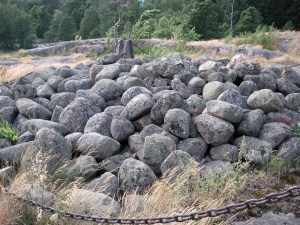
    In 2010, I started imagining the future World Design Capital. How to picture one’s own hometown as a world design capital, how to find the paths, buildings, and all the details and different perspectives, which all are true and necessary in the mixture; to represent Helsinki as a place with rich history?  One important step is to acknowledge our own design potential in the ways we perceive our everyday lives. To see all the creativity in the everyday life.  Finally, remembering Helsinki’s amazing location and closeness to nature is a surplus to the small capital. If one does not want to take one of the cruise boats to Tallinn or Stockholm, at least a trip to one of  the forests and national parks is a must!..As much as there is also international art on display (2010 there were sculptures of Manolo Valdes, picture above), and beautiful natural and man-made design around, there are also landmarks with so much historical value. This prehistoric grave is just a mile away from the city center.

    see more about Helsinki architecture in this blog