I moved to Los Angeles in 2014, after 11 years as a New Yorker. During those years, I went to graduate school, began and finished a career, learned to love opera, and mounted my first fine art exhibition – a crowd-sourced photography group show that was simultaneously a fundraiser for the nonprofit where I was a board member. What I never did in New York City was paint. At the time, my relationship to painting was purely as a viewer, standing a respectful distance away, wondering how in the world they did that. Who would have thought that three years later, at the instigation of my Los Angeles painting professor, the indomitable Barbara Kerwin, that I would find myself pursuing a graduate degree in painting?
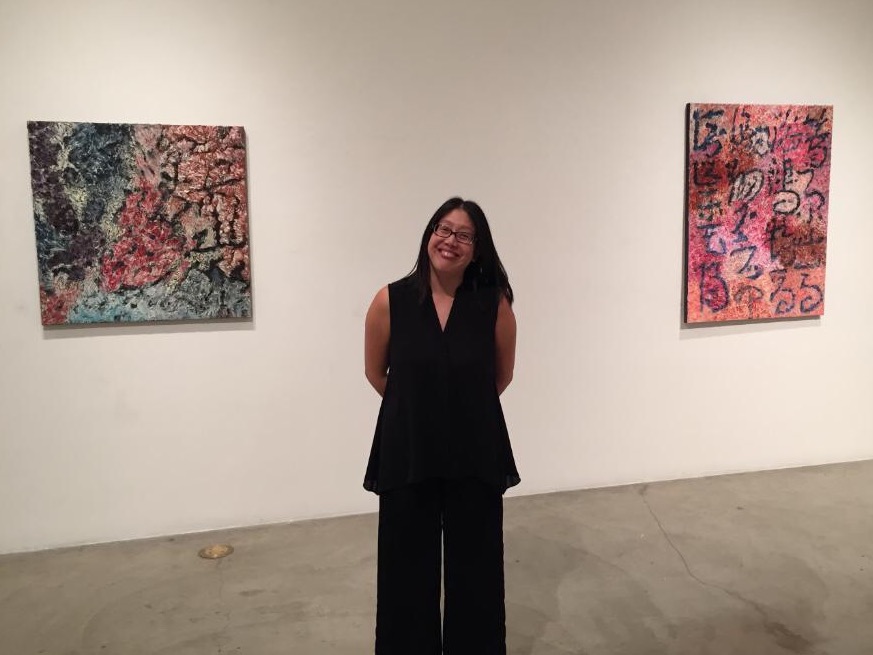
Our first-year MFA group show was titled “Twelve,” for the 12 of us that started the MFA in Art program at Claremont Graduate University this past August. The works I created for the show were made with oil pigment sticks, built up into a thick impasto texture by smashing them onto the canvas with a palette knife and mixing colors alla prima. The paintings are about the loss of meaning and culture through the generations and across the seas. Words, behaviors, rituals become hybridized, sometimes beyond recognition, when transplanted to a different environment, just as language and writing change over time, eventually past the point of intelligibility. Each of my paintings starts with a Chinese calligraphic text, drawn in black, that becomes obscured through layers of superimposed texture and color, ending in a very different visual experience compared to the black and white text that “birthed” it.
Patricia Chow’s two paintings pictured left in the Twelve-exhibition at the East and Peggy Phelps Galleries.
The largest painting (60 x 48 in.) is titled “Outremer” (French for “ultramarine”). The cool colors and coral-like shapes evoke underwater life, but the title also refers to the French territories in the South Pacific (called “outre-mer” in French, meaning “overseas”), that were visited by Gauguin and others interested in the decidedly un-PC idea of “primitivism,” and also where France has conducted a large number of controversial nuclear tests. Thus, in addition to the Chinese text being washed away “underwater,” the painting’s title also alludes to aspects of modern world history that some might prefer to be swept under the rug.
Patricia Chow with her recent paintings.
Each of my paintings starts with a Chinese calligraphic text, drawn in black, that becomes obscured through layers of superimposed texture and color, ending in a very different visual experience compared to the black and white text that “birthed” it.
Patricia Chow is a Los Angeles-based artist whose abstract paintings engage the intersection of Eastern and Western cultures across time and space, and the hybridization and reinterpretation of meaning. She is currently a first-year MFA student in Los Angeles, CA.
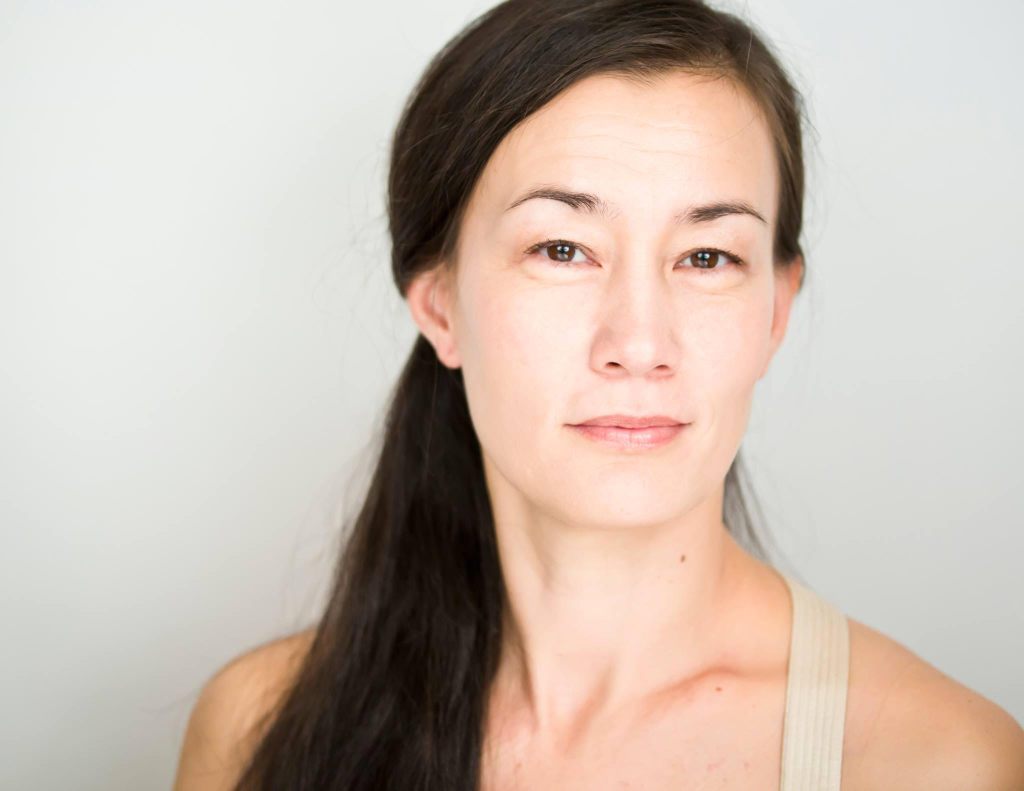
New York City based performer Marina Celander crosses boundaries in her artistic practice, which combines a variety of genres and approaches to making art. Her solo performances echo authentic voice, and her deep participation on stage with theater groups comes across as statuesque, moving, gentle and charismatic. Marina Celander is born as Swedish-Korean, and is a recipient of 2014 Lilah Kan Red Socks Award for her outstanding contribution to the Asian American professional theater in New York City.
Firstindigo&Lifestyle: What choices did you make to become an actor, what is your background in the field?
MC: I started out as a modern dancer. After I graduated from London Contemporary Dance School I moved to New York and danced for a bit with various companies and choreographers. At one point I decided to take acting classes, which was something I had always felt I wanted to try but was afraid to do, and started studying with Gene Frankel at the Gene Frankel Theatre Workshop on Bond Street. Despite my fears, I took that first class with Gene and I remember feeling so elated and high, almost, as I stepped out from the darkness of the theater and in to the sunshine on the street. From that moment on I knew I had found what I needed to do with the rest of my life.
Firstindigo&Lifestyle: Where were you born and raised, at least Sweden is on the map?
MC: I was born and raised in Sweden. I grew up in Malmö which is in southern Sweden, right across the strait from Copenhagen, Denmark. I lived in London for three years while I was studying dance, and then I moved to New York when I was in my early twenties. I have been in New York ever since! I go back to Sweden every other year or so to visit my family.
Firstindigo&Lifestyle: You have performed with Yara Arts Group that is based in La MaMa Theatre for many years. How did you find yourself part of the company?
MC: I auditioned for a show that Virlana Tkacz, the artistic director of Yara Arts group, was putting up at La MaMa in 2000, called Circle. This particular show was special in that it had actors and musicians from Buryatia and Mongolia, as well as us New York actors. We had the chance to learn to sing these hauntingly beautiful Buryat songs from the Altai mountains. Two years later I traveled with Yara to Ukraine to sing Ukrainian folksongs, and visit Babushki, the grandmas, in the villages of Kratchkivka in Poltava and Svaritsevichiy in Polissia, and then we performed in Kyiv. This trip was also lead by Ukrainian singer, Mariana Sadovska, who was the musical director for our performance. Ever since then I have come back to work for Virlana in various poetry readings and events that she hosts, as well as being part of some of her theater productions.
Firstindigo&Lifestyle: Virlana Tkacz, one of the founders of Yara, and the director of the company, and many company members have a Ukrainian cultural background, But Yara is appreciated as multicultural in its productions echoing ideas of a World Theater. Did you find this conception as a great home for your own performance identity?
MC: Yes, I am really attracted to the idea of World theater. It is very fitting that Yara Arts Group is a resident theater company at La MaMa, because it is the home of World theater. Ellen Stewart, the founding mother of La MaMa Experimental Theatre, bravely and courageously invited individuals and companies from all over the world to perform and work at La MaMa.
Yara is an exciting company to work with, because of the always multi-lingual performances and multi ethnic cast. Lately, Virlana has been working with Ukrainian artists, but in the past she has worked with artists from Buryatia (in Siberia) and Kyrgyzstan. As a woman of color and a theater artist, I always deeply appreciate directors who are not type-casting based on ethnicity and race. In downtown theater in general, but at La MaMa in particular, I have always been given opportunities to act in a myriad of roles where my ethnic make up is not important. Virlana has given me and many other actors of color opportunities. I believe that putting a minority actor on stage for no other reason than the fact that (s)he is a good person to have in the show, is always a strong choice against the established order of theater in the West.
Firstindigo&Lifestyle: In 2015, you were part of a production that directly was touching Ukraine and the war that was happening on a huge crisis level there. Yara’s production premiere ‘Hitting Bedrock’ took place in La MaMa, (it was conceived and directed by Virlana Tkacz, set & light by Watoku Ueno, music by Julian Kytasty, assistant director: Wanda Phipps). Your role in the work was central. Tell more about your role and how it shaped in the context?
MC: The production Hitting Bedrock, was an important production as it addressed the war in Eastern Ukraine. My character was The Refugee, and her significance in the piece was that she represented all of those humans, women, children, men, the elderly, that have been rendered homeless because of the war in Ukraine, and elsewhere in the world. She represented all of those that have had to leave something important behind, a memory, a treasure, a family member, a secret, a lover, old letters, a photograph… It was a role that moved me deeply. As a result, that summer (2015) I went on a self financed, crowd-funded trip to face paint and give dance workshops to children in refugee centers in Ukraine.
Firstindigo&Lifestyle: In this play, the audiences had a participatory role. At one point, we were asked to give our belongings away, and were offered big tote bags instead, to put our coats and personal items in them. This was altering a perception from an audience member’s point of view into the experimental, perhaps reminiscing the point of view of people in the war. In what ways did being a central actor discussing your war losses while audience is so close to you, alter your own performance? Did this event change you?
MC: Yes, the audience were forced to walk through a long corridor in the basement of the theater, and thereafter they were asked to give away their personal belongings only to have them put into bags. The audience immediately got those bags back to hold for the remainder of the show, but many felt uncomfortable and some refused to give up their belongings even for a second. We had brusque and insistent “guards” in uniforms commanding people to go here, put their stuff there, go up, sit down, etc. When the audience had finally arrived in a “holding area” after having been shuttled around with their big bags, they had to witness the guards doing the same to me. The guards demanded to see what was in my back-back, and I showed them my toothbrush and my papers. At this point the audience is really right next to me in the holding area. Having the audience being so close to me, being one of them, really does something to the performance. As an actor I loved feeling them so close, feeling their reactions to me, their doubts, their fears, and them feeling my fears. It was also a little intimidating when on one occasion we had a lady who was a little drunk in the audience, and she was shouting quite aggressively at the stuff I said. That was worrisome, because she was so close.
Firstindigo&Lifestyle: Besides being an actor and performer, you handle multiple different roles. How did you come to dancing and performing Hula?
MC: Yes, I handle multiple different roles in my life on a daily basis. I am a mother, and an artist, a teaching artist, performer, face painter, a freelancer. I wake up every morning thinking, what am I doing today?
I started dancing Hula, traditional Hawaiian dance, in 2000, after finding an organization that gave beginner hula classes. I was very fortunate to stumble upon the Hawaiian Cultural Foundation (HCF), and there I studied with Michelle Akina, Janu Cassidy, Keo Woolford and kumu hula June Tanoue. I have since been involved with a hula halau, hula school, Pua Ali’i ‘Ilima o Nuioka, under the leadership of kumu hula Vicky Holt Takamine.
Firstindigo&Lifestyle: What is your connection to the hula/Hawaiian community in New York?
MC: It’s a small, but growing, community of Hawaiians, and Hawaiians at heart, hula lovers, and Hawaiian language and music lovers and enthusiasts. It is a beautiful and loving and inclusive community of people from all over. My connection is through hula.
Firstindigo&Lifestyle: A very interesting part of your practice is also face painting. That is a skill that requires another set of imagination and sense of personality in people. How did you start?
MC: I started face painting for my own children’s birthday parties, and it grew from there. Now I do other kids’ birthday parties. It’s a small side business, and I get clients usually through word of mouth. I really enjoy the face painting, and it makes me happy to paint kids’ faces.
Firstindigo&Lifestyle: In 2016, you created a solo work for yourself that was performed in Sweden. The work titled Mermaid’s Howl, handled a theme of you mother, and her Korean identity. How did you experience the project from the point of view of her identity, and your own, adding into the narratives that are so personal?
MC: I created a solo show called Mermaid’s Howl and performed it at the Stockholm Fringe in 2016. The story had been a long time in the making. As early as 2013, I had talked to my friend and mentor, Fred Ho, about my idea of writing a solo show. He quickly said, in typical Fred Ho style “Write it, I’ll produce it. Here is your deadline, use it.” He unfortunately passed away before that came to fruition, but I stayed true to my promise to myself and to Fred, to finish writing that piece. I am grateful to the Stockholm Fringe Festival for inviting me and giving Mermaid’s Howl its premier.
The story is about me growing up in Sweden and finding out who my mother was, and finally being able to connect the dots in my adult years. Connecting the dots from me, to her, to all of our maternal ancestors. The play is part dream, part real memory snippets, part madness and part immigrant mother-daughter story. It was a deeply personal process, of course, to write this play, which delved into questions of what is must have been like to an immigrant woman, all alone in a completely foreign country, without family, to raise a child on her own, have her dreams crushed or set aside. It also explores the question of women and madness, and what it means for women to not be able to fully express themselves as artists and human beings in a society that sees women as less valued than men.
MARINA CELANDER, MERMAID’S HOWL – PHOTO YOUN JUNG KIM
MARINA CELANDER, MERMAID’S HOWL – STOCKHOLM, SWEDEN 2016
Firstindigo&Lifestyle: Was the theme of mental illness and it’s feminine counter-narrative hard to project into a play?
MC: Mental illness is a topic that is still not openly talked about, it’s a little taboo. I wanted to bring it to the forefront and not skirt around the issue. Without glorying mental illness, I wanted to shine a light on it from a different angle, to let people see that there may be a societal value to possessing a different sight and different viewpoint from what is deemed “normal”. Normal is a societal rule, and normal is different in other cultures. In the West there is absolutely no point to mental illness at all. It is just a nuisance, a bother, a hindrance, a difficulty, something to be shunned and stowed away, far far away. I am not saying that it is not utterly devastating when serious mental illness occurs in a family, but I am saying that there are options as to how you would view someone with a divergent view of the world. Those with divergent behavior can actually have value in society, their divergence is seen as highly creative as well as highly unusual and abnormal. At the same time, madness in women have always been a tool to belittle and demean women, to incarcerate “difficult” women, and put women in their place by the patriarchic machinery.
Firstindigo&Lifestyle: The play also involved projections as part of it, tell more about the visual and performance collaboration?
MC: I had three amazing collaborators. The electronic score was composed by Dåkot-ta Alcantara-Camacho. The costumes were designed and made by Jane Catherine Shaw, and the projection design was made by Youn Jung Kim. Youn Jung knew my play very well. She was a student of Fred Ho, that is how we met. In the beginning of the writing process she and I used to meet regularly and have our little mini-writing labs, where we shared, read and discussed our work. Because of her connection to the piece from the start, she really knew the flow, the pace, the colors, the feelings of the piece. The projections grew out of her intimate knowledge of the story I wanted to tell, and her receptiveness to my suggestions made the working process so easy.
Dåkot-ta created a score that was so sensitive and evocative, and reminiscent of water and forests and shaman drums. His sounds were instrumental in setting the scenes for particularly relevant moments in the piece. It really was amazing to hear the music loud, with real speakers, for the first time! Goosebumps moment! Cathy made these amazing creations that felt magical to wear, and helped me grow into the characters I was portraying in the various environments.
Firstindigo&Lifestyle: What would you like to say about the performance experience in Sweden, did you feel you were at the crossroads of cultures while bringing the work there?
MC: I didn’t necessarily feel I was at a cultural crossroads in Sweden, but my piece, Mermaid’s Howl, is an exploration of my cultural heritage, so it was very fitting to have its premier in Sweden. Performing in Sweden was a homecoming of sorts. Being bi-racial I guess means you are a hub for cross-cultural activities within you.
Firstindigo&Lifestyle: This play involved also a Kickstarter- fundraising, and the audience was able to have a glimpse into the concept and to you as a person. What was this campaign process like?
MC: Yes, I decided to crowd-fund with Kickstarter as it seemed as the most reputable and an easy way to go. The opportunity to go to Sweden came up very quickly as I was invited to perform with Mermaid’s Howl just a couple of months before the festival started. I had to come up with the funds to go very quickly.
Youn Jung Kim is a great conceptual artist and photographer and film artist. She has a great eye and a great feel for what works and she listened to what I wanted to convey in my little promo video. From the short interaction we had on camera she created a little gem of a video for my Kickstarter campaign. (You can view the campaign here: https://www.youtube.com/watch?v=pq4-2zW7GZ0)
Firstindigo&Lifestyle: You are an activist in social platforms. You have performed radical acts in public places, closing yourself in a body-bag for instance.Tell more about the involvement. Do you think activism can change the dominant narratives in crisis? Are you an optimist?
MC: Yes, I’m always an optimist. The particular event you are mentioning was Belarus Free Theatre’s demonstration in NYC against Capital punishment in Belarus, where young people disappeared and their families were not notified of their deaths, and never received their bodies back. This was an event planned together with La MaMa. We gathered by City Hall, and then walked over to Foley Square, where we crawled in to body bags, zipped ourselves up and laid still for 30 minutes to raise awareness of the issue. We had monitors who were watching us to make sure nothing came to pass as we were inside the body bags, or in case anyone would freak out they could quickly zip us open again. It was a very intense experience, I have to say.
As artists we have an obligation to tell stories where we stand up for the underdogs, speak up for those weaker than us, for those who do not have a voice or platform with which to tell of their story.
Firstindigo&Lifestyle: What new adventures do you have planned?
MC: I performed a first draft, a first work-in-progress version, of a new solo show called Shakespeare’s Sistersat Dixon Place in NYC in January of 2017. My plan is to perform it again in a larger venue and to see the piece grow. Mermaid’s Howl will also be traveling to Massachusetts sometime in the near future. We are working out the details now, so I will tell you more when I can reveal more, but I am very excited that this show will have a future life.
Firstindigo&Lifestyle: You are also performing with Yara in their new production?
MC: I’m currently performing with Yara Arts Group’s new show at La MaMa called 1917-2017: Tychyna, Zhadan and the Dogs. Again, it is a project based on Serhiy Zhadan’s poetry. It was shown this spring in Kyiv, by a Ukrainian cast, and now it’s our turn to put our spin on it. Serhiy and his punk-rock band, The Dogs, are in New York performing with us. It’s an exciting show! It’s always very special to perform with a live band. Other musical elements in the show are Julian Kytasy’s bandura compositions. This piece makes us reflect on the concept of tyranny and how easily it arises – it did in Europe in 1917, and now in 2017 we are currently in danger of allowing it to rise again. The show opened on Friday June 9 and runs at LaMama ETC until June 25, 2017.
***
Information about the Yara’s 1917-2017: Tychyna, Zhadan and the Dogs at La Mama here: http://lamama.org/tychyna/
Aimee Lee is an artist, papermaker, writer, and the leading hanji researcher and practitioner in the United States. With paper, she makes thread, sculpture, books, drawings, prints, garments, and installations. AimeeLee’s background as a performing artist and musician carries traces of paper as sets and costumes. Her installations are artistic research on paper and sound. She has pursued a career with traditional Korean hanji, coming up with new aesthetic concerns and techniques for her artistic practice. As a scholar, she is author of award-winning book,Hanji Unfurled (The Legacy Press).
Firstindigo&Lifestyle: You are a musician, a performer with live violin. How did you start creating performances onsite, including your own installations, manifesting set designs and creating costumes? Did everything start with music?
Aimee Lee: My early aspirations were to become a concert violinist, but I learned in college that I was not serious enough to devote the requisite hours of practice and study. However, I still loved music and wanted to stay close to musicians, so I continued to play and my first jobs were in music administration—bringing music to people who did not have access, or bringing people together through music.
When I moved to Chicago for graduate school, I entered an interdisciplinary program that encouraged combining different media, especially performance. It was a book and paper program, but I was interested in the intersection of books and performance. Once I began to make paper, the connection between paper and performance was so compelling that I created installations that were dependent on paper that I made. The performances, which almost always included sound from my violin, activated the installations.
Firstindigo&Lifestyle: Some of the live performances, which you composed and put together implement almost haunting kind of sound that responds back from the architecture of the venue, and then audience is stretched to interactive listening and feedback, where did you get the ideas to make these works?
AL: Mostly, I studied classical music, but later learned improvisation and jazz. The heart of what I have always loved to do is rooted in improvisation, whether or not I was aware of it. Human communication, which sound and music are, has always fascinated me, so I wanted immediate feedback and interaction with my audiences. In Chicago, I was influenced by performance residencies with Aaron Williamsonand Greg Allen, and by Julie Laffin.
Firstindigo&Lifestyle: Now, we can perhaps say that you have become a master of hanji, the Korean traditional paper making. Where did you find the enthusiasm to start exploring it, and how did it come about?
AL: While I studied papermaking history in the graduate school, I noticed that it began in China, moved to Korea, and then traveled to and flourished in Japan. Most of the existing research in English on East Asian paper was based in Japan, and I was unable to find much about hanji (Korean paper). I grew up at a time and place in the US where people always tried to guess my heritage, but they could only imagine that I was Chinese or Japanese. This sense of Korea being overshadowed affected me deeply, so I felt a curiosity about Korean paper history. My Fulbright research in Korea uncovered an entire history and culture that fascinated me on all levels, as an artist, a researcher, a Korean American, a person in the world. After my return to the U.S., I felt a strong responsibility to share what I had learned. I would never call myself a hanji master, but will always be a steadfast hanji ambassador and artist (read Aimee Lee’s exhibition review in Firstindigo&Lifestyle)
Firstindigo&Lifestyle: Is the knowledge of making hanji widespread in Korea today, how about the new generations and passing down this historic form that goes back hundreds of years?
AL: Korea has similar issues to the U.S. and other cultures where the current knowledge of traditional craft by the general public is quite limited. It is not a priority in contemporary life, so not many people in Korea are aware of the process of making hanji and its impact on Korean history. There are less than 25 paper mills remaining in Korea, and very few have serious apprentices, because it’s not an easy living. In a world where you could live and work in an urban center with all the amenities you need, why would someone decide to live in a rural area doing manual labor for very little money? There are no good incentives to do the work, even if you believe in continuing an ancient and important tradition.
Firstindigo&Lifestyle: How sustainable is the process, could you tell about the ecological aspect of the paper making?
AL: Papermaking on a small scale (meaning individuals or families who are in business) in Korea is ecologically sustainable, though it may not be financially so. The main raw material is the paper mulberry tree, which is cut each year. This coppicing practice encourages the plant to grow back every year, so the same plant can produce material for over 20 years. These are not trees in the way Western minds think of hardwood lumber: they are tall and skinny, almost shrublike, and cutting them down does not kill the plant. The traditional methods of processing always used plant materials so that production byproducts were easy and not toxic to dispose of or reuse. The bulk of the energy that goes into making hanji is human energy, which means that the process is very labor intensive but has a very light ecological footprint.
Aimee Lee discusses hanji objects at the Korean Cultural Center in New York, March 2016
Firstindigo&Lifestyle: Is it correct that Hanji derives from nature, or implies a closeness to it?
AL: Hanji is made from plants, and could never have been invented without a human closeness to non-human nature by observing the possibilities of certain species and experimenting over time. Dorothy Field, artist and author (my favorite is her book Paper and Threshold) writes beautifully about how certain plants long to become paper, and all they needed was the human hand to let them reach that state.
Firstindigo&Lifestyle: Can Hanji accessories, or clothing, be compared to textiles, or is it irrelevant?
Paper and textile have a very strong connection, aside from each being able to be transformed into the other. The first paper was made from hemp cloth, and hanji can be cut, spun, and woven into cloth. Hanji has been used to make clothing, and today’s contemporary designers and manufacturers are including hanji into their textile production.
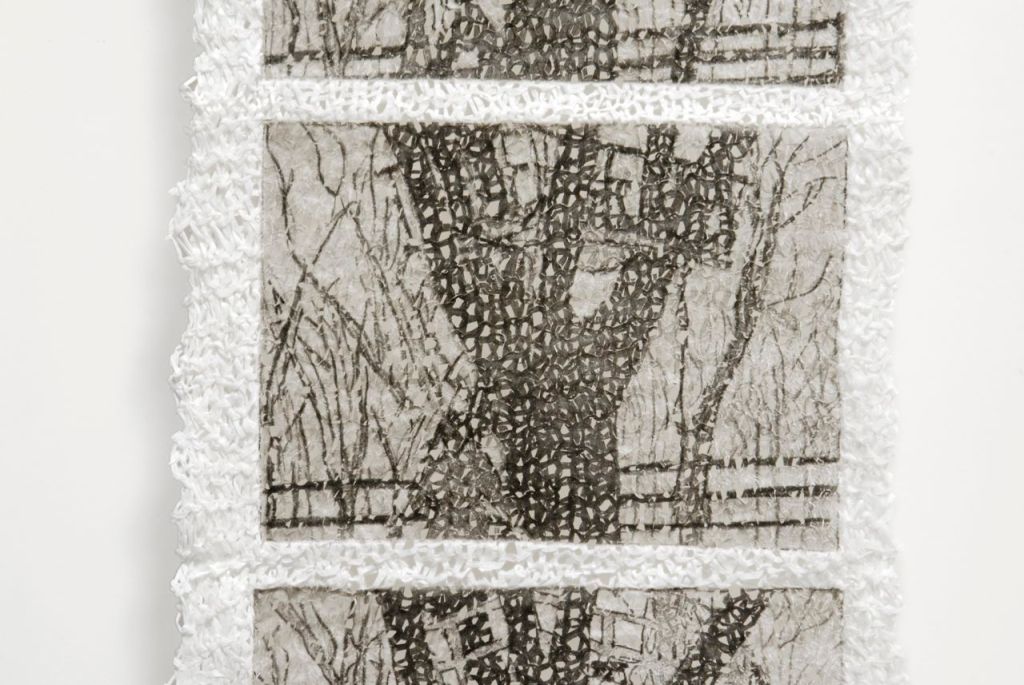
Aimee Lee, All there, 2016, Dye on paper, thread, private collection.
Firstindigo&Lifestyle: You are teaching as well, could you tell about the workshops and education aspect?
AL: I mentioned before that sense of responsibility to share knowledge about hanji to a much wider audience. Part of this is from a conservation instinct, out of a fear that hanji is disappearing. But most of it comes from a joyous instinct, out of my love for this material that is so endlessly versatile. I always knew that handmade paper had great range, but even after almost a decade, I continue to find possibilities for hanji. If the substrate was not impressive, I would not feel compelled to promote it. However, I want people to know about hanji as an option, so that they can have another tool in the toolkit. This means that I teach a range of workshops, from preparing fiber to making hanji to manipulating it by hand. I travel continually to spread the word, in the hopes that eventually hanji will become as familiar as other papers, and that paper itself can be regarded on the same level as canvas, clay, metal, glass, wood, and so on.
Aimee is beating fiber to make hanji while teaching at Paper Book Intensive 2016 in Saugatuck, Michigan.
Firstindigo&Lifestyle: The aesthetic form of Hanji art and folk art influences your making, how do people receive these traditional objects, which you are making today?
AL: Most people don’t know about the lineage of the objects, so the responses are mostly of wonder—they are amazed that my pieces are made of paper in the first place. This provides an opening to share the stories of their historical use, and illuminate the ways that humans have always made objects that are not only useful, but embedded with meaning. Some have asked if I am interested in using the techniques to make much more contemporary ‘looking’ art. I have wanted for years to extend crafts like jiseung into installation and larger work that goes past the original shapes and functions of their predecessors. The issue is that the time and labor that it takes to make one piece is so great that I could only go in that direction if I had a very long and uninterrupted stretch of time to work. However, I am gratified to see that some of my students are moving in that direction after learning about hanji and its applications.
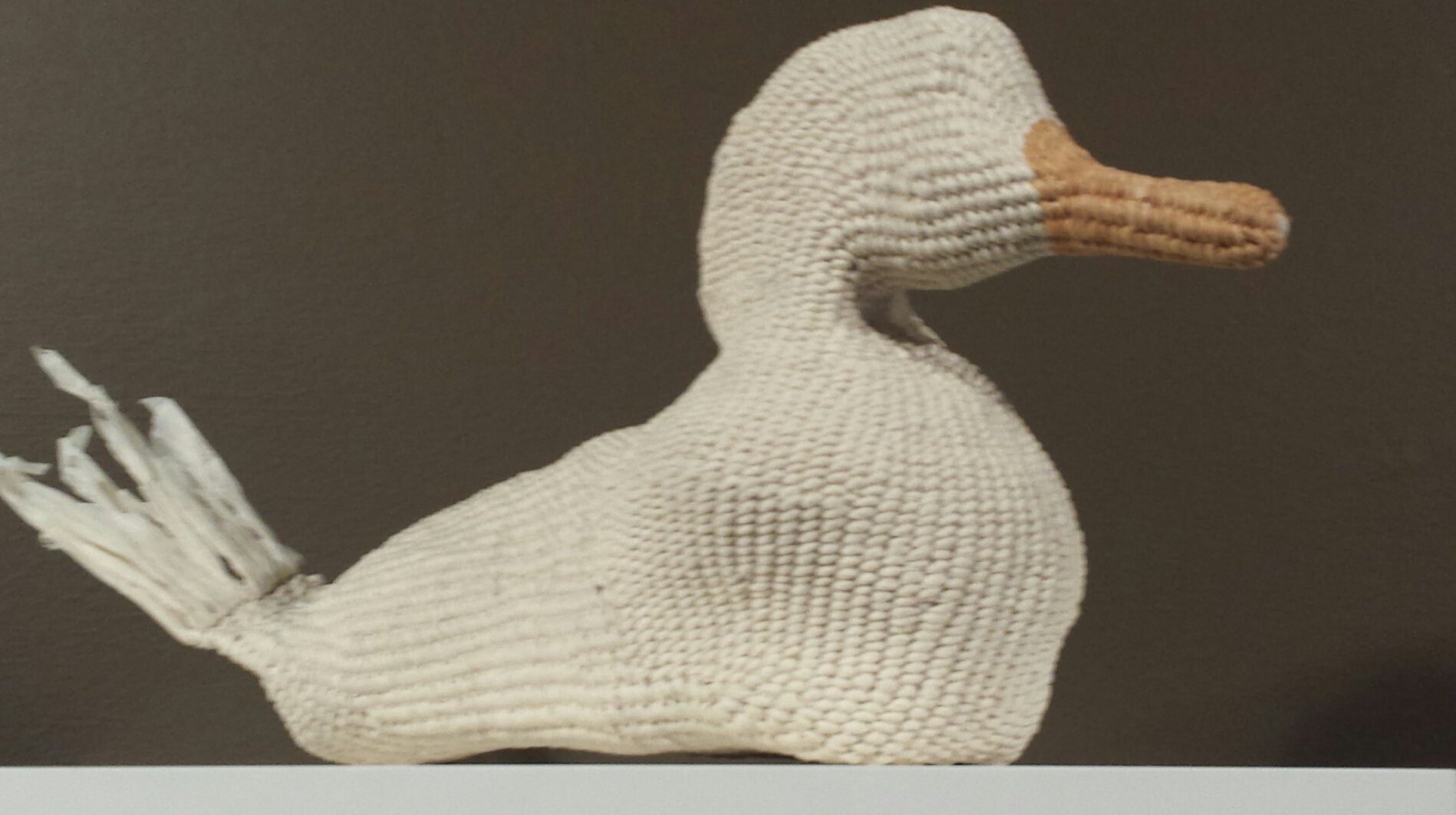
Aimee Lee, hanji duck, exhibition at the Korean Cultural Center, NY, March 2016
Firstindigo&Lifestyle: What other materials do you use today in the making of your art?
AL: For the longest time, I have been very strict about using hanji whenever possible, or other handmade papers. My thread box is always full of different paper threads I have made, though I use cotton, linen, and silk thread to sew my hanji dresses. I also use the raw materials that make these papers, such as the cooked bark before it is beaten to a pulp. I use mostly natural dyes and finishes, which add color, structure, and protection to the paper. Last year, I collaborated with Kristen Martincicon a paper and ceramic installation, and recently had a couple of jewelry metals artists help me with additions to my paper ducks at Haystack Mountain School of Crafts. I’m interested in continuing this last investigation further.
Firstindigo&Lifestyle: What is fascinating about your use of paper is its multiple dimensions from small objects to books. Your own writing and art (illustration) is sealed into these art books. Tell about the books, which you have made, how did the stories develop?
AL: Books came first for me, before paper. I was making artists’ books at Oberlin College while studying with Nanette Yannuzzi Macias, which was a game changer. It was a way to combine writing, drawing, storytelling, and all kinds of other media into a form that felt very familiar and yet new. I don’t remember when I started to draw comics, but like improvisation, it was something that came naturally to me. I always thought that the point of being able to make my own books was the ability to create all of my own content. Most of my books contain original writing and stories that come from my own life experience, literature that I love, and the immediate present moment—whether an emotional space or an actual time in history that could be marked in the news cycle.
Aimee Lee, Lapse relapse, 2015, ink and persimmon dye on kozo and hanji, thread. Oberlin College Art Libary collection.
Aimee Lee, Blue moon, 2015, Naturally dyed, spun and woven mulberry paper, mildweed paper covers, thread, 4 leaves.
Aimee Lee, Figure and ground, 2006-2011, pen on handmade paper, tacket binding, 12 pages, CIA Gund Library Collection
Aimee Lee, Arithmetic, 2016, Pencil and stamped foil on handmade paper, 300×300
Firstindigo&Lifestyle: Do you travel to Korea to get new ideas and exchange?
AL: I am able to get back every several years, whenever I am funded. However, because of the distance and difficulty of making enough time to visit (I prefer going for longer periods of time), it’s not a journey I make often. Certainly it is inspiring, but it is a challenge as well because the expectations of me as a Korean American woman can be stressful.
Firstindigo&Lifestyle: Often you hear that there is a division of thought between Eastern and Western approaches or philosophies. Do you feel you are bridging the gap between east and west in your practice, or do you think about these questions?
AL: This idea comes up often and much of my work can be seen as bridge building between cultures. However, I do my best to stay away from the reductive nature of “East/West” because it sets up an automatic “Us/Them” mentality that can become dangerous. My life experience of feeling reduced to a single word, automatically, because of how I looked, keeps me aware of the unconscious instincts we have to categorize everything. I prefer to present my scholarship and artwork as being rooted in and inspired by many different traditions and cultures. It’s impossible for me to work any other way because I was born to immigrant parents and always lived between at least two disparate cultures.
The “east meets west” cliché is one I particularly dislike, as if it has just happened, and as if there are only two monoliths in the world. It also comes from the point of view of a certain place being the center or more superior, which is problematic. Most cultures around the world have been in contact with each other for centuries, so cross-cultural understanding is not a new thing or an anomaly. Rather, it’s the norm.
Firstindigo&Lifestyle: Where do you see yourself as an artist and educator in the future?
AL: My goal is to build a new hanji studio for myself, where I can work, make paper, and teach independently, while continuing to travel to teach and exhibit. I want to train apprentices in this new space so that I can increase the number of people who can support hanji. There’s at least one more scholarly book left in me as well, so I look forward to finding the ideal setting to properly research and write it. All of this will be unlocked, I think, once I find the right place for myself to be.








 Firstindigo&Lifestyle