Tag: artistic practice

  • Interview: ruby onyinyechi amanze, drawings on paper

    Interview: ruby onyinyechi amanze, drawings on paper

    ruby onyinyechi amanze embeds a notion of scholarly artist in a true sense. Next to her large drawings on paper stands a mind that is influenced by spatiality in a geographical sense. The artist employs a design sensibility that gives her drawings variable perspectives. ruby amanze completed her art degrees, worked in art institutions, and as the Director of Education at the Museum of Contemporary African Diasporan Arts (MoCADA). She was a Fulbright Scholar teaching art at the University of Nigeria, Nsukka in 2012-2013. Currently, while still teaching art, her artistic practice evolves in a studio located in Brooklyn, New York City.

    Firstindigo&Lifestyle: It is fascinating how you translate the theme of hybridity into formations with so much vivid color and fluidity. Do you think this resonates with the fact that you were transferring between various continents?

    ruby: Most definitely. There is a way of being and moving in space, that I feel is unique to the experience of having come from many places. Automatically, there is less permanence associated with land (geography) or a sense of home. My understanding of home was that it changed a lot. So I adapted into a shared consciousness that home equates fluidity. Also, that my physical body had the right to claim space wherever I was- nothing felt off limits. I started to identify myself as a hybrid and to recognize that there were many narratives of hybridity. Initially, there was an idea that people who moved in that kind of way didn’t belong anywhere- that they had no home and somehow weren’t “authentic”. Or that they lost something…something they would always search for. I disagree.

    I feel that my life is enriched by these multiple homes. I meet people from all over the world who have had similar transcontinental experiences, and I know I’m part of a borderless, expansive “country”. We don’t have a landmass. But the space is a legitimate one. A lot of this informs my spatial decisions in the drawings.


    What does being ‘African’ mean to you personally, was there a strong sense of a Nigerian community in England where you grew up? 

    ruby: Being African for me can mean many different things, depending on the context. Generally speaking, I think it’s far too broad and simple of a “classification”. What I know of Africa is miniscule compared to its vastness. And that goes for any of us, who refer to the region so lightly…the truth is we know next to nothing. Even to zoom in to Nigeria, where I’m from- the same sort of complexity exists. Non-African colonizers, as is the case for many – if not all African ‘countries’ – arbitrarily decided the country’s borders. The writer Taiye Selasi said in a Ted Talk, “nations are concepts”. They’re inventions. She said that what makes more sense, is to think about where you are ‘local’ of, as opposed to a ‘national’. I think this is true, so while I was born on the landmass we call Nigeria, what is more accurate to say right now, is that I have a relationship with the city of Lagos. That’s what I know most of Nigeria. That’s where I have friends and routines…where I invest time and spirit. That’s where I am at home. Yes, there was and still are, large communities of Nigerians throughout England. Growing up there, my family was part of a circle of families that emigrated around the same time, some of whom had known themselves in Nigeria prior to relocating. My generation of this circle is still close. We grew up essentially as cousins.

    When did you start making art, how did your career path take direction?

    ruby: I’ve been making art, and identifying as an artist, since I was a small child. It has always been, everything I’ve wanted to do and be. My pursuit of it was single minded. At every point that there was an option, I chose art. Coming from a family of Nigerian immigrants, who had grown up with the societal framework that art is not a career, I had to be quite stubborn and relentless in advocating for it. To my favor, I excelled in all academic areas, so my parents didn’t fight me too much, and perhaps took the mentality of ‘waiting it out’ to see if it would pass! It didn’t pass and here I am today, as I knew I would be. All of my life choices have been around art. I did my B.F.A and M.F.A worked in art institutions, taught art (and still currently do)…The turning point for my career was when I decided to leave the best job I’d had, as the Director of Education at the Museum of Contemporary African Diasporan Arts (MoCADA). I left to do a Fulbright on contemporary drawing in Nigeria. It was a year commitment primarily to the studio. When I returned, there was no going back to anything other than a full time dedication to my career as an artist. This was the best decision I ever made…
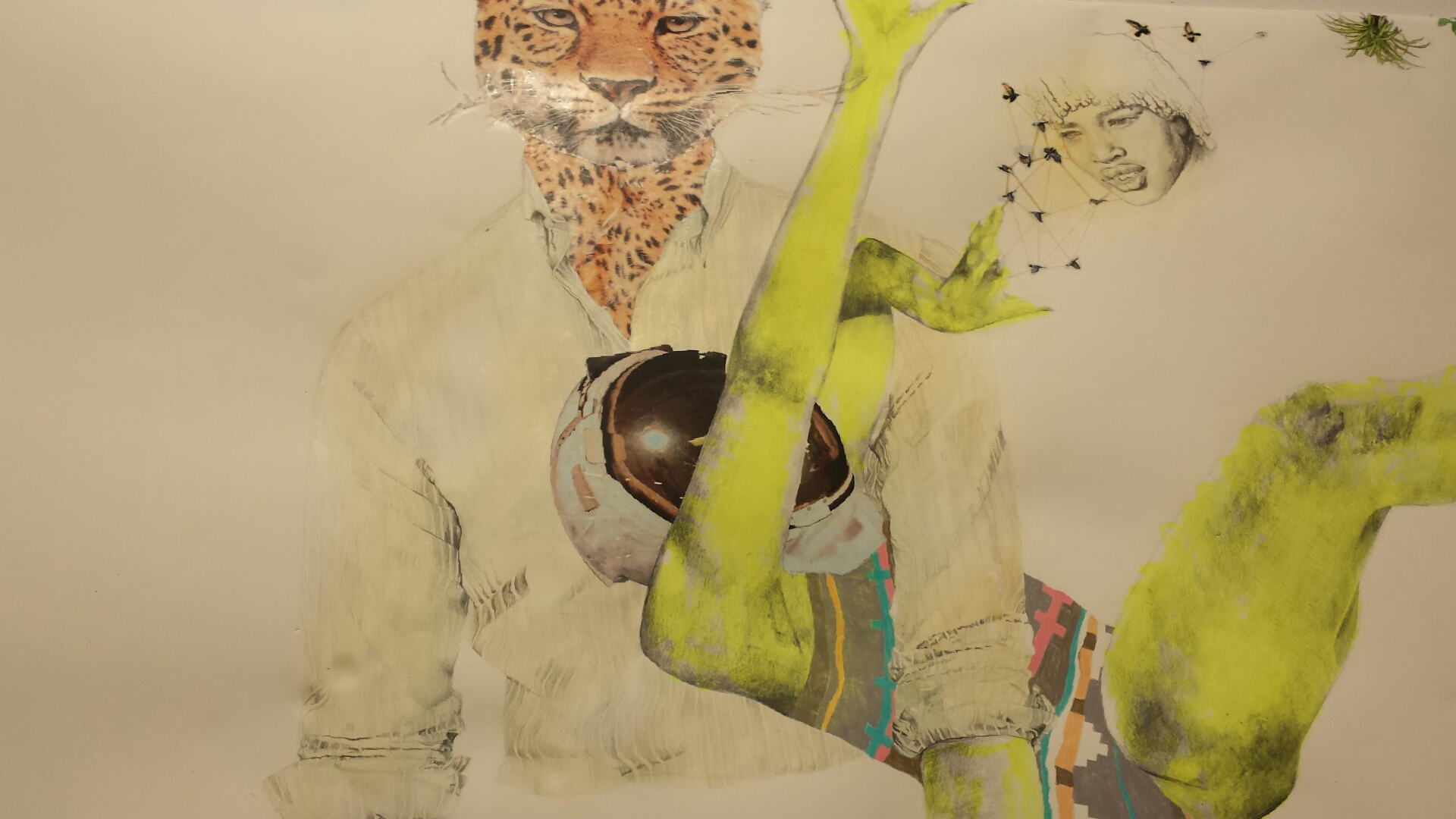
    ruby onyinyechi amanze, works on paper, detail
    ruby onyinyechi amanze, mixed media works on paper, detail. Mariane Ibrahim Gallery, The Armory Show, 2016. photos: FirstindigoandLifestyle

    Can you recall your aesthetic language? Somewhere in the drawings/paper, the characters dance, move, and seem to be very mobile?

    ruby: Funny that you say that, as I’m influenced a lot by dance, performance and movement languages such as Gaga (that I recently discovered and have since incorporated into my extended ‘studio’ practice). Also films…slow moving, non-linear, beautifully ‘choreographed’ spaces and exchanges. I go to the cinema every other week if I can, and am completely absorbed into the imagery. It’s like going to library and collecting books for research. I collect images, not knowing when or how exactly they’ll resurface. Architecture and design influence my imagery a lot.

    In hindsight, I’m aware of many instances where I aligned myself with design conversations and practices. I don’t think I had the language to make the connections before…to talk about my drawings as design. It just was a pull that I kept following. After my M.F.A, I contemplated returning to school to study architecture. I think architectural drawings are so beautiful. And the ways they think about space, as something malleable that can be shifted or constructed, is fascinating to me.

    Your drawings on paper seem to be narrating things, and yet say something very poetic in their way of leaving lots of white space around the figures and colors. How about, are any of these patterns and colors influenced by some African aesthetic traditions, and folk features?

    ruby: I think of the drawings as non-linear narratives. Story telling is a fluid art, and even when it’s ‘true’, there is always an element of fiction in it. I’m a storyteller. And I leave space for the viewers to insert themselves or participate in constructing the narrative. There are clues- some of which come from actual experiences (mine or sampled), some of which are entirely fabricated. I don’t feel any obligation to give the viewer everything. Nor do I feel that art is a platform solely for me to communicate a particular and clear ‘message’. That’s not my job as an artist.

    While spending time in Nigeria, what did you learn and study? How was the experience like; did it feel foreign at times, or was it more like returning home?

    ruby: I’m sure I learned many things…but mostly from the normal day-to-day living, as anyone would wherever they found themselves. There were no grand epiphanies. Generally speaking, there was no “adjusting”. I wasn’t there as a student, but in the position of a professor, I think there’s always a reverse learning that happens in the classroom- if nothing else, how to be a better professor. I was there and it was my home, my life- it felt familiar. Of course, there were things that were different. But the only thing that really rattled me were social attitudes that seemed antiquated when it came to gender or sexual equality. Let’s just say, I got into a few fights!

    ruby onyinyechi amanze, works on paper, detail
    ruby onyinyechi amanze, mixed media works on paper, detail. Mariane Ibrahim Gallery, The Armory Show, 2016.

    Do the paper works without borders or frames imply different moods than the ones with frames?

    ruby: No, it’s just a different presentation. I like that paper does many things.

    Could you tell a little about the experience and feedback you received at the Armory Show, you were there with Mariane Ibrahim Gallery during the first week of March? 

    ruby: I’m happy to have had the opportunity. It can be a complicated space for an artist to navigate, because it’s a market. There is little conversation about practice or curatorial interests. I had to separate it in my mind from the studio. In making the work, I was very intentional about maintaining my integrity. Time wise, the work was shown at the Armory, but in a different time, it could have been shown anywhere. In other words, showing at the Armory didn’t change anything for me in terms of what I’m interested in exploring in the studio. More than sales, what I’m most excited about is the visibility…the introduction to museums and such.

    Where are you heading next, artistic plans for the future?

    ruby: I look forward to many things in my career as an artist. But the number one joy in all of this is what happens in the studio. That’s where I’m heading next…
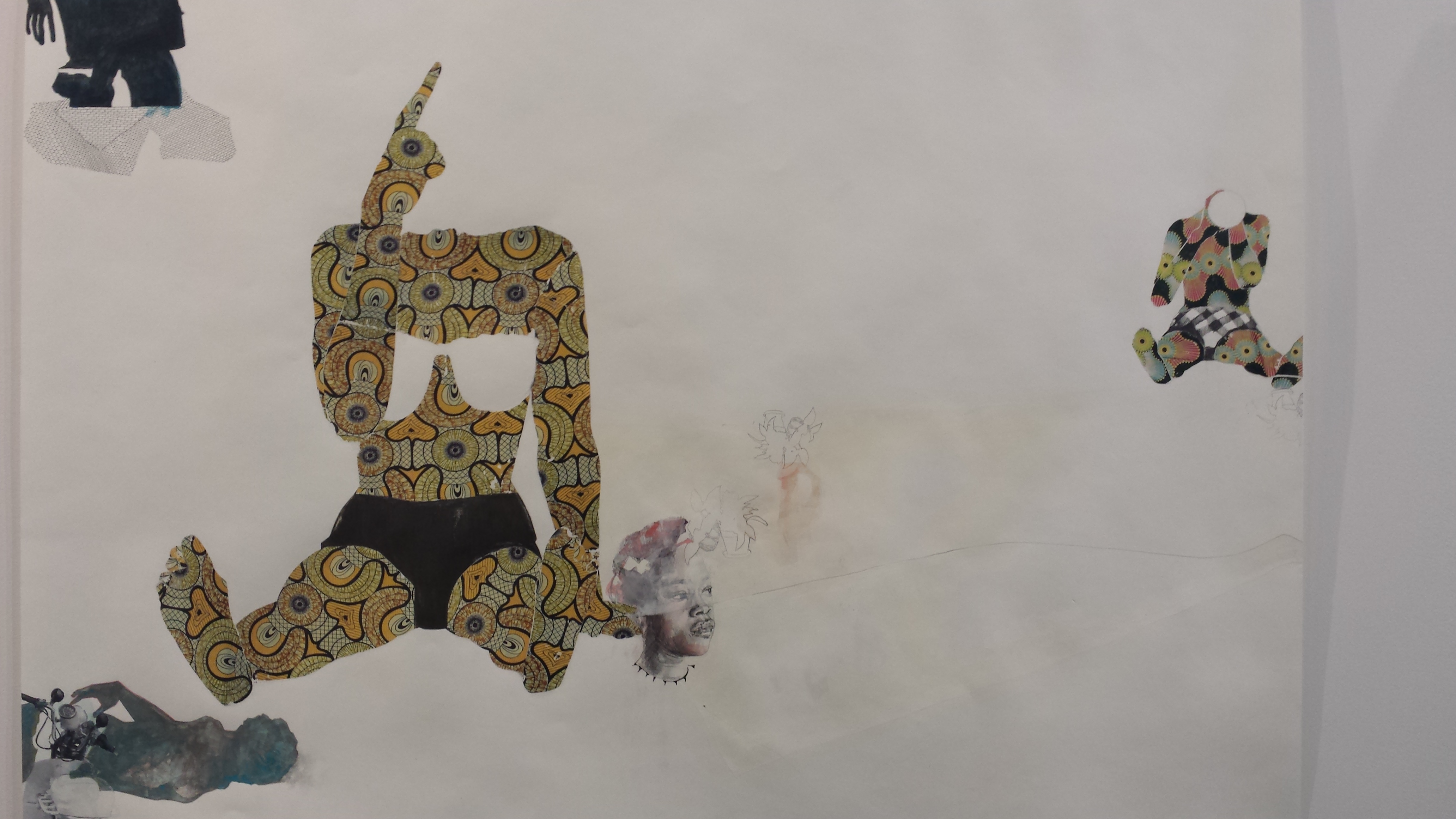
    ruby onyinyechi amanze, works on paper
    ruby onyinyechi amanze, I sent you to survey the world, and when you did not return, I came, 2016.

    Artist website: www.rubyamanze.com


  • Riitta Ikonen’s artistic day dreaming

    Riitta Ikonen’s artistic day dreaming

    Artist Riitta Ikonen traveled recently to Greenland to discover new artistic work that reflects interaction between humans and their natural environment. Her exhibition, “Glacial Reveries”, is on view at The Chimney Exhibition & Performance venue in Brooklyn until February 7th. Interestingly, the body of work touches directly a topic of glaciers and their fate in the age of the anthropocene. Reveries, then, as a form of day dreaming, means for the artist a human survival strategy during the end of the world scenario. The objects include; a wetsuit for the tip of an iceberg, a lifejacket for a brick, eroded stones tied back together with strings, a video hidden in a suit, stairs leading up to cinder block windows. Few year ago, Riitta Ikonen captivated her audiences with a collaborative photography project, Eyes as Big as Plates, which embeds something remarkable of the elderly human portraits, characterizing people among their surroundings. In this interview, the artist discusses her exhibitions, travels, artistic practice and plans.

    Firstindigo&Lifestyle: Could you tell about this ongoing project called Eyes as Big as Plates, how did it start, develop, and so on?

    Riitta Ikonen: Eyes as Big as Plates is an ongoing collaborative venture with Karoline Hjorth, a photographer with a journalism and tall-ship sailing background. We met in 2011 on an artist residency after I, in search of a collaborator, typed in: Norway+Grannies+Photographer into an Internet search engine and found Hjorth as the top search result. (She had just published a book on Norwegian grandmothers.) We met for the very first time on the doorstep of a 20 m² flat in the small town of Sandnes, southwest of Norway.

    Starting out as a play on characters from Nordic folklore and the personifications of nature in the lore, Karoline and I wanted to find out what kind of connection the Norwegians had with their rocks, fjords and hills. Those hills hadn’t changed since the tales, but the people sure had. We figured that the older the local interviewee/model, the closer we would get to the talking rocks of the tales. Folktales often made complex natural and sociological issues understandable and accessible, with phenomena taking on forms and characteristics that even a mere mortal could have a dialogue with. Perhaps our Eyes as Big as Plates images aimed to discuss the contemporary human in the nature in a similarly approachable language. After interviewing in Sandnes for two weeks, our investigation started shifting more towards imagination and Eyes as Big as Plates has evolved into a search for modern human’s belonging to nature.

    Much of the western society is unnecessarily confused when it comes to the ‘usefulness’ of older people. As the project continues to cross borders, it also aims to rediscover a demographic group too often labeled as marginalized and generate new perspectives on who we are and where we belong.

    The series is produced in collaboration with retired farmers, fishermen, zoologists, plumbers, opera singers, housewives, artists, academics and ninety year old parachutists. These are people we meet through friends, relatives and newspaper ads, in hardware stores, noodle shops, indoor gardening society meetings, swimming pools, on the city streets etc.

    The title Eyes as big as Plates refers to two Scandinavian folktales featuring respectively a goat and a dog with eyes the size of plates.


    Firstindigo&Lifestyle: It seems that the work was presented in multiple international places. Do you think that there were different receptions of your work that you find as constructive?

    RI: I traveled to the Upper Peninsula of Michigan in the US last fall with Eyes as Big as Plates exhibition and was honored to witness the reactions to the photographs from of the large Finnish community. More people of Finnish descent live in the northwest part of the Upper Peninsula than anywhere else in the world outside of Finland. The images resonated with the crowd in a way that transcended borders, time and language. The Nordic spirit was redolent in the minds of the third generation Finns yearning to keep the connection to their heritage alive. Though the exhibition was small, it was one of the most moving and personal of the dozens of lectures and openings I attended last year.

    After the opening of the Eyes as Big as Plates exhibition at the National Museum of Greenland, Karoline and I got to listen to Teitur from the Faroe Islands perform live at the Katuaq Center. His song ‘Home’ struck a cord in that moment and I realized there is a ‘home’ in each image for me, perhaps for others too, a universal anchoring point. Greenland was exceptional in many ways and I know that this was the first trip of many more to come.

    I wish I could have attended the shows in Korea and Bogota too, but that would have required a body double. I have worked quite a bit with the Norwegians since 2011 and the Norwegian National Museum has been touring an Eyes as Big as Plates exhibition with a workshop for a couple of years now. At the opening of Fotogalleriet in Oslo, Karoline and I also got offered a chance to work on a public art commission by the Arctic Sea at Kirkkoniemi-Kirkenes, where we work on documentary portraits for a brand new hospital until 2017.

    Firstindigo&Lifestyle: Readers of this blog are interested in the artistic language and process, are there any compelling features that make yours?

    RI: The process is most often rooted in collaboration, with the current show in New York at The Chimney being a cheerful exception. The latest works consist mainly of interactive sculptures and video all of which bubbled from last October’s trip to Greenland. The pieces were produced after digesting the experiences of the spectacular land- and seascape near Nuuk, and filmed over the next three months in Finland, the Pacific Northwest and New York. The below piece of writing by Robert Smithson also accompanied me through the making process as a kind of fluid spine.

    ‘One’s mind and the earth are in a constant state of erosion, mental rivers wear away abstract banks, brain waves undermine cliffs of thought, ideas decompose into stones of unknowing, and conceptual crystallizations break apart into deposits of gritty reason. Vast moving faculties occur in this geological miasma, and they move in the most physical way. This movement seems motionless, yet it crushes the landscape of logic under glacial reveries.’
    Robert Smithson, “A Sedimentation of the Mind: Earth Projects”, 1968

    Firstindigo&Lifestyle: How do you see that artistic collaborations and working with curators have formed your artistic language? Are you able to pin down, or do you have a story about how a dialogue with the art field has forwarded your career?

    RI: I collaborate with people (architects, artists, photographers, sculptors, writers, postal workers etc.) to catalyze the interaction that determines the direction and the work. Unpredictability feeds my practice and keeps the process interesting.

    Working with courageous people is necessary for progress.  My solo show ‘Glacial Reveries’ in NY is far wilder than I could have imagined with the fearless support and insight from the curator, Clara Darrason. She encouraged me to follow my initial plan of making the gallery goers walk under water, on the bottom of the ocean with the water level up in the ceiling. We also ended up installing a 25-foot tall iceberg in the show.

    Firstindigo&Lifestyle: Are you currently based in New York City, and do you have specific plans for staying and working here?

    RI: I am currently on an airplane, and spend a great deal of time in transit. I am based in Kouvola with restless feet. I just met up with Tiina Itkonen in Helsinki who has done a life’s work in Greenland and it is only a matter of time that I will return there! I was hoping to go to Mexico City, where I have works at the Material Art Fair, in March, there are also the RCA Secret exhibitions and sales in London and Dubai, but again- I am restrained by this one body only.

    Firstindigo&Lifestyle: Do you consider yourself a Finnish artist, are there any particular ways to designate and identify with your country of origin?

    RI: I am a Finnish artist and I feel it pulsates strongly in my work and me. I receive a tremendous amount of support from Finland, whether it is from the brilliant network of Finnish Cultural Institutes around the world, Consulate staff, Cultural foundations, or curators. Most often as a Finn, you are only two steps (at most) away from a fellow creative countryman. This network is incredibly loyal and operates on a penetrable scale- a truly privileged situation however you look at it.

    Firstindigo&Lifestyle: As mentioned, your current project and exhibition, Glacial Reveries is on display at The Chimney in Brooklyn. How did you find yourself going to Greenland to do a project there?

    RI: It was a lifelong dream to go to Greenland; it was also the last Nordic country I hadn’t worked in. My collaborator Karoline Hjorth and I decided ‘it shall be done’, and we compiled a list of various Greenlandic institutions to reach out to. I called a few numbers and sent some emails. I received no reply. Eventually I got used to the ‘radio silence’, but made a habit of ringing one number or another every week. Most often no one replied, sometimes a receptionist or an answering machine picked up. A year went by stubbornly. We finally made the contact when Åsa Juslin from the Finnish-Norwegian Cultural Institute in Oslo, introduced us to Mats Bjerde and Mette Hein from NAPA (The Nordic Institute in Greenland), who were organizing Nuuk Nordisk Festival in the capital. After Åsa’s email, the ball started rolling.

    Firstindigo&Lifestyle: Is a topic of climate change important to your work, and how about the nature as such?

    RI: Climate change discussion and open dialogue is vital and art is a good communication tool. I am a bit hesitant to talk about nature as I am coming to think that there is no such thing. There are just us in our surroundings, whatever those may be. The idea of nature might be just as manmade as Shopkins. Either way, to acknowledge that you are not separated from your surroundings can be a way to get the most real picture of the world available to us. (Timothy Morton has written interestingly on that)

    Firstindigo&Lifestyle: Is art political to you and if so, how?

    RI: ‘The personal is political’ as it was once aptly put.

    Firstindigo&Lifestyle: Did you find your artistic medium early on, or did you master and explore various techniques?

    RI: After the wish of becoming a conveyor belt worker in a confection factory faded a little, a career as an artist was an obvious second choice. I am still exploring various techniques, and am a happy amateur. As a fish farmer living by the Arctic Sea said it very nicely last year: ‘I am a charlatan and an amateur, a typical Finnmarking who has adapted to this county of contrasts. I love what I do (Latin Amator = lover, amare = to love), unlike a professional who does something not because he loves it but to earn money. There’s a big difference. (Oddbjørn Jerijærvi)

    Firstindigo&Lifestyle: Do you have specific plans for the future?

    RI: Go work in the desert in the spring, complete a National Park Residency, exhibition at Pielisen Museo in Northern Karelia, continue the Time is a ship that never casts anchor project in Kirkenes, Exhibitions in Germany and the Douro Valley in Portugal, Mail Art- Art Mail Show at the Finnish Postal Museum until the end of February 2016, RCA Secret in London and Dubai, Material Art Fair in Mexico City this month, More Greenland, etc.

     Artist website: http://www.riittaikonen.com/

     The Chimney, New York: http://www.thechimneynyc.com/

  • Ofri Cnaani’s ‘Wrong Tools’

    Ofri Cnaani’s ‘Wrong Tools’

    Artist Ofri Cnaani has created a new photography exhibition consisting of prints and a performance piece at Andrea Meislin Gallery. Photographies on display echo ideas deriving from Xerox art of the 1960s simultaneously connecting with the visual world of the mesmerizing early photography of the 20th century. The exhibition ‘Wrong Tools’ will be on display until October 24, performances taking place on Wednesdays, Fridays and Saturdays. Cnaani’s Blue Print photographs are like intuitive maps constructed of performative ideas that associate with artist’s own body. With both of her performance and photographs, she creates a presence. The works are building up from fragments, and the pieces are put together in a compelling logic. These could be like ruptures built on the Internet surface, where constant image flows create new associations. Here is Ofri’s interview.

    Firstindigo&Lifestyle: Your ongoing solo exhibition ‘Wrong Tools’, at the Andrea Meislin gallery speaks a strong esthetic and spatial approach with performance element added to the photography gallery. The performative element also looks back from the blueprints, which display hands in various positions doing tasks, perhaps. Are these prints your hands making the past performances, or projects?

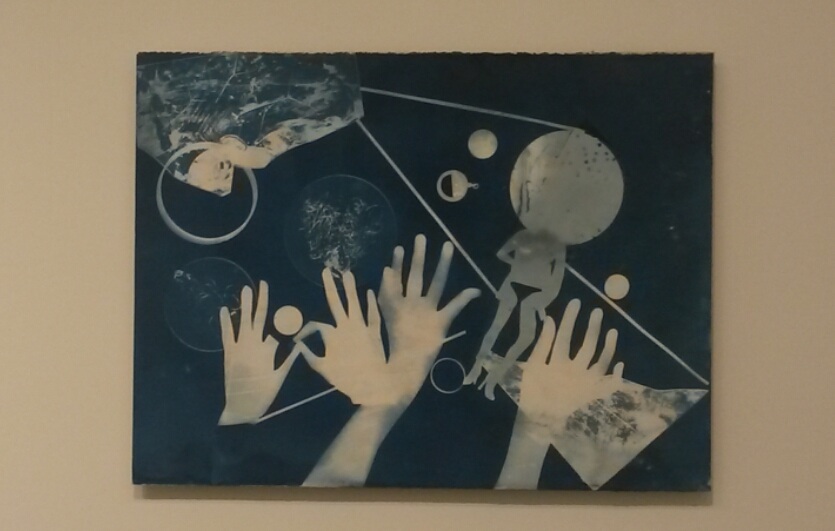
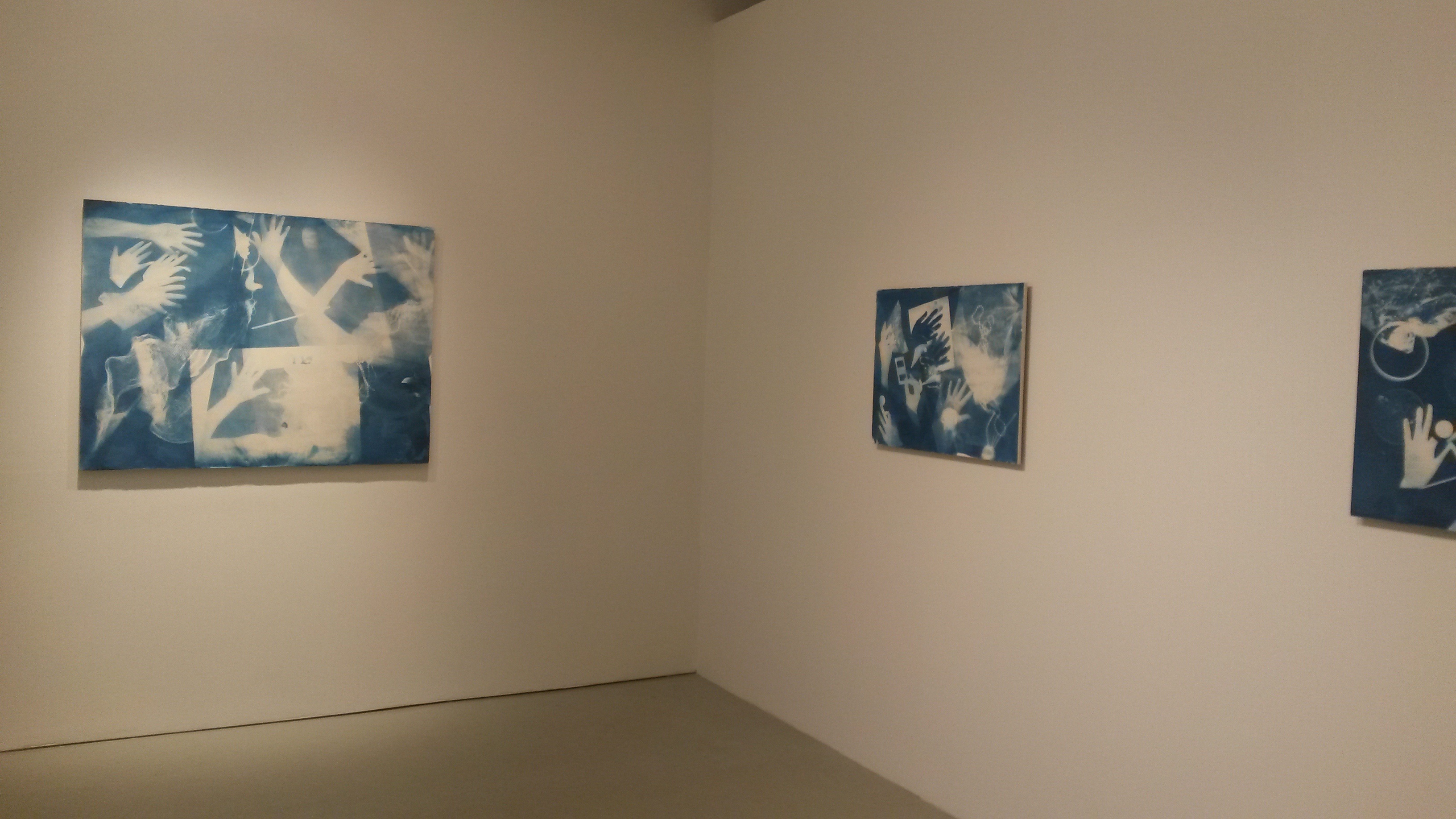
    Ofri Cnaani: In the cyanotypes I’m using my own body. I’m using the special qualities of one of the earliest photo techniques to promote some sort of performative photography. In a way, it is very similar to what I do in the performance: I’m creating an image in a limited amount of time that is constructed from found objects, made objects and my own body. Like in the personalized ‘image maps’ I’m creating in the performance, here too, I have a limited control of the final result. The process is always between failure and magic.

    In your actual performance that I observed taking place during the opening night at the gallery’s foyer with windows, you encounter audience member on a participatory table setting, where each unique guest sits opposites of you. The scene comes out as very intimate and poetic; we are simultaneously looking at the wall where the reflection of the table surface is displayed with your real-time construction of objects and images on it. And, we are grasping the exchange between you and the other person embodying the performance. Quite interesting, a guest was taking pictures with her phone of the very situation as well. What is taking place in these moments? How do the photographs and the recording of the event resonate in the doing of the performance physically?  

    OC: When someone sits with me, I first offer him or her a ‘reading’ of his or her visible future. I used a tarot-like deck that I designed titled ‘future business’. I also ask them to give me one personal item and to choose two items from my collection of small objects. I’m using the message on card they chose and the three objects they selected and gave me as a starting point, to create a live collage-like image. I called it ‘image map’. This image is captured and printed using a special apparatus I build for the show. Lastly I stamped it with a ‘Copy’ stamp and signed it with red ink, handing the Original Copy to my visitor.

    As the title ‘Wrong Tools’ already implies so many interesting visual connotations, could you tell more what is the idea or meaning behind it, is it metaphoric with a larger idea and also coming to the performance? Does it resonate solely with ideas, which derive from computing?

    OC: My husband, who is great in building things, always says everything is very easy if only one is using the right tools. I realized I’m always using the wrong tools.  My studio is a mess and I’m always using the tools that are wrong for the job. I like to think about my method, using the collections of two and three-dimensional objects in my performance, as ‘endless metabolism’. I’m using the same little objects for different performances, as well as for the cyanotypes and other photos. The same objects travel between many of my projects, always been used in different ways, but never used as they were originally meant to be used.

    Ofri Cnaani_OC real and fake-series_Cyanotypes
    Ofri Cnaani, OC real and fake-series, Cyanotypes, at Andrea Meislin Gallery

    Then, your exhibition at the gallery has these colorful images called ‘future business’, that have a short message embedded in them. It seems that they relate to the performance, do they have an element of time in them as well?

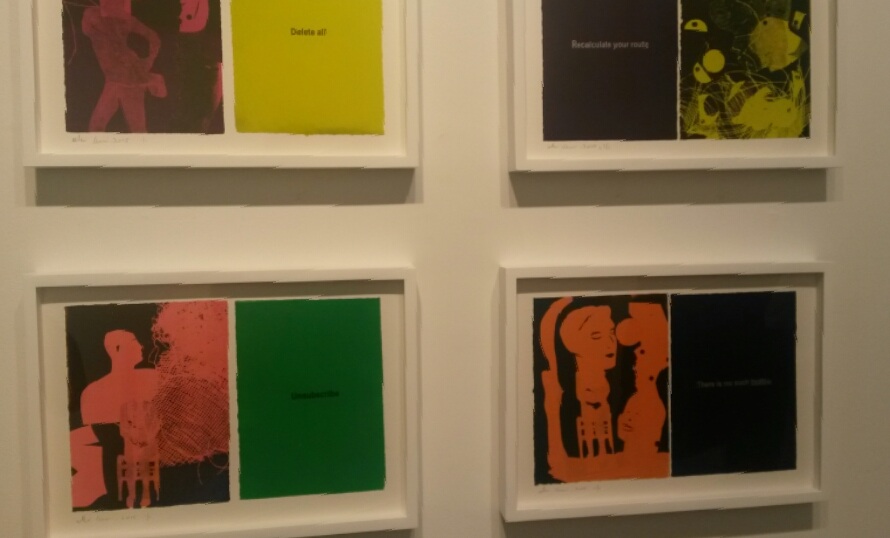
    OC: The monoprints are also ‘one of a kind’ and were made in a similar way. I’ve been using cut-outs and flat objects, placed them on paper and rolled them under the press, so each one is a different arrangement, although some of the cut-outs appear more than once. The texts are the same texts on the special edition tarot deck I produced and then use in my performance.

    On each card there is a message we get regularly as an online user like ‘Delete All’ ‘Unsubscribe’ or ‘Change Your Profile’. These lines are charged with a very different meaning when we receive them as messages in a one-on-one ‘reading’ session where we all are so vulnerable.

    Ofri Cnaani_future business-series_monotype prints
    Ofri Cnaani, Future Business-series, Monotype Prints, 2015

    Adi Puterman curated your exhibition for Andrea Meislin Gallery, what do you wish to tell about the curating exchange and process, do you know each others tactics well?

    OC: Adi and I worked on the show for over a year and she was very involved with each step: from the concept of having an on-going 6 weeks performance in the gallery, to the selection of the pieces, and communicating my ideas in a written text.

    I have noticed that your artist career includes plenty of performance works, such as the ‘Seven Words’ at the Metropolitan Museum. This past work is also very interdisciplinary. Is a question of the different art forms relevant to you in your own art making, or are all forms closely related?

    OC: I’m driven by concepts and often by time constraints (like a different space I’m working in or a different collection or archive I’m using). I’m less driven by a specific medium or style.

    As an educator of the arts, how do you teach time-based process to your students, do you have guidelines for that?

    OC: We see many projects and discuss them, we read texts and using mind-mapping method in order to understand them and connect them to other ideas, texts and art works.

    I often think that New York city is such a creative hub with so much international potential gathered in one place. Do you consider that as an international artist based in the city you have a specific role or identity, which is perhaps one here, and another that goes back home in Israel communicating and identifying with the contemporary art scene there?

    OC: I’m not sure what do you mean by that but once you leave the place you were born and raised, your identity is always ‘more than one’ and in a constant negotiation.

    You have created public artwork, do these works imply a different kind of activism or sensibility that comes with the public space, or are all ideas you are doing basically interrelated? 

    OC: My work is context specific. When I work in the public realm I work not only with a specific building and its specific history. The process always involves a community or a group of individuals. The process in those projects is part of the final piece. The final images are never known when I start working on a public piece.

    Can you tell a little what are your next steps going to be like?

    OC: Next week I’ll be doing a performance that is similar to the one in the gallery at Dallas Aurora. My project is part of ‘Altered States’ exhibition, curated by Julia Kaganskiy. Next month I’m going to Inhotim in Brazil to work with the park employees to create a participatory performance titled ‘Frequently Asked’ that will be then presented in Inhotim on early December.

    Ofri Cnaani, Blue Print, 38.5x49.5, on display at Andrea Meislin Gallery
    Ofri Cnaani, Blue Print, 38.5×49.5, on display at Andrea Meislin Gallery. Images by Firstindigo&Lifestyle