Tag: artistic practice

  • Visiting Linda Cunningham’s studio

    Visiting Linda Cunningham’s studio

    Last month, New York based artist Linda Cunningham showed me her art studio in the Bronx, where she lives and works.  It is located next to the Bronx Art Space that is fostering arts education and collaborative artistic projects. She told me stories behind the art works, both the sculptural works and the collages that combine drawing and photography.  The studio is in a newly renovated building nestling at the heart of the historic urban Bronx.

    Firstindigo&Lifestyle: Linda, you were one of the first artists to come to this location, how was the neighborhood back then, it’s been now a good fifteen years? You did a series of artwork digging into the Bronx history, in which immigration was a theme or a subject. There seem to be real person’s story involved, including documents, such as passports with photos. Could you tell about the project that was exhibited at the Andrew Freedman house in 2012?

    LC: When I first moved to this historic landmarked area of the South Bronx, I began photographing the now renovated 19th Century row houses with brownstone trim, the contrasting graffiti walls with the shopping carts of the homeless. The barbed wire and I merged those images with a young Jamaican’s poetry and rubbings from the historic signage telling about Jordan’ Mott’s iron foundry. Later I was invited to create a large installation in No Longer Empty’s exhibition at the Andrew Freedman House, an amazing building designed like a Renaissance Palace, left from the early 20s when the Bronx was blossoming. My installation was constructed like an open book from broken drywall panels and broken old wood frame windows with each panel referring to an era of Bronx history. I along with other artists scavenged in the water soaked ruins, excavating the papers representing early 20th Century history of the Bronx. Including among them was the unusual passport of a resident of the house with two different last names, both apparently Jewish heritage, along with her photos. She had traveled all over Europe 1936, and through the Third Reich and into Switzerland several times, so her story suggests that she might have functioned as part of an underground.

    Linda Cunningham_bronzesculpture
    Bronze at Linda Cunningham’s Bronx studio

    Firstindigo&Lifestyle: You recently attended an Art Fair in Harlem, titled FLUX art fair in May 2015; do you have any specific notes in regards to engaging with the community during this festival?    

    LC: This was such a lively engaging event during which I enjoyed most interesting conversations about my work. The artwork displayed in this art fair was tough and engaging and in general more accessible than in most other art fairs

    Firstindigo&Lifestyle: What captured my attention was your rich methodology of juxtaposing various elements. Your artwork depicted ancient olive trees in Italy that are approximately 800 years old by now. These trees got bacteria from Costa Rica somehow. Did the local community got involved in saving them? 

    LC: I don’t know anything about the local community. I just read about it in the Times saying that “they” are trying to contain the epidemic.

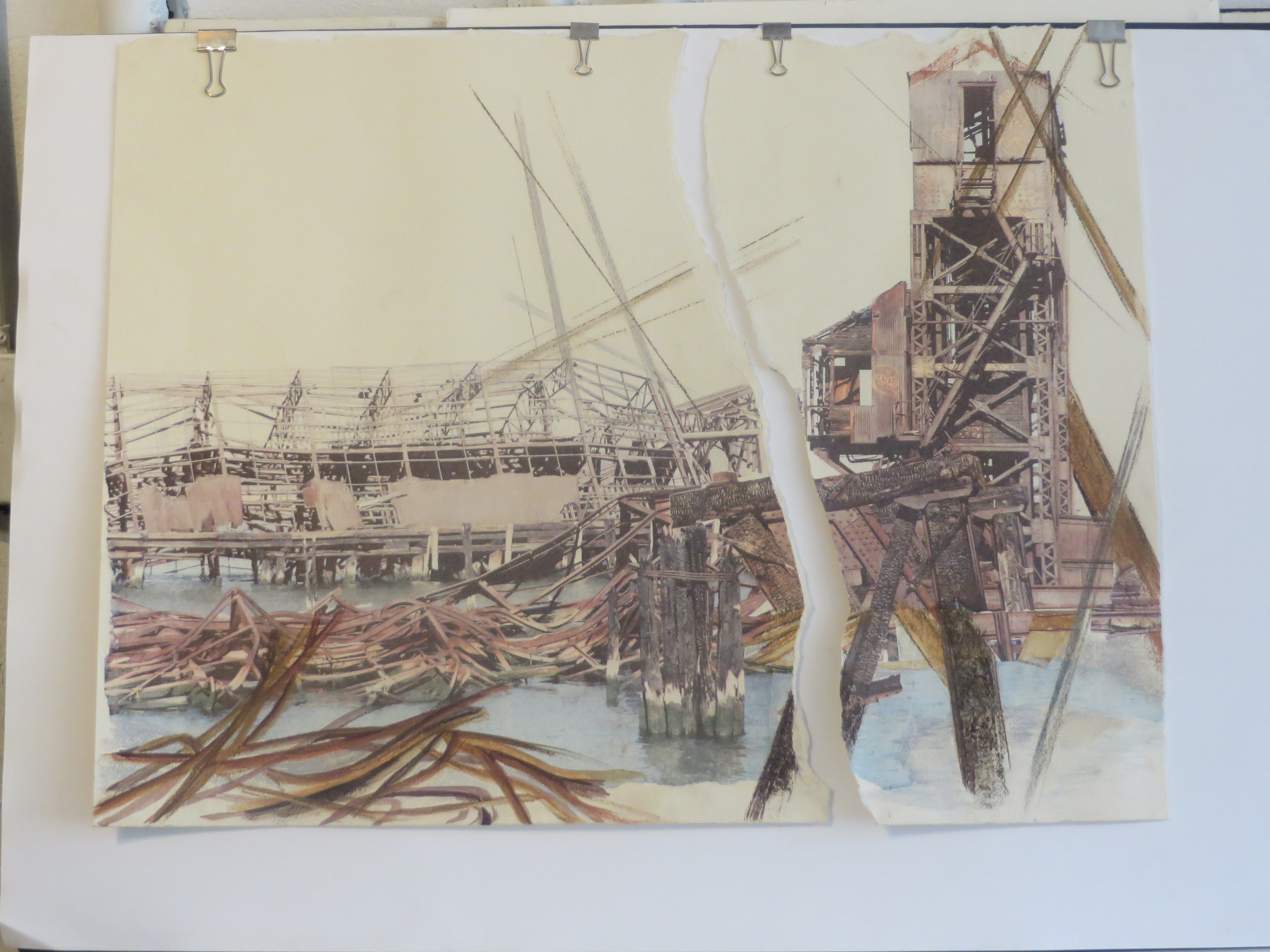
    Firstindigo&Lifestyle: What you did in your collage was that you implemented the trees together with post-industrial photographic scene of Ruhr in Germany. This area used to be a center for coal, and now it’s gone. Tell, what is the particular message behind this juxtaposition?

    LC: Both of these astonishing entities are vulnerable, but these amazing ancient trees will continue being productive and useful for centuries, whereas, the astonishing human designed technology is obsolete in 75 years or less and falls into ruin.
    Linda Cunningham_Collage

    Firstindigo&Lifestyle: You have worked with sculpture. The bronze in them comes from ’recycled’ old weaponry from the Pennsylvania army base. The story behind the material is so intriguing, and the fact that you wished to turn the weapons into ’vegetal’, so the forms are like plants.  The texture of your sculptures remind of natural formations appearing rough, in some parts they are smooth, as if ironed.  Could you tell a little bit about the process, how did you find them, and how was it to work with the material?

    LC: The bronze came from military scrap, which I obtained with some difficulty through a not-for-profit institution where I was teaching for a number of years, Franklin and Marshall College. The scrap bronze, which mostly came from ships, military ships, which are not really weapons. The bronze was smelted and poured into a defined shape in flat, oil-bonded sand molds.  The cooling of the hot bronze creates the rough surfaces as the bronze is poured. I am doing some casting currently.

    Firstindigo&Lifestyle: Another element in your sculptures comes from nature. It’s fascinating how some of the rocks you have in the studio are from the ocean. The nature has worked in them so that the huge pressure in the floor has pressed the shells to attach into the stones. One of the rocks is also volcanic, and comes from the Californian coast. Do you have a specific relation to ocean and water in your artistic thinking, as I see the ocean appear in many of your collages?

    LC: I have always been drawn to the eternal rhythm and power of the waves, but in my youth I had read Rachel Carson’s “The Sea around Us”, a beautiful factual narrative about the origins of life and the vulnerability of the life giving sea so essential to our survival.  Then super storm Sandy gave my early interest a new focus.

    Linda Cunningham_Collage2

    Firstindigo&Lifestyle: Also the technique in your collages is interesting, you are drawing and then adding laser photo transfers to paper. Even the surface has layers, cement or metal appears on the surface of the paper adding three-dimensionality. Could you tell more about this appeal? 

    LC: I have worked as a sculptor, and even when I am engaged with these large drawings I am drawn to include appropriate resonant texture and sensibility.  Even though photography can be manipulated it is essentially documentation and convincing as reality. The veracity of photography seems essential. My exhibition will be at Odetta Gallery in Bushwick in November 2015, and I will include especially drawings fused with sculptural elements. I was working on creating some new spectacular bronze forms that will be included in the show. I work on torn irregular shapes because reality doesn’t fit neatly inside a rectangle shape, rather it’s discontinuous, fractured etc. I work from places I have been, responding to particular environmental and historical issues raised e.g. from flooding of Venice, and a jungle growth strangling Ancient Cambodian temples. I built the installation with the Hebrew text some years ago after I spent a year in Berlin on a Fulbright scholarship. I did an installation In Kassel for an alternative documentary, and obtained many of the elements from the former East/West border known as the Berlin Wall.

    Linda Cunningham_Collage3
    Linda Cunningham’s collage depicting trees and Ancient Cambodian temples

    I have always been drawn to the eternal rhythm and power of the waves, but in my youth I had read Rachel Carson’s “The Sea around Us”, a beautiful factual narrative about the origins of life and the vulnerability of the life giving sea so essential to our survival. Then super storm Sandy gave my early interest a new focus. -Linda Cunningham


    Linda Cunningham_Berlin Wall
    Elements from the Berlin Wall at Linda Cunningham’s studio


    ***

    Artist website: http://www.lindalcunningham.com/

    Check also Bronx Art Space

    All images: Firstindigo&Lifestyle

  • Training artists for innovation: Competencies for New Contexts

    Training artists for innovation: Competencies for New Contexts

    photo: Wilma Hurskainen: “He Doesn’t Like Water”, 2012

    The book Training artist for innovation: Competencies for new Contexts was published in 2013, (the Theatre Academy of the University of the Arts in Helsinki in Finland). It discusses the topic of artists who are trained for creating innovation in various contexts outside their own artistic practice. The book is  based on a  project, which  gathers together different agents in European countries, who are leading artistic innovation. Kai Lehikoinen and Joost Heinsius are the editors of the book.

    The book-project brought together artists, companies, organizations, universities and cities, which have experienced artists working with them.  The idea for the publication came from the challenge that both society and businesses need new solutions and interventions, as they face changes.  Professional artists with artistic interventions can respond to challenges of today, bringing in new questions and ways of thinking. Artists “offer contradiction, as well as confrontation and friction, and they provoke new ideas.”  

    Training Artists for Innovation: Competencies for New Contexts argues that artists who take the challenge for artistic interventions need specific training to establish their artistic know-how for new contexts. Artistic competencies can be trained, so to speak. Innovation can occur where artists, with their own practice and methods, contribute to the arts sectors and organizations, to the business world and sectors, where societal policies are made. The book responses to a framework of European context, but the idea can be shifted to other parts of the world.

    A very basic question; are artists not innovative by nature, opens up a dialogue between artists and new contexts.  According to editors Heinsius and Lehikoinen, “A gap has risen between the arts and society that needs to be bridged and closed” .

    Art can intervene not only on the walls of office spaces, but it can come to peoples’ working life as well.  This statement is inspired by models learned from community art, and by the experience coming from social and health sectors, where art has always been respected as part of human life.  The new innovation comes in the intersection, where businesses and organizations want to raise their creativity,  and understand their creator capacity in conjunction to human-based factors. As the book shows, the arts can add value, for example, by  bringing in emotional and aesthetic dimensions. Artistic interventions can boost creativity and raise energy, bring in new ways of listening, managing, and interacting with others. The book emphasizes that the term artistic intervention is understood as “interdisciplinary professional practice that takes places in business settings and involve professional art-making and creative arts practices”.

    What are, then, the issues that interventions can tackle? Topics and issues of course vary, and depend on each context. Artistic interventions can be connected to strategy and concept development, to work processes, to team-building and social interactions, and to public relations, for instance. In the level of cultural policy, the arts have a key role, together with other creative sectors, to add into the diversity of society. In a larger societal (European) policy level, the following seems very relevant and welcomed, when thinking of the creative economy:

    “At the national level, the starting points differ from country to country.  In some countries, it is the perceived gap between the arts sector and the rest of society that needs to be acknowledged – that is, the need for the arts to appear as relevant to other sectors in society. In other countries, innovation development welcomes the arts as the perception of shifting from technological innovations to social innovations and creativity.”

    Training Artists for Innovation: Competencies for New Contexts  is a book that asks a relevant question of,  how to do it with the arts. It gives several examples of the relevant competencies that artists can embody for their interventions. Gerda Hempel and Lisbeth Rysgaard,  from Danish Artlab, write in their chapter Competencies – in real life, about their own model of working with artists and businesses.  What they suggest is that artists need to manage a variety of specific tasks that relate to understanding the culture of the organization: such as developing and describing the concept, knowing how to sell and negotiate, and,“how to engage and conduct the process, how to extract learning and evaluate, and how to support the implementation within the organization.”

    Their chapter reveals that when artists share a common denominator, the artistic base, methods and tools vary in different art forms. For example, a violinist in the opera house has a different approach than an avant-garde performer who works in an experimental performance space.

    Artlab founders and consultants Gerda Hempel and Lisbeth Rysgaard bring in the artist perspective of working with businesses. They open their Artlab Entrepreneurial Model (that is based on their 12-year experience in the field) and reflect this in relation to real artists, who they interviewed. This shows how artistic interventions function from the artists point of view. The model itself is like a metaphoric artistic house, which includes 4 interactive work spaces and a storage. Its aim has been to help professional artist who want to go entrepreneurial and find new job opportunities, or look for new management skills for their career. The house allegory with 4 spaces  includes: The Shop/Back office, The Workshop/Development, The Scene/Artistic intervention, The Shop/Front office, and Storage/place for new ideas. Artlab’s  model functions as a visual guideline to see  parallel tracks. It offers artists a tool to plan and prioritize their work.

    Training Artists for Innovation: Competencies for New Contexts has a message for everybody working in creative industries. It offers chapters with real examples, and discusses  how real artists have solved their tasks, approached different organizations and worked with businesses. The book is a guideline to discussing competencies that artists need in order to work with various sectors.  It clearly opens a discussion, which goes to two directions. 1. Artists need more than ‘just’ their own artistic skills and competencies to go outside their craft. 2. Yet, artist have special skills and innovative qualities that (only) come from their artistic work and expertise.  To bring these two to meet; some common ways can be created.

    In summary, artists need special qualities to work with organizations and companies; this includes knowledge of those cultures. They should have pedagogic competencies to set up methods and approaches for intervention. Artists also benefit from research competencies to find information, and to critically view the information and other collected material. What artists also should learn about, are skills in project management and marketing. 

    (The book Training Artists for Innovation: Competencies for New Contexts is licensed under Creative Commons as BY/NC/ND, and it can be downloaded from the page/click the book’s link)

  • VOLTA edition #2 Derrick Velasquez

    VOLTA edition #2 Derrick Velasquez

    Artist Derrick Velasquez was presented at VOLTA by Philadelphia-based pentimenti Gallery. His marine vinyl and plywood wall pieces are sculptures, if you like, and at the same time they possess some qualities that are decorative, or design. Yet, this is not entirely summing up what he is doing with the ingredients. The art made by Derrick Velasquez is very physical. The layers of meaning, which come to your mind begins with words, like arts and crafts, ancient, poetics, mechanics, physics, installation, historical play with objects, and the body-art. He says in VOLTA NY 2013 introduction to his work, that his attempt is to ‘construct a language of structure that questions our physical and psychological interactions with industrially manufactured materials that exits in the spaces we inhabit’. Velasquez works with plywood to investigate the gravity or tension on the wood together with the materials of marine vinyl, acrylic and hardwoods. He adds into these the human body dimension. When the body is part of the picture; questions, how the wood can be stretched to measure our physicality, and what is a relationship between the space, the materials used and the body, are relevant. All these questions are also important in design. While his art looks very organic and natural, it also comprises qualities of forced, structured and compressed; so the tension is created.

    The Untitled (draped body) wall pieces series has come out from a meditation process, in which Velasquez discovered  his direct connection and interaction with the large sheets of vinyl. In order to cut the sheets of material, he carried the textile material over his own body that became a table and cutting surface for the work. He tried to think and imagine the visuality of the vinyl draping over his body, when he could not see what it would actually look like from the outside. Overall, his intention has been to take away the ‘consumer use’  of the materials, and let his body create the form for the objects. So this way, the image and spatialization of the form is a continuation of his body, it is an embodiment of the craft, and the weight of his own body, which has shaped and layered the form.

    For his series Untitled, which was on display at VOLTA, Delasquez did meticulous hand cutting of individual strips of marine vinyl placing and accumulating them onto precut wooden forms.

    Derrick Velasquez, Untitled 63, 36 x 24 x 1.5 inches, Marine vinyl, oak, 2013. Courtesy of Pentimenti Gallery, Philadelphia, PA.

    As a bookbinder the vinyl is a material I used as covers for hand bound soft cover journals. The form and process of the formalized wall pieces came from an every day practice of precutting enclosure straps for the journals and placing them on a screw on the wall. As these began to accumulate, I realized I was denying the intended surface of the vinyl and exposing the innards of the synthetic fabric. This creates a new flat surface that lacks the continuity of a sheet of fabric and becomes a construction of sophisticated and subtle color harmonies by way of hundreds of hand cut and layered strips.  As number of the vinyl strips grows, the relationship of the visual structure slowly shifts – the vinyl no longer conforms to the shape of the wood form, but instead rounds out to a gentle curve.


    Untitled (draped structure 2) is a piece inspired by images I’ve taken while driving over bridges. By taking the language of structure that exists within a bridge, I’m referencing the mechanical aspects engineering and physics of a form that has a different set of parameters than the human body.  By draping the vinyl over this invented structure, I aim for an indirect narrative and association between edifice and drapery.  Ideas of gravity, force, tension and repose come to mind as one might observe and think about the relationship between buildings or bridges and the colors placed on them. (Derrick Velasquez, 2013)


    (See also his installation art (Knitting movie) on his website here. Derrick Velasquez was born in Lodi, California, He currently lives in Denver, Colorado. He received his MA of Fine Arts  from The Ohio State University in 2008, and his BA of Studio Arts and Art History degrees from University of California, Santa Barbara in 2004.)