Tag: curator

  • Fashion Curating: Unsustainability, gender and class readdressed

    Fashion Curating: Unsustainability, gender and class readdressed

    Fashion Interactions is a multidisciplinary exhibition that explores fashion culture by means of contemporary art, design and media. The exhibited works comment, on the unsustainability of the fashion industry, analyze the relationship of fashion and corporeality, and investigate how people use clothing as a tool for building identities. The exhibition is Curated by Annamari Vänskä & Hazel Clark and it presents works from: Federico Cabrera, Heidi Lunabba, Jasmin Mishima, Anna Mustonen, Nutty Tarts, Timo Rissanen, Salla Salin, Heidi Soidinsalo, Saara Töyrylä and Timo Wright. This exhibition opens on Friday November 15, 2013 in New York City. It is a collaboration with Parsons The New School for Design and the SheilaC. Johnson Design Center, Finnish Cultural Institute in New York, and the Centre for Fashion Studies (Stockholm University).

    Image 

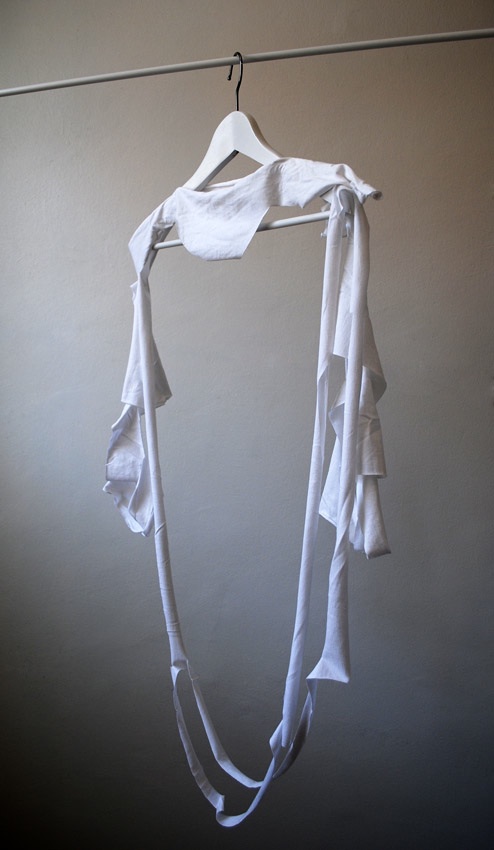
    (Fashion Interactions-exhibition, Timo Wright-‘un fit’ video still)

    FASHION CURATING NOW is a daylong symposium at Parsons The New School for Design on Saturday November 16 9:30 am-5 pm. The symposium reflects the subjects around the Fashion Interactions exhibition focusing on the possibilities and challenges of contemporary fashion curating on a global scale. Critical points of view are stressed, as is contemplation of fashion’s kinship with art, design, industry, performance, and self-presentation. I asked a few questions from Leena-Maija Rossi, who is the Executive Director of Finnish Cultural Institute in New York, about the seminar and other related topics. 

    Firstindigo&Lifestyle: Can you explain the background of the seminar?

    L-M Rossi: The background of the Fashion Curating Now is in the exhibition project Fashion Interactions. It has its origins in the show Boutique, curated by Annamari Vänskä, which was part of Helsinki’s World Design Capital year in 2012. Finnish Cultural Institute wanted to bring a new edition of the show to New York and partnered with Parsons New School for Design in order to do that. The process of “re-curating” an already existing exhibition made us think of curating fashion at large: how to present fashion in an interesting way “outside the  market”? How to make engaging exhibitions on fashion, how to show its entwinement with fine art, how to find new fora for curating, e. g., in the new media? How to make visible the political aspects of fashion?

    Firstindigo&Lifestyle: Finnish fashion and design have gained more international visibility, creating their own trends as well, how do you see current research field is following trends from the industry?

    L-M Rossi: I see fashion research as a developing and dynamic field, especially when it connects with studies on class and consumerism, and, of course, studies of gender and sexuality. I do not know if the task for the research is to follow the trends, I rather see research as a field for critical interventions.

    Firstindigo&Lifestyle: In Finland, it seems that industries have also been able to point to cultural questions, what do you see as current research themes coming from the field/industries themselves?

    L-M Rossi: Sustainability is of course a timely research theme, and the way it intersects with the issue of class. I am also really interested in the potentiality of queer fashion research, and I would really like to see more analysis on gender nonconformity, not so much of equaling queer with identity categories.

    Firstindigo&Lifestyle: Yourself, you have written about advertising, media, gender representations/performance-related, in the contemporary visual culture. What do you see this global exchange is giving to these themes?

    L-M Rossi: I think fashion is a crucial part of visual culture at large, especially because of its border-crossing nature. Gender is being profoundly done by people’s choices of dressing up and wearing their clothes, and these choices are, again, influenced by advertising. So one could say that the fields of fashion and advertising are constantly participating in the global processes of doing and undoing gender.

    Firstindigo&Lifestyle: How well or how do Finnish fashion industries communicate globally? How do you see the branding, would it be more individual voices than a canon etc.?

    L-M Rossi: It seems that many Finnish designers communicate quite naturally in the international field of fashion. Like visual artists, I think they first and foremost present their individual voices; it is very difficult to build a uniform “brand.” But then again, many seem to be thinking of such issues as high quality materials and sustainability. 

     Firstindigo&Lifestyle: Art, fashion, design: How would you speed-describe these together?

     L-M Rossi: Fashion and design are artforms, fashion is an interesting field within design. All of them make difference in everyday life.  
     Image

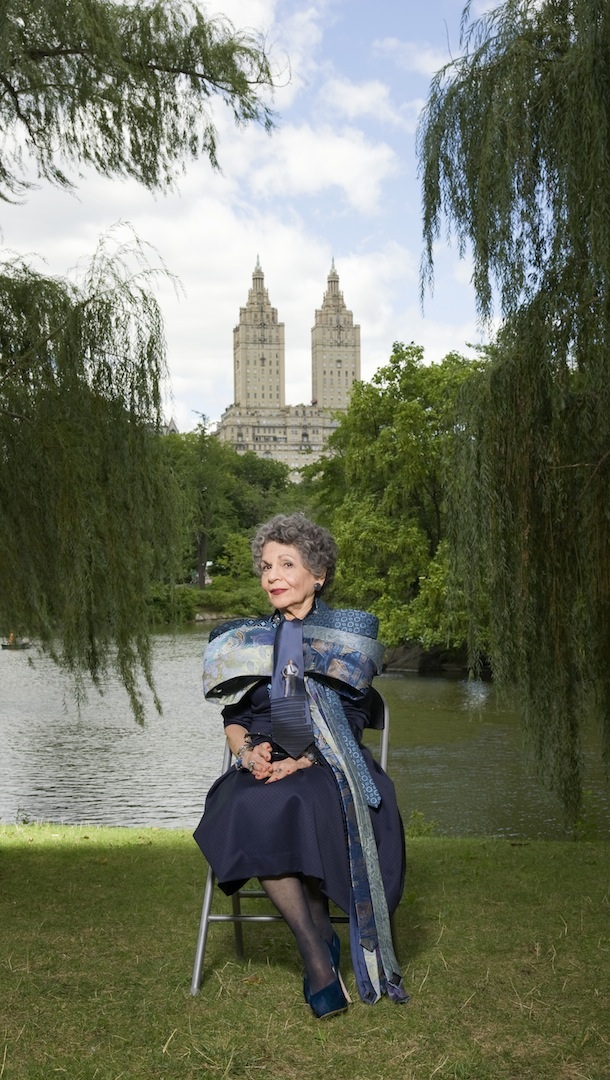
    (Fashion Interactions-exhibition, Nutty Tarts & Heidi Lunabba) 

    /// INFO: FASHION INTERACTIONS ///

    Fashion Interactions-Exhibition

    Opening: Friday November 15, 6pm – 9pm

    November 11 – December 13, 2013

    Open daily 12pm – 6pm

    Arnold and Sheila Aronson Galleries

    Sheila C. Johnson Design Center

    Parsons The New School for Design

    66 Fifth Avenue at 13th Street, New York

    The exhibition is supported by the Finnish Ministry of Education and Culture, Frame Visual Art Finland and Consulate General of Finland in New York.

       /// FASHION CURATING NOW ///
    Symposium, Saturday November 16, 9:30am – 5:00pm

    David Schwartz Fashion Education
    Parsons The New School for Design
    560 Seventh Avenue at 40th Street
    New York

    Finnish Cultural Institute in New York Facebook.
    http://www.ficultureny.org/node/330

    http://www.newschool.edu/sjdc

  • Leevi Haapala discusses with Axel Straschnoy (2011)

    Leevi Haapala discusses with Axel Straschnoy (2011)

    Curator and art researcher Leevi Haapala (Kiasma, Museum of Contemporary Art in Helsinki), and a friend visited New York in 2011. We sipped cocktails, walked and talked. The global art scene, environment, artist-stories, what was going on in the world; inspired our conversation. Leevi was after a bunch of creative ideas. My thought was to start a blog as a platform, where to reflect what it means to be global and to stay attentive to different cultures. During the time of starting FIRSTINDIGO&LIFESTYLE, many changes had taken place in New York City. The first post was published on September 11, 2011, which was the 10 year anniversary of the tragic attack. It was all over the media, people were talking about it, artists were discussing it. The ‘darkness’ was still touching and moving. Yet, there was an opposite force as a new kind of optimism that was even more dazzling. The city was creating new urban plans. The High Line was only one example of the greener thinking.

    This is to 2-year-old blog, which will feature more voices in the future. It wishes to bridge gaps between distances, worlds, body parts, artists, adventures, thinkers, beautiful minds.. Happy Fall!

    Below is a link to a video where Leevi discusses with Axel Straschnoy, a visual artist (born in Buenos Aires, lives in Helsinki), who held his exhibition BOXES at the MUU gallery in Helsinki in October 2011. The themes were so timely. Enjoy!

    Interview between Leevi Haapala and Axel Straschnoy from Axel Straschnoy on Vimeo.

  • What is a virtual feminist museum?

    What is a virtual feminist museum?

    Griselda Pollock’s writes in her Encounters in the Virtual Feminist Museum: Time, Space and the Archive (Routledge, 2007), about the choice and power, as well as about alternative views in the curating of art.

    Spring time is full of art showings. Some of the contemporary art events used ideas that were earlier introduced. Current mixing of concepts and art are already well established. Where is art actually taking place, is it the person performing it, is it in unique details, or is art a social phenomenon, or is it in your subconscious? Looking into Griselda Pollock’s view on curating offers some interesting insights.

    Would art galleries be any different than museums from the perspective of power? In case there would be no space for alternative voices in the museums, would ‘officially’ curated galleries be any different? What Pollock implies is that ‘reading against the grain’ is much more than just aesthetical choices. Virtual feminist museum needs to touch silenced territories. Whose story will be told in the future is important. But we choose to follow the path of retelling the same ‘official’ stories.

    I just learned about an art project, which would fall into a category of ‘alternative’ curating. After all, writing about works in a more positive light, using the power of choice, and overall, rethinking the ethical parameters in actual processes, is crucial for this type of curating. Who gets to participate in a biennale, for instance?

    I found some answers from Estonia. The contemporary art movement called Artishok was established in 2008 in Tallinn. It was initiated by a group of young voices who wanted to “scatter clusters of symbolic capital and status quo”. They were ten young artists, ten young critics, and ten exhibition days, showing new works with critical reviews that opened new works each day. Multiple tastes, philosophies and world views were the key words in the project, which aimed to do something around the exhibition experience as well.

    “Artishok Biennale is an experimental exhibition format that was brought to life by art and criticism…”  (http://artishok.blogspot.com) The next, 3rd in a series, Artishok Biennale will take place in October 10th-20th 2012 in Contemporary Museum of Art of Estonia in Tallinn. The biennale aims to bring X young Baltic and Scandinavian writers to promote X young Estonian artists. This will happen in a moment, where Estonian art world “is struggling for the preservation of the most basic functions”… (III Artishok Biennale will be supported by the Cultural Endowment of Estonia.

    Artishok seems to offer ideas for alternative curating. How would the project do something that relates to a virtual feminist museum?

    Griselda Pollock states that “The dominant social and economic power relations that govern the museum make feminist analysis impossible” (2007, pg. 9). She further adds that “The museum in contemporary society is increasingly bounded into the circuits of capital between entertainment, tourism, heritage, commercial sponsorship and investment” (pg.10).

    So, can this rhetoric be changes in establishing something like the Estonian biennale?

    Art criticism is a tricky institution, and it needs to re-evaluate itself together with the artists. What is truly at stake today is that criticism still has a powerful voice in creating the future for the arts.  The mission statement of the Artishok Biennale is collaborative, as both the artists and writers can be at home “within the ever changing landscape of contemporary art”. What is so great about Artishok is that it has taken the art criticism seriously. It has created reading groups, interviewed renowned professionals from around the world, and brought professional circles and the media together. Artishok has also touched upon the idea of the exhibition spaces. The first two biennales were exhibiting in white and cubic city galleries. The 3rd biennale will take place in Contemporary Museum of Art. The group sees that the art museum is a positive space, because as a young institution the Estonian museum is ambitious and interested in experiments.

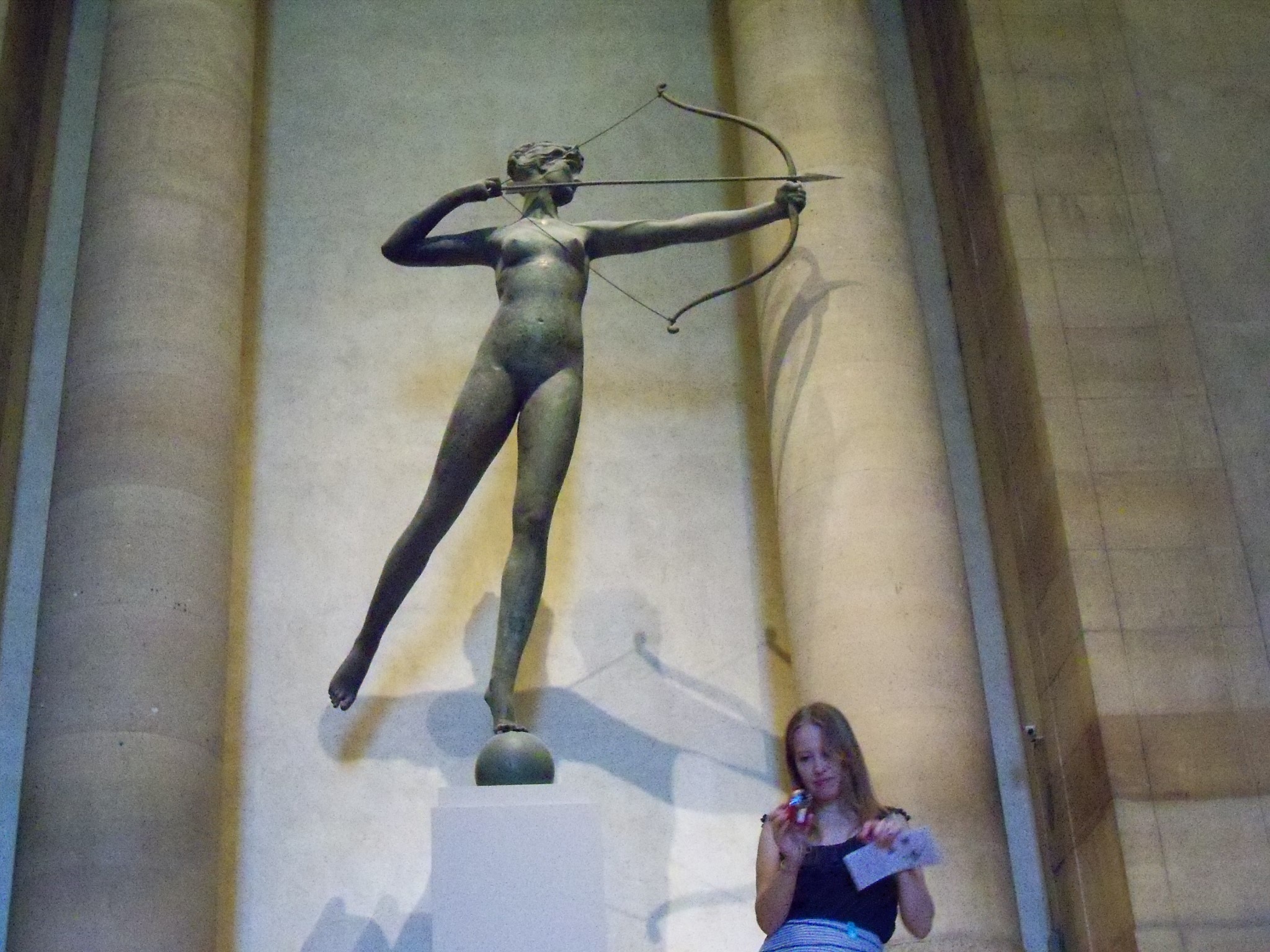
    Coming back to the virtual feminist museum. This blog writing showcases one photograph, which is empowered by a writer of this blog. Her writer name is Firstindigo. In the picture she is looking at her camera, which is her documenting device. She also admirably pretends to hold her defined notes of the documented art. But in fact, this might be completely false. It is rather implied that she holds an art museum program or the museum floor map in her hand. The fact is insignificant in the picture. The location is Philadelphia Museum of Art. The sculpture in the picture matters: Diana was made in America in 1892-94 by Augustus Saint-Gaudens, who was born in Ireland.

    ***

    {Addition to this article by Liisa Kaljula from Artishok comments on March 21, 2012}:

    So nice to read your contemplations on alternative curating and also that you merge it with feminist theory! Some little remarks though on the purely factual: Artishok was founded in 2006 as a platform for different activities on art and criticism, but mainly as an art criticism blog, 2008 it started with Artishok Biennale. The founding formula of the biennale was that there had to be ten artists and ten critics involved in the exhibition each time. The rest has been up to the changing curator. This time instead of one person picking the participants, I wanted to let the critics choose, and for that to make sense, they had to be with as different backgrounds and agendas as possible. So this is why there are critics who are into queer theory and feminism, phenomenology, self-mythology, modernism, video games, sculpture and installation, photography and so on. So basically these ten critics who all have different agendas pick ten artists – and they will all merge in the autumn as one big happy family, when each and every critic has to write about each and every artist.