ETH Zurich pavilion was constructed of waste materials and opened to visitors during the IDEAS CITY Festival in May 28-30, 2015. The 3-day biennial festival takes place in New York City in May mapping the future of cities with culture as a driving force. It is a collaborative event, including a conference and street festival, inviting to civic action, as well as giving a platform for creative ideas to be exchanged. This year’s theme was inspired by Italo Calvino’s literary work Invisible Cities (1972). Participants explored questions such as transparency and surveillance, citizenship and representation, expression and suppression, in their daily lives.
Cities, like dreams, are made of desires and fears, even if the thread of their discourse is secret, their rules are absurd, their perspectives deceitful, and everything conceals something else. (Italo Calvino, Invisible Cities)
TheETH Zurichpavilion hosted events through the festival. What does a truly smart city mean to us was a highlighted theme around the site. The pavilion was entirely made of waste, so while our answers to what smart cities are can be many, an important question is the future scaling of consumption in the cities. ETH Zurich poses a sustainable approach where we need to reconsider what we can do with all the waste that now ends up in landfills. Some solutions include tackling the pre- and post-consumer waste, while transforming it into construction materials like bricks and panels, which then can be used in making future buildings, homes and new products.
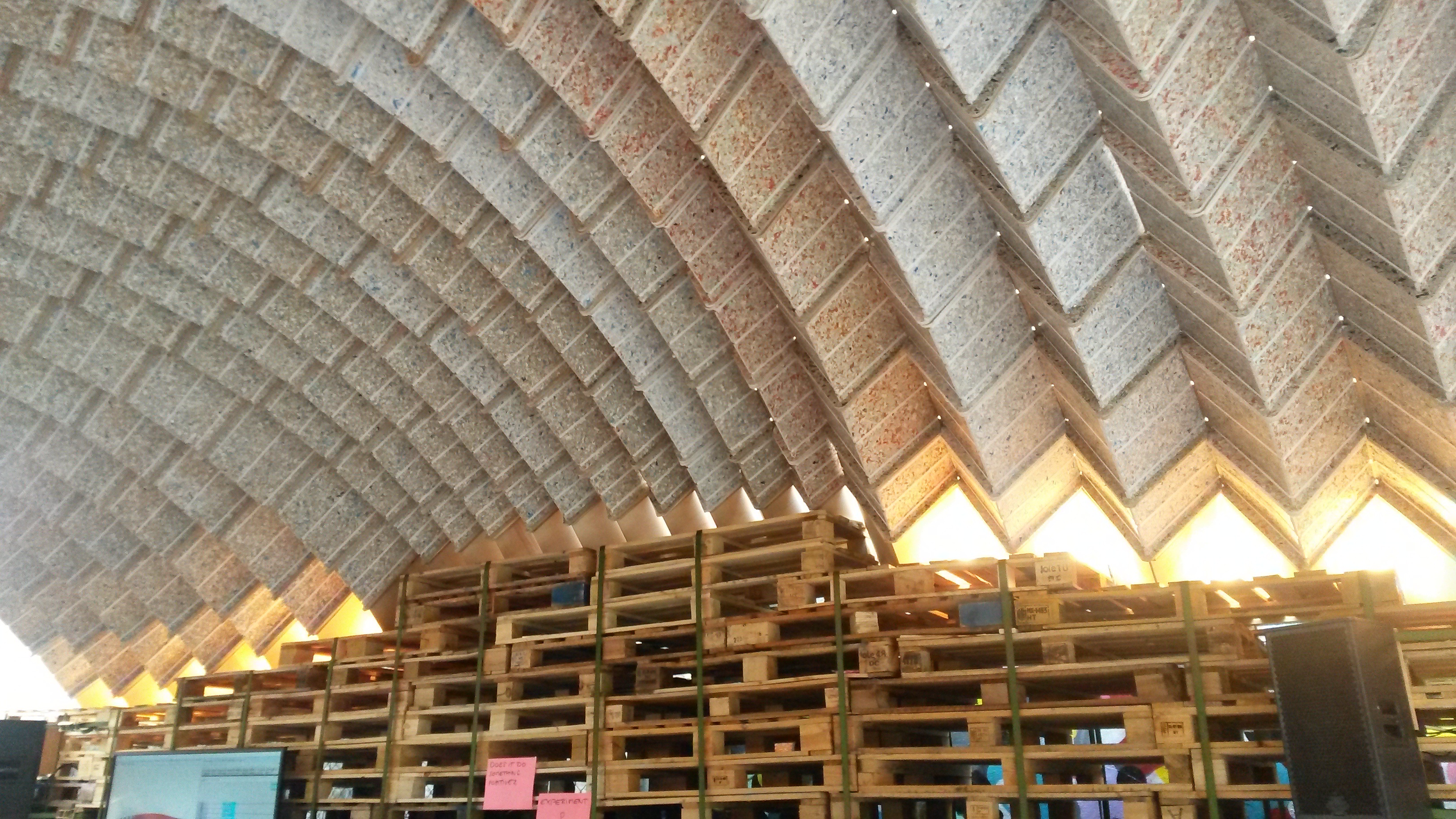
ETH Zurich Pavilion during Ideas City 2015 (all images Firstindigo&Lifestyle)
The pavilion is designed with a vault-like roof, showcasing bricks made of waste. It displays engineering technique that minimizes the use of material through the structure of the design. It lets in a good amount of daylight and feels airy. The structure brings into mind Guastavino tile vaulting as source of inspiration. Some of the Guastavino vaulting can be seen for example in New York subway’s abandoned City Hall station. In that context, the vaulting benefits from a technique that uses self-supporting arches with standardized size tiles. What this Pavilion truly showcases is that in the future, cities will hopefully optimize the designs so the structures will occupy less space. Big cities like New York struggle with lack of space, so fitting the pavilion in-between the buildings in downtown 1st avenue looked and felt smart and savvy.
The expressive Pavilion was designed to ‘visually float in the narrow slot between the buildings of First Street Garden.’ It is designed by the ETH Assistant Professorship for Architecture and Construction, Dirk E. Hebel and the Block Research Group. What the structure also implies aesthetically and visually is the potential of design to utilize so unstandardized and ‘weak’ materials in construction. The Pavilion’s shape follows the flow of forces, resulting in a compression-only vaulted structure. It has a double curvature and triangular beam-section, giving the structure a higher depth for the same thickness and weight.
ETH Zurich pavilion hosted panels and presentations, where participants pondered what a truly smart city means to them. It also curated an exhibition ‘Building from Waste’, which had over 25 construction materials deriving from waste.ETH Zurich pavilion detail reflects daylight bringing out the colors and texture
Subodh Gupta, Seven Billion Light Years V, 2014. Oil on canvas, found utensil, resin, 241.3 x 226.1 x 10.2 cm / 95 x 89 x 4 in
Subodh Gupta’s new exhibition ‘Seven Billion Light Years’ opens with multiple content, showing his performative sculptures, installations, films and a body of new paintings at Hauser & Wirth starting on February 10th. The exhibition takes root in the life in India which is his native country, addressing the local life where mundane and sacred exist side by side. Gupta is known for utilizing found everyday objects in his artworks, resonating meaning with utensils used in making and cooking food, as well as larger vessels such as a bicycle, on which smaller everyday objects are stacked. His works narrate about the culture of accumulation, where the people, food, and the daily exchange gets fused, appearing both chaotic and ritualistic. As a centerpiece of the gallery’s current exhibition is a series of new paintings called ‘Seven Billion Light Years’. These belong to Gupta’s signature subject of using basic kitchen utensils that are familiar to every Indian. Gupta’s art works raise questions, addressing what it means if the world’s people are not anonymous, but have identity and a bit of infinity. In the level of the paintings, the artist uses three-dimensional objects that are fixed to canvas with resin. These paintings carry the exhibition’s title, but there is more behind the meaning. The title refers to the seven billion inhabitants on the earth echoing about the materiality and the material fragility of our human lives. It displays the idea of intrinsic marks that we leave on the earth’s surface throughout the years. The objects speak about the human marks in the cosmos as well; the distance between our mortal lives and the cosmos appears as unfathomable.
Anthropologist and writer Bhrigupati Singh has written about Gupta’s work. The artist reminds us that what is near is
‘no less cosmic or mysterious – on the surfaces of ourordinary domestic vessels that journey with us, sometimes for years. What we discoverin the process are intricately crafted pieces of the cosmos.’
Gupta’s film ‘I go home every single day’ (2004/2014), narrates his commute between New Delhi and his native home in Patna. The journey in the film poetically tells about the changing landscape of the urban cityscape and the more traditional Indian home. The home is a place, where the camera lens repeatedly comes back to focusing on outdoor areas interpreting smaller details, in which the white wall becomes a surface of nuances. It acts as a backdrop for objects, ropes, plants and canvas totes. The yard itself as entrance stands as a sign for the domestic; water pipe carry a meaning that water is a sustenance, without it there would be nothing. Everything in-between the train and the home is in evolving chaos, where progress lives as traditional life changes and even disappears.
Pure (1), 1999-2014, Mixed media, Dimensions variable, installation view, ‘Subodh Gupta, Everything is inside’, Museum fur Moderne Kunst Frankfurt am Main, Germany, 2014. Photo: Axel Schneider
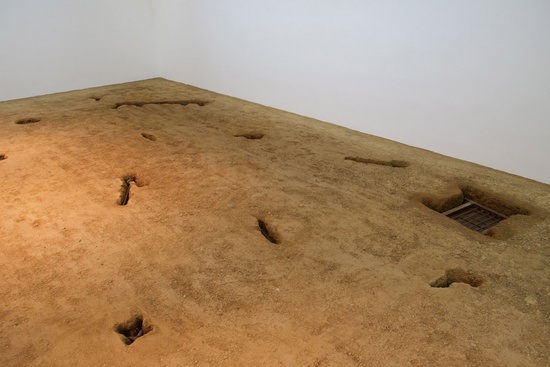
As a counterpoint to Gupta’s recent paintings called ‘Seven Billion Light Years’, Hauser & Wirth also presents an installation ‘Pure (I)’ (1999 / 2014), which is a variation of a piece exhibited last year at the Museum fur Moderne Kunst in Frankfurt am Main, Germany. Gupta’s early work ‘Pure (1)’ originates back to 1999, and it was first presented at the Khoj workshop in Modinagar, India. This initiated the ongoing project on the everyday objects as vessels of larger cosmic power. The artist started collecting household utensils around New Delhi, including a hookah an a plough, sinking them into a field which was composed of a paste of mud and cow dung. He also covered himself with the same paste laying at the center of the field in a yoga posture of shavasana (the corpse). This, according to the artist, resulted in the state of ‘meditative blankness’.
At Hauser & Wirth, ‘Pure (I)’ has become a new work, in which Gupta is revisiting his own artistic process that took place 15 years ago. At the gallery, he presents a group of household objects that are partially buried in pure earth, along with a group of black and white photographs which stand for the neighbors from whom he borrowed the original objects for the earlier piece in 1999. These photographic portraits hang opposite of the earthy field, where gallery visitors can also walk, and hence experience its entity. The group of photographs present the people as de facto collaborators from the artist’s time of making his art.
Another big piece of art is an installation ‘This is not a fountain’ (2011-2013), that comprises of a large number of timeworn aluminum utensils that the artist collected. In the midst of it are water pipes, which while dripping ‘keep washing’ the surface of the installation. The artist states that he has been interested in the uniform of the mass-produced dishes. Yet, what comes out is the water as an essential element that pours as a ritualistic connotation for purity, showing the basis of things themselves. Meanwhile, the other art works at the gallery exhibition also reflect about Gupta’s own biographical attachment to his subject. His own middle-class background allows him to show the contrastive realities of the deprived and poor versus the richer classes. His use of everyday vessels made of various materials, where the socially humble turns into a shiny bronze, displays a sharp division between different social classes, whilst in the global exhibition space the meaning gets circulated into other levels as well, perhaps becoming a subtle divider between east and west. Additionally, the short film playing with the same title ‘Seven Billion Light Years’ (2014/2015, film, 2. min), meditates a Hindu philosophical idea of the cosmos as leela, which means play and dance in the traditional philosophy. The daily bread-baking becomes a metaphor with cosmic turns, where bread flies lightly like moments in life.
‘Seven Billion Light Years’ will be on view 10 February 2015 at the Hauser & Wirth’sdowntown gallery location at 511 West 18th Street, and be on view through 25 April. The exhibition coincides with the debut of a major work by Subodh Gupta in the exhibition ‘After Midnight: Indian Modernism to Contemporary India 1947/1997’, which opens 8 March 2015, at the Queens Museum in New York NY.
To map Gupta’s work a little more in its context, the following video presented on New Delhi TV (NDTV) along with his short interview, is a good start:
Christy Rupp was presented at VOLTA NY’ 14by Frederieke Taylor Gallery. The artist who is known for her 1980s public art projects, was at the art fair with her new work that raises questions about environmental threats and issues around wild animals and nature. One part of her presentation was a series of sculptures around microfauna from the Gulf of Mexico; artworks are made from welded steel and encaustic wax. In another series of sculptures (images above), Rupp explored the relationship between ivory and energy. These were made in response to threats coming from drilling, addressing also accurate issues around poaching. The artist has made sculptures called ‘The Fake Ivory Series‘ (welded steel and encaustic wax) pointing that wild animal spices are threatened to extinction as they are poached for their tusks. The art stands for trophies as desired objects that include animal parts such as ivory. Scrimshaw or tattoo-like scribbles on them make comments on the value placed on energy over life. The sculpture ‘Walrus‘, 2014, a mixed media work with credit card solicitations, concretely points to currency over humanistic ideals that protect our environment.
Rupp, Walrus Tusks with Greenhouse Gases, 2012. Courtesy of Frederieke Taylor Gallery, NYC
The artist’s past includes diverse projects that are politically, socially and environmentally engaging. Rupp participated in the legendary “The Times Square Show” and “The Real Estate Show” of 1979-80, and she is affiliated with Colab and Group Material. To address artist’s past and her works in context, the gallery also showed video and documentation of her art projects from the early 80’s period.
Christy Rupp’s recent notable shows include:
“Dead or Alive” at the Museum of Arts and Design, NY 2010, “Dear Mother Nature” at the Dorsky Museum of Art, SUNY New Paltz, NY 2012, “This Will Have Been: Art, Love & Politics in the 1980’s”, Museum of Contemporary Art, Chicago, IL 2012, “American Dreamers” Pallazzo Strozzi, Florence, Italy w/ Hudson River Museum, and “XFR STN” Transfer Station at the New Museum, NY 2013, among numerous others.






 Firstindigo&Lifestyle