Tag: environment

  • Artist Interview: Choreographer Simo Kellokumpu

    Artist Interview: Choreographer Simo Kellokumpu

    Sightseeing is a performative proposal to deconstruct an archetypal figure of tourism through a site specific procedure. It’s about shifting from sightseeing to siteseeing and what this involves in terms of spacialization and temporality of the seeing that can trigger a sight specific experience. (Simo Kellokumpu & Vincent Roumagnac) . Sightseeing is a Dance Film directed by Simo Kellokumpu and Vincent Roumagnac (FRA/FIN 2012, 28 min). The film will be part of the LOIKKA DANCE FILM-FESTIVAL next week in Helsinki.

    Firstindigo&Lifestyle: How did you choose dance and choreography?

    SK: I’m not sure if it is about choosing in my case –  I find it more like a development of perception within the conditions where I have lived. I have realized that choreography is something I have always been interested in, but I didn’t have a word for it before getting to know dance. As dance and choreography are two different media, what interests me now as a choreographer in choreography is to consider it as a form of (an artistic) practice, which articulates, shifts and opens social, temporal, spatial and material contextual circumstances. To think and practice choreography is to be in the movement all the time. When I auditioned for the Theater Academy (TeaK) in Helsinki, I already knew that I wanted to study choreography. They asked me in the final interview about the relation between a dance technique and choreography. Now after more than 10 years later, I still remember it as an important question in a way that I was confident that the choreography as a medium is the right one for me. We had 3 years BA-studies together and after these years there was another audition to the department of choreography. The audition again was an uneasy experience, but I’m very happy that I had the chance to study there 2 more years in that department.

    Firstindigo&Lifestyle: What does interdisciplinarity mean to you as choreographer?

    SK: In practice it’s now about the dialogue between me and my collaborator a French artist Vincent Roumagnac whose roots are in theater and in visual arts. Also, it is about the question how to shift and echo the choreographic process into another medium/and vice versa. In this way, I would prefer to use the term intermediality than interdisciplinarity, because it is about what is at stake ”in between” the different media we use. For example, I think that artists like Bruce Nauman or JulieMehretu have a lot to give for a choreographic process. The history of contemporary performance, the body – and the visual arts is full of makers into whose works I can relate to with my choreographical references. At the moment, I am interested in, what kind of aesthetic forms comes out from the artistic process, whichcombines contextual choreography and the economical and philosophical principles of degrowth. I don’t have any ”artistic ideas”, but I am rubbing the notion of choreography with other contexts, media and circumstances, and speculate on the resulting inter-forms.

    Firstindigo&Lifestyle: Tell me about the project in Iceland, who did participate in it, and what did you do with the landscape?

    SK: I was invited to an international Aeringur contemporary art festival (in Rif 2012) with Roumagnac. The festival invited artists 10 days before the opening to work on the specificity of the site where the festival took place. We decided to work by the volcano/glacier Snaefjellsjökull with the notion of Sightseeing (and playing with homophonic site-seeing…). We aimed to play with these notions from the critical point of view meaning, asking how mass tourism usually consumes landscapes. Therefore, we wished to ask, what logical system of perception does it enclose that the spectator-tourist him/herself imposes an arbitrary framing of the landscape (the cliché). We worked on the deconstruction of this logic of seeing and experiencing the site by embodying (the body of the viewer) and re-framing (the framing of the landscape). So, having alternative forms of perceptual experience of the specificity that is usually attached to the nature-tourism site. We filmed a video of 30-minutes including me + the local people and participants at the Aeringur art festival. We also made an installation for the opening of the festival.

    Firstindigo&Lifestyle: You live in Berlin, how is that now different from Helsinki, or Finnish dance and art scene?

    SK: One of the main reasons to move my base to Berlin was to concentrate on the development of choreographic practice in a vibrant international context. I always thought that I would move to Brussels or Paris, because I’ve studied french for 5 years. But I found in Berlin a lot ofinteresting contemporary art, and colleagues in the same position, so I decided to stay – typical storyfor an artist, I guess.

    When I went to Berlin in 2008, I was in the middle of a serious professional crisis. I was thinking to change the profession because this crisis had been going on already maybe a year or so in Finland, even if I had possibilities to work. I thought to quit practicing/making choreography. But what eventually happened to me was through questioning the logic, aesthetics and social and material conditions of the production-making, where I had been in Finland. I found some possibilities to realize workswhere choreographic thinking is processed out to, or with, the spectator without being subjected to the logic of a dance-piece or production, which is rehearsed and produced to be performed always the same way, no matter what is the context. I think there’s enough productions in the (art)world already. I try to find ways of making art and the living, which escapes this economic logic of the art-market – it’s a tricky equation to solve but I think it’s necessary.

    In Berlin, I also took time to study, what has happened within western contemporary choreography in the last 15 years. I dove into the contemporary arts and understood many crucial things for my professionalcrisis. Berlin was a perfect place to be for this kind of professional process. I think themajority of the art-scene is in Berlin for other reasons than ”making a career” – I think it’s a place for developing your artistic practice. Stimulating art-city it is.

    It’s been at the same time relieving and challenging to step out from the safe small scene into the total anonymity where no one knows who you are, and where you have no artistic institutional support at all. To step out from the familiar, expected and recognizable logic of working and presenting works, you inevitably bump into unexpected and unknown landscapes in many ways. It was right thing for me to do – to change the location doesn’t necessarily bring you something more, it can also be the movement, which prunes and clears out.

    The main differences with Finland are quite simple. Finland is quite homogeneous and the art-scene is small. Of course one of the reasons for this is the geographical position, which already positions artists in a certain way, I mean there’s not that much people going to Finland especially.Finnish choreographers are not yet well-known in the Mid-European scene. I’m happy to see that there are some interesting younger generation choreographers like for example Anna Mustonen on their way. I am confident that they start to appear in critical European contemporary stages and venues as well, if they want to participate into the logic of touring with works.

    In Berlin, there are artists from all over, and it seems to be in constant movement.  It is questioning already things in practice, which haven’t been spreading out yet. Different ways and disciplines of making are mixed, and as a spectator you have a good possibility to experience diverse vital critical art-scene, which challenges your thinking, perception and position. Berlin is poor, and the venues do not support artists the same way than in Finland, but it is a place, where people want to come to show their work even if also the audience is very demanding – in Finland the audience is very polite, and the discourse between the audience and the artist is completely different.

    In Finland, we are not used to talk about art that much. In Berlin it’s common that the spectator has critical questions about the work. Aesthetic talk is an aesthetic talk in Berlin, whereas in Finland I have experienced it more like a personal talk, which is connected to the romantic idea of an inspired artist who expresses him/herself. The tradition of dance and choreography is longer and thicker in Berlin and in Germany – Finland is a young country and the position of a contemporary choreographer is hardly to be taken seriously, or the position of an artist in general. But it’s hard everywhere for artists I guess, especially in these neoconservative political times. What I find meaningful in Berlin, is the history of a place where artists have been stretching, breaking, testing and questioning the ways of making and presenting art. Also this affects to the Berlin’s position as a vibrant, substantial and horizontal art-capital.

    In last 1,5 years, I have been more active again towards the ”scene” and been meeting more people. I have even learned to say no to the proposed possibilities also in Berlin. I’m interested in working with Finnish performers, because I think they are good in the way that they are grounded and down to earth. For the moment, I’m happy to be working in a light collaborative structure, but if there’s a working group included, I’d like to bring the group to Berlin and present the work then in Finland. This way there’s automatically cultural exchange, and stimulation happening to many directions. I am planning now together with a Finnish Berlin-based director Mikko Roiha to create a platform or stage for Finnish performing arts in Berlin. We are working on to find the ways now, and looking for collaborators from Finland and Berlin to get this project going to be able to offer one possibility for Finnish artists to present their work in Berlin.

    Firstindigo&Lifestyle: How do you understand dance technique? What is a Kellokumpu dance technique?

    SK: I think of it as a certain neuromuscular organizational system, what you can study and learn to embody. Nowadays, I have moved on from thinking dance-technique(s) as something necessary for the choreography. I mean, I am interested in finding the ways to understand, how a subject, we call a ”dance technique”, is used and connected to the broader social, aesthetic or historical context. For me as a choreographer, it is necessary to understand these connections more than having a ”dance-technique” – I find it problematic if a choreographer finds his/hers dance technique and sticks only to that without questioning its broader social, historical or aesthetic dimensions. Usually, I have worked with the dancers who have a broad understanding and physical potential. I find (Forsythe’s, if I remember correct) thought about dancer’s body as a body of a monster intriguing. I have certain elements and tasks to combine when it comes to the idea of the movement-texture. But like I said, I’m thinking about choreography nowadays as a medium, which doesn’t necessary need a body to be processed and presented. I am interested in working with the notion of choreography and its possibilities; dancers and dance-techniques can be part of it or not.

    Firstindigo&Lifestyle: So, what are your greatest influences?

    SK: In 2010, we (with Roumagnac) created a solo-work for me which included a staging of my choreographic mothers and fathers so to speak. From Finland, there were Ervi Sirèn and Tarja Rinne. And then, Merce Cunningham and William Forsythe were on stage with me in this work (not physically present, note). I am still aware that these names are important for me when it comes to the personal history of dance and choreography. Like many, I am interested in the 1960’slegacy in the western contemporary arts. To name a few, Judson Dance Theater, Situationists, Minimalists, Arte Povera-, Fluxus-artists and then choreographers like Cunningham, Lucinda Childs, Forsythe and Jérôme Bel are the sources of my inspiration. Of course, my position is nowadays to have a critical point of view to my genealogy as well, and to look ahead by following what is happening in the development of the choreography.

    Firstindigo&Lifestyle: What did you learn while you were spending some time in New York?

    SK: I spent only one month in New York and it was the first time for me there. I mainly wanted to go after Merce’s (Cunningham) footsteps a bit, so to speak. So I took some classes in Cunningham Studios and visited museums and galleries, got to see performances etc. The trip was part of the project of mine what I processed with Roumagnac who was in Paris at that time, it was a continuation for our one month work-trip to Beijing. In New York, I thought a lot about the relevance of being aware about the history and the line(s) where you belong into. I found it significant. I even bought a blue unitard.

    -Check the LOIKKA DANCE FILM-FESTIVAL calendar here.

    -Artist’s website: http://kellokumpu.wordpress.com/2010/09/21/11/
  • VOLTA NY-13 edition #1 LYNN ALDRICH

    VOLTA NY-13 edition #1 LYNN ALDRICH

    VOLTA NY’s 13 art fair is running for the sixth year in a row. The art fair celebrates a brand new location in SoHo’s vibrant 82 Mercer Street. I visited VOLTA during its opening day on Thursday March 7th (until March 10th). Spending time next to the colorful, innovative, thoughtful, provocative, and utterly timely international platform of contemporary art was worth every minute. The two floors packed with art, which were made with diverse techniques and means, and meeting people from around the world, who were enthusiastic about it, did not even feel a bit too much. Also, it was refreshing to stop for a moment, to look out from the large windows and enjoy the street scene, whilst being inside experiencing art. After looking out, I could again discover something new.


    lynn-aldrich-out-of-the-ink-in-the-dark-2012
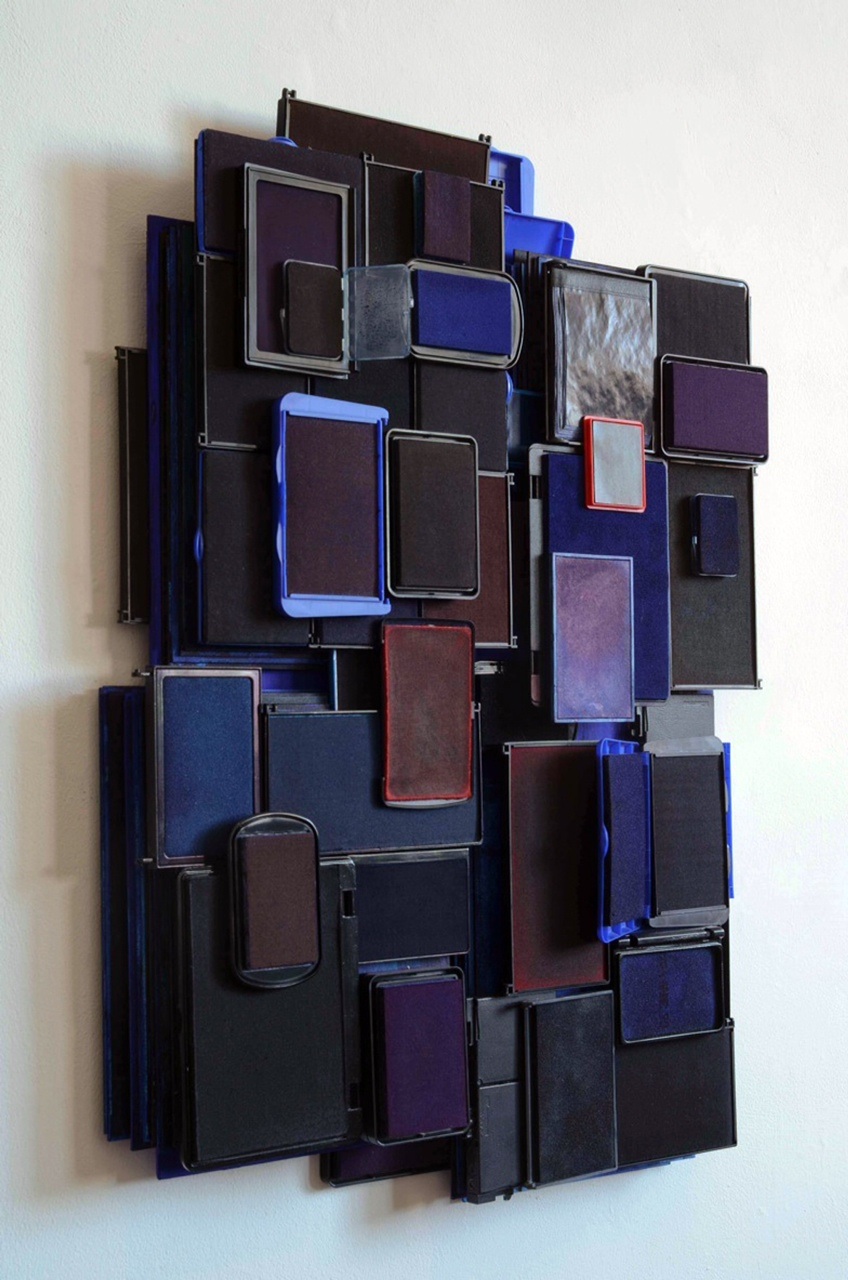
    Lynn Aldrich, Out of Ink in the Dark, 2012, ink, ink pads, cartridges, blotting paper, carbon paper, 27 x 20 x 4 in


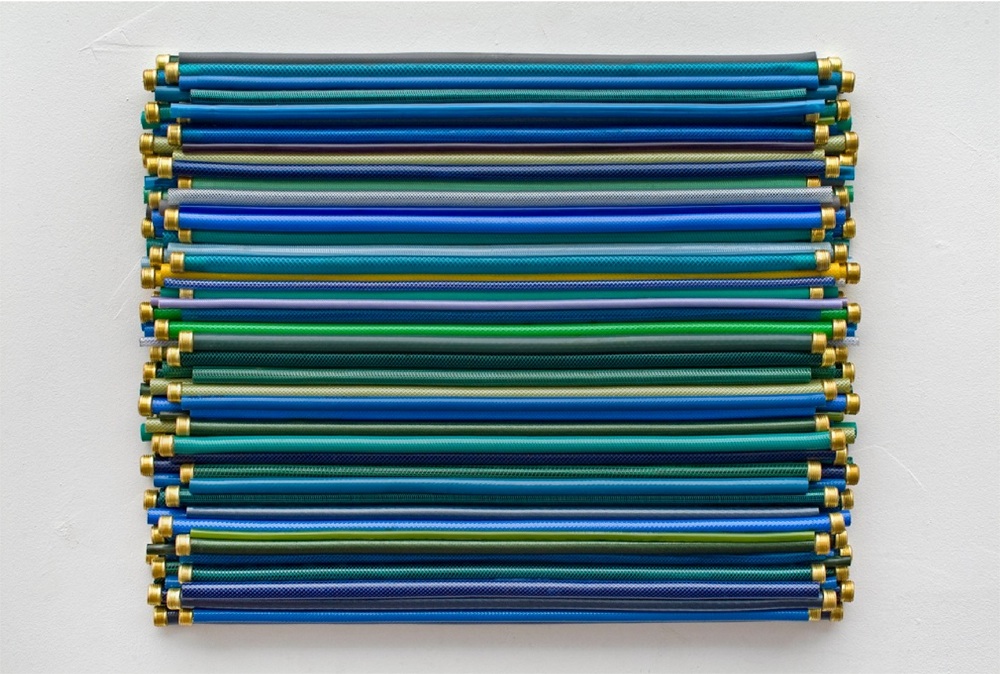
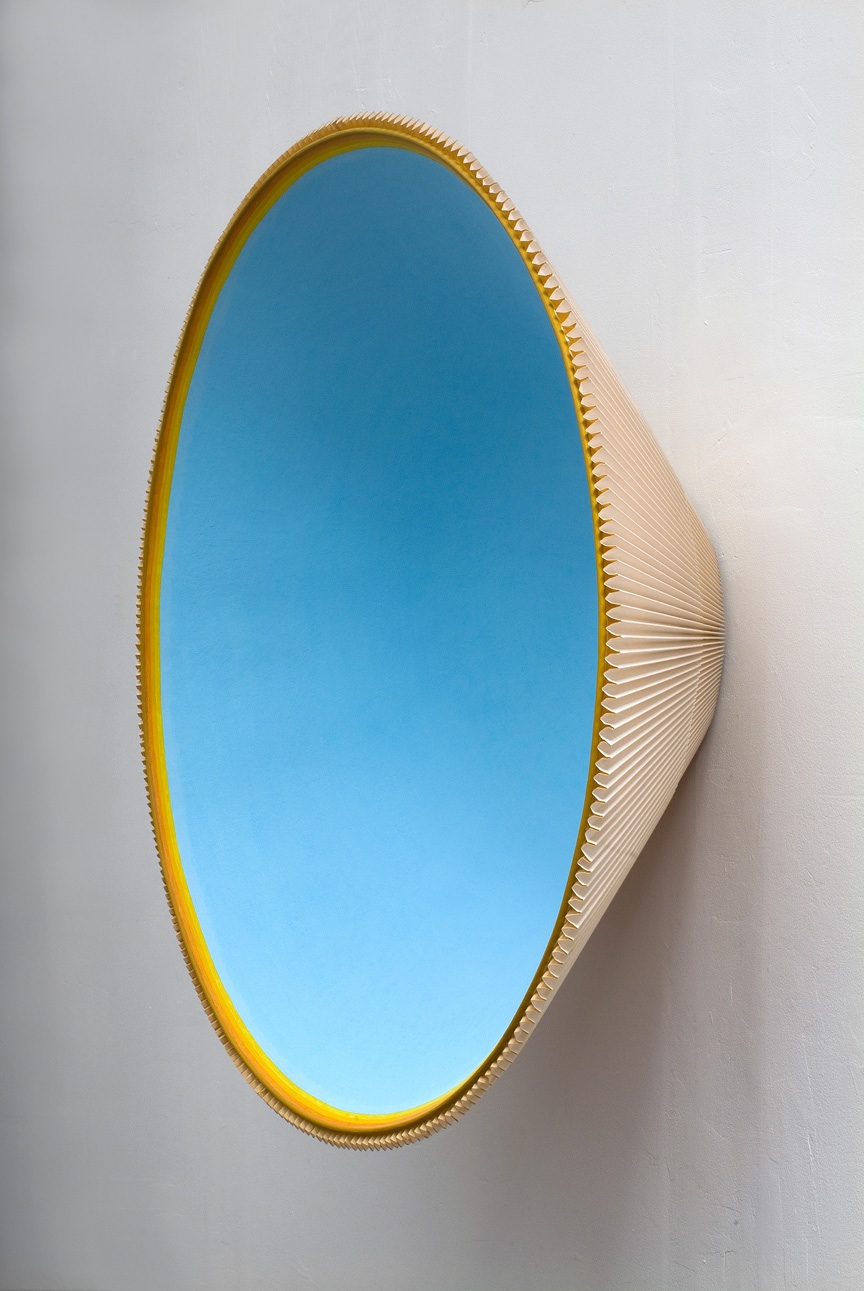
    My first story from the show is about Lynn Aldrich. Los-Angeles based artist Lynn Aldrichs exhibit at VOLTA takes place at the same time as her solo show is at the JENKINS JOHNSON GALLERY in New York. This show called Free Refill: Old & New Works opened on February 7th and is now on display through March 30, 2013. Lynn Aldrich’s creativity is truly on display of her sculptures and installations that show huge potential to the acute topic of environmental change with social relevance. Aldrich’s aesthetic, carefully made almost minimalist works state a question about our excessive consumption and our man-made impact/problem on the environment. Lynn Aldrich uses materials that are part of our everyday collectables from the Home Depot store, for example. Her sculptures and installations contain parts, which, if gathered excessively, lead to problems with waste and garbage. The plastic accumulating in the ocean is one such problem. Her use of bold or natural pastel-like colors melt in with vivid and organic forms, which together create ideas of technological interplays between humans, their sciences and innovations, and the natural environment. What I especially like is that the sculptures evoke clear sensorial responses. The Sky Light (Noon) sculpture, (no. 1 here), radiates turquoise light and invites to be in-contact-with itself. The sculptures also showcase authoritative presence. A work on the wall, Out of Ink in the Dark, 2012, (no. 2 here), possesses loudness and command reminiscing of the devices that have taken so much space in our everyday communication. Plastic Pacific, 2010, (no.3 here) articulates with its title about the Great Pacific Garbage Patch, and echoes about the human imprint on the natural ecosystem. The plastic tubes with oil glaze represent clearly the unnecessary amount of things that we have gotten used to, and have access to. By using everyday objects from Home Depot world, such as hoses, pipes and sponges, Aldrich states their physical functions. Alternatively, she references with the objects, that they represent the water flow of the ocean or the cleaning of the ocean. The works are asking us to pay attention to and listen to its fragile system, and asking us to do something about it. The Desert Springs, 2005-2009, (no. 4 here), with downspouts and gutter extensions, is an installation in which the organic nature-like looking particles are like the Coral in the ocean.


    Lynn Aldrich, Plastic Pacific, 2010, garden hoses, plastic tubes with oil glaze, brass ends on wood panel, 26 x 32 x 3 in
    Lynn Aldrich, Desert Springs, 2005-2009, downspouts, gutter extensions, gutter corners, enamel, dimensions variable ~ 59 x 70 x 62 in
  • Robin Rapoport: From Alexander technique to design sensing

    Robin Rapoport: From Alexander technique to design sensing

    How to describe living the artistic life? How to live a life surrounded by one’s own art? Making art is so intimately linked into one’s sensing of the world that there isn’t simple answers. In the current research of art, we try to map different kinds of knowledge embedded in the artistic processes. ‘Living’ with the arts is like ‘dwelling’, which in fact implies an old meaning for a house. The doors in the house keep opening and closing as a trespass to new fragments of interiors. The repetitious movement of stepping in and out of the interiors gives even the doorhandles almost allegorical significance.

    Robin Rapoport’s designs at her Conneticut home and studio.

    Robin Rapoport is a sculptor and designer who has been choreographing for her dance company Headless Horse. As a dancer in Robin’s company, the creative process made me reconsider dancing together with the sculptural.  Robin has been looking for a living and forming entity in the sculpture, which could be realized through the dancer’s body and her movements. Another layer came from the Alexander technique, which would bring those two materials even closer together. I asked Robin about this entire connection, wanting to know how the Alexander technique has changed her.


    RR: So funny you should ask that. The other day I was speaking with a magazine publisher of home design who wanted her editor to meet me and I said I have a class for Alexander Technique, but will skip it in order to meet her. I reflected that most people do one thing like designing, and here I spend so much time on another activity perhaps losing accounts because I’m not as available. But if you understand Mr. Alexander’s work it is crucial to one’s sense of clarity. The more I go, the more I discover holding in my body that I need to release, and as an artist I am curious where this will all lead. I know I’m changing so much already. The way I stand, my breathing, and so I am not so hyper. I can make better decisions with a calmer mind. We are for the most part so disconnected from ourselves and from the proper use of the self, which enters into all arenas of movement. I am very concerned with health and maintaining it. I do not want to stiffen up but remain easy and fluid. And I think to be an artist is to think outside of the box, to think ahead, to be perhaps more aware of the dangers our planet presents to us on a daily basis. This Alexander Technique is what I do to combat that.

    ORGANIC FORMS

    Robin Rapoport’s sculptures and sculptural furniture display an array of different approaches to organic forms, which could be labeled, as somewhere between Scandinavian and African, they are modern, natural and primitive at the same time.The sculpture and furniture feels animated and living. In some cases it is almost talking to you, and these pieces are shaping the space. The design presence is not too loud, but the pieces make statements and offer alternative points of view to look at the space. A piece of furniture is standing on its own legs, when it is a floor lamp, for instance. And if it is a bookshelf it can even include eyeballs. You might as well know what I mean: When you talk to plants, you talk to trees. And this design is so ’whimsy’ that you might as well talk to it.

    When Robin takes on the art of creating a house with her interior design, she likes to enhance the warmth of the interior walls. The walls already have imaginative touch in them. Cardboard covered walls with a touch of asymmetrical designs gives them a hint of geometry, and overall, they have ethereal lightness in them. This meditative approach, which she also calls as an art of ‘dwelling’ continues in the wooden sculptures. The sculptures both gather and form the space around them, and they have their own individualistic character. Robin’s interest to form is fluid. Materials appear with fluidity; they are towards rough or process-like, rather, than simply solid or static structures.

    Robin Rapoport, eyeball shelves

    THE HUMAN BODY

    The Dance Company is close to being like a living sculpture, where human body is constantly taking new shapes and testing the space where it moves. The dancing bodies with sculptural elements on stage together with them, is another Rapoport’s take on the theme. Along with the abstract, animated and organic forms are these narratives, which have several underlying layers. These stories unfold themselves in a course of a fairytale, or as a series of otherwise magical happenings.

    Dance, short film, sculpture, and light design evolve from the same source creating narratives without suffocating punctuality. Robin’s events evolve around the form and texture. Sometimes a piece of plexiglass gives an idea to a story that becomes a gesture in the dance performance, or it is part of the furniture created, and the objects found, all made for the home. Home is an evolving space, which is the dwelling. And living one’s home is part of the artistic process. Basically home is living together with art, and art keeps changing, as the interiors get different stories and layers.

    Robin has created her home in the woods of Greenwich, CT, together with her husband Edward L. Milstein, who himself is a painter of geometric color. Both share a passion for the arts, design and architecture. These three-colliding elements are coexisting in their home, where exterior is also mixing with the interior. A visitor who comes to their spatial industrial loft-like house and art gallery encounters the presence of the woodland nature. The house is evidently coexisting with its environment, as the landscape is not too worked, but remains the same type of organic fluidity with the rest of the things around. They collaborated with the Robert Young architects to create their ’Art Barn’. In the summer the house has a wire screen wrapped around it which is covered with wisteria, and so becomes a green jewel box in the woods emerging from a winter cinder block form of grey. It is amazing how a ’green screen’ that is like a living skin over most of the surface make the concrete-block look different. The greenery also adds thermal insulation.

    LIGHT DESIGNS

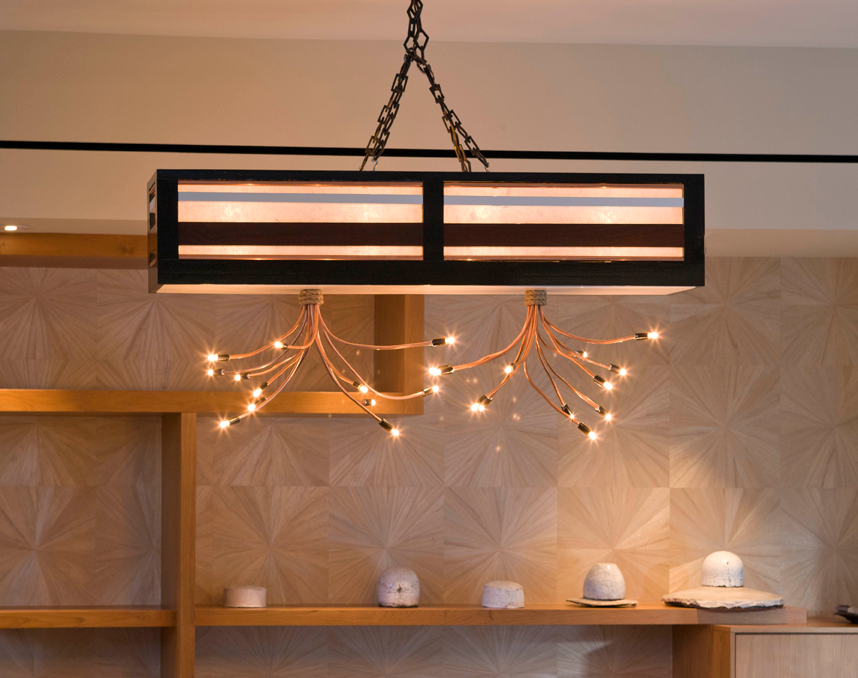
    As of today, Robin has developed Light Designs. She is creating fixtures that come from the sculptural roots of using wood, copper and paper. Interesting ceiling lamps are the ones like an octopus or simply ‘branchy’ wired designs, which are light weighted structures for the ceiling. Ceiling lamp can contain one long rectangular design that has two branchy-designs attached to it, or it can be a smaller sculptural design having one wire inside them.

    {photos:courtesy of robinrapoporthome.com}

    I asked Robin few more questions. I wanted to know how living in the woods inspires her. I also asked, where will her designs be in the future, and where will her passion be.

    RR: I think there is nothing more beautiful and magical and instructive as Nature and so I stay here, somewhat hidden and enclosed and perhaps somewhat lonely at times as well but this is where my work unfolds. When I travel to New York it is to study the Alexander Technique but then I come home to walk the property where I have lived for 24 years. Every year I add or shift plants and every following year I can take pleasure in watching them bloom. Outside and inside are distinct yet connected, as are we with both an exterior and interior persona? With so much suffering and tragedy in the world I feel blessed to have this place as a personal sanctuary and which makes me acknowledge every day a higher being which I can attribute the beauty all around me to.

    I hope my Light Fixtures can add beauty to a room. They are crafted by hand so each is unique. I am happy to personalize them for customers meaning that I could change the paper color and or wood color. How fascinating is it in Nature that a plant on the outside can be a dull grey with spikes and when it blooms the most delicate of leaves and colors emerge. And this color is for our eyes to appreciate like cinema except you can touch it.

    My next passion is to have a home furnishing boutique where I would sell my designs for tablecloths and ceramics, as well as have my design services. I love to set the table, and I find very little of interest in the tabletop design right now. So much of what is out there is about simplicity and “whiteness”, but perhaps just too much simplicity. We have lost great craftsmen (women). With the current economy people are afraid to stock inventory that is not trendy. But I am uninspired by what is now trendy. I just find it bland and so will make my own.

    ***

    {ROBIN RAPOPORT’S WEBSITES: Robin Rapoport Home and Robin Rapoport:Dance, Sculpture, Film}

    ***

    Robin Rapoport established Headless Horse in 2002 in New York City. The dance company has performed in live show, in festivals and in her short dance films. Her ‘Thief’ appeared in Palm Springs International Film Festival, and in the Jumping Frames Film Festival in Hong Kong.

    ***

    {/More pictures for the Greenwich, CT house are seen at http://ryarch.com/art-barn}