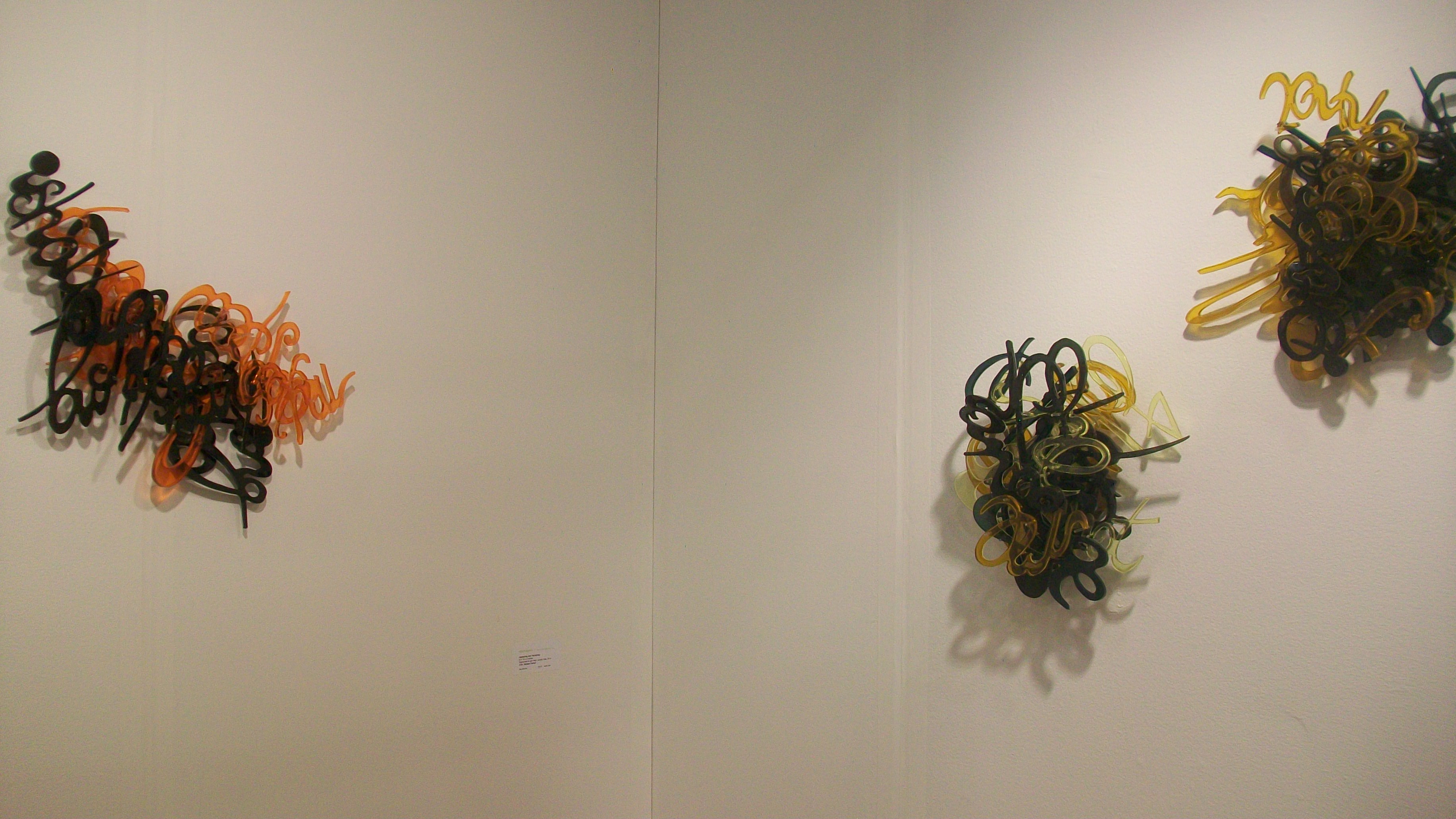
Christy Rupp was presented at VOLTA NY’ 14by Frederieke Taylor Gallery. The artist who is known for her 1980s public art projects, was at the art fair with her new work that raises questions about environmental threats and issues around wild animals and nature. One part of her presentation was a series of sculptures around microfauna from the Gulf of Mexico; artworks are made from welded steel and encaustic wax. In another series of sculptures (images above), Rupp explored the relationship between ivory and energy. These were made in response to threats coming from drilling, addressing also accurate issues around poaching. The artist has made sculptures called ‘The Fake Ivory Series‘ (welded steel and encaustic wax) pointing that wild animal spices are threatened to extinction as they are poached for their tusks. The art stands for trophies as desired objects that include animal parts such as ivory. Scrimshaw or tattoo-like scribbles on them make comments on the value placed on energy over life. The sculpture ‘Walrus‘, 2014, a mixed media work with credit card solicitations, concretely points to currency over humanistic ideals that protect our environment.
Rupp, Walrus Tusks with Greenhouse Gases, 2012. Courtesy of Frederieke Taylor Gallery, NYC
The artist’s past includes diverse projects that are politically, socially and environmentally engaging. Rupp participated in the legendary “The Times Square Show” and “The Real Estate Show” of 1979-80, and she is affiliated with Colab and Group Material. To address artist’s past and her works in context, the gallery also showed video and documentation of her art projects from the early 80’s period.
Christy Rupp’s recent notable shows include:
“Dead or Alive” at the Museum of Arts and Design, NY 2010, “Dear Mother Nature” at the Dorsky Museum of Art, SUNY New Paltz, NY 2012, “This Will Have Been: Art, Love & Politics in the 1980’s”, Museum of Contemporary Art, Chicago, IL 2012, “American Dreamers” Pallazzo Strozzi, Florence, Italy w/ Hudson River Museum, and “XFR STN” Transfer Station at the New Museum, NY 2013, among numerous others.
Simeen Farhat, “She Looses her Temper”, 14 x 16 x 5 inches. Cast and pigmented resin & acrylic rods, 2014.
Pakistani-born, Dallas-based artistSimeen Farhat has taken a classic novel ‘Alice’s Adventures in Wonderland’ as a starting point for her new installation for VOLTA NY 2014 edition, which ran from March 6-9 in Soho. VOLTAis called as ‘invitational solo project fair for contemporary art’, so Farhat’s solo exhibition was equally presented by a gallery who is already endorsed multiple times by the fair. Her exhibition, curated by Christine Pfister of Pentimenti Gallery from Philadelphia, emphasizes a materiality of the language puzzles. The artist is known for creating poetic works with dimensionality and message, that come with the use of different languages and ways of communicating in our cultural encounters. This time, her colorful and even candy-colored sculptures and installation speak about the problematic nature of cross-cultural communication, showing the emotions and frustrations that are attached to the rules of using our languages. Farhat’s previous works have drawn from such languages as Farsi (RUMI poetry) and Urdu. Text used around the ”Alice” installation is English.
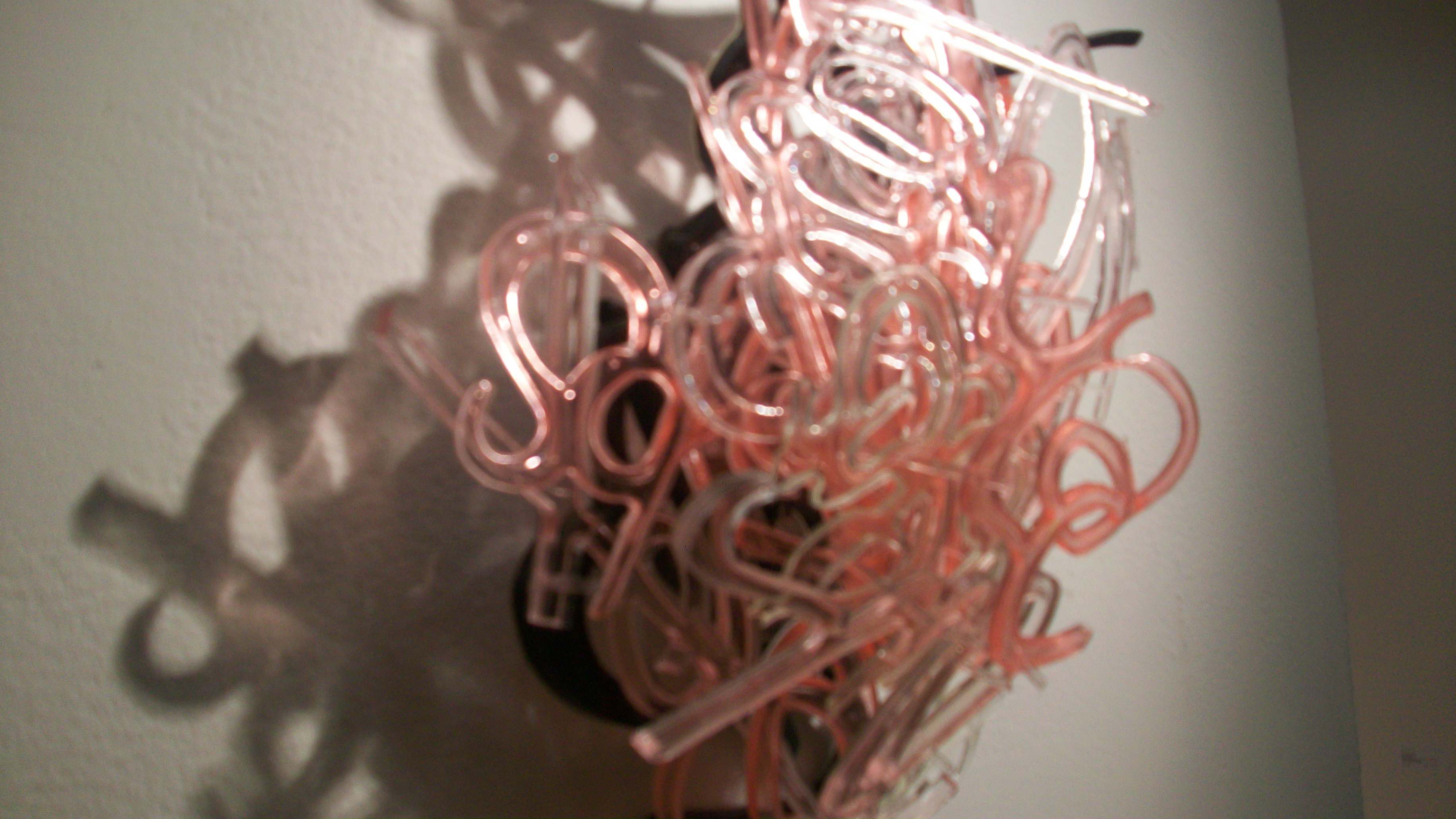
The immediate surface of the words come across as part of the form, and the text intermingles with the sculptural transparency. This already creates puzzles as we see only fragments of language, which, when viewed from a distance, create aesthetical form. When we step closer to the sculptures, the objects invite us to perceive them from different angles. Pink and black cast resin wall sculpture “She Looses her Temper”, is an example of Farhat’s sculptures that emphasizes the multiplicity of the form when viewed from various positions. As it comes to the emotional statements of texts, the ”pointiness” of words structure dynamic messages.
Philosophy is important element in Farhat’s artist statement:
“Words – written or spoken, understood or misunderstood, poetic or prosaic, curvilinear or rectilinear, are what motivate me to create my visual narrative. I am fascinated by how, through language, we understand a great deal about ourselves and surroundings, and how ideas: simple, complex and abstract, are conveyed and understood using symbols.” (Simeen Farhat)
Simeen Farhat, “She Looses her Temper”, 2014Simeen Farhat puzzles with languages, Pentimenti Gallery, VOLTA NY2014.
”Alice’s tears” create undoubtely the center of Simeen Farhat’s VOLTA installation. The blue teardrops in various sizes seem to flow effortlessly from the ceiling, pouring down from Alice’s eyes when she has grown tall. The viewer can imagine Alice, by experiencing the shades of blue in the sculptures, some of them so light-colored that they are almost invisible towards the white backdrop, some darker. The shapes also vary from softer and rounder to sharper ones, and they accumulate and reshape closer to the ground. The tears are seen differently depending on the lighting conditions; the shadows are creating part of the narrative too. Farhat has sometimes included textiles into her previous installations to reference the (female) ‘body’. For Alice, the handcrafted cast resin has worked miracles. Different blue shapes and sizes embody the space leaving room for imagination and story.
Simeen Farhat has exhibited in the United States and internationally, including Pakistan, London, the UAE, India, Finland and Germany. Her collaboration with Pentimenti Gallery will continue through 2014, and her solo exhibition will open in Philadelphia later this year.
In his photographic portraiture of the male body, Kari Soinio studies masculine corporeality, body language, sexuality and identity and looks at the ways perception and recognition operate through visual representations. His auto-portraiture-based work takes a critical look into masculinity and femininity in maleness, showing ambiguous bodies with traits of both and in doing so addresses and challenges masculine complacency and self-importance.
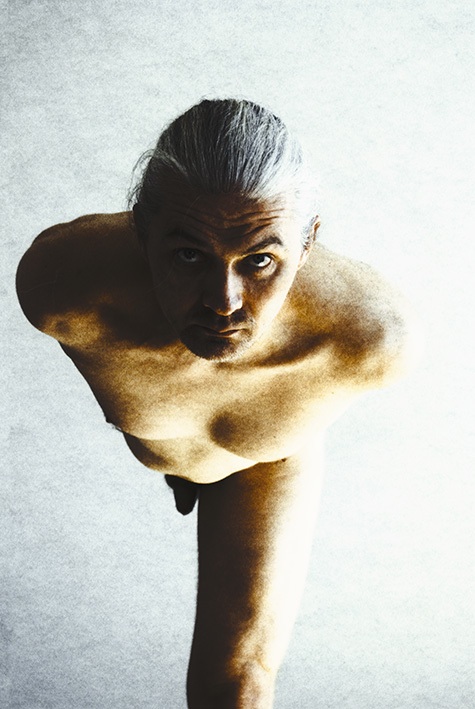
Kari Soinio, Athletic Hero #1, digital C-print, 2012
When looking at Kari Soinio’smale portraits, it feels relevant to ask, how do we actually portray the male bodies in general? Soinio’sportraits offer answers that are more subtle than loud. His work is more questioning than giving answers, more provoking than seducing, and more aiming to challenge than trying to frame simple answers. The presence in his photography is strong. The body in the images becomes the one, which is both looking at you as a viewer, and simultaneously makes its own subject the mysterious one. The portraits are saying, you can look at me now, but here is the movement, which does not create passivity of an object. The entire question could be played around the underlying theme of a ’hero’. I am a male as a subject for photography, and, therefore, when you label me, I’m aware of the multiplicity of the ways you are looking at me.
Generally, one can suppose, a man who is portrayed, stands for a cultural hero, often a superhero. We can imagine man and his sports, man in the wilderness, man in action, man doing his duty, man and the muscular body, man and a celebrity status, man and nature, man and the urban life, man and his gadgets, man in his clothing, man in his business suits. The list is endless when we think about it. In the Western art world, we tend to think a man of modernism is someone who is portrayed as part of the bourgeoisie. While he was posing, he came out as a dandy, as a flâneur, being mostly comfortable in his position of posing, being able to pose and gain gaze through a masculinity with substance (think of Oscar Wilde, for instance). Now, self-portraiture is an interesting sport itself, how to present your own body, how to create the gaze, how to, simply, pose?
How about a naked man? Is there a controversy regarding the subject? Seeing naked men in portraits is still quite a taboo outside the art-context. Perhaps, even photography and male nudity still have a quite fresh relationship. Even when the history of performance art and some theatrical traditions of avant-garde have exposed naked bodies as sites of performance throughout the past century, the subject matter still has the power to startle us. The human body and its performativity is a powerful tool enabling us to discuss society, gender, sexuality, identity, culture, power, class, race, beauty and aesthetics.
Kari Soinio, Athletic Hero #13, C-print, 2012
Body representations and questions relating to them, and to our ways of posing are without argument more often associated with women’s bodies. However, whether it is our bodies in advertising, in media, in television, in art, in fashion, in sports, in health and nutrition, we have opinions about our physicality. Our skin is reality. It is the window to our selves rather than what we aim to say, or how we wish to act. Our visually overexposed cultures tend to invite us to look at, to evaluate, to be seduced, to judge, to react to the lens. Yet, that is a very human characteristic. We are bodies, and we need to focus the conversation on what is our relationship to ourselves.
Kari Soinio says that his source of inspiration is the complexity of the male ’self-consciousness and body image’. This opens into many interpretations of the masculine essence in our culture, showing maleness through icons of male heroes. Soinio’s portraits discuss with these cultural images, yet they offer ways to look at the masculinity as a more vulnerable entity, which nudity already poses. Is his posing creating classic male bodies? In the ways the torso, arms, head, shoulders etc. are presenting shape and balance, yes. When it comes to mixing the color palette into the image, some of the more toned ones are definitely blurring the lines of the self. The rigid becomes more soft and round.
Is nudity a surface where naked male body transforms into something else than naked female body, because of the culture they impose? The latter is often a territory for many cultural signs, which note male gaze, voyeurism, sexism and pornography. Therefore, portraying women’s bodies differently is a constant challenge in the art of photography. The iconography of a male posing in pictures might offer a surface to investigate our bodies as sites for many identities, which are necessarily not just male. This play is of course available for ‘any-body’ regardless of gender. In Soinio’s photographs, the viewer can see a body that is in and out of balance. The portraits do not fit inside their frames, they want to step out. From this viewpoint, the naked heroism is within our acceptance of our body as a spirituality. We might see the human body as part of nature, part of yoga-culture, part of wellness and balance. The nature-body communicates across the simple boundaries of gender. Our bodies are aiming to balance and be off-balance. The experience as the viewer is to kinesthetically feel together with the portraits, and move outside the frames.
…Kari Soinio is a New York based artist working mainly with photography. He received his BA from the Lahti Polytechnic in his native Finland and his MFA from University of Art and Design in Helsinki. He has also studied at the International Center of Photography in New York…
Kari Soinio has recently shown at Storefront Bushwick in NYC (2013), at Heino Gallery (2012) and Korjaamo Gallery (2011) in Helsinki, at Northern Photographic Center in Oulu (2011) and at several galleries and museums in Finland, including numerous shows at the Museum of Contemporary Art Kiasma and Finnish Museum of Photography in Helsinki. His monograph “From Landscape to Place” was published in 2009 in conjunction with shows at Heino Gallery and a mid career survey at Kerava Art Museum. His show at the Institut Finlandais in Paris was part of Mois de la Photo in 2010 and received significant attention from the French art press. His work has been shown internationally in the US and in Europe: at Mappin Art Gallery, Sheffield, England, NGBK gallery, Berlin, Germany, Arthouse, Sofia, Bulgaria, Ludvig Museum, Budapest, Hungary, Signe Vad gallerie, Copenhagen, Denmark, Peer Gallery, New York, USA, Gallery Papatzikou – Photobiennale Thessaloniki, Veroia, Greece, Ingrid Hansen Gallery, Washington DC, Municipality of Neapolis Gallery, Thessaloniki, Greece, and Kakelhallen, Mariehamn, Åland. Soinio’s work has appeared in NY Arts Magazine, Connaissance des Arts, l’Humanite, Réponses Photo, Art Actuel, La Tribune, Next Level and in numerous books, newspapers and TV programs in Finland.
Gallery Information:
Station Independent Projects organizes exhibitions and events with a focus on artist advocacy. It is located in Lower East Side.






 Firstindigo&Lifestyle