Tag: Helsinki

  • Kamppi Chapel of Silence in the World Design Capital 2012

    Kamppi Chapel of Silence in the World Design Capital 2012

    Kamppi Chapel of Silence opened in May-June 2012 and immediately became a Helsinki World Design Capital architectural landmark. It has become a huge tourist attraction with thousands of visitors coming to see it on a weekly basis, and the architecture has gained international following. The Chapel is designed by the K2S Architects, and is built by the Evangelical Lutheran Church of Finland. It is a collaboration of the City of Helsinki and the Church. Kamppi Chapel of Silence is a unique concept in Finland, being a first of its kind.

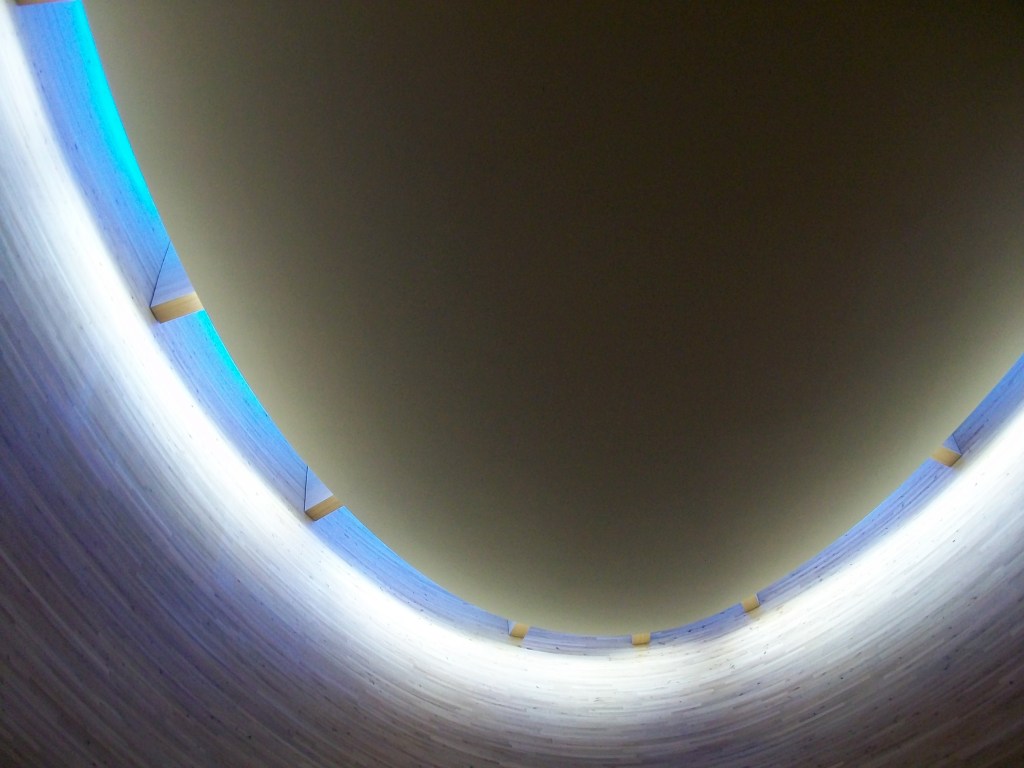
    The Chapel was nominated for the European Union Prize for Contemporary Architecture Mies van der Rohe Award. Nordic Architecture and Design Magazine FORM chose it as the building of the year within Nordic countries. The architectural shape brings in mind, for some, ideas of Noah’s ark, and for others it reminds them of egg or bowl shapes. What is extraordinary about it, is the element of cutting out the sounds of the city. When you enter the space you have come into contact with silence, and you are isolated from the urban mayhem. The Chapel entrance hall is designed for encountering people, there is a service desk for the staff to meet with the community and visitors. The Church offers prayer services and communion, but it does not offer the usual congregational services like weddings and funerals. Its main focus is to be open for people and to assist the surrounding areas. The professionals in the Chapel encounter and help visitors and even meet the youth hanging out in the shopping mall area. This sometimes means dealing with usual social problems of public spaces.

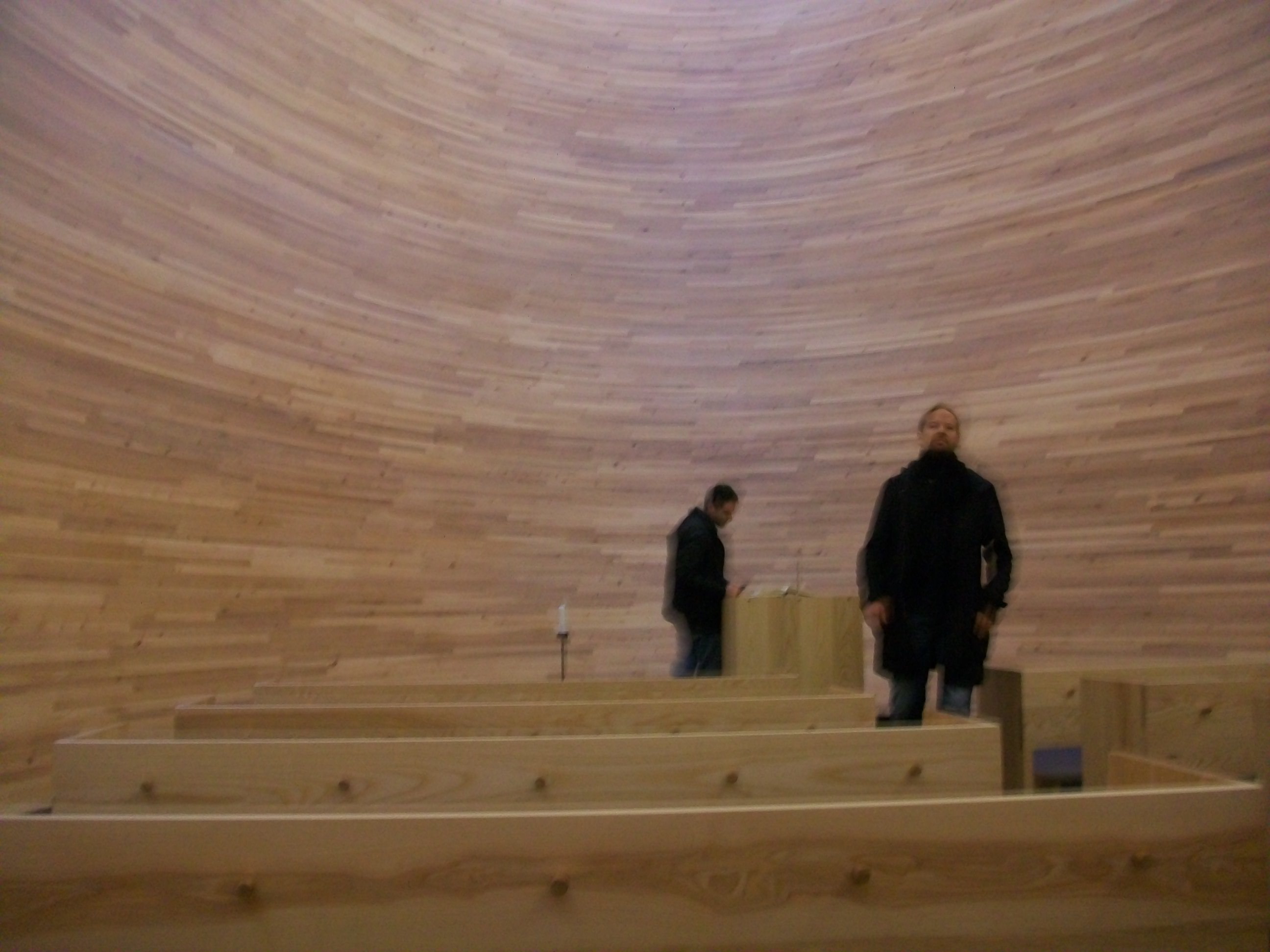
    The building brings in natural light during the daytime. The rest of the lighting is created to keep this natural balance. The lighting is operated by sensors, which adapt to human movement. The Chapel interior is made of alder, with common alder planks cut to shape, the benches are made of ash tree, and the exterior is made of horizontal spruce strips, which are bent at different radiuses. The exterior wood is glazed with a special wax that utilizes nanotechnology, and its frame is prepared of massive glulam beams, which were cut to shape. The exterior consists of 30 kilometers long of the material. The World Design Capital was launching a theme for innovative wood architecture, as it is more ecologically sustainable in the times of the World’s ecological crisis.

    The acoustics are fantastic for musical performance, however there is no room for an organ.  It would be ideal space for baroque ensembles to perform, for instance. The most important concept of the Chapel is to be a service desk for both the locals and travelers alike. The doors are open for anybody to enter either to stop by or spend some quiet time there. The Chapel is located in the middle of the Kamppi market square, which incorporates a big shopping mall and a metro station. The area has hotels and museums nearby so it invites tourists and international visitors. Overall, the square is an ideal location for the Chapel, since it is an intersection of the cultural and the leisurely, bringing in people from all parts of the city. The Chapel itself is a small gathering place holding the most 60 people.

    The City of Helsinki implemented that the World Design Capital projects come up with ideas of service design. Part of the thinking of the design is that it is embedded in the everyday life of people, and it can be more than just objects, material things and products. Design can be experiences, and it can encourage communities to create, to meet and come together, to influence and serve others. When this idea is brought together with architecture it adds another layer of the human experience. Good architecture is there to serve communities, and create meeting points in the busy city-life. The Kamppi Chapel employs professionals from the City and from the Evangelical Lutheran Church of Finland Helsinki parish, employing twelve people.  A pastor and a deacon, a youth social worker, two ushers, and the manager are employed by the Church. The city employs two social workers, two social instructors, and two cleaning professionals.

    inka

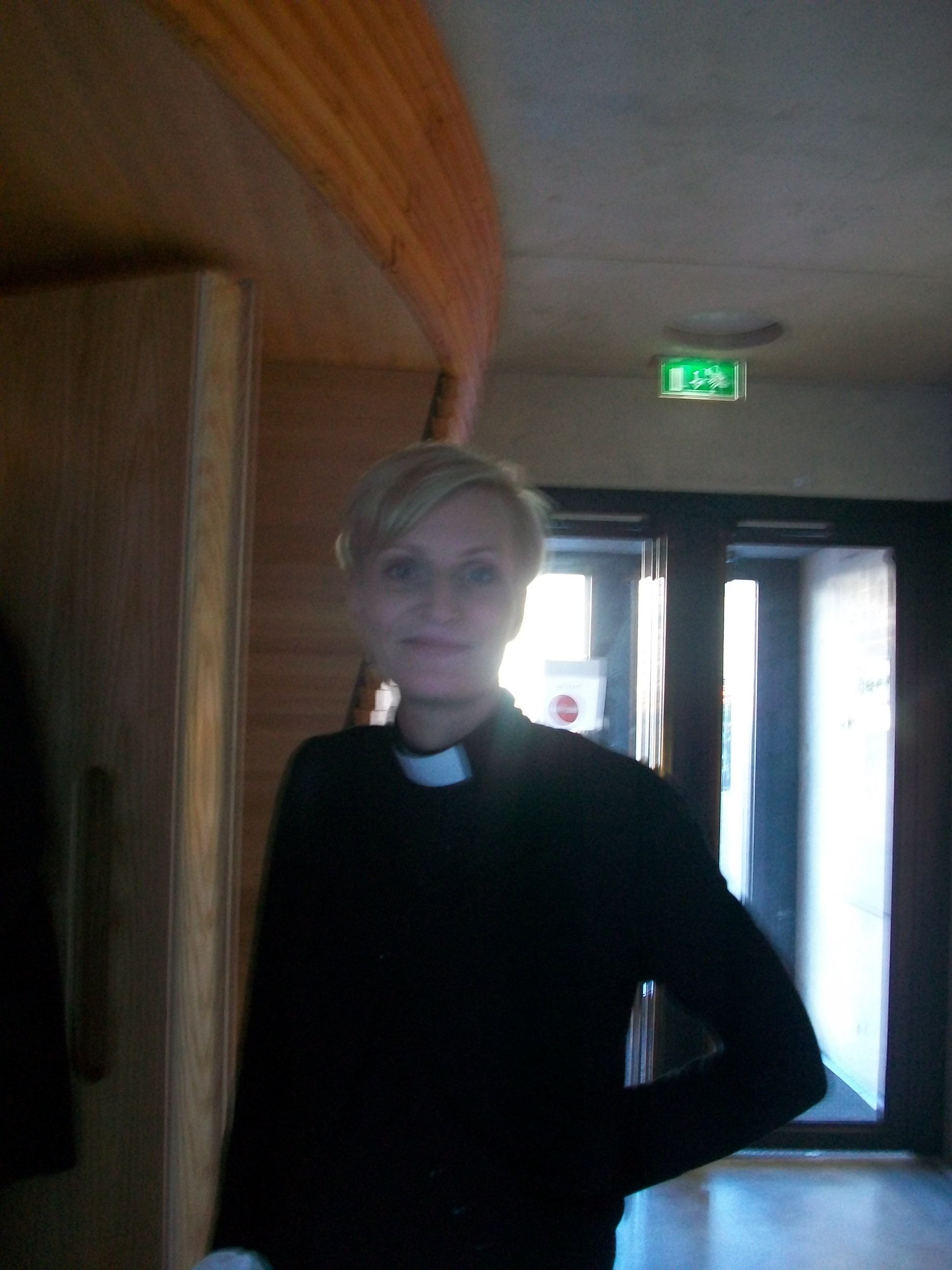
    Pastor Nanna Helaakoski


    December 12, 2012, was a special day for the Kamppi Chapel. 12.12.12. was commemorated there with several weddings in the Chapel. This is an unusual occasions, so I spoke to the Chapel’s pastor Nanna Helaakoski about it.

    – The December 12, 2012 was made a theme day of weddings at the Chapel. We had 16 couples to celebrate their wedding ceremonies. For some of them it was more important to get a rare chance to be married in the Chapel, than to emphasize the 12.12.12 as a special wedding day.

    Websites: K2S Architects Ltd. www.k2s.fi/

    http://www.helsinginkirkot.fi/fi/kirkot/kampin-kappeli

    WDC Helsinki 2012 wdchelsinki2012.fi/en

    (Update: Mice family living in the Kamppi Chapel moved to nature. Pastor Nanna Helaakoski assisted them. The following video was published on Jan 16, 2013 by Kotimaa24:n production’s Päivikki Koskinen and Katri Saarela, 2013.)

  • ‘New Nordic Oddity”?…and other design definitions

    ‘New Nordic Oddity”?…and other design definitions

    What I find very intriguing in the current design-discussion, is the questions of how we signify the things, and how we see the world-object -relations from different points of view. What now seems timely, is to define and differentiate ourselves as consumers with more softer values. We are ‘humans’ after all, meaning that we are responsible of the planet, therefore, what kinds of significations we give to the things and objects in the era of mass-production is crucial. How we consume, how we define what we consume, how we differentiate things, adds value to the objects. The meaning-systems behind the branding of products are referential, but they are also truthful from the point of view that they engage our participation in the entire definition-game. As it is also true that what kinds of nouns and adjectives we give to the objects, puts them on the market more.

    Where comes a need to define the objects, which we use, which surround us, and so on? A question is relevant in relation to design, since we incorporate the objects in our daily lives. That is the pre-value of the design. ‘National’, or should we say ‘regional’ or ‘geographical’ instead of a national as we share a global world, is attached to the design-products, and calls for several attributes. This is strongly the case in the branding of Finnish design. Let’s look back to 2008.

    The summer of 2008 generated an exhibition of Finnish design in the Helsinki Design Museum. The exhibition was called Fennofolk-New Nordic Oddity. One of the exhibit curators, professor Timo Salli from the University of Art and Design in Finland, told the newspaper Helsingin Sanomat that the Fennofolk-New Nordic Oddity -exhibition aimed at honoring the local Finnish culture. It tried to find “weapons” from the Finnish culture. Additionally, Salli mentioned that the show was not trying to bring in the latest trends from Paris to be shown “too late” in Finland, but when viewed from the “Slavic-urban” perspective, the contents were precisely that of the “national romanticism” (Pöppönen/HS 11.6.2008).

    In the interview, it became evident that the fennofolk idea had been invented couple of years prior to the show together with Salli and co-artists Jari Leinonen and Paola Suhonen (founder of Ivana Helsinki brand). Fennofolk-New Nordic Oddity displayed works from 80 different artists, who deployed a great variety of media in their works, not just birch and birch bark, which are the traditional folk art materials that Salli himself used in his exhibition designs.

    What inspired me immensely about the show itself, and what also captured my curiosity when I read Salli’s interview,  was the idea of design branding; the core idea of how we choose to define the objects and things, give them certain value. And look at them in respect to our own pasts, weather it is local histories or our own experiences in Finnish forests, for example. The beauty of the Fennofolk-New Nordic Oddity is hidden in the paradox. Finland is, first, a culture of the ‘fenno’, what ever that means. At least it comes with the traditional methods of designing the birch. Second, Finland seems to represent in the design imaginings some kind of New Nordic or Northern Oddity, which could mean something Nordic (as it is part of the Nordic countries) and then something New (as exiting?). What remains is the definition of Oddity. A question remains, what would that be? How do we define Oddity in relation to Finland and its designs?

    Helsinki World Design Capital might come up with some answers…

    See also Paloni Designers on this blog

  • Follow me to the forest

    Follow me to the forest

    It is time for Helsinki Design Week (HDW). We are impressed that the locations include the Old Customs Warehouse. There will also be a fashion show in the brand new Helsinki Music Centre (designed by LPR-architects Marko Kivistö, Ola Laiho and Mikko Pulkkinen). Finnish people love their music, also for the reason that Finnish music has gained world class reputation with our composer Jean Sibelius. After Sibelius, of course, several other 20th and 21st century composers have turned into the unique sounds, which have defined Finnish art music. Perhaps one definition for the musical trends could be a word ‘moody’. It is quite easy to pin it down when one listens all the brass-instruments in Sibelius.

    The new Music Centre stands in a row of other remarkable buildings along Mannerheimintie-road, which honor Finland’s musical tradition and the local arts. Next to the new construction is Alvar Aalto’s Finlandia Hall with its beautiful white marble walls. The modern classic stands out as a continuum of (evolving) organic shapes within the city landscape. Then, a little away from the center is the Opera House, which opened in 1993. The Bauhaus-inspired building was designed by prominent HKP-architects Eero Hyvämäki, Jukka Karhunen and Risto Parkkinen… As going towards the city center along Mannerheimintie, the Music Centre shares an outside green area with Kiasma Museum of Contemporary Art, Designed by American Steven Holl Architects, the museum opened  in 1998.

    During the Helsinki design week, a fashion dimension is added to music. As a result we have an interesting Nordic-Finnish combination of performativity.  Like the musical tradition, Finnish design can be associated with some unique factors. The design and architecture take inspiration from the nature. It makes sense as the country is filled with so many forests and lakes. The nature functions not only as a source of inspiration for design patterns, but it also offers concrete materials and structures. The use of a birch tree and birch bark has been common since traditional times, for example. Birch bark was used in folk designs, and it still continues to define some of the Finnish design, which has taken new forms.

    In 2010, I started imagining the future World Design Capital. How to picture one’s own hometown as a world design capital, how to find the paths, buildings, and all the details and different perspectives, which all are true and necessary in the mixture; to represent Helsinki as a place with rich history?  One important step is to acknowledge our own design potential in the ways we perceive our everyday lives. To see all the creativity in the everyday life.  Finally, remembering Helsinki’s amazing location and closeness to nature is a surplus to the small capital. If one does not want to take one of the cruise boats to Tallinn or Stockholm, at least a trip to one of  the forests and national parks is a must!..As much as there is also international art on display (2010 there were sculptures of Manolo Valdes, picture above), and beautiful natural and man-made design around, there are also landmarks with so much historical value. This prehistoric grave is just a mile away from the city center.

    see more about Helsinki architecture in this blog