Tag: installation

  • Anri Sala’s musical mystery

    Anri Sala’s musical mystery

    “Anri Sala: Answer Me” -exhibition, which will be on display at the New Museum until April 10th, 2016, features multichannel audio and video installations. In his recent works, Albanian artist Anri Sala has interpreted musical compositions, classical works so to speak, with experiments that are structured into video and sound installations. The monumentally compound works navigate through the limits of our perception; mapping the sound and the spatial, and investigating the sound in the architectural spaces. This experiment transformed New Museum floors into symphonic areas of soundful meaning, leaving room for small encounters.

    Anri Sala’s often political works have tested the boundaries of sound and language in our construction of cultural realities. From cultural point of view, his works seem to investigate contexts that are outside the dominant aspects of reality. Or the realities are rather revealed through the layering of world of sounds. We have adopted a notion that the words create the meaning in our cultural communication. Yet, as Sala with his approaches has shown, it is possible to challenge this definition further by mapping and deconstructing the terrain, in which words actually restrict our ways of interpreting or seeing the world. From this perspective, the everyday life is full of noises that communicate without restricted syntax. Sound, form this point of view, has a great capacity to alter meaning.

    Sound’s features are attached to the material world that is so close to music. For Anri Sala, sound plays a role of an incomplete music, or music, which is in the state of becoming. Sound as a mediating device – even when it is real musical pieces divided into fragments – can document and edit reality, and communicate on a new level of poetic composition. This becomes immanent through the artist’s works, which New Museum profoundly projects. What stays with the viewer, is the personal corporeal experience, which is created in the architectural space as the entirely new perception. The change in the reception of the artistic works is focally in the embodiment. The surrounding sound world invites the viewer to walk into the next room full of sound. Or it freezes on the threshold, making the mystery of the sound’s origin more significant.

    Fragmentation and repetition is evidential in Sala’s second floor installation. The work unfolds as a two-channel HD video from 2014: ‘The Present Moment (in B-flat)’. This installation depicts different interpretations of an original compositional score by Arnold Schoenberg, titled ‘Verklärte Nacht Op. 4’ (1899).’ On the video, the chamber music setting acts as a fictional rearrangement of the historical work. Two videos feature a sextet of two violins, two violas and two cellos that play solitary notes from the musical work. Eventually the original musical score unfolds. The audio-visual installation works powerfully on two separate screens absorbing the body of a viewer into its mellow soundscape. The intimate portraits of the musicians, the movements and gestures of their heads, hands, arms, and backs, act as counterbalance to the interior, in which their playing has been recorded. The setting of empty room or hall creates an atmosphere of a vast space that accumulates sound on multiple stages. Sala’s meditative and mesmerizing piece truly puts an emphasis on the present moment.

    Upstairs, at the fourth floor of the museum, is a presentation of Anri Sala’s installation ‘Ravel Ravel Unravel’, from 2013. This is the work’s US premiere, it debuted in 2013 at the 55th edition of the Venice Biennale, where the artist represented France. In the title work ‘Ravel Ravel’ (2013), Sala reinterprets Maurice Ravel’s ‘Piano Concerto for the Left Hand and Orchestra in D major’. The composer created the composition in 1929 for an Austrian pianist Paul Wittgenstein, who had lost his right arm during the World War I.

    The museum space, in which the ‘Ravel Ravel’ video is installed, is designed to absorb sound and prevent echoes. In this chamber like room, there are two unique and separate performance interpretations of Ravel’s composition taking place. The musical echo is produced with ‘in and out of sync’ parameter, as two simultaneous performances measure temporal dimensions. The two pianists gradually shift out of unison, they are projected with their performances with two different orchestras. The one might evolve slightly different from the other, creating a minimal echo. Shifting between doubling notes and echoes creates the difference of the entire work, leaving the spectator paralyzed and in awe.

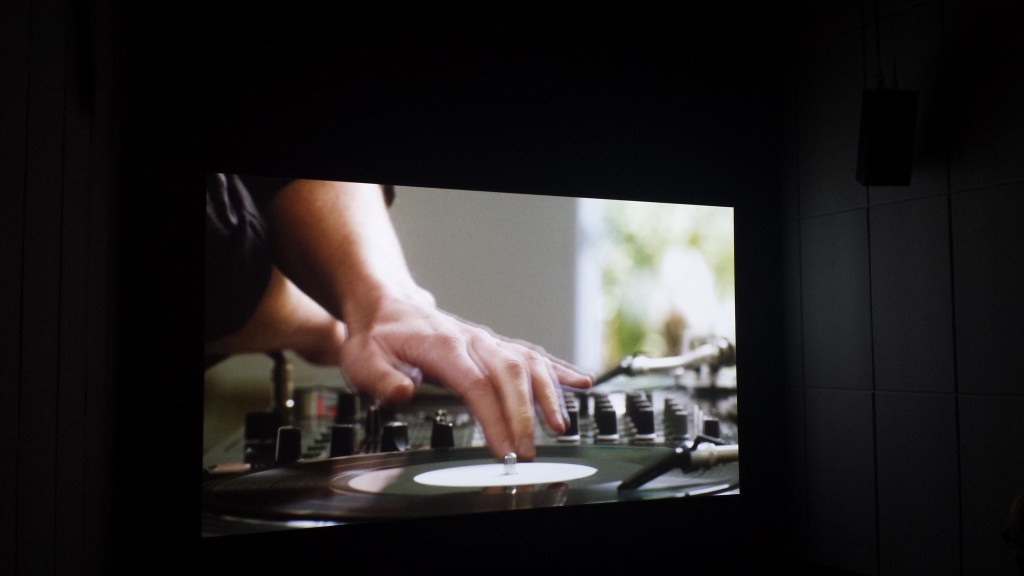
    Sala’s work contours in time, with tempo variation and within the space that has left no chance for error. The other video in the fourth floor being part of this work is titled ‘Unravel’, 2013. It debuted at the Venice Biennial alongside ‘Ravel Ravel’. ‘The Unravel’ video presents DJ Chloé Thévenin who takes part in the manual and physical manifestation of these two concerto recitals. She has the performance recitals on two turntables, in which she accelerates and slows the records in process. Fascinating, a visual turnout of the concerto sound in a new gesture.

    More info about the artist and the current exhibition “Anri Sala: Answer Me” :

    Hauser & Wirth about Anri Sala

    The exhibition info at New Museum
  • The magic of Hanji

    The magic of Hanji

    Re:visioning HANJI exhibition showcases artworks made from Korean traditional paper hanji.  Two artists, Ran Hwang and Aimee Lee, have each developed their own contemporary aesthetics and styles based on the traditional modes of mastering the paper in artistic forms.   The exhibition is on view until March 31 at the Korean Cultural Center in New York, and connects to the Asia Week New York.

    In the old days, the masters of the Korean paper manufacturing were called jijang. This profession was proudly inherited and passed on to the next generation. The art of Korean paper making is a complex production process starting with a fiber of mulberry tree. It has developed into multiple use of materials and techniques that are still valid today. Historically, paper was not only applied into books, but its role was more daily as functional material in architecture and clothing. It was also part of making calligraphy, painting, money and armor. The remarkable part of early Korean paper manufacturing was connected to Buddhist scriptures.

    The paper process starts with harvesting. A year old mulberry fiber is harvested during the time of November – February, when the plant has enough moisture and the fiber is soft. The skin gets steamed right after harvesting to make a peeling process easier. The entire making is ecological and does not harm nature in any way. After washing and drying, boiling, and peeling cycle, the fiber is used to make hanji. Then the project involves beating the fiber so paper will become thinner and tougher. Finally, the fiber needs to be dissolved and sieved into paper.

    Jiseung is an indigenous art form that Koreans have practiced for hundreds of years. It evolved from hanji; when books were printed and bound, the trimmed edges were saved and used further in making baskets and decorative items. The paper rope became popular, because it was softer than straw, but as strong, and available for use. Many of the traditional pieces have gotten lost through wars and modernization. Yet woven hanji artifacts still include everyday items such as shoes, baskets, wallets, backpacks, and lanterns. For young Korean-American artist, Aimee Lee, the idea of 100 percent hanji includes making the paper herself. She then weaves and naturally dyes the materials used in the artworks. Eventually her objects take a form from the traditional dimensions, gestures and environments. Lee says that her pieces borrow from the historical artifacts. The wedding ducks, which were traditionally given to Korean bride and groom, are one example of this long history. The artist plays with the proportion and shapes creating unique contemporary versions of the objects. She states that none of the original materials went to waste, because paper was so durable and labor intensive to make. Repurposing the paper is a way to connect to the tradition and stories. Paper was carrying secret messages during war. People made sandals out of civil service examinations and other certificates.

    My main material is paper and my central concern is how we use it. I make paper with abundant native and invasive species, which involves harvesting plants, stripping and cooking, processing into pulp, forming sheets, and drying. With this paper, I make thread, sculpture, books, drawings, prints, installations, and performance components. Aimee Lee


    Aimee Lee, objects from Hanji Ducks and Pot -series. Corded and twined hanji.
    Aimee Lee, objects from Hanji Ducks and Pot -series. Corded and twined hanji.

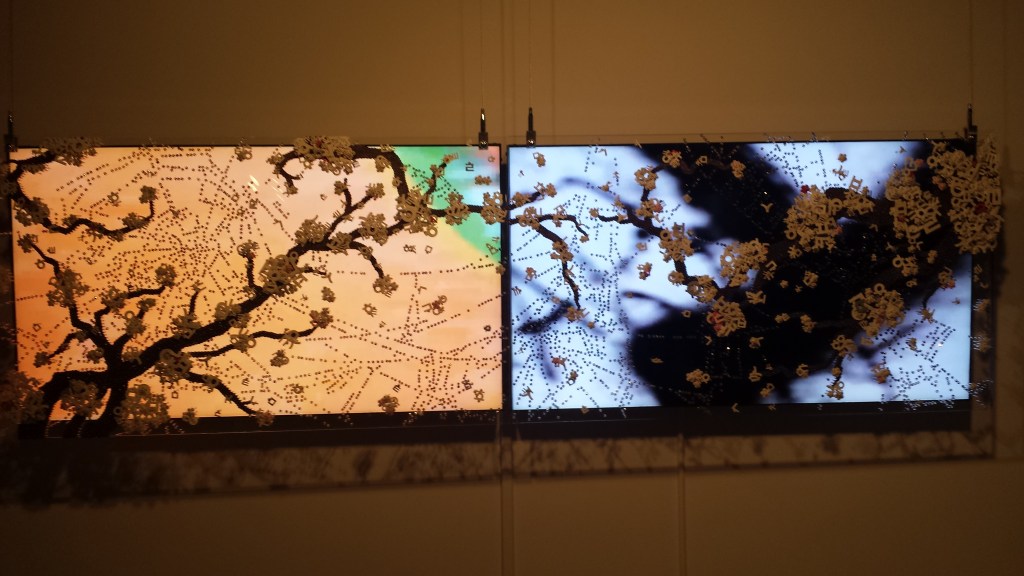
    Korean-born, internationally acclaimed installation artist Ran Hwang creates poetic pieces out of materials that are deployed in fashion industry. She uses handmade hanji buttons to create monumental pieces in installations that display iconic images. Her 9 feet tall work that displays Eiffel Tower and Triumphal Arch, required hours of securing handmade materials on plexiglas panel. The Beginning of the Bright piece, includes also Hangeul, the Korean alphabet. The work was displayed in Paris at the UNESCO headquarters to celebrate Hangeul’s designation as world cultural heritage. For Hwang, the lengthy hours of making the works means hammering each button on pins for approximately 25 times. The work is like meditative ritual similar to those of the zen-masters who concentrate on their practice for hours at a time.

    Ran Hwang, The Beginning of The Bright. Hanji Hangul Buttons, Pins on Plexiglas, 2015. 86.6 x 106.3 inches.

    Hwang creates three types of series, including, the plum blossoms, the birds and spiders, and architecture. The blossoms refer to ephemerality, to the endless circulation of life, which flowers depict when growing and falling. Architecture, like palaces, are symbols of power, which in the art also imply tragic events like invasions and deaths. The small creatures, birds and spiders, represent states between restriction and freedom, implying a constant flux and wandering in life. The artist states that all her work is in a state of fluidity. Nothing is fixed or permanent. The art evokes a dialogue between fleeting and the eternal.

    Ran Hwang, Contemplation Time, Paper Buttons, Beads, Pins on plexiglas, 2014.


    The combination of endurance and ephemerality is at the heart of my choice of using buttons as the primary medium. I hammer thousands of pins into wooden or acrylic panels with my bare hands. The process of creating these large installations is time-consuming, repetitive, and labor-intensive. Thus, the production process is a meditation for me to visualize a cosmological amount of time, and de-installation process is to end the cycle of life and start a new cycle.  Ran Hwang


    Ran Hwang: http://www.ranhwang.com

    Aimee Lee: http://aimeelee.net/

    Korean Cultural Center: http://www.koreanculture.org/

  • Janet Echelman’s 1.8

    Janet Echelman’s 1.8

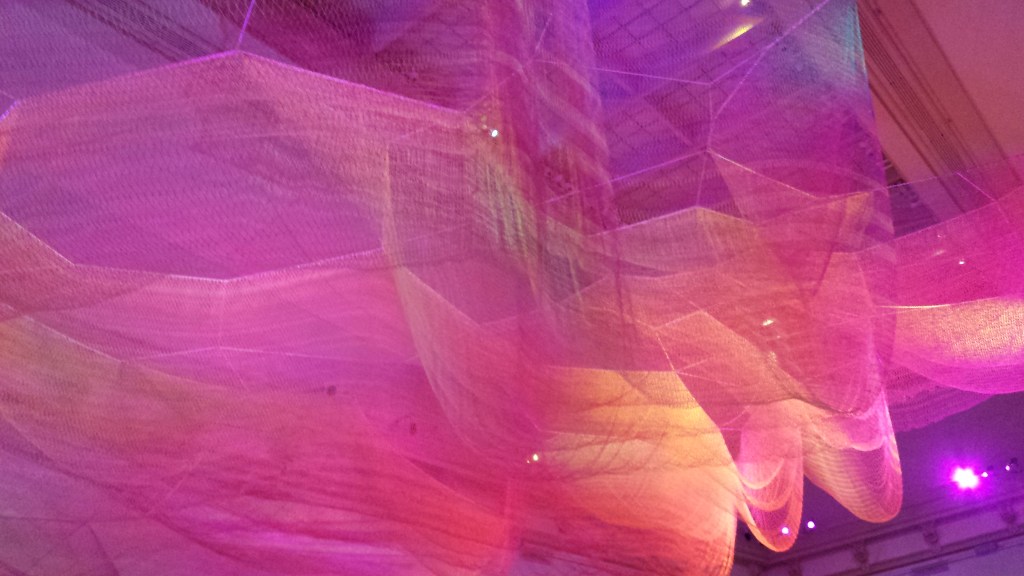
    WONDER exhibition celebrates the Renwick Gallery’s reopened spaces. The museum’s new statement is to bring the future of art into its program. It is now confronted with large-scale installations by nine artists. Janet Echelman is one of them with her piece 1.8, (2015). A large suspended net glides across the ceiling of the Grand Salon, which is located upstairs in the museum. The work is composed as knotted and braided fiber with programmable lighting and wind movement, above a printed textile flooring. Echelman’s sculptural installation speaks in relation to a map of energy released through the Pacific Ocean, when Japan’s Tohoku earthquake and tsunami took place on March 11, 2011.  The title of the work implies the 1.8 millionths of a second,  which measures the earthquake as it shifted the earth’s axis.

    Janet Echelman’s 1.8, 2015 from Firstindigo and Lifestyle on Vimeo.