Tag: museums

  • Bildmuseet poses strong perspectives in Umeå

    Bildmuseet poses strong perspectives in Umeå

    A tree blossoms, meadow is green, horizon is filled with stillness, which is almost touchable. The rich video footage by Jumana Emil Abboud narrates without noise. Palestinian artist, who lives and works in Jerusalem, uses video and audio to add into other mediums of storytelling. For her exhibition in Bildmuseet, The Horse, The Bird, The Tree and The Stone, the artist has added murals, and included drawings and sculptural objects to create installations that open up about personal and communal memories and losses. Her art handles belonging and peoples’ attachments to territories. For her project, she has visited sites, which carry haunted memory of the past. The artist visited wells and other water sites that no longer exist, but are retold in the oral history. Abboud’s current artwork carries magical components that mix with reality. The imaginary intertwines with researched material, which both influenced the art. The artist has collected stories and reinterpreted fairy tales from new perspectives. She used a story of Rapunzel, for example, to imagine lives of Arab women from a domestic point of view, to make it a women’s story that has universal visibility and resonance.

    Abboud was born in Shefa-‘Amr, Galilee and moved to Ontario, Canada with her family. After returning back home, and moving to Jerusalem, she encountered personal questions of belonging, and started making her journey towards finding her own connection to the place. Her exhibition at the Bildmuseet, asks through visual images and oral performances, what the personal and collective memories can be, and what the myths can tell us about ourselves and our history. What stories connect us to the places that we live in?

    Jumana Emil Abboud's videostill in Bildmuseet exhibition.
    Jumana Emil Abboud’s videostill in Bildmuseet exhibition.

    Abboud’s three-channel video installation Hide Your Water from the Sun (2016), goes back to 1920. The video is based on a study by ethnographer Tawfiq Canaan who dived into the Palestinian customs and folklore. The ‘haunted locations’ presented in the study, connect to multiple water sources, which are inhabited by demons, good or bad. Abboud visited these locations together with cinematographer Issa Freij. The original wells and springs pointed in the study have disappeared.  The artist applied the notion that in the Palestinian traditions the haunted or blessed sites become activated with storytelling and through fairy-tale practices.

    Upon returning home as a young adult, the artist did not feel connection to the place called home. She found a new connection by looking at the landscape, which played an important part of her childhood. It acted again as a direct link to her past. Abboud had also experienced stories as a child. The stories were not written down, so she wanted to ask questions about them and find out, how the political layer attached to Palestinians had pushed the oral history down. In her mind, the landscape related to all the stories told about the people, creatures, monsters and goblins. Landscape related to the past, and what she had learned as a child, but also to collective memory, which belonged to others as well.

    Abboud’s artistic whole, The Horse, The Bird, The Tree and The Stone, relocates the disappeared landscape, which went through alteration and changes of infrastructure. Many of the original sites have been buried. Only the older generation has memory of the haunted sites. Abboud’s installation include film, drawing and painting, reflecting the journey to the past that confronts the current political reality. The artist has also created recent performances out of the Palestinian folktales, which connect to contemporary life-stories of the people.

    ***

    More info about the exhibition at the Bildmuseet

    Besides Bildmuseet, Umeå, Jumana Emil Abboud has had solo exhibitions in Tel Aviv and in Switzerland, among other places. Her work has been exhibited at venues such as the Istanbul Biennial (2009); Acción! MAD-Festival, Madrid (2010); Sharjah Biennial (2011); Bodies that Matter, Galeri Man, Istanbul (2013); the Venice Biennale (2009, 2015); Baltic, Newcastle (2016); and Kunstraum, London (2016). Bildmuseet represents artist’s first major solo exhibition in Scandinavia.

    Bildmuseet.
    Bildmuseet by Henning Larsen Architects in Umeå University.
  • Bettina Pousttchi explores world time and architectural history in east coast premiere

    Bettina Pousttchi explores world time and architectural history in east coast premiere

    Bettina Pousttchi is a Berlin-based artist working in photography, video, and sculpture. German-Iranian artist studied at the Kunstackademie Düsseldorf, and participated in the Independent Study Program at the Whitney Museum of American Art in New York from 1999–2000. Pousttchi has exhibited throughout Europe, including Amsterdam, Berlin, Köln, and London, and participated in the Venice Biennale in 2003 and 2009. She held her first U.S. solo exhibition in 2014 at the Nasher Sculpture Center in Dallas, Texas.

    Through photography and sculpture, Bettina Pousttchi is interested in altering architectural buildings and monuments as indicators of the past and media of remembrance. Currently, the artist exhibits in two different museum spaces in Washington D.C. First exhibition titled Bettina Pousttchi: World Time Clock is on view until May 29, 2017, at the Smithsonian’s Hirshhorn Museum and Sculpture Garden filling the museum’s third-level inner-ring galleries. Concurrently with the World Time Clock series, The Phillips Collection presents her second D.C. appearance with the works titled Double Monuments. This exhibition by Bettina Pousttchi  is on view until October 2, 2016.

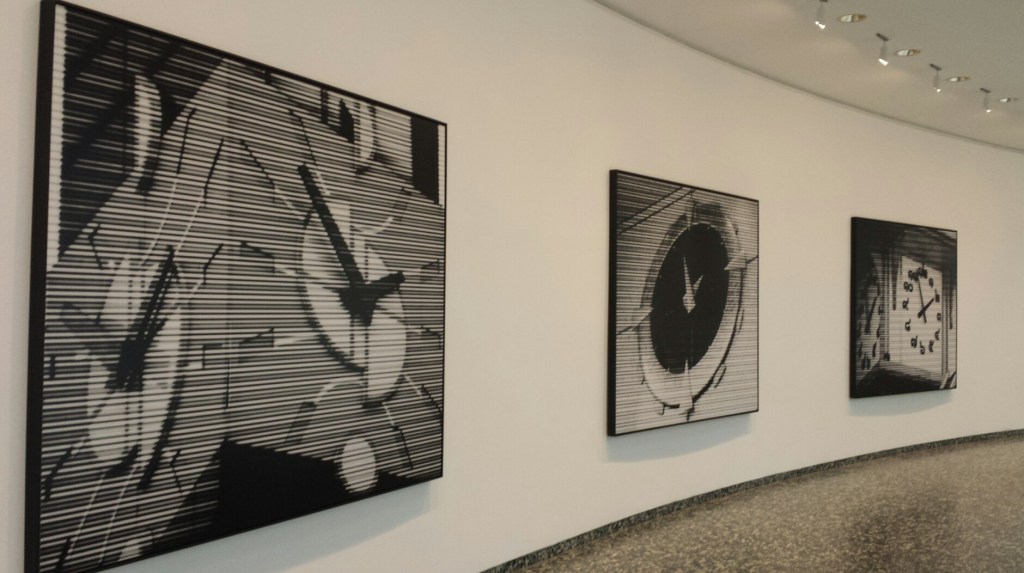
    Pousttchi’s exhibition at the Hirshorn is a premiere of her World Time Clock series, a project the artist began in 2008 and recently completed. The installation consists of a group of photographs that she created in 24 time zones around the globe over the last eight years. The artist has often contemplated systems of time and space in her art. To accomplish the World Time Clock photography, she traveled the globe capturing a portrait of a public clock in each time zones. In the final production, represented are locales far apart from each other, such as Bangkok, Moscow, Los Angeles and Tashkent, Uzbekistan. The circular format of the Hirshhorn’s inner-ring galleries on third floor works well with the theme of this exhibition.

    Bettina Pousttchi's World Time Clock at the Hirshorn's third floor is on view until May 29, 2017.
    Bettina Pousttchi’s World Time Clock at the Hirshorn’s third floor is on view until May 29, 2017.


    The photographs each show a clock displaying the same local time: five minutes before two. Together the images suggest a sense of suspended time and what the artist calls “imaginary synchronism.” Seen in close-up, the clocks are united in a single scheme that calls to mind the historic role of Washington as the site of the International Meridian Conference in 1884. It was here that the Greenwich Meridian was adopted as a universal standard, determining a zero point for the measurement of both longitude and time.

    Bettina Pousttchi’s second display, on view at the Phillips Collection until October 2, takes on from the notion of history and memory of architecture. The exhibition is part of the Phillips’s ongoing series Intersections, which interestingly highlights contemporary art and artists in conjunction to the museum’s permanent collection, history, and architecture. With her works Double Monuments for Flavin and Tatlin (2013), Pousttchi is in conversation with art and architectural histories, addressing the historic works of Russian Constructivist sculptor and architect Vladimir Tatlin from the 1920s, and American minimalist artist Dan Flavin from the 1960s. Pousttchi’s sculptural installation is composed of materials deriving from street barricades, and metal crowd barriers, which the artist transformed into sculptural forms. The objects create contrast and volume with neon that grows inside the powder-coated abstract forms. The sculptures include spiraling neon light tubes reminiscing those fluorescent light works created by Dan Flavin. The five sculptures range from 5 to 12 feet creating dramatic presence and enhancing both sculptural form and architectural setting at the Phillips. Their tower-like shape is a homage to Tatlin’s sculptural works, yet they have a theme and form of their own. Pousttchi’s works carry an idea of mystery of bringing in outdoor elements into the white gallery space. The white paint creates sophistication out of the raw urban elements while neon makes them settle somewhere in between the indoors-outdoors -scale.

    Bettina Pousttchi Double Monuments
    Bettina Pousttchi with Double Monuments on view at the Phillips Collection.
  • SFMOMA Serendipity

    SFMOMA Serendipity

    The opening of a new expansion of the SFMOMA art museum was celebrated just a couple of weeks ago. The intention of the new Snøhetta designed museum, is to increase public access to the museum by creating more room for education for the arts and related fields, to bridge the gap between the exhibiting gallery spaces and unticketed areas, as well as connect the outdoor spaces around the museum. More room to hang out, to meet, to educate, to inspire and to be inspired. SFMOMA opened at its current location in 1995, when the construction was designed by Mario Botta. For the reconstruction, Snøhetta design team had a challenge to double the gallery spaces, and help create a museum, which is a hub for new things to emerge. The refurbished museum aims to bring together American and International arts, while the collections span through gestural modernism and conceptual art, to the emerging contemporary art from the Bay Area. SFMOMA has also promised to reach out to global art communities at large.

    The new SFMOMA proves that it is possible to reinvent an art museum. First, the museum architecture plays a huge role in creating the potential for the artworks that are being installed, as innovative architecture contests the boundaries of the space. This time, museum interior communicates with the exterior. Snøhetta has created a construction, which is seamlessly woven into the existing building, adding into the city’s urban dreams. As a result, the museum goes beyond its construction site, and communicates with surrounding parks and alleys. This proves that the ‘institutional’ side of the museum’s bureaucracy is set in the background, and the numerous stages of the public dwellings offered to the visitors is more apparent. A visitor attains the key role through the alteration of the spatial elements. Having so many choices to play with, the architecture transmits the perception, and creates together with the artworks a unique encounter for each visitor. The architectural line, it’s material continuation inside and outside sparks into multiple directions. Second, art plays with architecture in a new and unexpected ways, and changes the constructions too. With Richard Serra, Sol LeWitt, and Alexander Calder, among others, it’s hard to make the space appear as null. But there is so much art in the world to add into the master classics. New works show as much potential to communicate with the space.

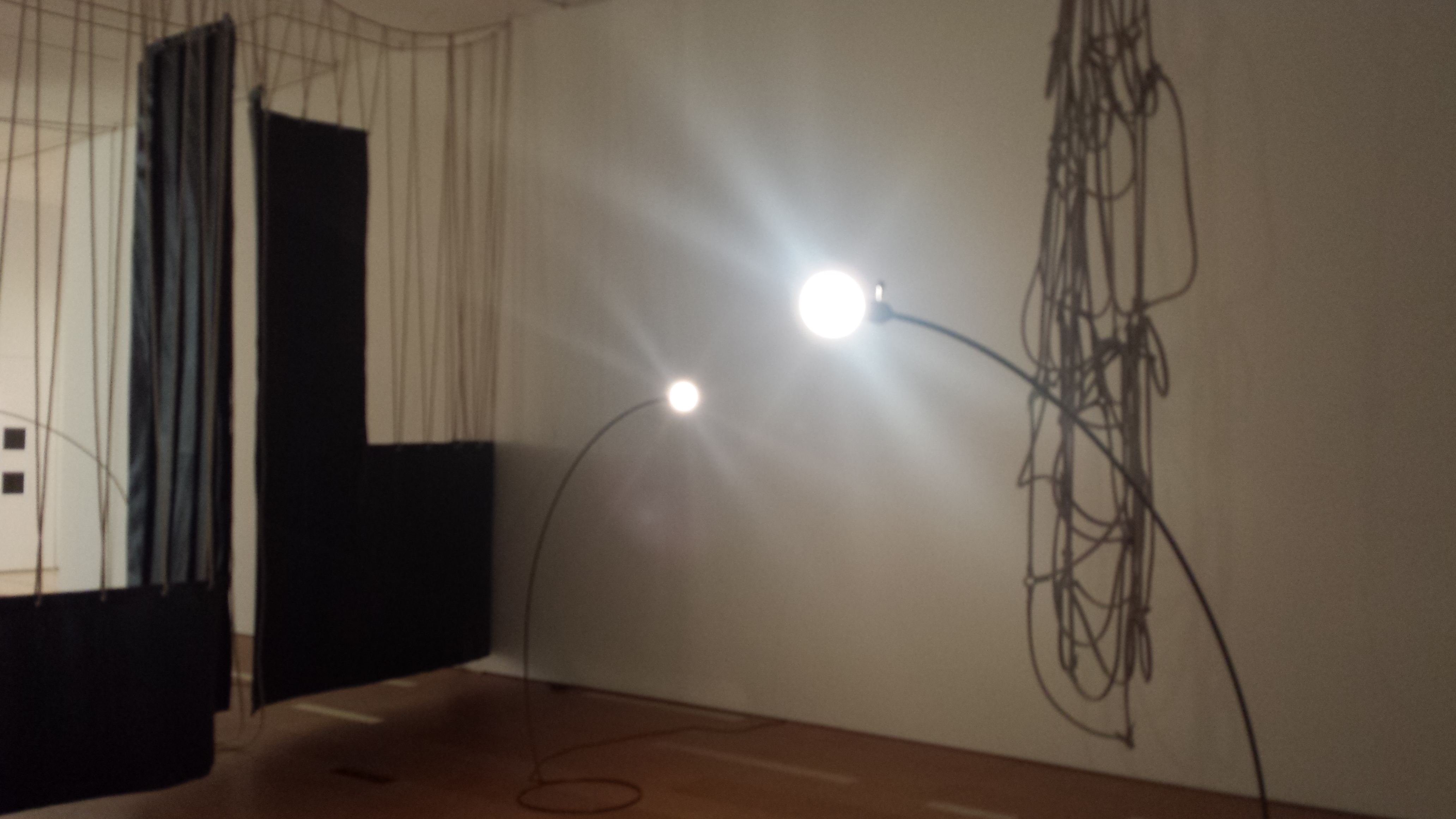
    A new contemporary art installation inaugurates the museum’s New Work -space. Leonor Antunes, has created work with a title ‘a spiral staircase leads down to the garden’ (2016).  This piece communicates with the architecture, showing diverse angles to enter the gallery space. The artist has stated that she carries ghosts with her into her works, in bringing artists, designers, and architects whom she admires to her installations. ‘a spiral staircase leads down to the garden’ is no different, appearing as a continuation of the space as an interior. The handcrafted materials cover the floor, hang from the ceiling, light the space, and block a direct path. The installation shows the artist’s interest in the Modernism, highlighting especially the woman practitioners in the history of craft and design.

    Leonor Antunes, installation view at SFMOMA.
    Leonor Antunes, 2016, installation views of her new work at SFMOMA.
    Leonor Antunes, new work at SFMOMA.
    Leonor Antunes, ‘a spiral staircase leads down to the garden’, 2016, Brass, cork, leather, hemp rope, nylon yarn, monofilament yarn, steel, electric cables, light pulps, brass and Bakelite light bulb sockets, and foam. Courtesy of the artist and kurimanzutto, Mexico City.

    The Doris and Donald Fisher Collection creates much of the museum’s art collection. In particular, noteworthy is the display around the historic gestural abstraction, which started molding the American Art after the end of the World War II. The movement started to erase questions about the art’s capability to evoke thoughts and feelings. Perhaps it originated in the idea of believing in the healing mechanisms of the art. One work is particularly interesting. Joan Mitchell’s large size triptych ‘Bracket’ (1989), is a great example of the instantaneous moment in art. For her, painting could represent similar forces as the sculpture, forging out the movement and physicality.

    Joan Mitchell, Bracket, 1989, oil on canvas, is an example of the gestural modernism.
    Joan Mitchell, Bracket, 1989, oil on canvas, is an example of the gestural modernism.

    The show around gestural modernism is well thought out as part of the SFMOMA’s new opening. It reaches up to redefining the concept of a gesture via selection of works. This becomes a red thread to other artistic displays as well. The museum exhibits plenty of work coming from the plural identities of the Bay Area, yet, some combining elements construct a more cohesive palette. The best part is that the transitional space of the West Coast and its cultural crossroads confuses the pattern of the gesture as something fixed, measured, white and universal. The inside of the culture is turned outside, as much as the architectural environment overlaps both domains.

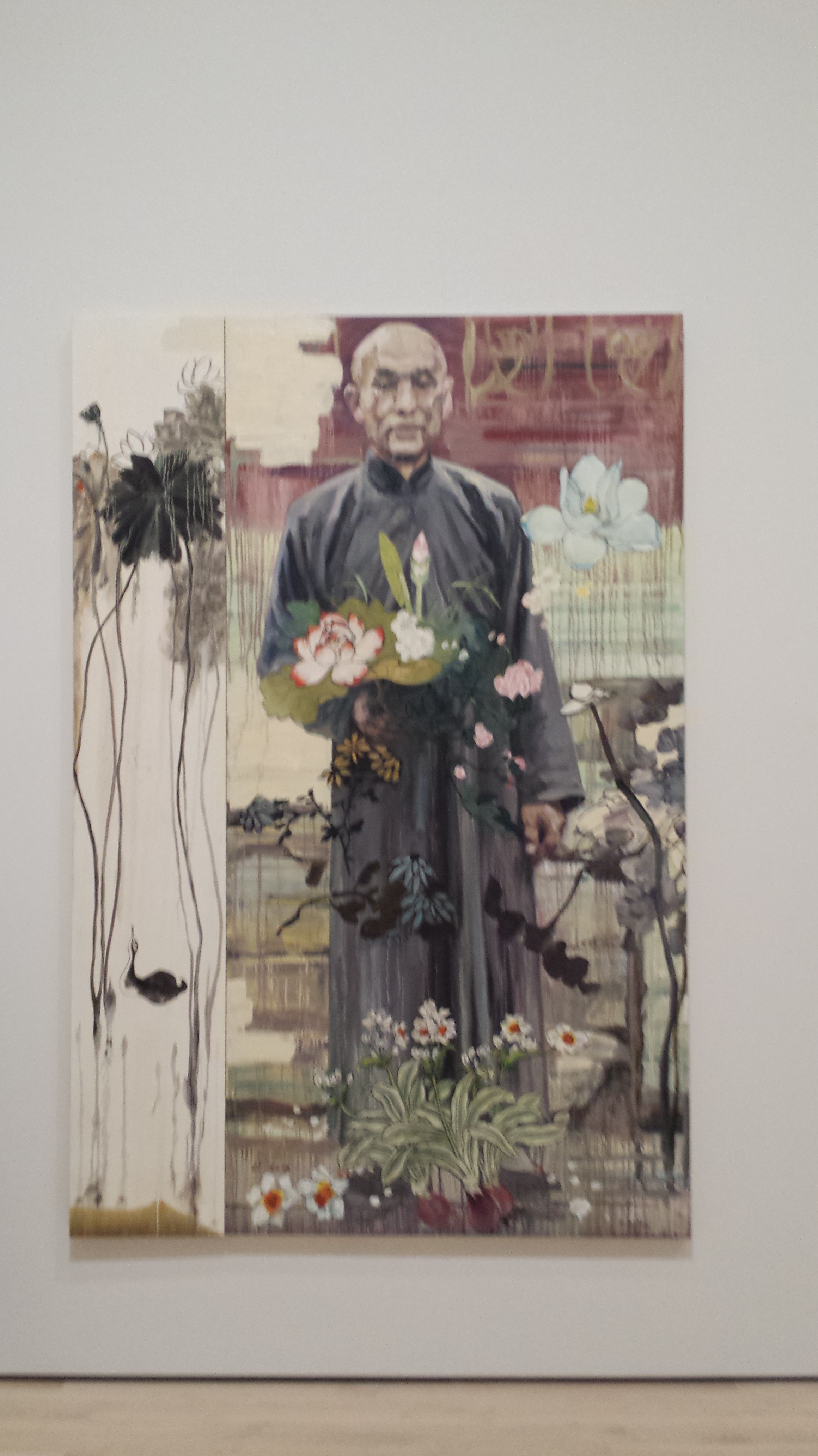
    Hung Liu's oil on canvas.
    Hung Liu, The Botanist, 2013, oil on canvas.

    The contemporary artworks do not create separation, but quite wisely culminate in supporting each other. Series of contemporary works follow black and white patterns, with a hip touch of pop art, and borrowing from chic minimalism of American interiors. These could of course be easily absorbed into the world of design and culture lending to Modernist and Postmodernist architectural patterns. Over all, the sometimes too heavy collective experiences are not so much emphasized, and there is more room for subdued artistic politics. Fragmented selves and posthumous experiences, ghosts of the artist’s personal influences as part of the installation define the process in the contemporary art.


    Images: Firstindigo&Lifestyle.