Tag: museums

  • Camilla Vuorenmaa carves wood into paintings

    Camilla Vuorenmaa carves wood into paintings

    Camilla Vuorenmaa is a young visual artist focusing on the human experience and the everyday encountering between people. She creates portraits with full of affect that stem from an exceptional artistic medium. Her portraits appear on carved wood as vigorously painted characters. An award-winning Finnish artist had a recent museum exhibition at the EMMA – Espoo Museum of Modern Art in Finland.

    The main motive in my works is the individual experience and a sort of portrait. Effort, success and experiences of failure, the dignity of everyday life, affection, frustration and the experience of innocence and pain are subjects I reflect in my works. Mainly I portray the figures as themselves, doing some kind of a activity or being in the middle of it. Fundamentally we are all alone with our personal experiences. -Camilla Vuorenmaa


    Firstindigo&Lifestyle: How did you find your recent artistic medium, is it common that an artist combines woodcarving and painting together?

    Camilla Vuorenmaa: I started to work with wood year 2010, when I had the first opportunity to work as a full time artist for longer period of time. I had wood on my mind already before, but then I knew it was time to start with this material. My work has though always been moving between 2 and 3 dimensional form. I have felt the need to add mass and structure to my paintings, for example continue it with foam rubber stuffed canvas, or continue painting to the wall, over its material form.

    Using wood in sculpture and even painting on the wooden sculpture is quite common. But this combination, painting and carving on wood boards is not yet very common. My working method is actually closer to the graphic boards that graphic artists make as a basis for their prints. Difference is, that I use that basis as the art piece itself, instead of making prints out of it. I call them paintings; others might call them something else.

    As an artist do you feel that you can associate with both design practices and with the fine art history?

    Camilla Vuorenmaa: Hard to say. I guess the things you grow up with, see and smell, forms, colors, light and shadow, basically everything has an effect on the visual idea. I am sure that Finnish design and especially its patterns have had influence on my visual choices. It is more unconscious than relevant though.

    Your recent exhibition at the EMMA – Espoo Museum of Modern Art, was about people working by the sea. Could you tell more about this project?

    CV: I applied to the SIM residency in Reykjavik on the winter 2014. I got the residency time to the September and October 2015 and it was perfect timing, since this project was on my mind before I knew about the prize and following exhibition at EMMA. All together, I had only nine moths to prepare EMMA exhibition, so it was good to have this idea already burning on my mind. I wanted to investigate the basis of the culture in Iceland, which is fishing. Everything in that country has basis on their fishing culture, so very simply, my aim was to go with the fishermen to the sea for some period of time, observe their working habits as an isolated community, atmosphere at the boat and individuals’ relation to the sea. I got connected to the MSC-Marine Stewardship Council representative Gisli Gislason in Iceland, and he told me a lot about the history of the fishing industry and helped me to connect with the Helga Maria ship’s crew. I went to the Atlantic Ocean with Helga Maria ship for one week on September 2016. During that time I photographed their working and used later these photos as basis of my paintings. The ship left from Reykjavik and went up until the northeast Iceland sea area. And returned. Gladly, weather was good most of the time.


    What was your experience in working with EMMA museum; did you work particularly with a curator to build the show?

    CV: Making an exhibition is usually a lonely work, but bigger shows definitely involve more people and more things to be taken care for. For EMMA exhibition I was closely working with curator Tiina Penttilä from EMMA. She came to visit me at my studio and also interviewed me for the catalogue several times during the making of the exhibition. I felt I got well supported by Tiina Penttilä and the whole museum crew during the making and building process. As an exhibition space, EMMA is wonderful and gives many possibilities to an artist. Especially I enjoyed making the wall paintings to the space. This was great experience as a whole.

    Where does your artistic process start, from the idea of a canvas, or from the wood?

    CV: Everything comes side by side, simultaneously. I choose material same time as I collect ideas. I take photos of something that interests me, like for example wrestlers. I made series of paintings based on the observation of the movement of one wrestling team in Helsinki. I do not really make sketches on paper; I see my photos as my sketches. I buy material, print photos that inspire me and spread them around the studio. Then I start to combine different sized wood panels and paint the beginning of the piece on the boards. I paint and carve, paint and carve until it is ready.

    Wood has been my main working material for the past six years, but now I start to feel working again also with other materials.

    You have worked with mixed media, how did you develop the techniques in each period of time, can you speak of artistic growth, or is it more like a seasonal thing?

    CV: I guess all the developments on my techniques have had to do with the search of some kind of layer in between a painting. Painting on canvas, plexi glass, paper, mdf-boards, wood, wall, all these have circulated in my work. I can return to a technique I tried and worked with several years later and proceed with it further. I see working as a visual artist also some kind of work of an inventor, chemist, and alchemist. All the material details and accidents with them lead in to interesting paths and can start even a new process.
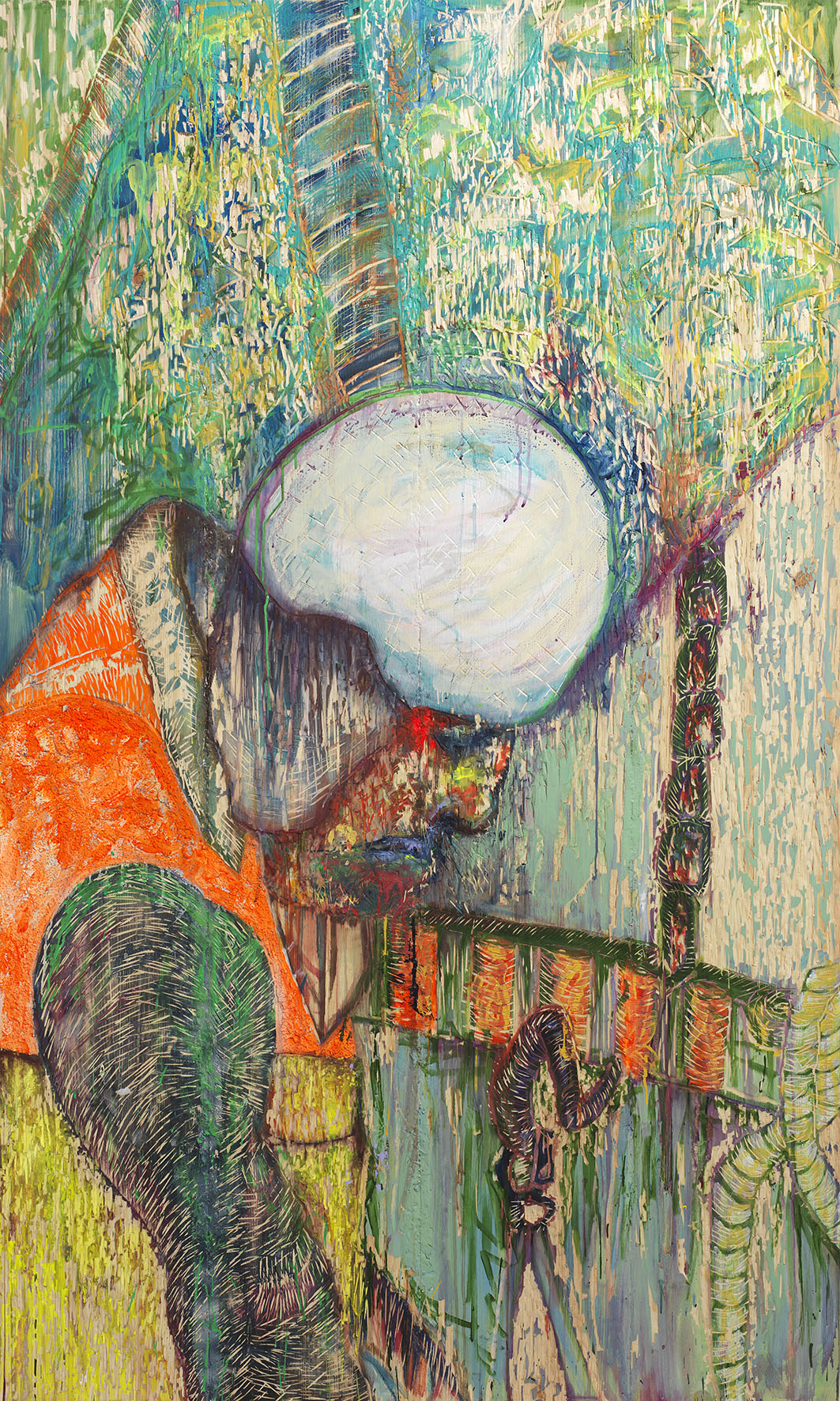
    Camilla Vuorenmaa, Fisherman, 2015, painting (carving on wood), 200x120x2cm, EMMA -Espoo Museum of Modern Art. Photo: Ari Karttunen/EMMA 

    What are you inspirations for creating your art, does it usually start with observations or fieldwork?

    I used to collect inspirational pictures from old magazines. I spend hours and hours in old bookshops and went through dusty old magazines and photography books. The nostalgia and history inspires me, and also the idea that everything that happens in the world has already happened many times, they just appear in more modern form from century to century. Also my love to literature and books as objects has something to do with it. For the past years I have also started to use more my own photography as a basis of my paintings. I have become maybe more brave to confront the subject, or my curiosity has gone over my shyness.


    How would you describe the education in Finland, much did you learn from your art education?

    CV: My times in Finnish Art Academy were great. My teachers gave me a lot of freedom and opportunity to try everything. I was on the painting department but visited other departments regularly to try their material and working methods. For some, this kind of working freedom might have been too much, but for me it worked perfect. And if I needed support or comments, I could get that from the courses or ask studio visits from the teachers.

    Is there something particularly Finnish in your art making?

    CV: Well, I guess wood is pretty Finnish material. As wood industry is still so big in our country. Also I have understood from my colleagues and collaborators in Sweden, Denmark, Iceland and England that Finnish painters seem to have something peculiar and wild in their visual language. This has been of course great to hear – what a compliment to Finnish painters.

    Do people ever ask you about the nature of your practice in regards to your gender as a woman making art, and your subjects for art, does the gender play any role in your art making?

    CV: Well, I wish I could answer that “no – I have never have heard any questions that have something to do with my art making and being a woman”. But of course I have. Many people still seem to wonder how a small woman like me can handle big wood blocks, or do so big sized works. Once I even heard one man saying to me that your works are great, they look as if they are made by a man. I wonder what Louise Bourgeois must have heard! Good thing is that these comments are though not the first and the only thing I hear about my work and my working methods. Art is always political. So of course my art is too. I am more interested to hide my perspective of the roles of humans in my work, than comment it very straight in my work. But of course it is there. And I was the one who made these images.

    What expectations do you have for the future, where do you see yourself going next?

    CV: Now I am in the rare situation that I have exhibitions and plans made already until next year. Usually I have not known my ways for more than six moths. Interesting for me is to also see how this will affect on my artistic work, I have a possibility to plan and make long-term choices. My next big solo exhibition will be on January 2017 in Gallery Forum Box in Helsinki. After that I will take part to two group exhibitions in Sweden. I am more than exited and grateful for this situation. My aim has always been to make it possible to work as a visual artist without making compromises in the content. I follow that road.

    Artist website:
    http://camillavuorenmaa.com/

  • Janet Echelman’s 1.8

    Janet Echelman’s 1.8

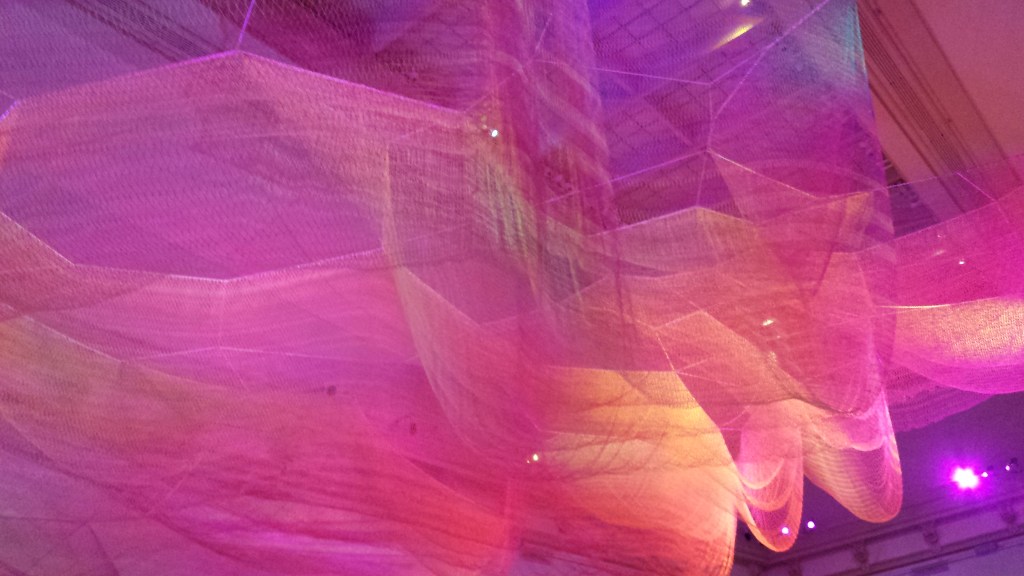
    WONDER exhibition celebrates the Renwick Gallery’s reopened spaces. The museum’s new statement is to bring the future of art into its program. It is now confronted with large-scale installations by nine artists. Janet Echelman is one of them with her piece 1.8, (2015). A large suspended net glides across the ceiling of the Grand Salon, which is located upstairs in the museum. The work is composed as knotted and braided fiber with programmable lighting and wind movement, above a printed textile flooring. Echelman’s sculptural installation speaks in relation to a map of energy released through the Pacific Ocean, when Japan’s Tohoku earthquake and tsunami took place on March 11, 2011.  The title of the work implies the 1.8 millionths of a second,  which measures the earthquake as it shifted the earth’s axis.

    Janet Echelman’s 1.8, 2015 from Firstindigo and Lifestyle on Vimeo.

  • Ai Weiwei @ Helsinki

    Ai Weiwei @ Helsinki

    Chinese artist and activist Ai Weiwei’s exhibition opened in Helsinki in September 2015. Ai Weiwei @ Helsinki will be on view through the end of February 2016. His first solo exhibition in Finland features 25 works from 1985 to the present, including selection of wooden sculptures and installations, and taking materials from antiques and building structures of old temples. Ai Weiwei’s exhibition is connecting to historical China, raising contemporary questions and speaking of the critical voice, which requires to be heard. The exhibition narrates of the personal and the cultural, weighting the nuances that the artist has tested in practice.

    Ai Weiwei is the artistic figurehead for thinking how today’s east meets west in many forms. I call my perception of the works ‘massivity of matter’. Firstly, the amount of matter in a museum space probably recalls any sculpture display as the intervention of matter over the space. In this exhibition, however, the sculptural speaks together with the space, the airy high ceilings are breathing with the objects. Second, the massivity of matter is more of a feeling that comes with the lack of scripture between the works. An echo of Chinese contemporary art, in which ancestral is disconnected from the line of reproducing the artifacts?

    Map of China
    Ai Weiwei, Map of China (2008) installation view.

    Map of China (2008), is Ai Weiwei’s large opening piece to the exhibition. The sculpture is tall, hard to measure, and made of tieli wood fragments that come from ancient temples. This material is centuries old and told to be very rare today. Map of China is made with traditional Chinese woodworking technique bringing the pieces together. The challenge was to create the work without any visible seams. The configuration has the shape of the country showing how there was not a single history or culture in the first place, but only a forced effort to fit all the richness into a one state.

    ai weiwei installation
    Ai Weiwei, Traveling Light (2007) & White House (2015) installation view.

    So a question arises, how to connect historical meaning and the general meaning of the past to those issues that define a contemporary consciousness of a man, after he had to struggle with the fascist propaganda and denial? I am not proposing this question as an individualist concern, but more as a rhetorical phrase to speak of a multiple choices. The artist can mirror his personal position on the power/to shed light on the power, which one-sidedly and univocally has taken over all the other voices, eventually starting to represent masses of voices. This is where massivity arises in artistic aesthetics. And perhaps this is why there is no single narrative imposed in the exhibition, because bringing together all the objects would already be a lot. They would utter so strongly, so let them escape the definition, and let the cacophony sing its well-orchestrated noise. Needless to say, as the wood is concerned, the aesthetics is well rehearsed, well mounted, the sculptural is well organized in groups, following up the international sculptural aesthetics of the moment. Working with wood, and collecting pieces that come from a cultural place with this huge time span; say, goes far beyond our contemporary time. This makes the works epic for today. Historical load is apparent. History arrives with the same massivity, as the ancestral would drive you over.

    To be a political artist is not easy from the point of view of artistic aesthetics. Our art world needs the voices to break silences, but often the politics becomes massivity. It would perhaps be different to subtly speak without ruins taking over, as objects do have their own weight without us directly attaching them to ‘art’. In this case, the objects are not simply cultural artifacts as they appear in the art museum context, however they connotate in the form of temples, for instance. Some pieces come from temples – that is the shrine nature of a house, narrating about ancestry and patriarchal dominance. These fragments are ultimate references to the age of property, practice, and material attachments.

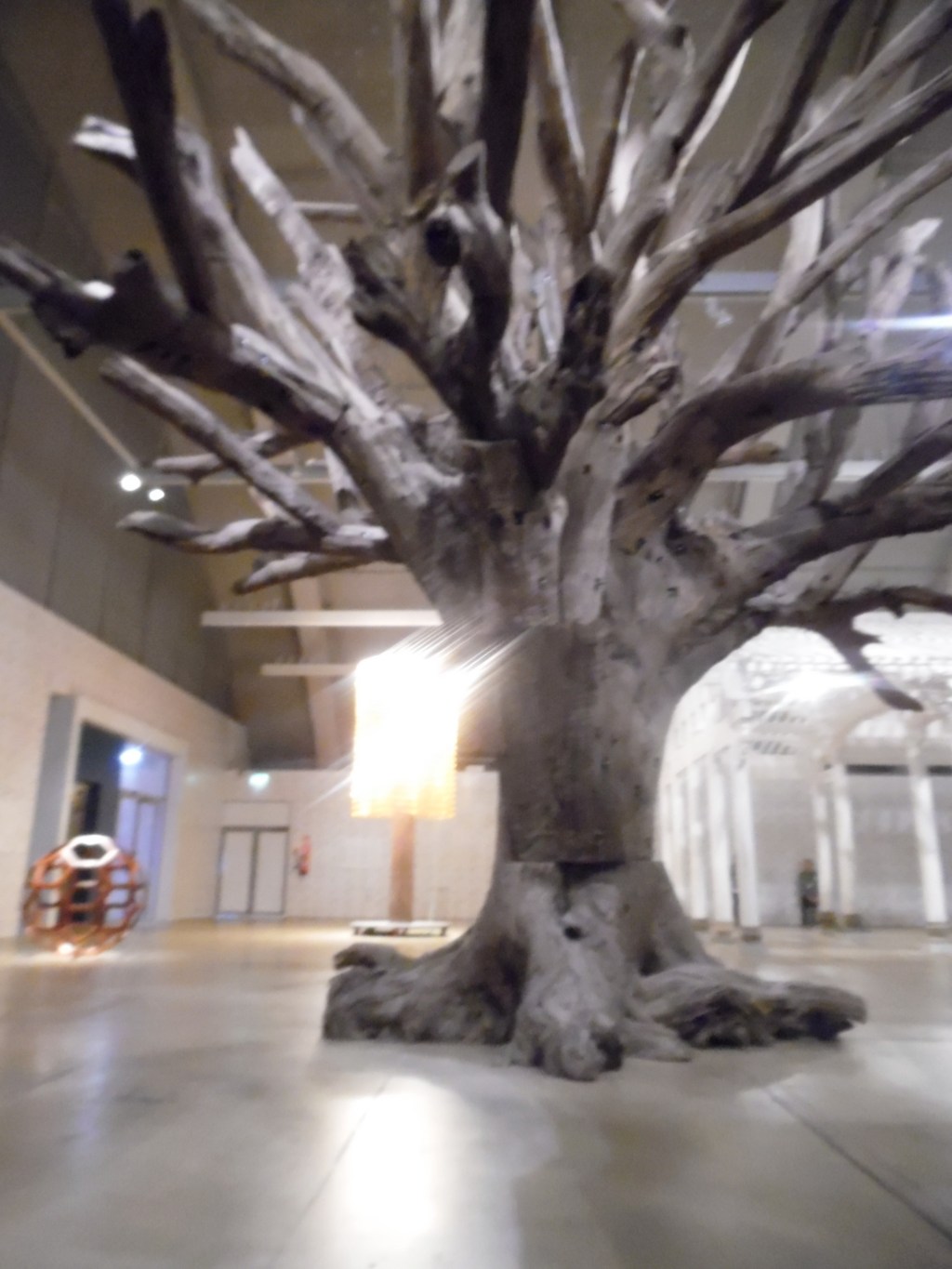
    Another sculptural work by Ai Weiwei, is called Tree (2010). It is an assemblage of different woods deriving from individual trees. The dead tree trunks were collected from various locations in the mountains of South China. Differences between components is left visible intentionally:

    ‘We assembled them (the parts) together to have all the details of a normal tree. At the same time, you’re not comfortable, there’s a strangeness there, an unfamiliarness. And it’s just like trying to imagine what the tree was like.’


    Wood as artistic material is so much about nature. Tree as a material is beyond our dominance. It exists and grows without our appropriation. But we did cut trees, we destroyed their existence, and we were cutting down entire forests. In the exhibition, the tree-sculpture is made from pieces to look like a whole tree, an original, yet at the same it is not. It is a look-alike, a not exactly, and a make believe of a tree, a form of a tree, a powerful signifier of a tree, of nature, of origin. It is quite interesting how this sculpture ended up being the center, as other objects are made of wood as well, representing crafty continuation of the artifacts as man made materiality, a continuation of time, which was before mass production.

    The modernity of artificial materials, known as the mass-production is another question. Mass production creates massivity. Perhaps the ancestral places speak in the same manner as the modernity. The history is long; we communicate and paraphrase with it. Perhaps this exhibition communicates beyond art, becoming dynamic battlefield for matter and spirit, proposing final materiality in art. Where do we stretch the line between the materials that make the essence of an artwork? We draw from culture, bringing cultural objects into museum to speak for the culture. And this takes place ultimately not in the name of individual subjectivity but for all the collective consciousnesses.

    After all, the dialogue between poetic and anti-poetic is what we are looking in the massivity. Poetry does not speak with the loudness unless it was dried out of mythological meaning and it communicates more with the naturalist approach to speak with metaphors. Metaphor can be standing for something, which is not invisible, and stands for something apparent, showing the evidence, creating presence of the political as inevitable. It is standing, yet changing?

    There is an evident need for change in the cultural. The aesthetic is more of a repetitive force that takes form in the massivity. The criticism toward west comes in the undertone of the material in consumption, as enlightening force. The materialism is our new religion?

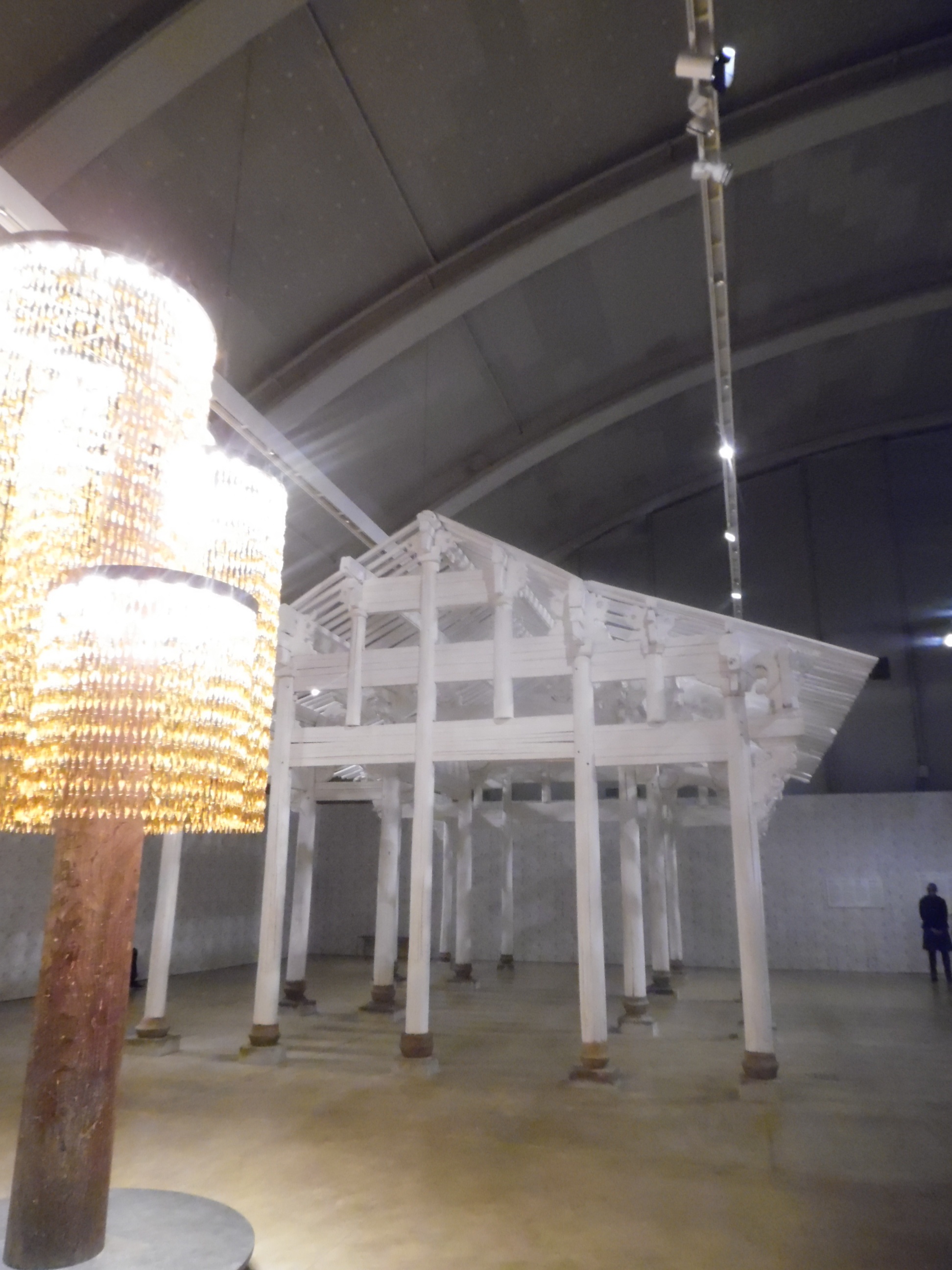
    Traveling Light (2007), is a sculpture mounted on a temple pillar, appearing as being a gigantic table lamp or crystal chandelier. Ai Weiwei became interested in light as an object from the point of view of illumination and environment. The large sculpture stands for the idea that objects are close to human scale to be experienced physically.

    Divina Proportio (2012), is composed of huali wood, referring to the golden mean, and as mathematical proportions to geometry in the Renaissance.

    The exhibition includes two previously unseen works, White House, and Garbage Container, the former speaking of China’s developments and urbanization, the latter about five homeless boys who died tragically.

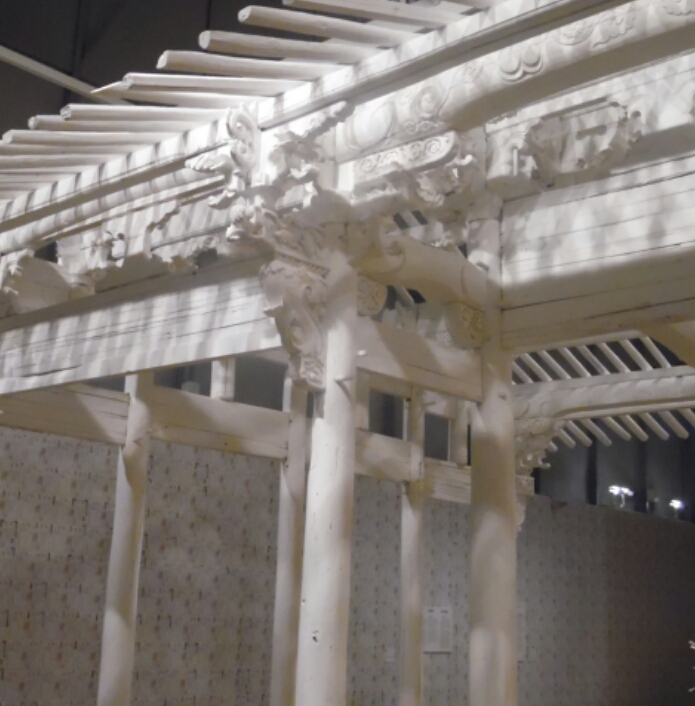
    A new piece in the exhibition titled White House (2015) is an entire residential house of the Qing dynasty. The composition includes different woods and is constructed traditionally using nail-less joints. The work stands for the heritage, as the new developments in China have pushed away the traditional. The new white paint on a wooden surface creates questions about past and present, authenticity and change.

    Ai Weiwei, White House, detail
    Ai Weiwei, White House (2015), detail.

    But cultures change slowly. The anthroposcience of human life shortly lived, continues in the legacy of a son who outlives his father (in a natural cycle). The artifacts have a longer life than we do, and this ends building the culture as fluid and as anatomically tilted. Objects lend to the patriarchal order creating legacy and interdependency. Objects echo about history, so in the name of the poetics and dialogue whenever they are on display there is an underpinning of voices that mesmerize with their presence.

    The exhibition architecture divides the show into two large rooms. On the other side there are objects, which call much of the legacy that is darker, even more personal than the first exhibition space. Ai Weiwei became a prisoner after he was arrested in 2011 at the airport in Beijing. He was sometimes handcuffed to a chair while questioned. He also kept washing his one set of clothes while in prison, drying them on a hanger.

    The art in this case becomes a historical conscience of a collective. It necessarily opens as a voice for the people whose history it is part of. The objects, their material consciousness and presence appear as inevitably non-corruptive, with presentation and physical presence, as non-poetic solidity. The substance is speaking through the stone, or the stones would shout, in this case wood objects.

    Ai Weiwei’s role as a seer or visionary, means a hard position at home in China. His work Through (2007), is composed of tieli wood once again, having fragments of old temples from Qing dynasty. The scale is massive, and piercing, the tables and pillars form an almost cage-like atmosphere.

    He says: ‘Artists are not in a position to decide the conditions imposed upon them but they can make statements about these conditions.’

    Through
    Ai Weiwei, Through (2007) & Frames (2013) in the background.

    Artists have their own life, their own existential power, their own presence and saying. When it comes to power propositions with artwork, let’s say this. It is hard to assume that the artist proposes his artwork knowing that the entire nature of the artwork would stand for the resistance of power. Cultural legacy changes in a moment, when it becomes ‘art’. The objects are in a terrain of global and international exchange of matter. When it comes to materiality in the sense or meaning, would not the objects have a saying only inside their cultural reference? Legacy or cultural speaking of the history changes with the art market. When legacy becomes art, it has become layered with different meaning; yet the objects are not entirely free of their cultural origins.

    The Garbage Container (2014), impresses as a valuable huali wood piece, reminiscing of a cupboard, and looking like a container when it turned on the side. Another impressive piece is the architectural installation titled Ordos 100 model (2011), which was built together with Swiss architect firm Herzog & De Meuron. Made of carved pinewood, an uncompleted, miniature city was planned to be build in Ordros. Treasure Box (2014), is another construction made of huali wood. interestingly, all the objects seem to highlight the wallpaper, titled as IOU Wallpaper (2011-2013), which has decorative appeal, yet a message that makes everything seem unconventional.

    Treasure box
    Ai Weiwei, Treasure Box (2014) with IOU Wallpaper on the walls (2011-2013)

    Ai Weiwei’s exhibition at HAM Helsinki in on view until February 28th, 2016.

    Artist website: http://aiweiwei.com/

    images: Firstindigo&Lifestyle