Tag: museums

  • Loud power of art: don’t be silent

    Loud power of art: don’t be silent

    Dan Flavin’s fluorescent sculptures are ‘situational’ in a way that they get their appearance in relation to the context and space on which they are displayed. His sculpture installation untitled (to Helga and Carlo, with respect and affection), reflects blue light with immense presence. When the spectator walks through the installation path she sees the surroundings as altered moments taking in her own reflection on the floor. But why is Flavin’s work so important? The question arises because Flavin’s minimalist art has drawn on a plenty of attention at the Hirshhorn Museum and Sculpture Garden in DC. The work extends more than ninety feet in size and is paired with the wall-mounted piece monument, which consists of white bulbs inspired by constructivist art. The first installation of the untitled was at the Kunsthalle Basel in 1975.

    It speaks about architectural difference and boundaries. The sculpture-series recreates the architectural environment, it sets barriers making the room where the continuum is installed to appear as an infinite of the sculpture itself. And it creates a path in the space. The installation is composed of sculptural pieces varying in size and color.  By using industrial, somewhat regular fluorescent lights to produce artwork, Flavin shows how minimalist materials create powerful propositions about our environments and public spaces. The power lies in it that the every-day contest enters the museum space. What is this about, who am I when I walk this path? And this light brings me to the next door with words on capital letters that speak louder than I’m used to.
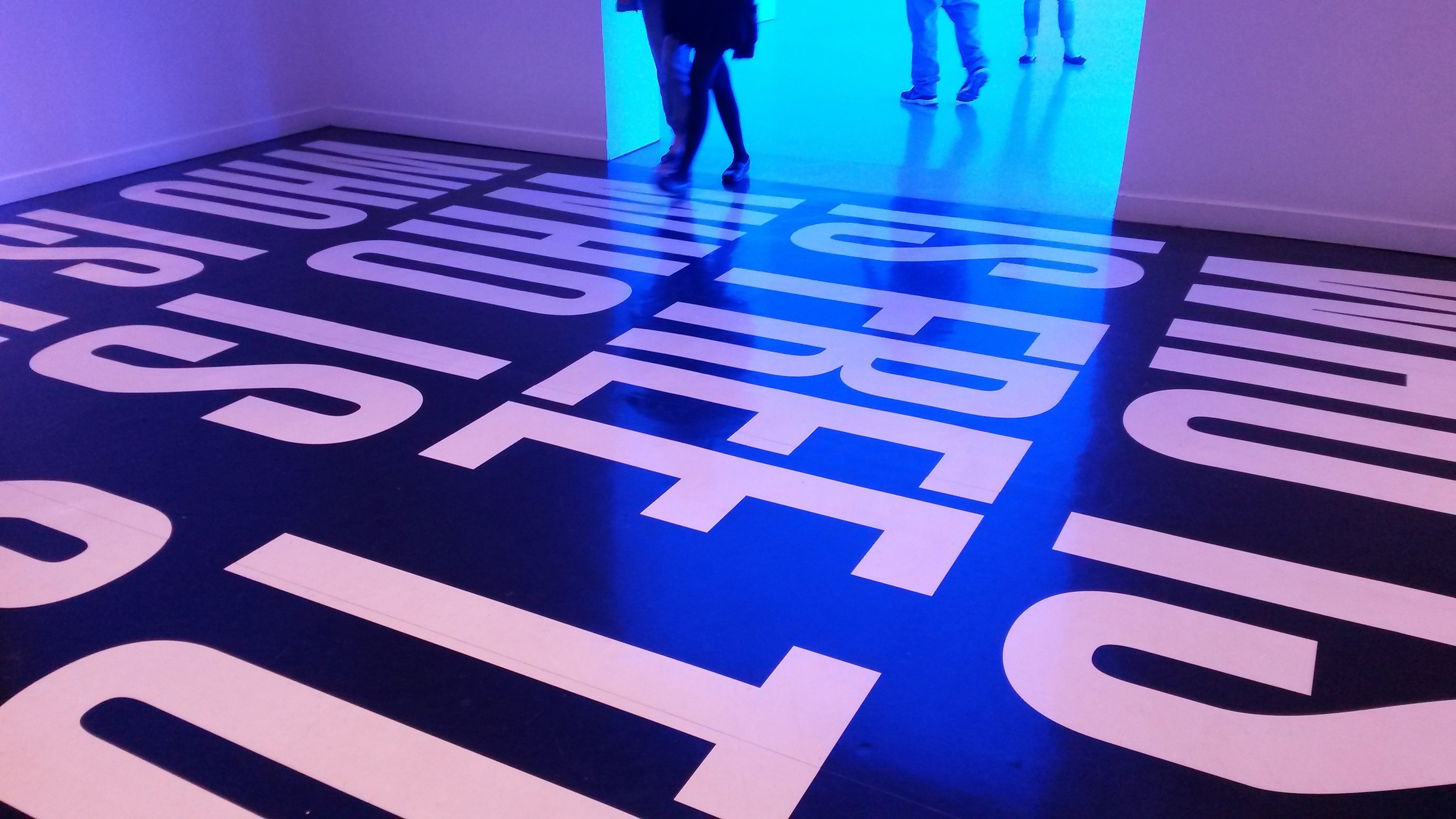
    Dan Flavin&Barbara Kruger installations at Hirshhorn Museum and Sculpture Garden

    Now it is time to stop and look around again, or actually down, since the floor has a message. Barbara Kruger’s installation since August 2012 at the Hirshhorn Museum’s lower level lobby area mixes the architecture of the space into a complete mismatch. It draws us in with text written allover on the floors, walls, and on the escalator leading up. And the printed smileys amuse and terrorize the restrooms. Barbara Kruger’s installation Belief + Doubt, speaks a loud red, white and black language. The messages are those of the digital age. We dwell through the global consumerist culture, in which our omnipotence is created around a simple truth of “I shop therefore I am”, as stated in the most well-known work made by Kruger. The truth is, if we can say so in the days of pluralist opinions, that we need Barbara Kruger’s loud art. If the politics of the everyday, the human culture and the global age needs of the voice that has an innate power to speak with capital wordings, it is hers. Yet, as an artist Kruger is tricky avoiding the task of giving us simple reasons to be her fan and give complete answers why the words chosen in her art would set truth about anything. Say this, and don’t think you could destroy differences, and there is not a one truth?

    “Belief is tricky because left to its own devices it can court a kind of surety, an unquestioning allegiance that fears doubt and destroys difference.” -Barbara Kruger


    Barbara Kruger's installation at Hirshorn Museum
    Barbara Kruger’s installation at Hirshhorn Museum

    Kruger is the poet laureate of the age of the spectacle. In her early career, she was working for Conde Nast Publications in photography and design. In the late 1970s, the artist begun creating photomontages with found pictures adding texts in them that would alter or complicate the meaning of the images.  At the Hirshhorn Museum setting, printed vinyl words and sentences invite the public to get involved, ponder the words, and create their own meaning and association based on the moment and the environment. Meanings of these phrases are open-ended because the every-day life just is with all the power-structures that we face or try to avoid. But at the same time the words are not only words, they are shouting: get involved, speak out loud, speak freely, don’t be silent, there are so many important words! Both great installations are still on view in Washington D.C.

    photos: FirstindigoandLifestyle
    photos: FirstindigoandLifestyle
  • Sarah Oppenheimer’s reoriented space

    Sarah Oppenheimer’s reoriented space

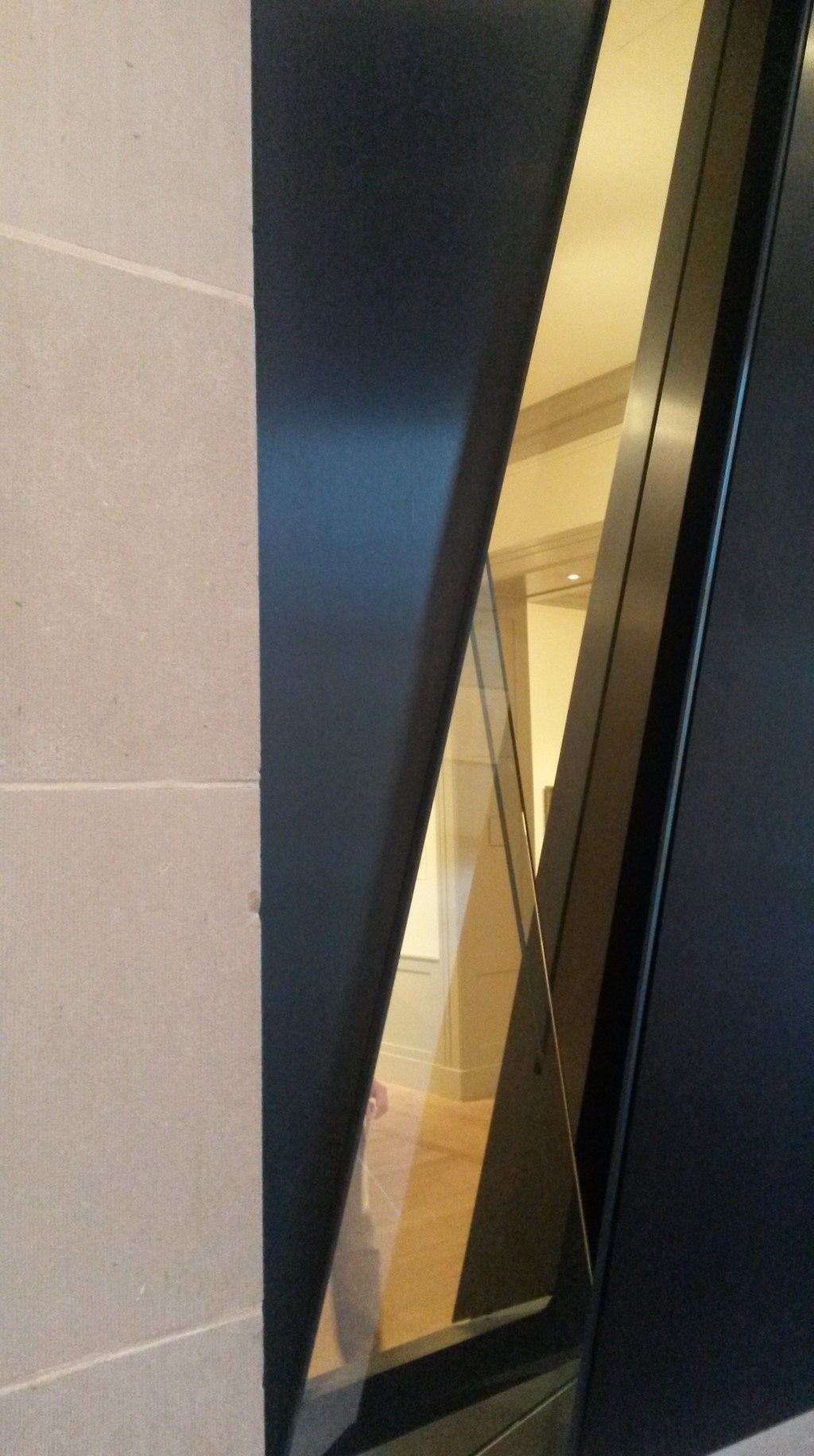
    Sarah Oppenheimer’s installations and public art works “W-120301 x P-010100” were commissioned for the Baltimore Museum of Art’s Contemporary Wing which reopened after its complete renovation in 2012 (built in 1994). The two-part permanent art work was concretely made in conjunction with the architectural space. It involved cutting holes in the museum walls and ceilings of various galleries. The holes, then, were filled with panes of metal and reflective glass to create new dimension for viewing at the space and art on different galleries, including visitors – who happen to be wandering through spaces simultaneously; and are reached by multifaceted and virtually charged viewing. The holes created ‘sightlines’ between the 2nd and 3rd floors of the Contemporary Wing and through the wall between the contemporary and Cone collections. What the installation claim is that the museum visitors can get glimpses and optical illiusions into spaces that are on different levels. Oppenheimer’s works radicalize the notion of museum space from a contemporary virtual perspective. The ’holes in the walls’ change the viewer’s perception when he/she suddenly sees others randomly passing by their visual screen that the artwork is.  The unexpected encounters create experiences with others simultaneously in the museum. My own ‘looking-at’ the sightlines makes me perceive someone on the other part of the museum as if they were sharing my experience. Its partially theoretical, and yet is twisting seriously with the architecture. With this installation, we can view art museums from a new perspective, as if this kind of illusory tool enables us to grasp art simultaneously from various historical eras. The sightlines allow viewers to see unexpected views of fellow visitors, art works, and galleries above, below, and across from them.

    The Baltimore Museum of Art is the first art museum to commission a site-specific installation by award-winning artist Sarah Oppenheimer. Anyone interested in Oppenheimer’s works would also say that the architectural dimension is much more than ”just” art. In fact, the installation combines art and curiosity borrowed from sciences that are engaged in visitors’ participation. The museum as architectural space and as encounters, interacts with its visitors and the institution’s daily life. The installation does not only play with space and our perception, but it encompasses it on a new level. Museum architectures might sometimes appear as ‘static’ and locked in particular histories.  The artist’s intervention of architectural space is a dynamic way to create interaction, encounters, and puzzles, and bring also art history discussions into new levels.

     Artist’s website:  http://www.sarahoppenheimer.com/


  • threeASFOUR spring/summer 2014

    threeASFOUR spring/summer 2014

    On September 8, 2013, avant-garde fashion collective threeASFOUR debuted their spring/summer 2014 line at The Jewish Museum as part of threeASFOUR: MER KA BA – exhibition. The collective’s fashion and art is inspired by the geometric patterns found in synagogues, churches and mosques throughout the world. For the nine sculptural dresses featured in MER KA BA, they use laser-cut lace, origami pleats, and 3D-printed textiles to unite symbolic patterns from diverse religions.

    (Video by Brian Gonzalez)

    The collectives 3 designers were born in different cultures:
    Gabriel Asfour is from Lebanon, Adi Gil from Israel, and Angela Donhauser from Tajikistan. Their approach to fashion is poetic and socially conscious. For threeASFOUR, couture is about more than just beautiful clothes; ‘it is both wearable art and a platform for their free-spirited philosophy.’ 
    — — —

    threeASFOUR’s MER KA BA installation exhibition is on  view until February 2, 2014, at the Jewish Museum in New York. Check the exhibition site.