Tag: popular

  • Visiting Linda Cunningham’s studio

    Visiting Linda Cunningham’s studio

    Last month, New York based artist Linda Cunningham showed me her art studio in the Bronx, where she lives and works.  It is located next to the Bronx Art Space that is fostering arts education and collaborative artistic projects. She told me stories behind the art works, both the sculptural works and the collages that combine drawing and photography.  The studio is in a newly renovated building nestling at the heart of the historic urban Bronx.

    Firstindigo&Lifestyle: Linda, you were one of the first artists to come to this location, how was the neighborhood back then, it’s been now a good fifteen years? You did a series of artwork digging into the Bronx history, in which immigration was a theme or a subject. There seem to be real person’s story involved, including documents, such as passports with photos. Could you tell about the project that was exhibited at the Andrew Freedman house in 2012?

    LC: When I first moved to this historic landmarked area of the South Bronx, I began photographing the now renovated 19th Century row houses with brownstone trim, the contrasting graffiti walls with the shopping carts of the homeless. The barbed wire and I merged those images with a young Jamaican’s poetry and rubbings from the historic signage telling about Jordan’ Mott’s iron foundry. Later I was invited to create a large installation in No Longer Empty’s exhibition at the Andrew Freedman House, an amazing building designed like a Renaissance Palace, left from the early 20s when the Bronx was blossoming. My installation was constructed like an open book from broken drywall panels and broken old wood frame windows with each panel referring to an era of Bronx history. I along with other artists scavenged in the water soaked ruins, excavating the papers representing early 20th Century history of the Bronx. Including among them was the unusual passport of a resident of the house with two different last names, both apparently Jewish heritage, along with her photos. She had traveled all over Europe 1936, and through the Third Reich and into Switzerland several times, so her story suggests that she might have functioned as part of an underground.

    Linda Cunningham_bronzesculpture
    Bronze at Linda Cunningham’s Bronx studio

    Firstindigo&Lifestyle: You recently attended an Art Fair in Harlem, titled FLUX art fair in May 2015; do you have any specific notes in regards to engaging with the community during this festival?    

    LC: This was such a lively engaging event during which I enjoyed most interesting conversations about my work. The artwork displayed in this art fair was tough and engaging and in general more accessible than in most other art fairs

    Firstindigo&Lifestyle: What captured my attention was your rich methodology of juxtaposing various elements. Your artwork depicted ancient olive trees in Italy that are approximately 800 years old by now. These trees got bacteria from Costa Rica somehow. Did the local community got involved in saving them? 

    LC: I don’t know anything about the local community. I just read about it in the Times saying that “they” are trying to contain the epidemic.

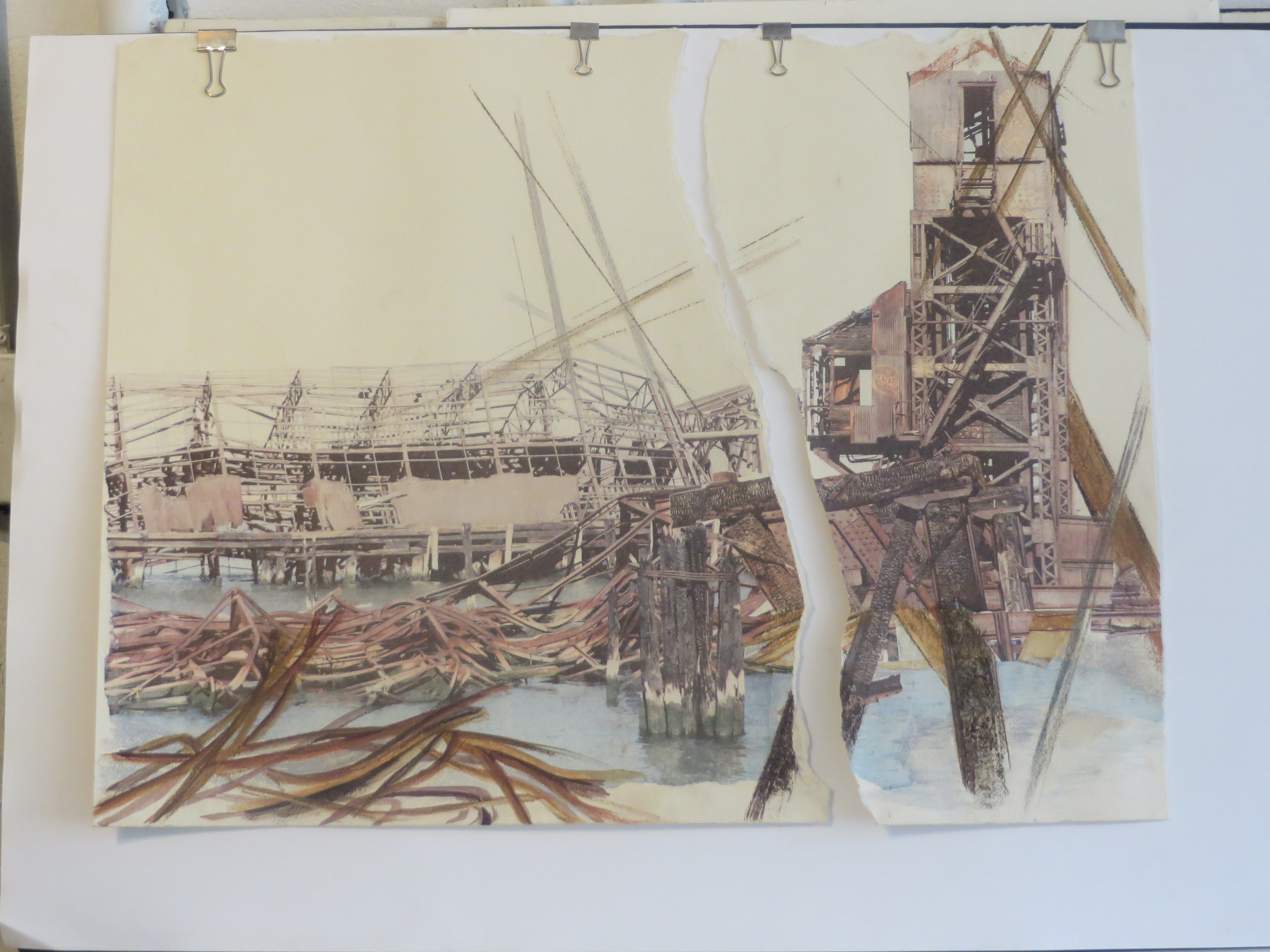
    Firstindigo&Lifestyle: What you did in your collage was that you implemented the trees together with post-industrial photographic scene of Ruhr in Germany. This area used to be a center for coal, and now it’s gone. Tell, what is the particular message behind this juxtaposition?

    LC: Both of these astonishing entities are vulnerable, but these amazing ancient trees will continue being productive and useful for centuries, whereas, the astonishing human designed technology is obsolete in 75 years or less and falls into ruin.
    Linda Cunningham_Collage

    Firstindigo&Lifestyle: You have worked with sculpture. The bronze in them comes from ’recycled’ old weaponry from the Pennsylvania army base. The story behind the material is so intriguing, and the fact that you wished to turn the weapons into ’vegetal’, so the forms are like plants.  The texture of your sculptures remind of natural formations appearing rough, in some parts they are smooth, as if ironed.  Could you tell a little bit about the process, how did you find them, and how was it to work with the material?

    LC: The bronze came from military scrap, which I obtained with some difficulty through a not-for-profit institution where I was teaching for a number of years, Franklin and Marshall College. The scrap bronze, which mostly came from ships, military ships, which are not really weapons. The bronze was smelted and poured into a defined shape in flat, oil-bonded sand molds.  The cooling of the hot bronze creates the rough surfaces as the bronze is poured. I am doing some casting currently.

    Firstindigo&Lifestyle: Another element in your sculptures comes from nature. It’s fascinating how some of the rocks you have in the studio are from the ocean. The nature has worked in them so that the huge pressure in the floor has pressed the shells to attach into the stones. One of the rocks is also volcanic, and comes from the Californian coast. Do you have a specific relation to ocean and water in your artistic thinking, as I see the ocean appear in many of your collages?

    LC: I have always been drawn to the eternal rhythm and power of the waves, but in my youth I had read Rachel Carson’s “The Sea around Us”, a beautiful factual narrative about the origins of life and the vulnerability of the life giving sea so essential to our survival.  Then super storm Sandy gave my early interest a new focus.

    Linda Cunningham_Collage2

    Firstindigo&Lifestyle: Also the technique in your collages is interesting, you are drawing and then adding laser photo transfers to paper. Even the surface has layers, cement or metal appears on the surface of the paper adding three-dimensionality. Could you tell more about this appeal? 

    LC: I have worked as a sculptor, and even when I am engaged with these large drawings I am drawn to include appropriate resonant texture and sensibility.  Even though photography can be manipulated it is essentially documentation and convincing as reality. The veracity of photography seems essential. My exhibition will be at Odetta Gallery in Bushwick in November 2015, and I will include especially drawings fused with sculptural elements. I was working on creating some new spectacular bronze forms that will be included in the show. I work on torn irregular shapes because reality doesn’t fit neatly inside a rectangle shape, rather it’s discontinuous, fractured etc. I work from places I have been, responding to particular environmental and historical issues raised e.g. from flooding of Venice, and a jungle growth strangling Ancient Cambodian temples. I built the installation with the Hebrew text some years ago after I spent a year in Berlin on a Fulbright scholarship. I did an installation In Kassel for an alternative documentary, and obtained many of the elements from the former East/West border known as the Berlin Wall.

    Linda Cunningham_Collage3
    Linda Cunningham’s collage depicting trees and Ancient Cambodian temples

    I have always been drawn to the eternal rhythm and power of the waves, but in my youth I had read Rachel Carson’s “The Sea around Us”, a beautiful factual narrative about the origins of life and the vulnerability of the life giving sea so essential to our survival. Then super storm Sandy gave my early interest a new focus. -Linda Cunningham


    Linda Cunningham_Berlin Wall
    Elements from the Berlin Wall at Linda Cunningham’s studio


    ***

    Artist website: http://www.lindalcunningham.com/

    Check also Bronx Art Space

    All images: Firstindigo&Lifestyle
  • Julian Stanczak’s color energy

    Julian Stanczak’s color energy

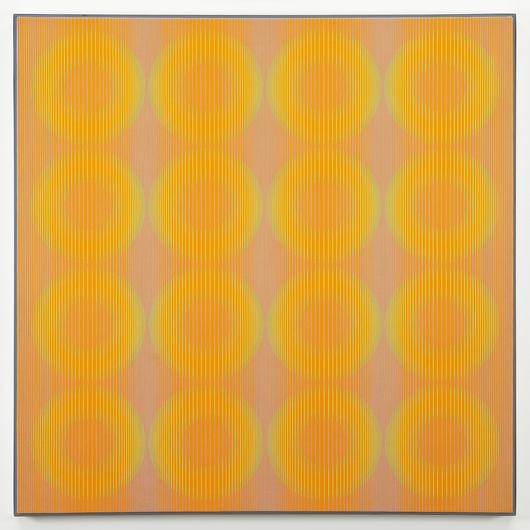
    If you can imagine color energy that bounces back from the walls with blues, reds, greens, and yellows with prismatic and subtle intensity that resembles music, Julian Stanczak’s paintings are for you. The seasoned painter at 86, believed in the power of the abstraction, and in the musical inspiration in his art-making, as he posed in front of his painting during the opening of his solo-exhibition in New York. Stanczak’s exhibition ‘From Life’ is now on view at the Mitchell-Inness & Nash -gallery and will run until December 6. As a young boy, the painter had wanted to be a cellist, and transferred his emotive passion into his paintings. Even a recent work from 2011, titled as ‘Proportional Mixing’ (2011), still handles colors in abstract modalities like in musical compositions. The gallery’s first solo exhibition of Stanczak’s work comprises of a dozen large-scale paintings from the 1960s to the present, including works that have not been seen in the public view for decades. Now on view are artworks, in which the colors are arranged in geometrical forms, lingering hypnotic chromatism and possessing internal vapor, communicating energy and organic presence.

    In 2000, the artist began to create small panels and combine them into wall constellations. He produces the canvases through a complex process of tape masks. The color layers are systematically added and unveiled coming out as repetitions, with spacings and rhythms. The artist relies on his own vision of a finished work without doing preliminary sketches. He emphasizes life experiences in his art, so naturally his own personal history comes to life in the artworks. Stanczak experienced huge differences in places as a young person. He was born in Poland in 1928, spent time in a labor camp in Siberia, and in Polish refugee camp in Uganda, Africa. He immigrated to the United States in 1950. He studied at the Yale University with Josef Albers and Conrad Marca-Relli graduating with M.F.A in 1956. During his formative years, the artist found his way to Phillips Collection in DC and was inspired by Paul Klee’s paintings and watercolors in the collection.

    JULIAN STANCZAK: FROM LIFE
    October 30—December 6, 2014
    534 West 26th Street

    http://www.miandn.com/

    Julian Stanczak wih his Quartet in Cadmiums, 1994, Acrylic on canvas, 4 canvases, each: 89 1/8 by 60 in.
    Julian Stanczak wih Quartet in Cadmiums, 1994, Acrylic on canvas, 4 canvases, each: 89 1/8 by 60 in.

    This slideshow requires JavaScript.

  • Artist spotlight: Hiroaki Umeda discusses his recent works

    Artist spotlight: Hiroaki Umeda discusses his recent works

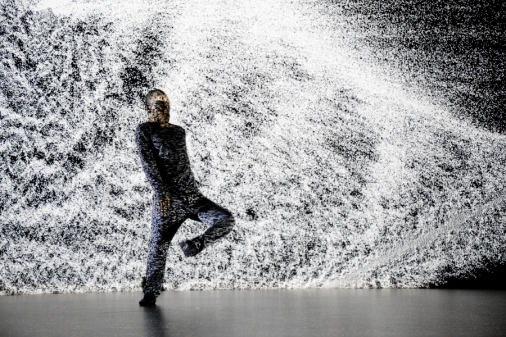
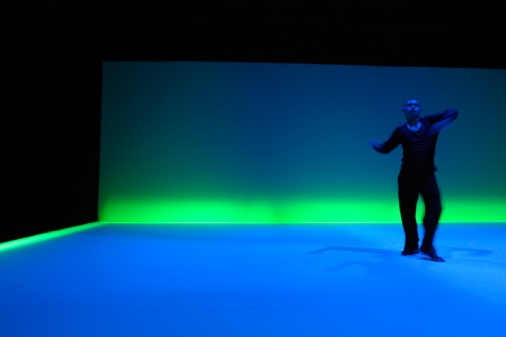
    Japanese contemporary choreographer Hiroaki Umeda recently presented his new choreography Peripheral Stream with L.A. Dance Project at Théâtre du Châtelet in Paris. in 2013, he worked with an ensemble of 11 dancers from GöteborgsOperans Danskompani in Sweden. In the piece, Interfacial Scale, Umeda created the choreography, set, costume, light and sound design. As well as being a choreographer and dancer, Umeda is a visual artist, photographer and video artist. He established his own company S20 in 2000. Umeda has entered the international scene with his multimedia performance works that employ his own body and self-created video images, music and lighting designs. These are recorded on a single notebook computer.

    (On the video Hiroaki Umeda talks about the Interfacial Scale which he created for the GöteborgsOperans Danskompani in Sweden in 2013)

    Since he first drew attention at the 2002 Yokohama Dance Collection R, Umeda has gone on to win praise of dance professionals around the world for the way he wraps his improvisational body movement in intricately woven spaces defined by light (video) and music with the beauty of an art installation. (Tatsuro Ishii for 国際交流基金 / The Japan Foundation Performing Arts Network)

    FIRSTINDIGO&LIFESTYLE: You are known for your own choreographic language that has influences from different styles, and, from the movement point of view is highly flowing and gestural. Is there a way to trace the evolution of it, how did the movement develop?

    Hiroaki Umeda: I started to dance at the age of 20, which is very late in general. At the beginning, I took some dance classes, such as Ballet, Hip Hop and etc. After a year of taking some dance lessons, I realized that there is no specific “dance style” that I want to learn: the dance I wanted to pursue had in fact not existed yet. Plus, I found that what is interesting for me in dance was, not the style, but what lays beneath those styles which is the “principal of movement.” So I started figuring out and understanding the principal of movement by myself, then I applied that principal to my body movement. I would say that my dance should be addressed not as dance but rather as a movement, since I focus on, again, what lays beneath the system of dance, which is the system of movement.

    HIROAKI UMEDA: "Haptic." Photo: Shin Yamagata.
    HIROAKI UMEDA: “Haptic.” Photo: Shin Yamagata.

    You are a Japanese contemporary choreographer, can you describe the dance scene in Japan?

    HU: I have been accepted more abroad than in Japan from the beginning of my career, so I cannot say much on behalf of the Japanese choreographers about what you are asking. However, I personally feel that contemporary dance scene in Japan has not been developed enough yet. The scene is very closed. But on the other hand, it is also true that because of the close-knit circumstances, it has developed very idiosyncratic styles. I cannot say if this close-knit condition is good or not good for the Japanese contemporary dance scene. Anyway, in Japan now, there are so many people who have been struggling and working hard to develop and open-up the scene more; that is a really big hope for me and I thank them a lot.

    You started your artistic career with photography, and then moved towards dance, how did this transition happen?

    HU: I was looking for an art style, which can accept real-time expression, thus, more than photography, I found that dance could be suitable for what I want to express. Dance is an art form in which I can physically put myself into in real time. In photography, on the contrary, it was really hard for me to materialize a piece in real. That is why I shifted to dance from photography. However, I have not totally detached myself from the photographic art form since I have been taking a standpoint throughout that dance can be a form of visual art. Lighting design, which I learned in photography, is now an essential factor for a dance piece.

    The way you construct your choreography seems multidisciplinary. The sound and lighting design, and the visual dimension is crucial in your composition? Can you even differentiate which comes first?

    HU: In practice, I start from abstract drawings, in fact, just lines. This drawing expresses my image of the tension of space, and it functions like the score of the piece to become. According to the drawings, which envision the whole image of the piece, I put together all materials, such as sound, light, dance and etc.

    The visual addition or sometimes ’distortion’ makes your compositions also appear aesthetically ’charged’, could you say something about it?

    HU: In my work, I focus a lot on how the bodily sensation could emerge from the space, and how, in turn, the bodily sensation could change the tension of space. That is, first and foremost, what I am interested in. The basic composition of my piece is always based on choreographing the tension of the space. By acutely tuning into the space, it is possible to attain a lot of stimuli that can provide you with physical sensations.

    What does it culturally mean to be a Japanese choreographer now, from the point of view of globalization?

    HU: have not been working consciously as a “Japanese” choreographer. I have been working as just an artist, focusing on how to bring my pieces to more people all over the world. I think that it is more important to be one of the many artists of the world, than just a Japanese artist.

    Does Butoh as art movement mean anything to you? How about Kabuki, Gutai, and action art? They have also called you ’’avant-garde’’?

    HU: I really appreciate their art works. But actually I am not so close to those Japanese avant-garde cultures. And I cannot tell if they have called me as “avant-garde.”

    What role a nature and technology play in your mind-set?

    HU: Nature and technology are not oppositional concepts for me. As a matter of fact, technology is a tool to understand and approximate nature. By the same token, I think that human beings and art, which human beings create, are a part of nature.

    Where did you grow up? Where do you work these days?

    HU: For the last several years I have been traveling almost all year round. I grew up in Tokyo, and I consider Tokyo as my hometown. But I have been working everywhere in the world. I think that what I do in my art is not connected to any specific country, city or place, so actually I don’t mind working any place in the world.

    You did a work for Gothenburg Dance Company (GöteborgsOperans Danskompani). How was it to work in Sweden, also in terms of cultural exchange? Did dancers like the movement?

    HU: Dancers of the company were from all over the world. They were really skillful and had great intelligence, and were very professional. To start off with, I gave them a system of movement which becomes the under layer of my choreography, and the dancers tried to find their own movements from tapping into that system. I am sure that I enjoyed seeing their movements develop from my system, even more than they enjoyed learning my system. At the moment, I have limited experience as a choreographer for big companies so the dancers helped me a lot and I learned so much from them. I would say that the process was more of collaboration, rather than providing choreography to the dancers.

    In terms of the cultural exchange you are asking, the company was too international to feel any specific cultural differences. I would say that working with them was rather like a kind of universal project, working in various mixed cultures.

    How was it to collaborate in Benjamin Millepied’s LA Dance Project 2? How was the audience response in Paris?

    HU: Compared to LA Dance Project, the Gothenburg Dance Company was strict in terms of working procedures and time schedule precisely because they are a huge public company; I needed to follow their administrative schedule in terms of creative process, which I totally understood. On the contrary, Benjamin’s LA Dance Project is, although they have diverse range or repertoire, still small in scale as a company. For this reason, I could work more closely with the dancers and staff that enabled me to go further and experiment more in the piece. To be very honest, I didn’t expect a good response from audience in the Châtlet. Surprisingly, however, the Paris audience quite openly accepted and appreciated my piece. I was impressed by their open-mindedness.

    Can you name some of your influence or mentors, colleagues?

    HU: There are too many names to list up here.

    What are your plans for the future, and dreams?

    HU: From last year, I have started making choreography devoid of human body. For me, human bodies are not the only elements for choreographic consideration. In fact, I want to really challenge choreographing anything with “movement,” and develop a dance piece with various elements. One of my dreams now is to choreograph water.