Tag: sculpture

  • Discover Teresita Fernández

    Discover Teresita Fernández

    Teresita Fernández’s current solo exhibition is on view until December 31 at Lehmann Maupin’s 536 West 22nd Street location. Her seventh solo exhibit with the gallery coincide with her sculptural installation Fata Morgana, which is on view in Madison Square Park in New York. The gallery shows her latest body of work, including sculptures that are composed of intimate interior landscapes in concrete, cast bronze, and glazed ceramic. Recalling the artist’s earlier Rorschach pieces (2014) – a sculpture made of gold chroming, fused nylon, and aluminum – the new multidimensional works play with the idea of landscape and terrain. The theme of landscape in these Viñales pieces convey three-dimensional forms. The sculptures are detailed yet rough as they are somewhat fragmented, echoing of darkness and distortion, interior and exterior.

    Best known for her unique works and public projects, Fernández explores the natural world, as well as the scale, being sensitive to the act of looking, perhaps finding out about the human versus the landscape. Her conceptually-based art making includes research, and communicates with an entire world of references coming from different sources. In the exhibition, Fernández has created a series of darkened and intimately sized ink and graphite drawings, which are mounted on small-size wooden panels.

    TERESITA FERNÁNDEZ Viñales (8 Nights), 2015 mixed media on wood panel
    TERESITA FERNÁNDEZ Viñales (8 Nights), 2015, detail. mixed media on wood panel.

    These small pieces in sequences show her innate interest in scale. The dynamics between the immense and the intimate; the vast and the miniature; the macro and the micro are definitely part of the exploration. As the natural world as a reference is often large, the human viewpoint brings it closer; in other words we can grasp what we may or could see, if we had time and body to get to these places. Nature’s body is too vast to be created as miniatures, but this is what Fernández actually does. She has looked closely into the malachite mineral rocks and at their interiors comparing their material formula into full-sized landscape of the Viñales Valley, an iconic landscape in rural Cuba. She took up the saturated rich greens and turquoise colors from the malachite, being inspired by their clustered formations. These reminded of the aerial views of the green and lustrous landscapes of the rainforests.

    Fernández draws huge parallels between the malachite rocks and her own experience of the caves in Viñales. The whole project is tricky and fascinating. She reflects the idea of the landscapes both visually and physically, taking in both extremities of light and darkness, inside and outside, containment and amplification. In the exhibition, the Viñales landscape merges with the malachite rocks, which come from the Democratic Republic of Congo, and with the sculptural materials that of concrete, bronze, and ceramic. Fernández fuses with these materials and plays with the scale creating metaphorical “stacked landscapes”, which narrate several layers of references to a place.

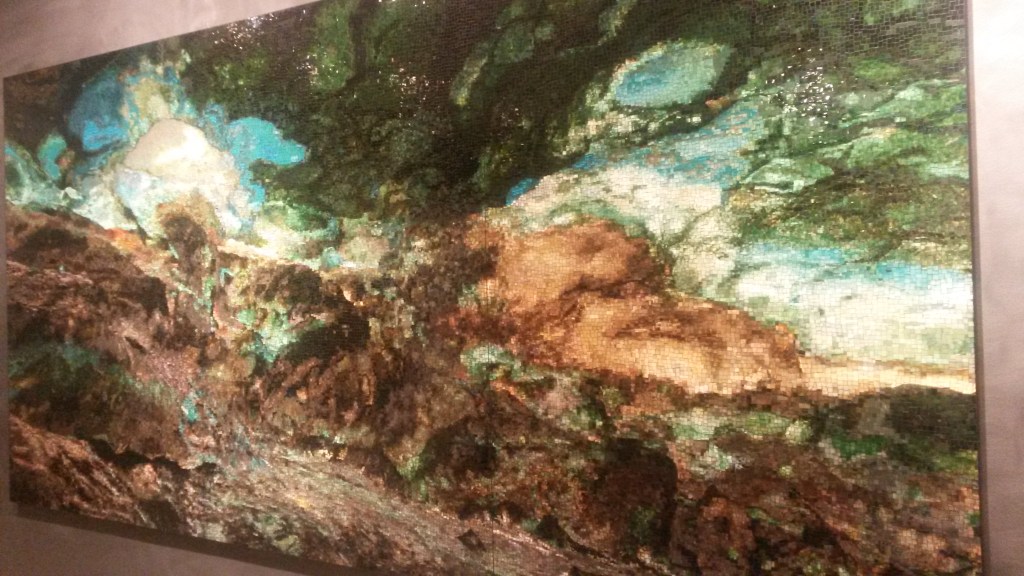
    The exhibition includes three large-scale works made as glazed ceramic panels. The panels shine as saturated greens forming abstracted images. Their inspiration is the actual landscape of the Viñales Valley with its otherworldly mogotes (rare, limestone tower formations), cave interiors, and the exposed surfaces of minerals. Again, the artist is using clay, which is earthbound material. Yet the result is as if the accumulation of this material creates completely imaginary sense of the landscape itself. This is maybe the way art meets a complex surface of the natural world.
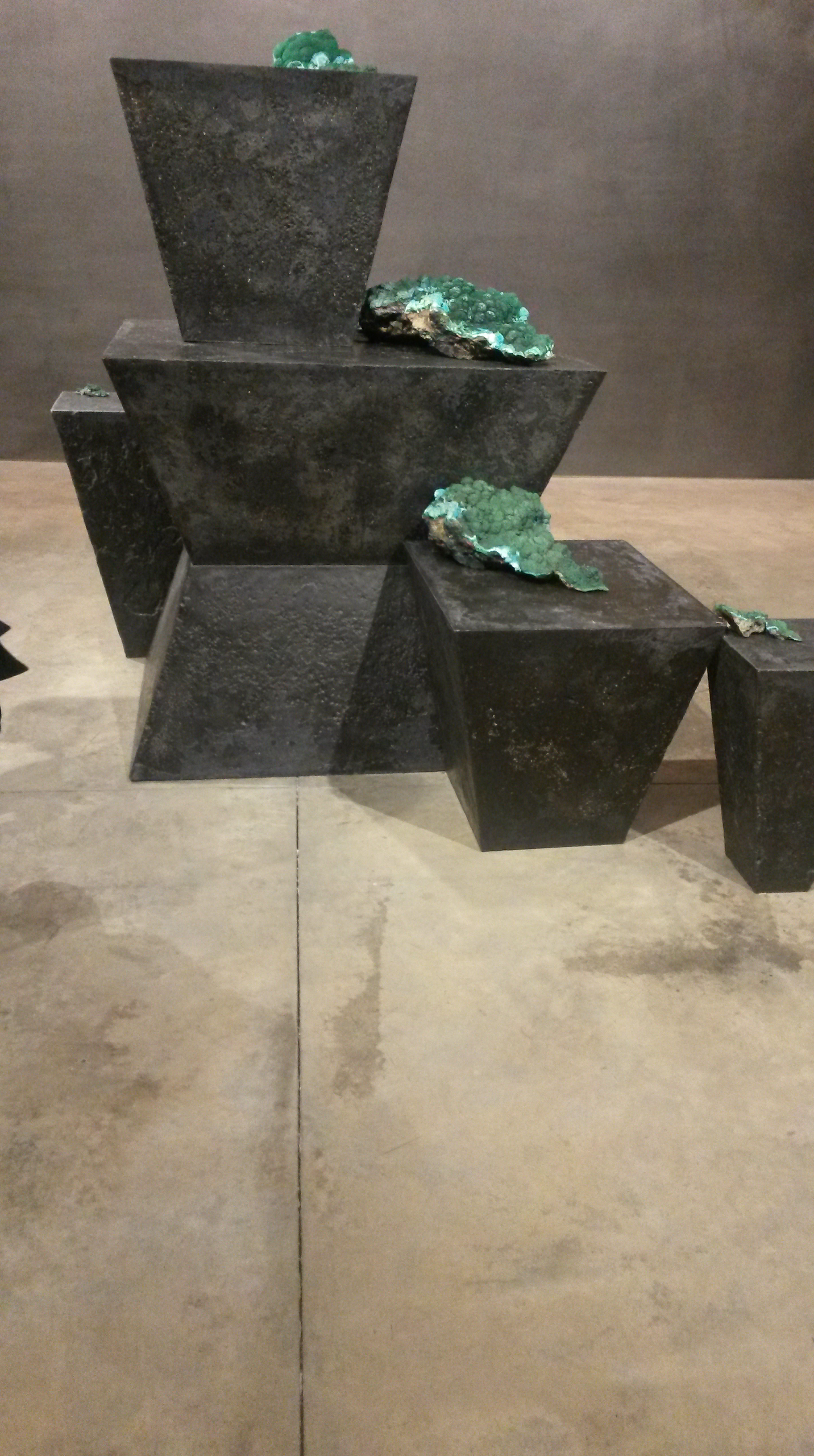
    TERESITA FERNÁNDEZ Viñales (Reclining Nude), 2015
    TERESITA FERNÁNDEZ Viñales (Reclining Nude), 2015
    TERESITA FERNÁNDEZ Viñales (Reclining Nude), 2015
    TERESITA FERNÁNDEZ Viñales (Reclining Nude), 2015

    The central sculpture in the exhibition, Viñales (Reclining Nude), is a horizontal configuration of trapezoidal cast concrete structures of various sizes and heights with descending malachite and bronze forms that evoke the sprawling, verdant landscape from distant to close-up perspectives. As viewers engage with the full-round sculpture, the suggested landscape expands and contracts, prompting viewers to visually construct the image and become the size of what they are looking at.


    Teresita Fernández have a deep rooted association for the cultural and aesthetic language of nature, as she has explored the surfaces of the landscape. She has visited the place, grasping intuitively about something unique of it. Thus the language of the place pours in richly textured forms, being poetic and narrative, echoing about rootedness, history, and different contextual phases. The forms shine through layers, ceramic bits, detailed and yet rough edges of pieces, depicting large and small fragmented knitbits of information. The old, or ancient speaks with the natural, as they have become entangled to stand for their environmental presence. Fernández uses devices like proportion and unconventional materials to draw the viewer into her works. She stands for individualized experiences that ask questions of place and us as humans. Ultimately, the essence reflected in each work could be described as tactile.

    … … …

    Teresita Fernández at Lehmann Maupin
    November 6-December 31, 2015
    536 West 22nd Street, New York

    more information: http://www.lehmannmaupin.com

  • Dance meets art at Loretta Howard Gallery

    Dance meets art at Loretta Howard Gallery

    Yvonne Rainer’s work Trio A (1966), is one of the most enchanting dance pieces of dance history that paved the way to contemporary and postmodern dance practices. It is an interesting choreographic work, not least because it is exhilarating from pure performance and performer points of view. How many times do contemporary performers get immersed in new projects, where choreographers and directors inquire effortless, non-virtuous task-oriented movements and behavior to use them as backbones for their pieces. This in fact is not so easy to accomplish at all. As what performer goes through is not so much about ‘performing’ from a merely audience seduction point of view, but follows more a neutral way of not-doing too much. This might sound complicated, but makes all sense when in dance the performers start tapping the space, letting their bodies organize the way through the space. The inheritance of this type of movement in dance, a meticulous way of appearing happens sometimes simultaneously in conjunction to things and objects. In sculptural and spatial terms, the dancer is like a living and moving human sculpture. But more than that, the art of dancing in this case is shaped also around imaginary objects, or spatial lines that cut through the architecture of space. In Trio A, it seems that the space and objects were a great source of inspiration for Rainer, acting as inner elements, and shaping the movement sequences. There are, of course, noticeable tricky movements and balancing included in the work, even when the dancer (herself in the original Trio A, which was part of a larger work The Mind Is a Muscle) would not make a full sequence of complicated turns, for example. In 1966, Trio A changed the dance scene by examining the possibilities of human movement. Rainer had learned from Merce Cunningham and John Cage to have different approach to the her audience or spectators in general. She also started to experiment with film using the same methods as in choreography.

    When watching the composition of Trio A evolve on the video, it comes to mind that perhaps the biggest challenge is to maintain a calm steady movement flow. The work became a classic not only because it still makes powerful statements of what a composition and a performance is about; but stating a strong performer making the composition. It changed so much in the Western dance history.

    Dance does not always get noticed among contemporary art forms, or is quite rarely placed in the art history like visual arts. When it appears to be paired together with and being a component of the visual arts as a performance art, or in conjunction of musical composition, it gets a different approach. The so-called post-modern dance era brought in new curiosities in terms of artistic collaborations that stretched beyond boundaries of different art forms and genres.

    Loretta Howard Gallery opens on September 10 with a new exhibition entitled “Where Sculpture and Dance Meet: Minimalism from 1961 to 1979.” The gallery curates annually an historical exhibition, and this truly interesting archival exploration showcases videos of historic performances and sculptures associated with minimalism both in art and dance. The exhibit is timely as it is doing homage to ideas that are still in a dialogue setting current trends in visual arts and performance. The exhibition shows that choreographers and sculptors, for instance, used methods of composition that were known as subjective. Yvonne Rainer belongs to these artists who brought minimalism to dance. She did not eventually wish to include her Trio A showing into the gallery exhibition, but her historic rehearsal recording from Conneticut with a group of performers works as a good intro to her style.

    In the exhibit, there is also a video of sculptor Robert Morris’ work,  in which a masked male performer performs with a sculpture created by Morris. In the 1960s, he built his early sculptures in Yoko Ono’s loft that also involved unique performance elements. Choreographer Simone Forti’s archival video of her piece Slantboard (1961), is an important addition to the exhibition. The work includes a platform in its center for performers to attach to and play with. The exhibit culminates around a piece Dance created by Lucinda Childs (original from 1979). The video is a double performance in a sense that Childs’ company performs in the background video when the Dance is recreated for stage. The choreography gathers an architectural sculpture from Sol LeWitt around it. Childs collaborated with the artist in set designs, and used music from composer Philip Glass.

    Andy Warhol’s installation of helium filled pillows, Silver Clouds, adds an interesting story to the exhibition. Warhol created the pillows which then functioned as a set in Merce Cunningham’s dance work Rainforest (1968). Performers in this choreography encountered the clouds when they were floating across the stage. Cunningham often explored dancers and objects to create ‘random’ encounters, so it is great that the exhibition’s shows a performance video and the sets in the gallery space to make the central point come across.

    In addition to the artists and collaborations mentioned, Loretta Howard Gallery displays Trisha Brown’s video Group Primary Accumulation (1973) as part of this archival display. The choreography explored altered understanding of the beauty and power with simple repetitive movements. Brown used principles of mathematics, modularity and repetition when composing the dance. Next to this video, there are minimalistic sculptures on the walls from Donald Judd, who created designs for some of Brown’s choreography. Then, a strong sculptural work is on display from Ronald Bladen.

    The exhibition “Where Sculpture and Dance Meet: Minimalism from 1961 to 1979”, is curated by Wendy Perron, who is the author of “Through the Eyes of a Dancer” and former editor in chief of Dance Magazine. It is co-curated by Julie Martin, who is an independent scholar and currently Director of Experiments in Art and Technology (EAT). The exhibit is on display from September 10 until October 31st, 2015 at Loretta Howard Gallery, 525-531 West 26th Street, New York.


  • Visiting Linda Cunningham’s studio

    Visiting Linda Cunningham’s studio

    Last month, New York based artist Linda Cunningham showed me her art studio in the Bronx, where she lives and works.  It is located next to the Bronx Art Space that is fostering arts education and collaborative artistic projects. She told me stories behind the art works, both the sculptural works and the collages that combine drawing and photography.  The studio is in a newly renovated building nestling at the heart of the historic urban Bronx.

    Firstindigo&Lifestyle: Linda, you were one of the first artists to come to this location, how was the neighborhood back then, it’s been now a good fifteen years? You did a series of artwork digging into the Bronx history, in which immigration was a theme or a subject. There seem to be real person’s story involved, including documents, such as passports with photos. Could you tell about the project that was exhibited at the Andrew Freedman house in 2012?

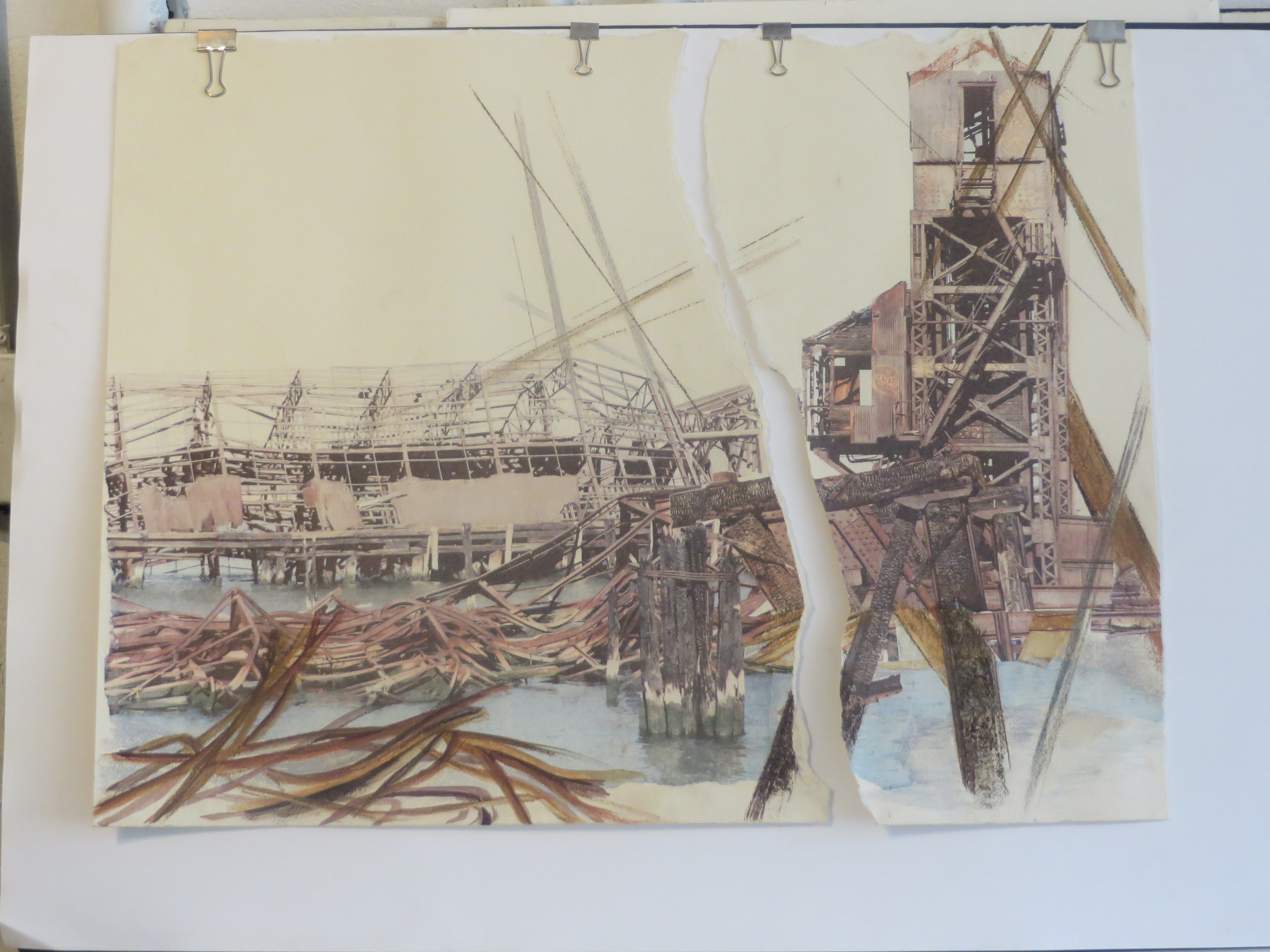
    LC: When I first moved to this historic landmarked area of the South Bronx, I began photographing the now renovated 19th Century row houses with brownstone trim, the contrasting graffiti walls with the shopping carts of the homeless. The barbed wire and I merged those images with a young Jamaican’s poetry and rubbings from the historic signage telling about Jordan’ Mott’s iron foundry. Later I was invited to create a large installation in No Longer Empty’s exhibition at the Andrew Freedman House, an amazing building designed like a Renaissance Palace, left from the early 20s when the Bronx was blossoming. My installation was constructed like an open book from broken drywall panels and broken old wood frame windows with each panel referring to an era of Bronx history. I along with other artists scavenged in the water soaked ruins, excavating the papers representing early 20th Century history of the Bronx. Including among them was the unusual passport of a resident of the house with two different last names, both apparently Jewish heritage, along with her photos. She had traveled all over Europe 1936, and through the Third Reich and into Switzerland several times, so her story suggests that she might have functioned as part of an underground.

    Linda Cunningham_bronzesculpture
    Bronze at Linda Cunningham’s Bronx studio

    Firstindigo&Lifestyle: You recently attended an Art Fair in Harlem, titled FLUX art fair in May 2015; do you have any specific notes in regards to engaging with the community during this festival?    

    LC: This was such a lively engaging event during which I enjoyed most interesting conversations about my work. The artwork displayed in this art fair was tough and engaging and in general more accessible than in most other art fairs

    Firstindigo&Lifestyle: What captured my attention was your rich methodology of juxtaposing various elements. Your artwork depicted ancient olive trees in Italy that are approximately 800 years old by now. These trees got bacteria from Costa Rica somehow. Did the local community got involved in saving them? 

    LC: I don’t know anything about the local community. I just read about it in the Times saying that “they” are trying to contain the epidemic.

    Firstindigo&Lifestyle: What you did in your collage was that you implemented the trees together with post-industrial photographic scene of Ruhr in Germany. This area used to be a center for coal, and now it’s gone. Tell, what is the particular message behind this juxtaposition?

    LC: Both of these astonishing entities are vulnerable, but these amazing ancient trees will continue being productive and useful for centuries, whereas, the astonishing human designed technology is obsolete in 75 years or less and falls into ruin.

    Linda Cunningham_Collage

    Firstindigo&Lifestyle: You have worked with sculpture. The bronze in them comes from ’recycled’ old weaponry from the Pennsylvania army base. The story behind the material is so intriguing, and the fact that you wished to turn the weapons into ’vegetal’, so the forms are like plants.  The texture of your sculptures remind of natural formations appearing rough, in some parts they are smooth, as if ironed.  Could you tell a little bit about the process, how did you find them, and how was it to work with the material?

    LC: The bronze came from military scrap, which I obtained with some difficulty through a not-for-profit institution where I was teaching for a number of years, Franklin and Marshall College. The scrap bronze, which mostly came from ships, military ships, which are not really weapons. The bronze was smelted and poured into a defined shape in flat, oil-bonded sand molds.  The cooling of the hot bronze creates the rough surfaces as the bronze is poured. I am doing some casting currently.

    Firstindigo&Lifestyle: Another element in your sculptures comes from nature. It’s fascinating how some of the rocks you have in the studio are from the ocean. The nature has worked in them so that the huge pressure in the floor has pressed the shells to attach into the stones. One of the rocks is also volcanic, and comes from the Californian coast. Do you have a specific relation to ocean and water in your artistic thinking, as I see the ocean appear in many of your collages?

    LC: I have always been drawn to the eternal rhythm and power of the waves, but in my youth I had read Rachel Carson’s “The Sea around Us”, a beautiful factual narrative about the origins of life and the vulnerability of the life giving sea so essential to our survival.  Then super storm Sandy gave my early interest a new focus.

    Linda Cunningham_Collage2

    Firstindigo&Lifestyle: Also the technique in your collages is interesting, you are drawing and then adding laser photo transfers to paper. Even the surface has layers, cement or metal appears on the surface of the paper adding three-dimensionality. Could you tell more about this appeal? 

    LC: I have worked as a sculptor, and even when I am engaged with these large drawings I am drawn to include appropriate resonant texture and sensibility.  Even though photography can be manipulated it is essentially documentation and convincing as reality. The veracity of photography seems essential. My exhibition will be at Odetta Gallery in Bushwick in November 2015, and I will include especially drawings fused with sculptural elements. I was working on creating some new spectacular bronze forms that will be included in the show. I work on torn irregular shapes because reality doesn’t fit neatly inside a rectangle shape, rather it’s discontinuous, fractured etc. I work from places I have been, responding to particular environmental and historical issues raised e.g. from flooding of Venice, and a jungle growth strangling Ancient Cambodian temples. I built the installation with the Hebrew text some years ago after I spent a year in Berlin on a Fulbright scholarship. I did an installation In Kassel for an alternative documentary, and obtained many of the elements from the former East/West border known as the Berlin Wall.

    Linda Cunningham_Collage3
    Linda Cunningham’s collage depicting trees and Ancient Cambodian temples

    I have always been drawn to the eternal rhythm and power of the waves, but in my youth I had read Rachel Carson’s “The Sea around Us”, a beautiful factual narrative about the origins of life and the vulnerability of the life giving sea so essential to our survival. Then super storm Sandy gave my early interest a new focus. -Linda Cunningham


    Linda Cunningham_Berlin Wall
    Elements from the Berlin Wall at Linda Cunningham’s studio


    ***

    Artist website: http://www.lindalcunningham.com/

    Check also Bronx Art Space

    All images: Firstindigo&Lifestyle