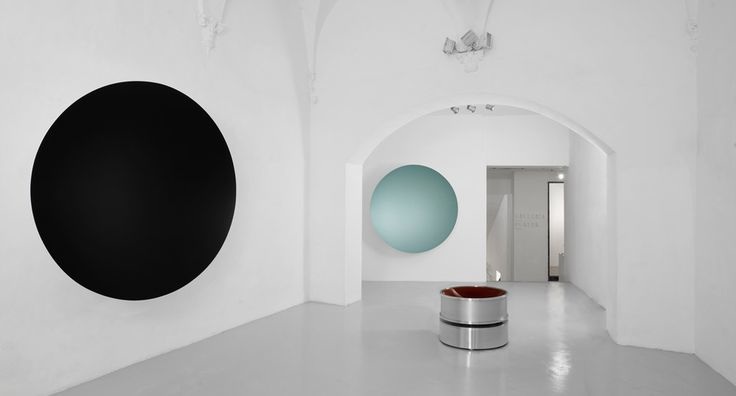
Anish Kapoor returns to Italy with a new exhibition Descension, a project produced specially for the former cinema and theatre space of Galleria Continua in San Gimignano. The exhibition takes its name from the installation Descension, which is a black whirlpool consisting of motor-powered water swirling towards its center. Interested in binary relations and opposite energies, Kapoor(born in Bombay in 1954, lives in London) poses alchemical questions with the large scale installation. It creates paradoxical ideas of matter, energy and the universe, which also touch our human core and perception. The exhibition opened on May 2 and will run until September 5, 2015.
The exhibition features a series of new sculptures in alabaster, in which the artist has meticulously carved out a more refined section. We can expect that the concepts of infinite and time are buried within their form and substance as they appear in nature. The intense red (and kind of orange) embedded in the translucent qualities of the alabaster sculptures suggest organic qualities. But idea travels well through the entire exhibition, which among alabaster includes a variety of mixed media works in fiberglass, paint, stainless steel, pigment and acrylic.
Anish Kapoor, exhibition view ‘Descension’, Galleria Continua, San Gimignano, 2015
Descension, the installation established by Kapoor in the stalls area of the cinema-theatre in San Gimignano, continues his earlier theme introduced as ‘Descent into limbo’ in 1992. The artist’s former work was presented respectively in Kassel, Germany as documenta IX; a Cubed building with a dark hole in the floor. In the middle of a cube, there was a kind of bottomless black hole opening up in the floor, which was “dragging” viewers with its powerful presence. The idea of Descension shows how Kapoor has an interest in non-objects and self-generated forms. In 2015, the installation destabilizes and undermines our perception of the earth as a solid element. The earth, perceived also as mother earth, is in constant flux and movement bringing forth a thrust downwards and towards an interior that is unknown and hidden from the visible world.
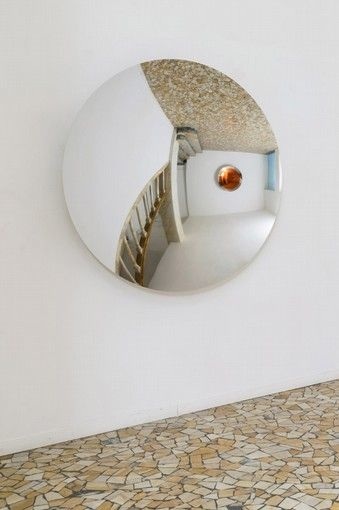
Anish Kapoor, Untitled, 2015, stainless steel, Courtesy of Galleria Continua
Kapoor has inevitably shown how he is reinventing his artistic language both in monumental dimension, as in more intimate pieces. His philosophical inquiry begun early with his very first works and has continued through to recent and more large-scale installations in museums and public spaces. His themes are partially alchemical, dealing with mystery and universality of time and space. But the human beings with their self-awareness and experiences is at the heart of his artistry as well.
”… all my life I have reflected and worked on the concept that there is more space than can be seen, that there are void spaces, or, as it were, that there is a vaster horizon. The odd thing about removing content, in making space, is that we, as human beings, find it very hard to deal with the absence of content. It’s the horror vacui. This Platonic concept lies at the origin of the myth of the cave, the one from which humans look towards the outside world. But here there is also a kind of Freudian opposite image, that of the back of the cave, which is the dark and empty back of being. Your greatest poet, Dante, also ventured into a place like that. It is the place of the void, which paradoxically is full – of fear, of darkness. Whether you represent it with a mirror or with a dark form, it is always the “back”, the point that attracts my interest and triggers my creativity.”
Anish Kapoor, Untitled, 2015, Alabaster, Courtesy of Galleria Continua
Galleria Continua, Via del Castello 11, San Gimignano (SI), Italia
Philosopher Gilles Deleuze has suggested that among the arts, sculpture presents perhaps best those qualities that are materially sensational. The sensation of stone, metal and marble vibrate according to strong or weak beats. Then, there are protuberances and cavities in the material that resonate with each other. The set-up of the sculpture with large empty space between the groups, or within a single group, makes it that one no longer knows whether it is the light or air that sculpts or is sculpted (Deleuze: What is Philosophy).
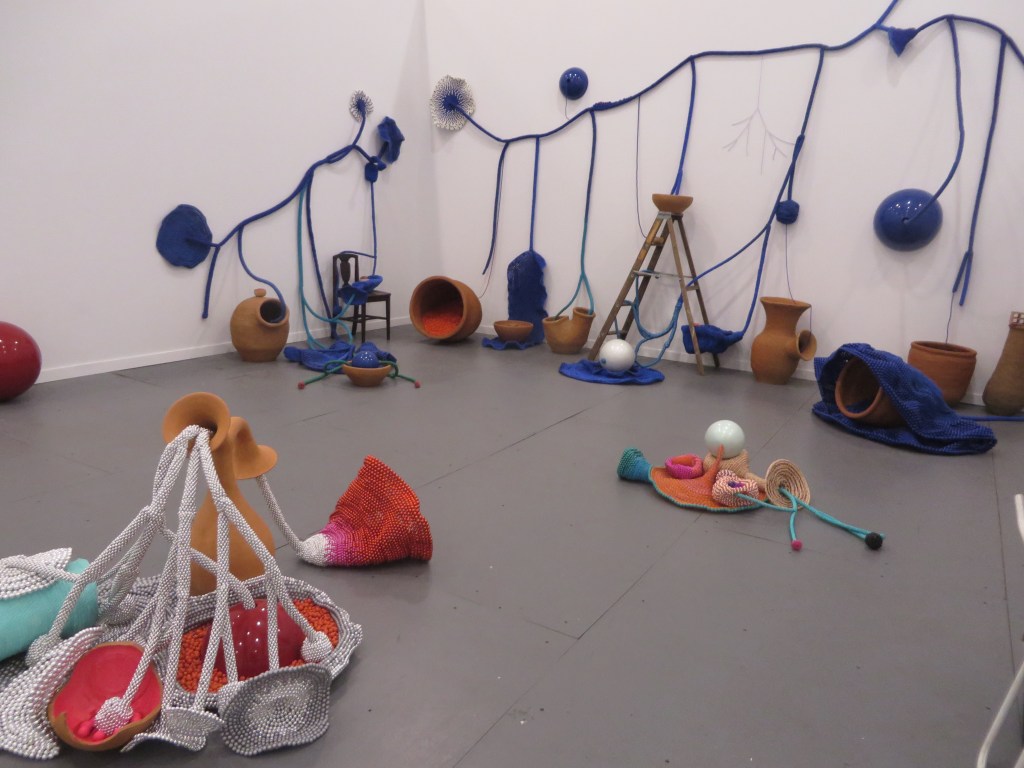
Maria Nepomuceno’s installation. courtesy: @A Gentil Carioca
Sensations attached to the materiality in sculptures relate to ideas of tactility (perceptible to the touch; tangible). Our experiences of materiality has shifted, as 21-century cultural landscapes keep molding our tactility through complex body-digital technology relationships, changing our imagination of the virtual spaces. Contemporary sculpture is reflecting some of these shifts, showing powerfully the time beyond the current, the moment at hand. Among some of the interventions, Frieze 2014in New York City paraded a loss of the technological overrule. The disengagement from materiality at large, was shown in some works. There were works that were pointing to our roots of craftsmanship, bringing back materiality of different scales, and putting out the new spatial engagements. Noteworthy is that large scale is not necessarily the most powerful signifier, but some minimal portions or material may also integrate ideas. An example of this kind was installation with smaller details and nuances by artist Maria Nepomuceno. The artist was presented at Frieze NYC by AGentil Carioca‘s Gallery from Rio de Janeiro.
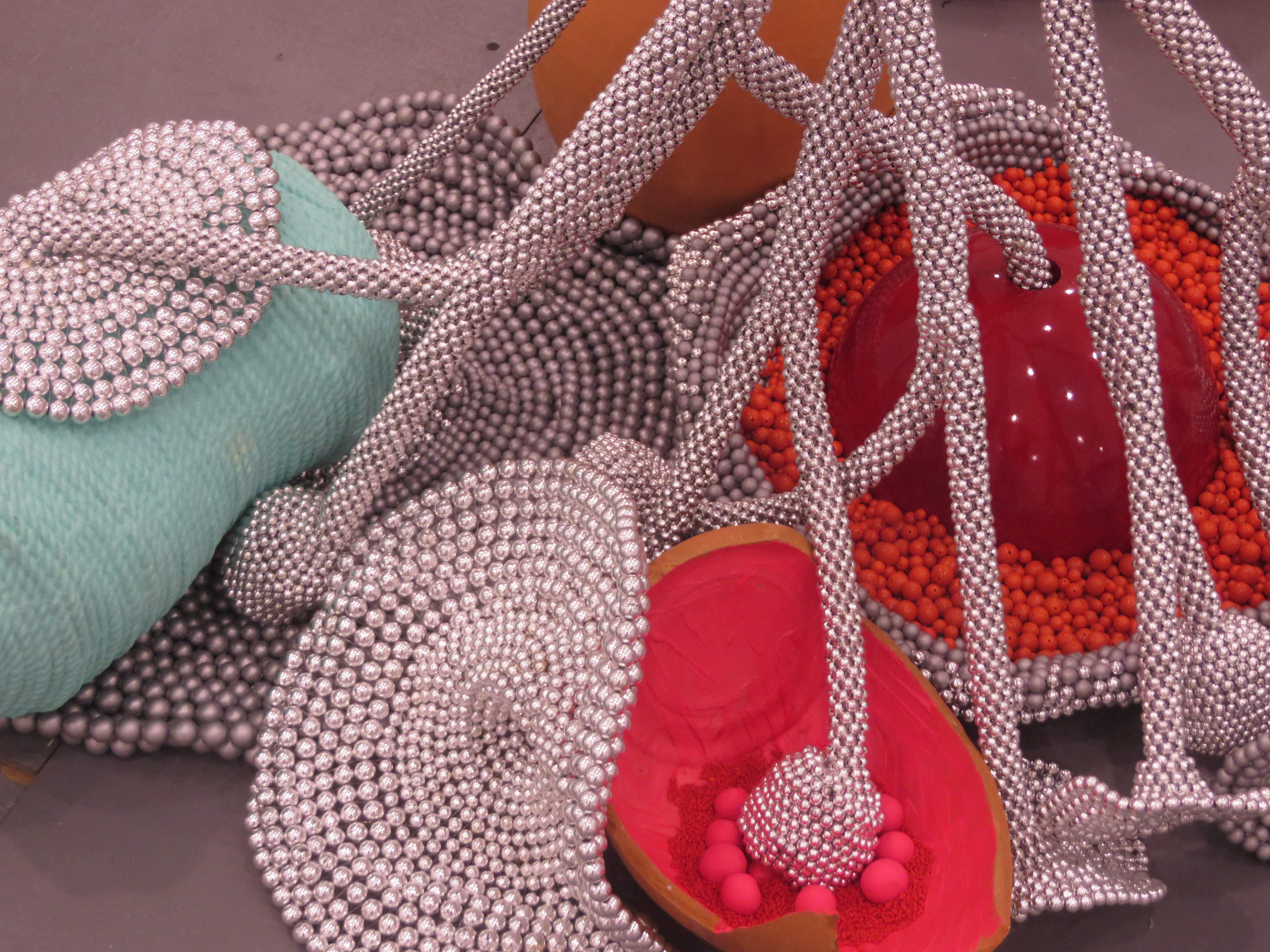
Nepomuceno draws on Brazilian craft traditions using weaving and braiding techniques, as well as her own designs to build biomorphic sculptural forms. The sculpted appears as seductive when the colors and patterns nourish imagination. The lingering movement and rhythm comes from the way of installing sculptures in the space, some scattered forming a logic. The artist allows sculptures to spread across space like vegetation. Rope and necklaces are used as raw material in the works, and the materials take a natural spiral form. The artists has been using body and nature as inspiration, creating infinity, and shaping of living organisms. The ancient traditions and techniques are a source for her art, as she gives materials a new form and content.
Another woman artist in Frieze show was talented Jumana Manna, presented by New York’s CRG Gallery. The artist recently exhibited her works at Sculpture Center in Long Island City titled Menace of Origins. Manna’s piece at the art fair was titled Crowd connecting closely to her recent show, and echoing of same elements and materiality. The artist has explored a notion of relics in her works. Using archaeology as a device, she has explored ruins and architectural forms that reminiscence human presence. The works that build ideas and are structurally challenging explore the construction of power, nationalism, gender, and history through material relationships. Manna works mainly with sculpture and video, often pairing them together to create surprising events.
Respectively, Liz Larner’s sculpture spoke from the Frieze exhibition of Los Angeles based gallery Regen Projects. Her bold sculpture was physically large and airy at the same time. A free-standing metal sculpture displays a cold aesthetic. Her sculpture “V (planchette)” (2014) has a smooth aluminum surface, which is painted a chalky black. It is curvy suggesting motion, giving feelings according to the angle it is viewed from. It is wider at its base, leaner in the middle, large and flowing at the top. The statuesque nature promises balance, but gives a hint of character that might be leading to odd and ambiguous places.
Liz Larner, V (porchette), 2014. Courtesy of the artist and Regen Projects.
Rémy Markowitsch’s five-part group of wooden sculptures took the stage curated by Berlin-based Galerie EIGEN + ART. His installation FALL uses two different historical events as material, namely four of the sculptures mimic the painting Absturtz (the Fall) by Swiss painter Ferdinand Hodler, depicting Alpine climbers that were created for the 1894 World’s Fair in Antwerp. The fifth figure comes from a different source, representing a German mountaineer Toni Kurz, who died when attempting to climb the north face of the Eiger in 1936. Sculptures are nude, so they come across as timeless, without specific location. His installation is accompanied by his other work showing mountains, which give out a feel of nostalgia to the romantic past times when climbing at the world’s highest mountains produced heroes, while there were sacrifices, and danger involved.
Lehman Maupin (New York/Hong Kong) brought in a large sculpture installation called Library II-II by artist Liu Wei. This sculpture is made from thousands of books and it weights nearly a ton. The gallery told that they had to reinforce the floor underneath the sculpture so its weight was supported. Liu Wei’s sculpture will be part of an exhibitionBringing the World into the World at the Queens Museum (opens on June 15). Around the sculpture, space is altered and tilted. The work notes literariness of our civilizations. The inventions of paper; dimensionality that comes with the written cultures and around ancient canopies of words. Lingua and library, freedom of press, freedom of writing, utterances. But more than any literal connotations of the material itself, the sculptural challenges beyond the apparent, parafrazing, the architectural of the cities and urban life cycles, as our connection to global spaces, and disconnectedness from the traditions.
Frieze 2014, Liu Wei, Library II-II, 2013. courtesy: @Lehmann Maupin
Galeria Fortes Vilaça from São Paulo presented Erica Verzutti’s concrete sculptures that were academic and playful at the same time. The gallery commented that Verzutti’s works gained a lot of attention at the Frieze art fair, due to their brilliant interactive quality, and sense of humor. The sculptures are semantically pointing to archeological pasts, many of them depicting minerals and natural stones that appear as traces of nature. Playfulness comes from the interactive quality of her sculptures, some parts are loose (like egg-shape stones) and can be organized differently. Double Sunset is a bit different from her other works, some of them on stands. The work on the wall showcases two basketballs as a colorful urban signifier of play and sports, when they are installed in the concrete. But ultimately the viewer has a chance for interpretation. A woman’s bust, femininity paraded?
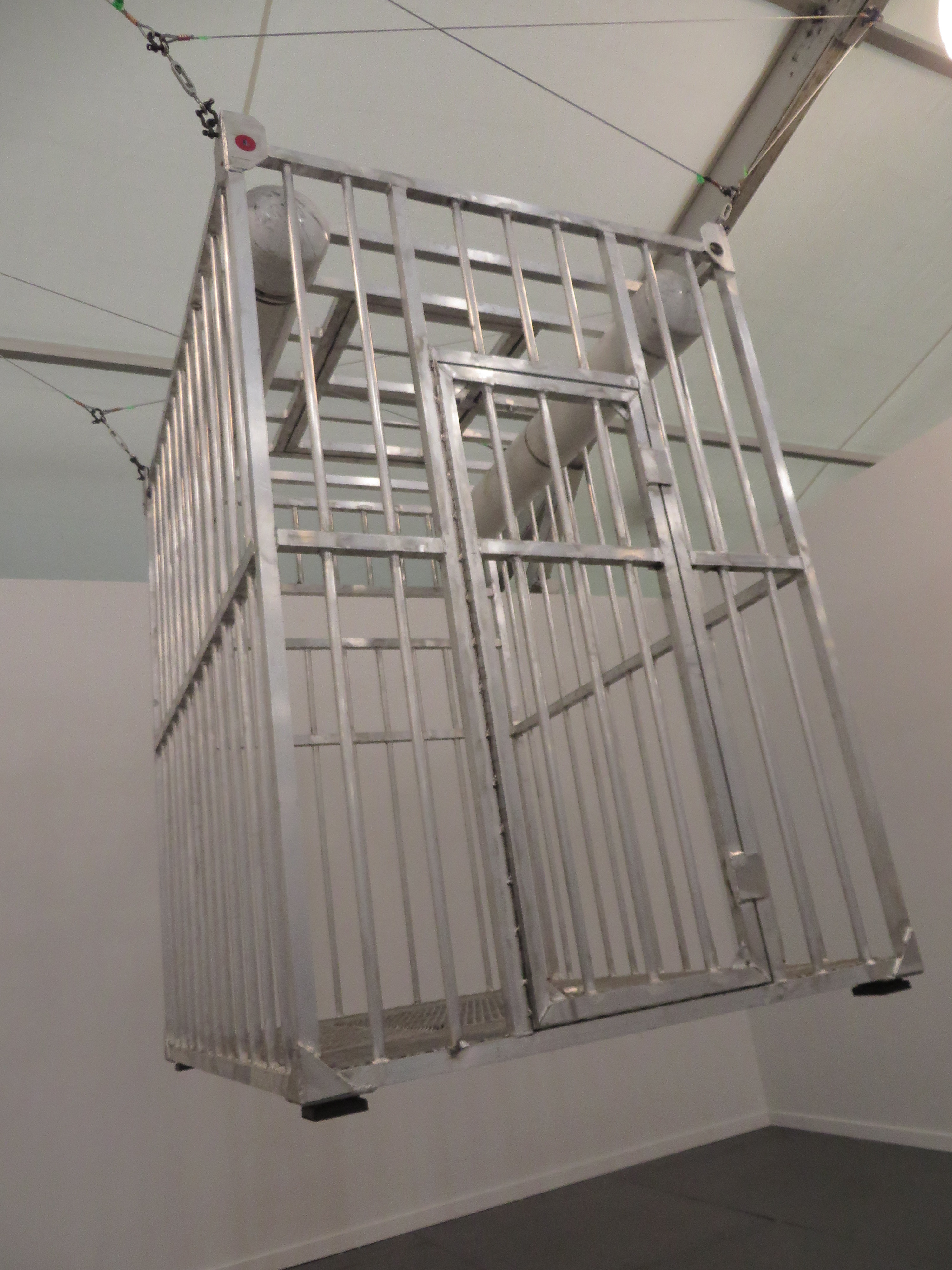
One show-stopper at Frieze was a pale installation composed of a single cage, which was hanging from the ceiling with nothing around it but the white walls. Wilfredo Prieto was the artist curated by Nogueras Blanchard galleryfrom Barcelona. It evidantly showed how to be captured, a sentiment so fearful, yet potentially something that makes art appealing to its viewers. The possibilities are endless to imagine how to relate to the cage as an object, to think what are the experiences and feelings attached to its awful shape. It represents zoo-like ready-made feelings, and it reminds of a consumer-object relationship without pointing to a specific direct target, except the art fair itself? Who would need a shark-cage? Who needs this kind of art? A question, what are the sensations attached to our art-viewing, comes to mind. Is art made for humans as animals? Weird crescendo of concepts makes it art?
Shark cage illustrates a perfect example of the first position. The piece does not allow for the poetic metaphor and is in itself a clear statement, provocative and critical of its environment, in this case an art fair. The presentation of this work becomes a pitched battle between the object, the context and the interpretation of the viewer. The artist participates only as a facilitator of such a meeting. A strict representation of the cage, without any further intervention, is what turns us all into potential sharks. (Alex Nogueras&Rebeca Blanchard)
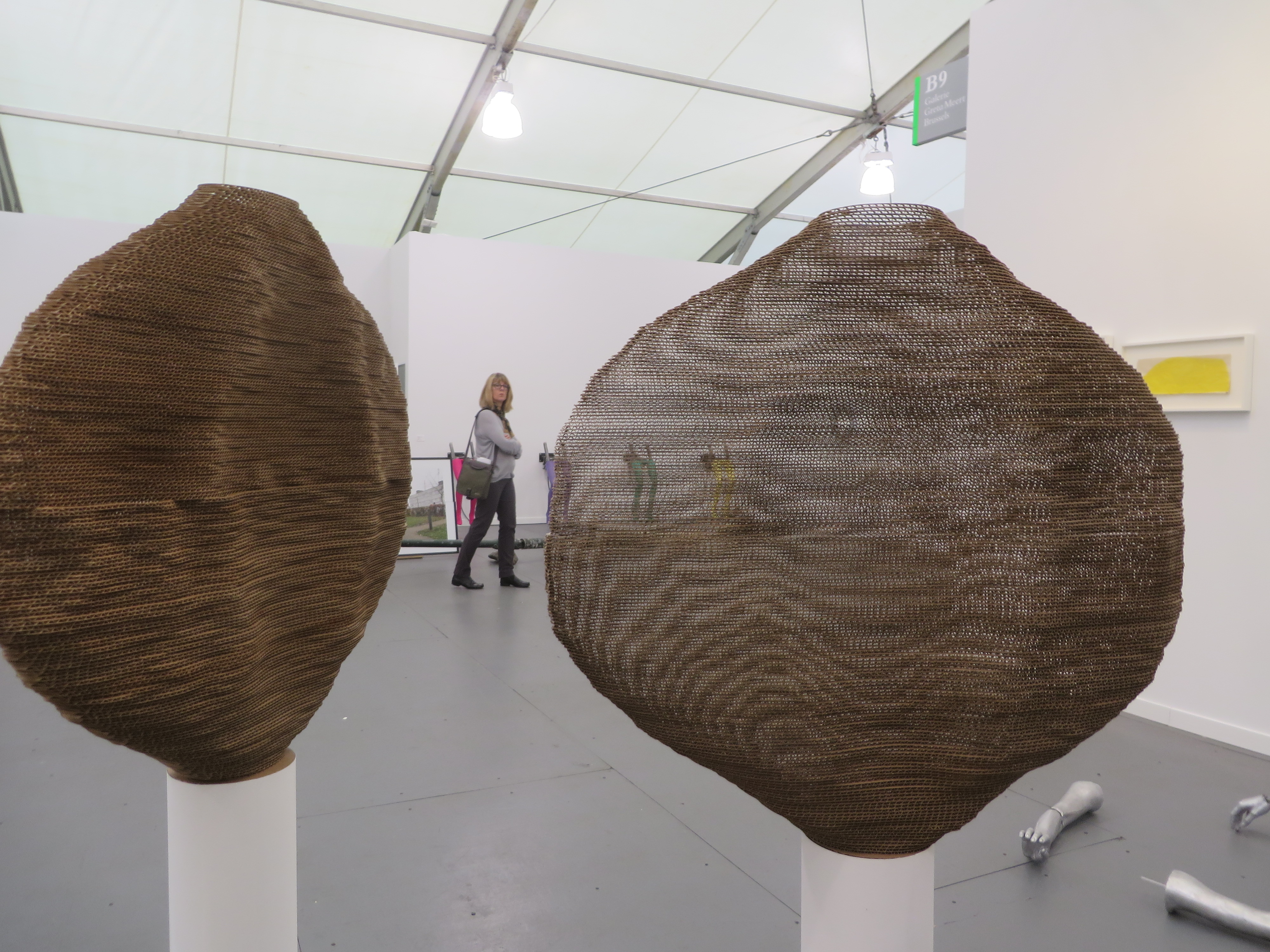
Tobias Putrih, Macula, 2014. courtesy: @Galerie Greta Meert.
One of the favorite was Tobias Putrihwho is internationally acclaimed artist working with such modest materials as cardboard and plywood. Those are exactly the materials that are hard to work with, as there is the air element that challenges them. Putrih’s two sculptures were presented by Galerie Greta Meert from Brussels. The cardboard was transparent enough to create a surface, which circulates light. His sculptural objects are attractive and sensual enough, as much as they project intellectual and architectural propositions, definitely aiming to shape our viewing experience. Touchable, palpable, airy, anything between transparent and materialwise poetic.
Last, but not least, Paul McCarthy’s large blue head sculpture belonged to New York gallery Hauser Wirth’sexhibition titled On the Fabric of the Human Body. His large heads are like prop-objects, and comment a tradition of beheaded figures in art history. Together with works from Rita Ackerman, Louise Bourgeois, Isa Genzken; McCarthy’s sculpture worked as expressive part of the art fair, expressing body that reinvents and transgresses.
Paul McCarthy, White Snow Head, 2012-2013. Silicone, fiberglass, steel. courtesy: @HAUSER&WIRTH
As a summary, what comes to mind is the movement of the virtual; our contemporary lifestyles embedded with mediascapes (term coined by Arjun Appadurai in 1990). The global cultural flow affects both the artists and the viewers, who are participants of the art world. The historical referencing opens to ideas of homogenization of the arts. Repetitive use of similar motives over and over again would easily define the art, and block any motion. Such would be the case if the consumer culture says that art should be purely digitalized! As we want to consume while we eat, rest, and start again with the same. Contrastively, art should provoke us, make us move from our comfort zones, let us move in between the sculptural, sense the provocative. It can touch our sensibilities. It should stop us from numbness.
Bortolami Galleryis one of the most innovative galleries in Chelsea’s vibrant art district. Currently it is hosting an exhibit for three artists who share an approach of minimalism. An exhibition is curated by Christine Messineo, and is titled in a punctuating manner: ”ANN VERONICA JANSSENS, KITTY KRAUS DANIEL STEEGMANN MANGRANÉ First lines, like first dates, or the first bite of dessert, can be deceptive.” Even if the works would not seduce you at the first glance, spending some time with the installation and connecting pieces, might make you fall in love. Stepping into the space, which itself is a constellation of whiteness, concrete floors and strong ceiling lights, puts you into a certain mood. The space tunes to receive the immaterial lightness of some works. On the other hand, some pieces makes you investigate your own perception.
This slideshow requires JavaScript.
The exhibition title is taken from a text by Ann Beattie. She handles a theme of difficult of beginnings, asking where to start. If the beginnings can remain elliptical, the encounters may be unstable. A curatorial choice thereof has been to follow this principle, and create the exhibition around three artists with above question in mind. Ann Veronica Janssens, Kitty Kraus and Daniel Steegmann Mangrané present works all share experience which do not reveal, as ”First looks cannot be relied upon.”
Ann Veronica Janssen’s career has been full of experiments with form and perception, testing our reflections into familiar forms and to spatiality. Also in this exhibition her pieces invite to reflect. Magic Mirror Pink holds a possibility for a mirror-effect. Disque Vert holds magical presence being placed on the back wall, immediately popping out from the white walls. It reminds of a musical instrument, but instead of making sound it whispers with deeper than surface reflection. All the miracle that Janssen’s three works play within the exhibition tell about ”scientific phenomenon or physical property of light—its ability to bend, to refract, to remain encased within a prism-like volume.” The artist’s sculpture IPE 130 is the center piece of the large installation room. This sculpture is a steel I-beam lying on the ground of the gallery. The top of the sculpture has been polished so it reflects your image, or the objects in the room that touch upon the surface. The purpose is to communicate with the architecture, as all Janssen’s works ultimately do.
The exhibit starts right when entering the gallery. First room with windows to the street is a small one. One immediately encounters Steegmann Mangrané’s sound installation. He has worked with sound that comes from seven speakers that are placed throughout the gallery; taking two rooms. The sound is composed as prolonged note played on the flute. ”The duration of each note corresponds to the lung capacity and stamina of the flautist, Joana Saraiva. As one note comes to its end, another note begins to play from different speaker in the gallery.” In this area, there is a need to find the source of the sound, which does not resonate clearly from the speakers. The art objects in the exhibition carry so much, so perhaps sound gets confused or finds ways to attach to different bodies. Mangrané has worked with notion of immateriality. The lightness of breath which is present in the musical notes creates meaning in conjunction to his sculptural works as well. He has created several metal chains that hang from the ceiling that reach the floor intending to alter the viewer’s ability to negotiate the space. Additionally, a group of small cardboard sculptures appear as the most ethereal part of the show – which overall seems slightly prismic, metallic, or technologically referential. These are like masks made of sycamore tree bark. Their curved altered face-like shapes absorb the light creating shadows on the wall, ”seemingly lending mass to the immaterial.”
Kitty Kraus’s piece Untitled (Light Box) which, although it is situated in the small room in the back, has especially strong presence. ”Taking the form of a large pedestal, the sculpture casts a strong light from only a thin horizontal aperture that runs around the middle of the dark, rectangular volume.” As you go around the sculpture you can see it upon yourself thus becoming part of its field. The sculpture leaves out an emitted light line that draws the perimeter of the room. When people enter the room the light from outside communicates with the darkness of the sculpture and its surrounding space. White lines of the exterior space meet with the dark hollowing entity of the box, creating magical installation that eats up the space, almost disturbing the perception, and pointing to the trivial?







 Firstindigo&Lifestyle