Tag: video

  • Bill Viola: The Moving Portrait

    Bill Viola: The Moving Portrait

    Bill Viola: The Moving Portrait is a retrospective exhibition happening at the National Portrait Gallery in Washington DC. The exhibition, on view until until May 2017, is celebrating a career of a pioneering video artist Bill Viola. The artist is recognized for his groundbreaking use of video technologies; and his works are known as poetic and performative, exploring the spiritual and perceptual side of human experience. Installed in multiple darker rooms, the show takes a viewer into a few episodes with the moving portraits. They are diverse, as one can imagine, and with each work the viewer’s experience becomes more fluid than staged or patterned. The works follow more circular way of reasoning than linear logic in storytelling.

    The portrait of Bill Viola himself is titled Self Portrait, Submerged, 2013 (color high-definition video on LED display; stereo sound; 10:18 minutes). This portrait connects to an idea of mortality, the artist himself is appearing underwater. He looks as if being still with his eyes closed, and he does not seemingly breath. However, the movement becomes present with the unfolding effect of the water moving and altering the stage so to speak. For Viola, self-portrait is an evergoing reflective way to figure oneself out. Self-portrait is always a self-representation. As an artistic discovery it would be more like looking beyond a merely simple representation of oneself; attaching a subjective and changing viewpoint into a larger psychological canvas. We live in an era of selfies, so what more is there to discover, beyond a representation? Where does the normative cultural portrait end, and the new interpretation start?

    In many of his works, Bill Viola summons the characters, young and old, male and female. These portraits are submerged underwater in a similar manner as his Self Portrait Submerged. A group of seven works are titled The Dreamers (2013). The portraits appear in a dark room as an installation of plasma displays mounted on the wall. They radiate very subtle visuality. There is water underneath of each character as their personal stage. It is the essence of the water that animates the otherwise still portraits to become sifting moments in space. The plasma videos are accompanied with a sound of a running water, which appears as a surrounding pulse for the portraits. These portraits take form as immersing works. In a way they are virtual, or the time is stopped as if there was an episode happening in another realm or in outer space. Each personality emerges as colors, when their fabric and hair covered bodies measure the dimensionality of the water. They contour and camouflouge barely within its surface.

    A very different video setting is formed around a work titled The Reflecting Pool originating from 1977-79. In the video, a man is emerging from the forest standing in front of the pool. As he is leaping up in a sudden movement, jumping into the water, the image freezes. The person remains still in the center of the image; he is frozen whilst the water in the pool is slightly moving and changing. Another take on a theme of time passing. This time, the person is also immersed into the surroundings even more, and perhaps becoming one with the green lush with all his senses.

    In a massive one screen video installation, a group of nineteen men and women from various ethnic backgrounds are struck by a great amount of water coming from a high pressure hose. The video called The Raft (May 2004), expresses different actions and reactions from the people to a seemingly catastrophic situation. Some are struggling physically showing hardship of survival with their bodies, the others remain more upright; yet all characters are touched and moved by the sudden force. The scene of the people reacting with their personal response, with their bodies moving, resisting, twisting, and falling, is effective. In the end, the water stops and leaves people with altered positions. The narrative brings into mind a natural force, which takes over peoples’ lives and controls their surroundings. An occurrence, which people cannot control. The video story opens a new stance to altered ways of being flooded, or being carried away with life occurrences.


    Bill Viola: The Moving Portrait exhibition is a well curated retrospective to the artist’s forty year career. It includes several works investigating life cycles, and the process of aging. It touches a question of gender, and the metaphysical place for people in the world. His video works speak with the language and gesture of the body and face. They confront us with emotion and presence. Portraits are not always beautiful, or the characters are not always beautiful in a sense of how we measure our bodily image. But they echo beauty with their truthfulness and soul, which goes further than a normative cultural presentation.

    Bill Viola started his discovery with a Portapak camera in the early 1970s. Since that time, the video has been his medium of expression.
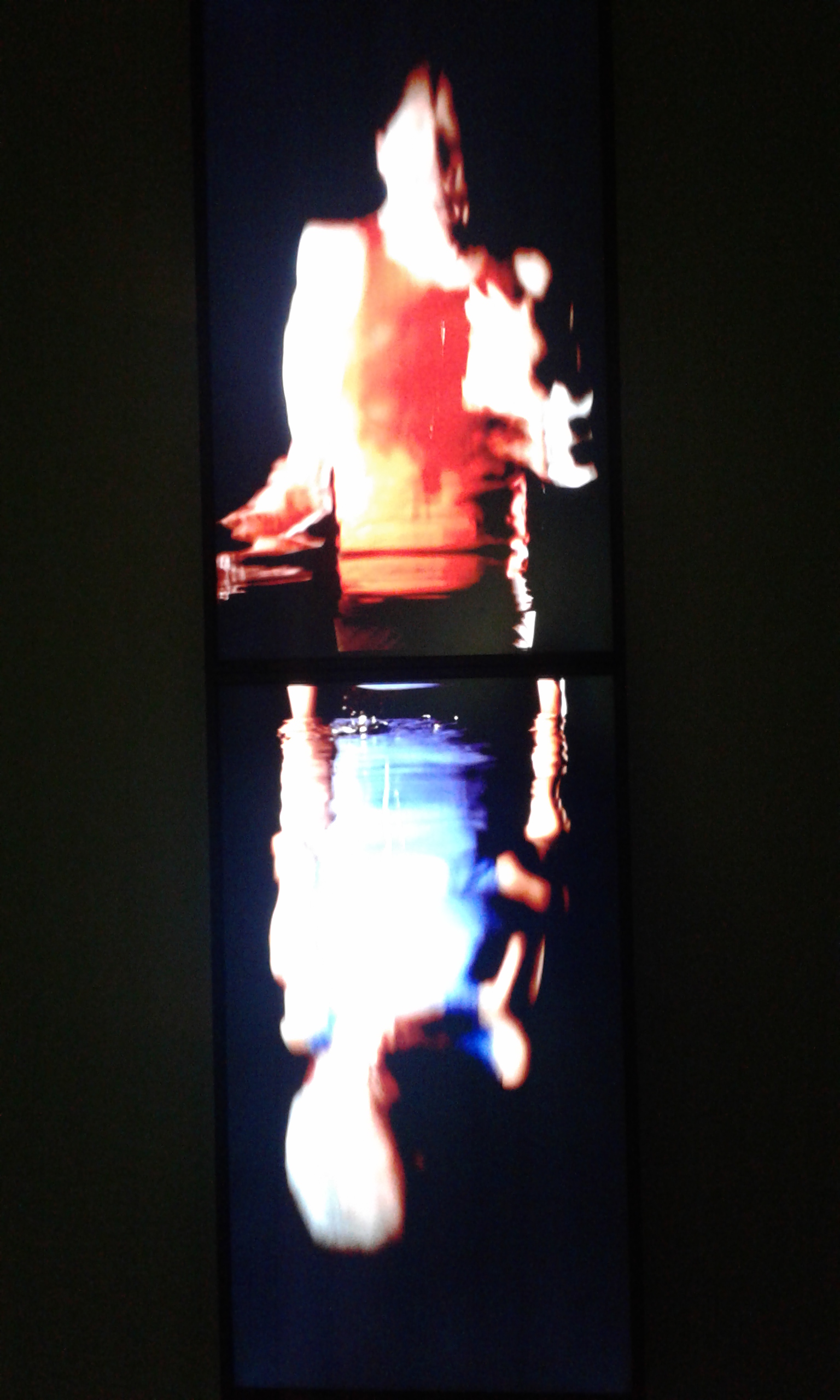
    Bill Viola, Surrender, 2001. Color video diptych on two plasma displays mounted vertically on wall; 18:00 minutes. Performers: John Fleck, Weba Garretson.
    Bill Viola, Surrender, 2001. Color video diptych on two plasma displays mounted vertically on wall; 18:00 minutes. Performers: John Fleck, Weba Garretson.

    ***

    More info about Bill Viola: The Moving Portrait exhibition at the National Portrait Gallery 

    More info about the artist on James Cohan Gallery 

    Artist website: http://www.billviola.com/
     

  • Anri Sala’s musical mystery

    Anri Sala’s musical mystery

    “Anri Sala: Answer Me” -exhibition, which will be on display at the New Museum until April 10th, 2016, features multichannel audio and video installations. In his recent works, Albanian artist Anri Sala has interpreted musical compositions, classical works so to speak, with experiments that are structured into video and sound installations. The monumentally compound works navigate through the limits of our perception; mapping the sound and the spatial, and investigating the sound in the architectural spaces. This experiment transformed New Museum floors into symphonic areas of soundful meaning, leaving room for small encounters.

    Anri Sala’s often political works have tested the boundaries of sound and language in our construction of cultural realities. From cultural point of view, his works seem to investigate contexts that are outside the dominant aspects of reality. Or the realities are rather revealed through the layering of world of sounds. We have adopted a notion that the words create the meaning in our cultural communication. Yet, as Sala with his approaches has shown, it is possible to challenge this definition further by mapping and deconstructing the terrain, in which words actually restrict our ways of interpreting or seeing the world. From this perspective, the everyday life is full of noises that communicate without restricted syntax. Sound, form this point of view, has a great capacity to alter meaning.

    Sound’s features are attached to the material world that is so close to music. For Anri Sala, sound plays a role of an incomplete music, or music, which is in the state of becoming. Sound as a mediating device – even when it is real musical pieces divided into fragments – can document and edit reality, and communicate on a new level of poetic composition. This becomes immanent through the artist’s works, which New Museum profoundly projects. What stays with the viewer, is the personal corporeal experience, which is created in the architectural space as the entirely new perception. The change in the reception of the artistic works is focally in the embodiment. The surrounding sound world invites the viewer to walk into the next room full of sound. Or it freezes on the threshold, making the mystery of the sound’s origin more significant.

    Fragmentation and repetition is evidential in Sala’s second floor installation. The work unfolds as a two-channel HD video from 2014: ‘The Present Moment (in B-flat)’. This installation depicts different interpretations of an original compositional score by Arnold Schoenberg, titled ‘Verklärte Nacht Op. 4’ (1899).’ On the video, the chamber music setting acts as a fictional rearrangement of the historical work. Two videos feature a sextet of two violins, two violas and two cellos that play solitary notes from the musical work. Eventually the original musical score unfolds. The audio-visual installation works powerfully on two separate screens absorbing the body of a viewer into its mellow soundscape. The intimate portraits of the musicians, the movements and gestures of their heads, hands, arms, and backs, act as counterbalance to the interior, in which their playing has been recorded. The setting of empty room or hall creates an atmosphere of a vast space that accumulates sound on multiple stages. Sala’s meditative and mesmerizing piece truly puts an emphasis on the present moment.

    Upstairs, at the fourth floor of the museum, is a presentation of Anri Sala’s installation ‘Ravel Ravel Unravel’, from 2013. This is the work’s US premiere, it debuted in 2013 at the 55th edition of the Venice Biennale, where the artist represented France. In the title work ‘Ravel Ravel’ (2013), Sala reinterprets Maurice Ravel’s ‘Piano Concerto for the Left Hand and Orchestra in D major’. The composer created the composition in 1929 for an Austrian pianist Paul Wittgenstein, who had lost his right arm during the World War I.

    The museum space, in which the ‘Ravel Ravel’ video is installed, is designed to absorb sound and prevent echoes. In this chamber like room, there are two unique and separate performance interpretations of Ravel’s composition taking place. The musical echo is produced with ‘in and out of sync’ parameter, as two simultaneous performances measure temporal dimensions. The two pianists gradually shift out of unison, they are projected with their performances with two different orchestras. The one might evolve slightly different from the other, creating a minimal echo. Shifting between doubling notes and echoes creates the difference of the entire work, leaving the spectator paralyzed and in awe.

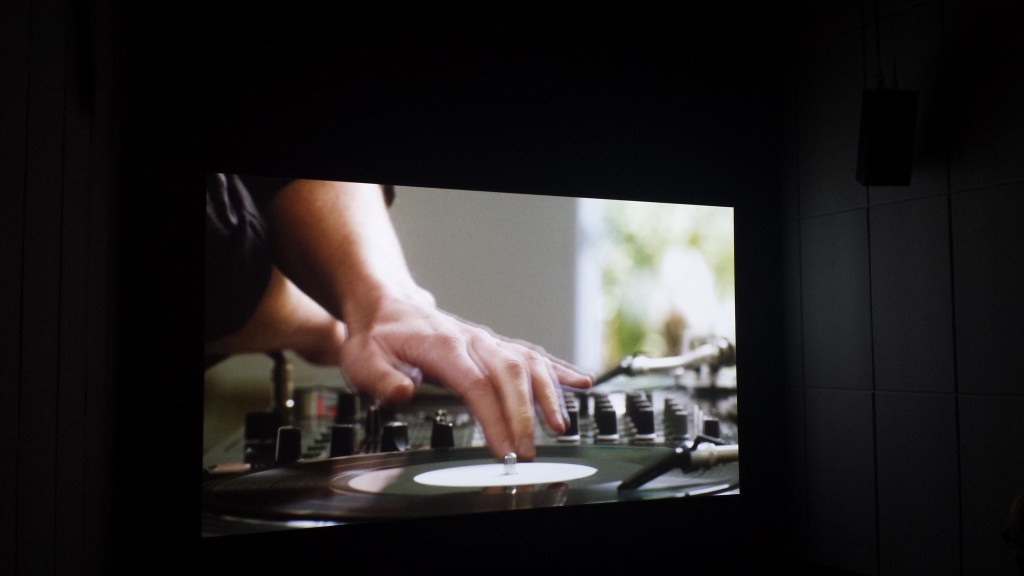
    Sala’s work contours in time, with tempo variation and within the space that has left no chance for error. The other video in the fourth floor being part of this work is titled ‘Unravel’, 2013. It debuted at the Venice Biennial alongside ‘Ravel Ravel’. ‘The Unravel’ video presents DJ Chloé Thévenin who takes part in the manual and physical manifestation of these two concerto recitals. She has the performance recitals on two turntables, in which she accelerates and slows the records in process. Fascinating, a visual turnout of the concerto sound in a new gesture.

    More info about the artist and the current exhibition “Anri Sala: Answer Me” :

    Hauser & Wirth about Anri Sala

    The exhibition info at New Museum

  • Janet Echelman’s 1.8

    Janet Echelman’s 1.8

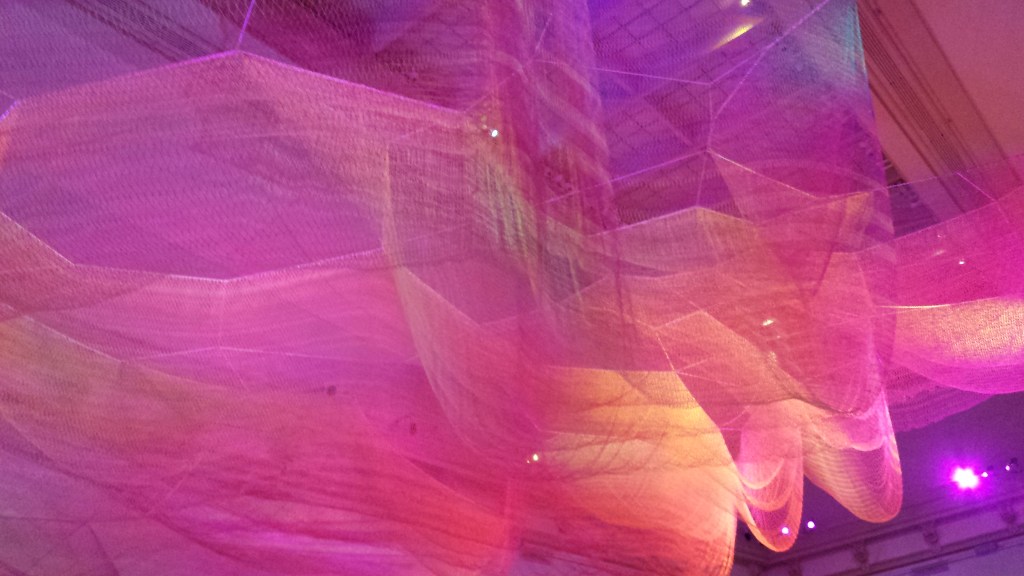
    WONDER exhibition celebrates the Renwick Gallery’s reopened spaces. The museum’s new statement is to bring the future of art into its program. It is now confronted with large-scale installations by nine artists. Janet Echelman is one of them with her piece 1.8, (2015). A large suspended net glides across the ceiling of the Grand Salon, which is located upstairs in the museum. The work is composed as knotted and braided fiber with programmable lighting and wind movement, above a printed textile flooring. Echelman’s sculptural installation speaks in relation to a map of energy released through the Pacific Ocean, when Japan’s Tohoku earthquake and tsunami took place on March 11, 2011.  The title of the work implies the 1.8 millionths of a second,  which measures the earthquake as it shifted the earth’s axis.

    Janet Echelman’s 1.8, 2015 from Firstindigo and Lifestyle on Vimeo.