Bettina Pousttchi is a Berlin-based artist working in photography, video, and sculpture. German-Iranian artist studied at the Kunstackademie Düsseldorf, and participated in the Independent Study Program at the Whitney Museum of American Art in New York from 1999–2000. Pousttchi has exhibited throughout Europe, including Amsterdam, Berlin, Köln, and London, and participated in the Venice Biennale in 2003 and 2009. She held her first U.S. solo exhibition in 2014 at the Nasher Sculpture Center in Dallas, Texas.
Through photography and sculpture, BettinaPousttchi is interested in altering architectural buildings and monuments as indicators of the past and media of remembrance. Currently, the artist exhibits in two different museum spaces in Washington D.C. First exhibition titled Bettina Pousttchi: World Time Clock is on view until May 29, 2017, at the Smithsonian’s Hirshhorn Museum and Sculpture Garden filling the museum’s third-level inner-ring galleries. Concurrently with the World Time Clock series, The Phillips Collection presents her second D.C. appearance with the works titled Double Monuments. This exhibition by Bettina Pousttchi ison view until October 2, 2016.
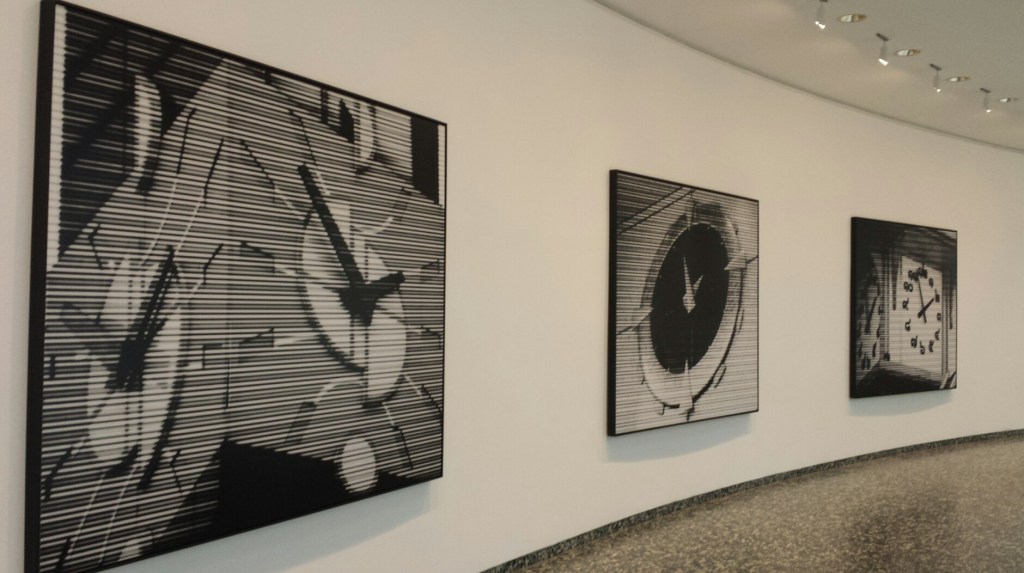
Pousttchi’s exhibition at the Hirshorn is a premiere of her World Time Clock series, a project the artist began in 2008 and recently completed. The installation consists of a group of photographs that she created in 24 time zones around the globe over the last eight years. The artist has often contemplated systems of time and space in her art. To accomplish the World Time Clock photography, she traveled the globe capturing a portrait of a public clock in each time zones. In the final production, represented are locales far apart from each other, such as Bangkok, Moscow, Los Angeles and Tashkent, Uzbekistan. The circular format of the Hirshhorn’sinner-ring galleries on third floor works well with the theme of this exhibition.
Bettina Pousttchi’s World Time Clock at the Hirshorn’s third floor is on view until May 29, 2017.
Bettina Pousttchi’s World Time Clock.
Bettina Pousttchi’s clocks come from 24 different time zones.
The photographs each show a clock displaying the same local time: five minutes before two. Together the images suggest a sense of suspended time and what the artist calls “imaginary synchronism.” Seen in close-up, the clocks are united in a single scheme that calls to mind the historic role of Washington as the site of the International Meridian Conference in 1884. It was here that the Greenwich Meridian was adopted as a universal standard, determining a zero point for the measurement of both longitude and time.
Bettina Pousttchi’s second display, on view at the Phillips Collection until October 2, takes on from the notion of history and memory of architecture. The exhibition is part of the Phillips’s ongoing series Intersections, which interestingly highlights contemporary art and artists in conjunction to the museum’s permanent collection, history, and architecture. With her works Double Monuments for Flavin and Tatlin (2013), Pousttchi is in conversation with art and architectural histories, addressing the historic works of Russian Constructivist sculptor and architect Vladimir Tatlin from the 1920s, and American minimalist artist Dan Flavin from the 1960s. Pousttchi’s sculptural installation is composed of materials deriving from street barricades, and metal crowd barriers, which the artist transformed into sculptural forms. The objects create contrast and volume with neon that grows inside the powder-coated abstract forms. The sculptures include spiraling neon light tubes reminiscing those fluorescent light works created by Dan Flavin. The five sculptures range from 5 to 12 feet creating dramatic presence and enhancing both sculptural form and architectural setting at the Phillips. Their tower-like shape is a homage to Tatlin’s sculptural works, yet they have a theme and form of their own. Pousttchi’s works carry an idea of mystery of bringing in outdoor elements into the white gallery space. The white paint creates sophistication out of the raw urban elements while neon makes them settle somewhere in between the indoors-outdoors -scale.
Bettina Pousttchi with Double Monuments on view at the Phillips Collection.
Laura Anderson Barbata is a transdisciplinary artist known for her onsite projects in Mexico, Venezuela, Trinidad and Tobago, the United States and Norway. She is currently working on participatory, collaborative works that combine performance, procession, protest, movement and wearable sculptures to convey a message. In this interview, Laura discusses her recent artistic work and collaborations, giving a sense of the issues that matter in our current society.
Firstindigo&Lifestyle: Where do you live and work now, it seems you have multiple engagements across different continents at the moment?
LAB: I work in NY and Mexico, my home country, but I am based in Brooklyn, New York although many projects often take me to different countries such as Jamaica, Venezuela and Norway to create and present projects. The work for each project is developed in my studio and onsite.
Firstindigo&Lifestyle: You work with an exotic art form, stilt dancing, what is the story behind, how did you become interested in this culture?
LAB: I became involved with stilt dancing communities in Port of Spain, Trinidad and Tobago in 2001 when I was invited to Trinidad by Caribbean Contemporary Arts CCA7 for an artist residency in Grand Riviere, a small community on the north of the island. As part of the residency I began a community papermaking project in the village of Grand Riviere and while we were working on the project I wanted to expand my work to the urban areas of Trinidad and learn from the rich Carnival traditions practiced there. I had initially wanted to work with Peter Minshall, a brilliant carnival designer who I have a great admiration for, but life took me in a different direction. Through a friend of CCA7, I was introduced to Dragon, the founder and director of Keylemanjahro School of Artsand Culture in the neighborhood of Cocorite in Port of Spain. Dragon has set up in the patio of his house a place where the youth from his community after-school could learn the art of stilt dancing. This is a community project that serves his neighborhood and is open and free-of-charge for all kids in the neighborhood. The primary focus is to keep kids off-the-streets and engaged in the cultural tradition of stilt dancing as it was passed down from West Africa to the West Indies, with the objective of having the group participate in the annual Junior Carnival Parade. The group worked with little to no resources and exclusively with the help of parents in the neighborhood. I was immediately attracted to the project, the objectives of the group and the cultural tradition, and felt that we could initiate a collaboration in which each could bring forth our skills, exchange knowledge and enrich each other´s practice. I asked Dragon if he would accept me as a volunteer and he immediately accepted me into the group, I worked with Keylemanjahro for 5 years creating alongside the kids and parents, costuming and thematic development for their Carnival presentations.
This collaboration made a great impact on both of our lives and work, and to this day I continue to work with stilt dancers. I always understood that working with Keylemanjahro was for a limited time, the experience had enriched both parts equally and it was also necessary for me to work close to home. Around this time, my gallery in New York invited me to have a solo exhibition and I proposed that we turn the gallery into a workshop for kids and teens and apply what I had learned in Trinidad and to show some of the work I had made in Trinidad and Tobago and they liked the idea.
Next, I had to find partners and collaborators, I had heard about the Brooklyn Jumbies, (a group of stilt dancers from the West Indies and West Africa), and approached them with a project in which we would have weeknight workshops in the Chelsea gallery and the street to train young stilt dancers and prepare a presentation for the group for a street performance on 23rd Street in Chelsea and then for the West Indian American Junior Carnival Parade. The project was titled Jumbie Camp and it was what launched my collaboration and relationship with the Brooklyn Jumbies, and to this day we continue to work together. To date, we have presented a number of projects together such as Intervention:Wall Street, 2011, (https://youtu.be/84E877vGkpc); Intervention: Indigo, 2015, (https://www.youtube.com/watch?v=-m0wLE7dSbY), performed at MoMA in 2007; and the project for TBA21–The Current titled What Lives Beneath that was performed in Kingston Jamaica this year (https://www.youtube.com/watch?v=gs72qGXI3GU) among others.
Laura Anderson Barbata, Intervention: Wall Street
Firstindigo&Lifestyle: The community aspect in the making of stilt dancing is evident, loud even. In what ways do you capture that essence in your own work within the subject, and in relation to its multiple contexts?
LAB: My interest is to integrate into my work the various traditions and customs that surround us and with an artistic lens insert them into a familiar space. Stilt dancing brings forth numerous ways of performing that include procession and carnival arts. My work brings together these different forms and, depending on the narrative, can integrate protest into the unfolding of the performative work.
Firstindigo&Lifestyle: How does stilt dancing appear to you first, as performance, as costumes, action, identity, visual art, or combination of all those things?
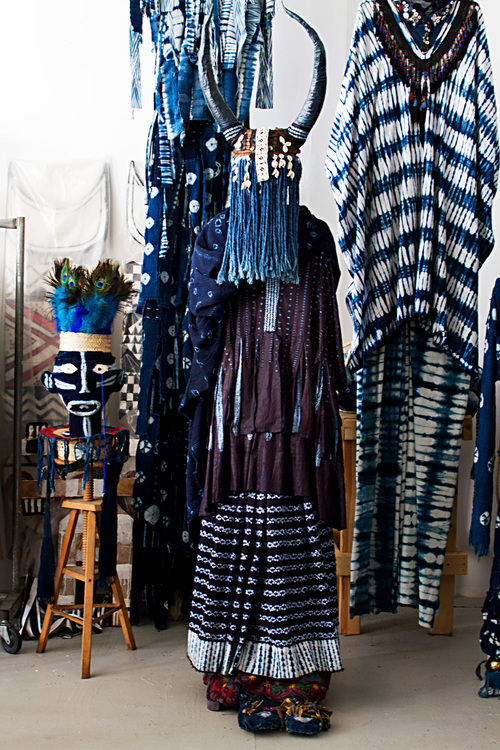
LAB: Stilt dancing for me combines many things. To start, we are working with scale– larger-than-life characters that have the possibility to capture our attention. The movement vocabulary of a dancer towering over us expands in space. They are accentuated and can extend themselves through their use of textiles and different materials. This is where costuming is essential to the performance visuals and the message. But also very important to me is the symbolism and tradition that is embedded into this practice.
Traditional Moko Jumbies are spiritual beings, whose purpose in West African communities is to protect their villages against evil or misfortune. We cannot look past the social role of the Moko Jumbie stilt dancer, and the metaphor is quite clear: to see the world from an elevated perspective. For me it is very important to always honor the historical function and cultural importance of a Moko Jumbie and to integrate that purpose into the work. So yes, it is about dance, procession, performance art, ritual, and also a vehicle for communicating a message through contemporary art.
Laura Anderson Barbata, 7 king nyame, 2005
Firstindigo&Lifestyle: Do you feel there is a line, which you cross in the making of community arts, in which the discussion turns towards the subject matter rather than the artistic medium?
LAB: I would hope that by working in this way we do away with those boundaries. Lines are usually drawn to divide and set limits, and my approach is to bring together diverse perspectives and traditions, where each one maintains its individual knowledge while at the same time exchanging and sharing diverse ways of seeing through our work together. Also, I aim for that moment when the spectator and the participants see and experience the totality of the work without disengaging the subject matter from the way it is presented. For example in Intervention: Wall Street, there comes a point where it is absolutely clear that through stilt dancing we are addressing the corporate and financial giants of Wall Street, but there is no effort in perceiving the message, they are intertwined. The metaphor in this case works off of all the layers of meaning embedded and the form through which it is expressed.
Firstindigo&Lifestyle: You have recently been participating in the making of environmental art project titled The Kula Ring. Could you tell about the expedition that took you to the Pacific Island with the group of artists and scientists?
LAB: The environment has been a continual concern and interest of mine from the beginning of my career. I began my practice making works in the studio that addressed nature and the environment through drawings on paper, sculpture and outdoor installations. I also initiated community projects in the Amazon of Venezuela that combined environmental protection and the preservation of oral history in the communities through paper and book making with local materials. This background and experience is the reason I was invited by the curator Ute Meta Bauer to become a fellow of The Current by TBA21, Thyssen Bornemisza Contemporary titled The Kula Ring. (https://www.tba21.org/thecurrent)
The project is an ambitious and innovative approach to explore and find solutions to environmental issues such as global warming and the protection of the oceans. The project brings together scientists and artists and together we embark on a number of exploratory trips by sea to different areas of the South Pacific. Along with researchers, curators and artists, I participated in expeditionary trip that took us to Papua New Guinea.
There have been subsequent exploratory trips to other areas of the South Pacific with other participants and curators leading those groups. As part of the project, The Current brings us together after our trips for a convening to exchange ideas and share our experiences and findings with different communities, and to listen to their own experiences and responses to our work. The first convening took place in Jamaica this year–in Kingston. We met, discussed and presented our work and findings not only amongst ourselves but also with the local community. For this convening I created the performance What-Lives-Beneath in collaboration with the Brooklyn Jumbies, custodian of the Jamaican oral tradition Amina Blackwood-Meeks, choreographer Chris Walker and members of the National Dance and Theater Company of Jamaica informed by scientists, environmentalists and activists. This work integrated into one performance: dance, procession, science, text, spoken word, scientific research, music and wearable sculptures created with craft elements originating from Papua New Guinea and other materials to portray sea life and the elements.
Laura Anderson Barbata, artist on TBA21 project The Current
The Current, What Lives Beneath by Laura Anderson Barbata for TBA21, Kingston, Jamaica, 2016
Firstindigo&Lifestyle: The Kula exchange or Kula ring, is a classic anthropological theme, its core idea is formed around gift and commodity exchanges. Perhaps our contemporary society and times can learn from this indigenous practice originating in Papua New Guinea? Do you personally relate to this theme, or does it have relevance to you as a principle?
LAB: One of the key tenets of my practice is reciprocity. My methodology combines an intuitive exploratory approach with a strong focus on listening. This means that I want to receive information through all my senses as well as intellectually and to find ways in which we can establish relationships built on the principles of reciprocity. So it is important for me to integrate conversations with collaborators and participants in every step of the process. The Kula Ring Exchange, as you say, is centered around gift and commodity exchanges. But there is also a secondary but equally important intention: to forge long-lasting relationships that are maintained and supported by the exchange of goods. On a personal level, this relates to my understanding of reciprocity and the value in creating kinships that transcend borders and ideologies beyond our everyday associations. I feel that contemporary society needs to focus greater attention to these forms of community building which demand personal involvement. These forms of exchange are capable of expanding our knowledge and can also bring a deeper meaning to our everyday lives, so that growth is not only personal but also expands to benefit the communities we live in.
Firstindigo&Lifestyle: Do you consider yourself to be an environmentalist, if so, how do you think art serves the topic of environmentalism, and brings forth embedded action?
LAB: Through the project The Current, I have had the privilege of meeting extraordinary world-renowned scientists, thinkers and activists that have devoted their careers and lives to environmental issues and conservation. I know what a true environmentalist is, and for this reason I would hardly call myself an environmentalist in the formal sense of the word. But I can say that I am deeply concerned with the environment and committed to learning all I can and through my work as an artist address these issues, in order to contribute on both a personal and professional level. In that way I might be considered an environmentalist.
I believe that joining artists and scientists who are focused and concerned about the environment can bring us to a better understanding of the problems we are facing, to enable us to communicate these concerns and findings more effectively to our audiences in innovative, inspiring and thought-provoking ways. I believe that every person on an individual level can create change, and if more people are inspired to join in these efforts there can be a significant positive impact.
Firstindigo&Lifestyle: Are there specific ways your art is bringing into cultural exchange, in terms of communicating between different people, and perhaps transmitting something unique into our society at large?
LAB: As I mentioned before, at the core of my work is the concept of reciprocity: the balanced exchange of ideas and knowledge. For this reason, my work methodology combines an intuitive exploratory approach with a strong focus on listening with the intention of bringing mutual benefits to all participants. It is very important to me that the bridges built between communities–the personal ties and experiences gained–continue far beyond each project. Art is the vehicle, the pretext for a conversation and for an exchange of ideas that incorporate the material as well as the personal for its execution.
Laura Anderson Barbata’s studio photographed by Dora Somosi.
Firstindigo&Lifestyle: Your knowledge about cultures and traditions is reflected in your artistic applications. From a more philosophical point of view, are there motivational approaches that resonate through your artistic lens?
LAB: I am strongly motivated to address through my work as an artist the challenges that face our current society. I feel a sense of urgency to delve into issues of human rights, women´s rights, indigenous issues and the environment.
Feminist artists and writers are a source of great inspiration and guidance for me, Judith Butler, Carol Adams, and artists Mierle Laderman Ukeles, Melissa H. Potter and Monica Mayer, to name only a few of the women whose work always has the capacity to teach me something new no matter how many times I read or see their work. Also on my usual go-to list are Jacques Ranciere and Paulo Freire. Theater is an art form that I love and always learn from. The Wooster Group, for example, always presents challenging works in innovative formats that are thought-provoking and executed in ways that combine various techniques, all of which teach me something new. I try to find community groups, activists, artist collectives, urban dancers and performance artists that work outside of the mainstream that are expanding and challenging the concepts of community dynamics, education, dance, performance, music, and proposing ways in which to see, live and engage with each other and the world around us.
Firstindigo&Lifestyle: It would be interesting to hear about your future, what projects are you continuing, and what topics are you exploring further?
LAB: I am working on a number of projects, as we have discussed earlier, one very exciting project I am working on is with TBA21 The Current, coordinated by Thyssen-Bornemisza Contemporary Art, in which scientists and artists are brought together to address the urgent issues of climate change and the oceans. This project is in its first year and my involvement will be for three years. I will be creating new works for this project in the form of performances and wearable sculptures which are still in progress.
I am also continuing my work on the Julia Pastrana project. For this project, I am further working on the topics related to her story, the injustices that she lived and how these are still relevant today. I am working on a performance piece presented as a work-in-progress that is continually evolving, a series of zines that address different topics related to Julia Pastrana such as: repatriation of human remains, museum ethics, exhibition practices, the objectification of people and women, human traffic, beauty and the commercialization of women´s bodies, feminism, animal rights, love, circus arts, and more. I am publishing a book about Julia Pastrana with contributions from scientists, scholars and art historians to address the story of Julia Pastrana from different perspectives that also includes art works. And for 10 years now, I am working on collaborative project with the artist collective Apparatjik and Concha Buika to create an Opera about Julia Pastrana, which will premiere at the main stage of the Norwegian National Opera and Ballet in Oslo, Norway in 2019.
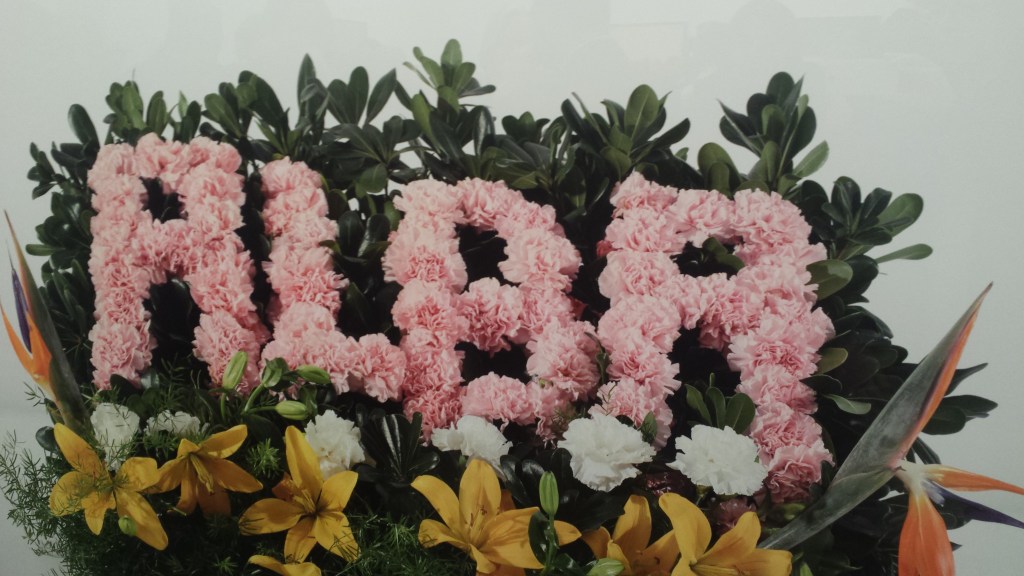
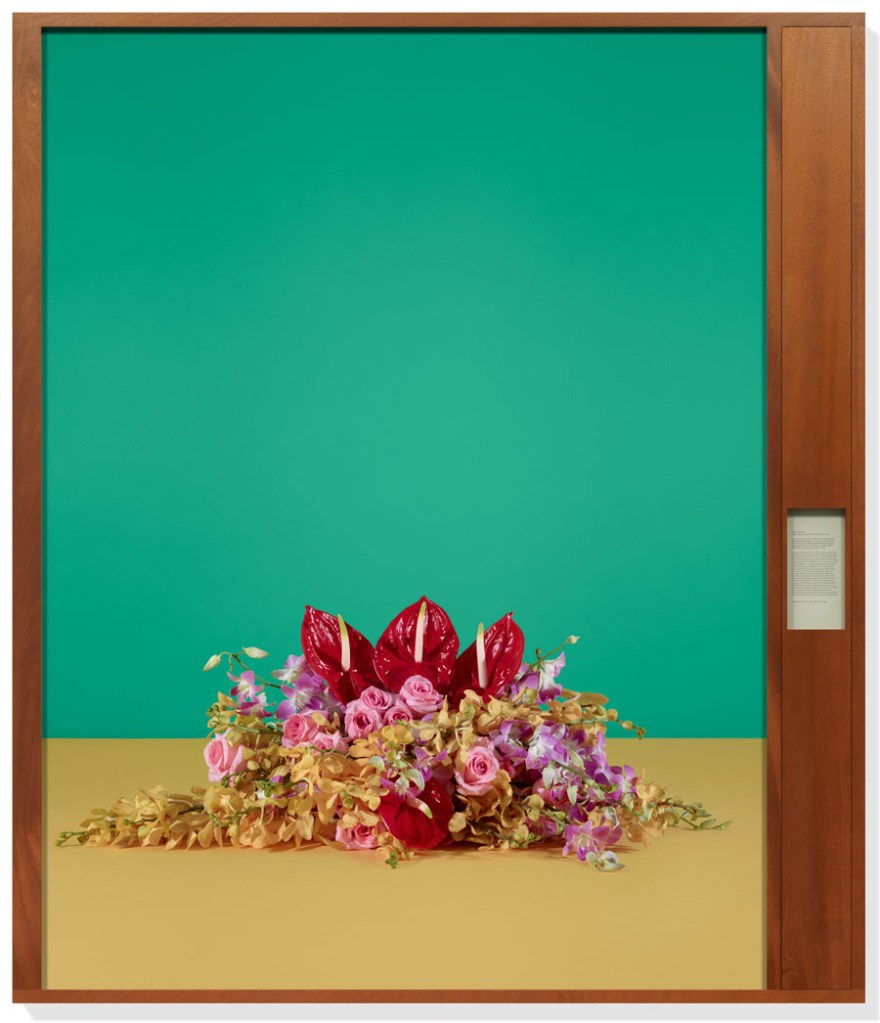
At the Gagosian Gallery’s Chelsea location, opened a new exhibition around a theme of ‘impossible bouquet’. Known for her challenging multidisciplinary photography, artist Taryn Simon has conducted extensive research for her current project Paperwork and the Will of Capital. The idea of ‘impossible bouquet’ refers to the Dutch 17th-century economy during which the market was booming. Simultaneously the birth of modern capitalism was reflected through the rich fauna of the era’s still-life paintings. The impossible bouquet is also an imagined bouquet. It includes flower pairings that cannot coexist in the natural world; the flowers are not blooming at the same time or they originate in different geographical locations. Today this economy has changed completely, when the global supply keeps bringing diverse specimen to the consumer’s market. The exhibition includes photographs of 36 bouquets formed as centerpiece and still-life. They gather thematically around 12 unique columnal sculptures, which also trace back to the fauna accumulated in the photography. Next to the large photographs are their textual references connecting the arrangements to their sources. The flower typologies in the artworks suggest real events that create the context for the exhibition.
These flowers sat between powerful men as they signed agreements designed to influence the fate of the world. —Taryn Simon
Taryn Simon, From the series Paperwork and the Will of Capital, 2015, Archival inkjet print.
Taryn Simon, From the series Paperwork and the Will of Capital, 2015, Archival inkjet print.
Taryn Simon, From the series Paperwork and the Will of Capital, 2015, Archival inkjet print.
The exhibition is Taryn Simon’s first at the New York gallery. The sculptures displayed in the exhibition were previewed at the 56th Biennale di Venezia in 2015. Now they appear together with large-scale photographs that culminate as a complete body of work for the first time. During the process of making the photographs and sculptures, which navigate layered meanings, Taryn Simon worked together with a botanist, investigated archives, and benefited from 4000 different specimen to structure the process. Each specimen coming to the process was dried, pressed, and sewed into the herbarium paper. The artworks engage a level of communication as botanical collages, in a photographic form, and as pressed and preserved subject in the sculptures. The artist utilized George Sinclair’s nineteenth century horticultural study, which contains actual dried grass specimens.
As much as the flowers have decorative power, the art speaks with full textual meaning. The textual references attached to the photographs and sculptures, describe diverse political agreements that semantically ground the ‘flower fantasies’ into realities, which touch lives. In the past, the bouquets staged world dramas. In their present artful context they contribute to breathing new air into the archives. The level of ignorance on the agreement’s impact on actual realities is communicated through the floral that is now taken care of. In the art it represents the colorful, palpable, and vivid side of the reality. Among the textual references, there are themes of global trading of goods, and examples of the attempts to access natural resources over national boundaries and geopolitical territories. There are strategic negotiations, where commercial value has weight over human capital, or it entirely suppresses environmental viewpoint. Often the signing table puts a full stop to development projects, social welfare and economic aid. For the artistic series, Simon studied archival photographs of official signings. She examined accords, treaties, and decrees that were drafted to influence systems of governance and economics. The subjects include nuclear armament, oil deals and diamond trading.
The environmental challenge of the global flower distribution connects intimately to the exhibition narrative. Paperwork and the Will of Capital, implies the complications behind the global consumption. The underlying political themes communicate about environmental fragility. One of the flower narratives introduce a plan that was created around the Caspian Sea oil reserves, known as Baku-Tbilisi-Ceyhan Pipeline. As an outcome of this plan, Western nations would have more ideal access to the area’s natural resources and allude strategic presence in Central Asia. The February 3, 2004 flower bouquet, testifying the signing of the finance package for constructing the BTC pipeline in Baku Azerbaijan, included: Baby’s Breath from Kenya; Dutch Iris from Netherlands; Israeli Ruscus; and Hybrid Tea Rose from Kenya.
Another environmental flower arrangement relates to the 2014 agreement to conduct studies on the Grand Ethiopian Renaissance Damn, bringing in parties from Sudan, Ethiopia and Egypt to negotiations. The construction of the damn contests the neighboring countries, because the negotiations handle the water rights to the Nile. While still in the construction process, the dam will be Africa’s largest hydropower project taking massive segment of its infrastructure. The discussion challenges larger schemes linking back to the colonial history, which places Egypt as majority holder of the Nile’s water, when in reality Ethiopia, Kenya, Rwanda, Tanzania, and five other African states share access to its waters. The flowers present at the negotiations were: Gerbera from Netherlands; and Hybrid Tea Rose from Ethiopia.
Can flowers change attitudes toward things and ideas? At least, the commerce between flowers from different territories and geographical locations stretches boundaries as we know them. Sometimes flowers travel further than people. Anthurium, Netherlands; Dendrobium, Thailand; Orchid Venezuela; and Hybrid Tea Rose, Kenya, were at present in the memorandum held to negotiate the status of refugees and asylum seekers to Australia. The negotiations took place in Cambodia on September 26, 2014. Australian refugees from the refugee center located on the Pacific Island of Nauru were to be transferred to Cambodia into a permanent resettlement. By shifting their refugee responsibilities elsewhere, the economically advantaged Australia signed to exploit one of the poorest nations in Southeast Asia.
Highly conceptual thoughts embed the large photographic prints and their similarly intentional sculptures within a frame of time that scopes past and attains to preserve some for the future. It seems that the fragility of flowers echo past remnants, but more forcibly introduce newly fluid forms. The photographs speak through large canvas. They accumulate painterly softness through the backdrops, and the archival feel responds to the dimensionality of the bouquets. The floral appears as richly layered; the bouquets were photographed multiple times. Sometimes the setting stands still as if being part of a funeral setting, then the collage screams out from the mahogany frames. The bouquets are in a state of being and emerging.





 Firstindigo&Lifestyle