Category: asian art

  • VOLTA NY 14: art speaks back from the walls

    VOLTA NY 14: art speaks back from the walls

    Jennifer Wynne Reeves creates collages on boards that some include wire, some hair or feathers, and some thick applications of paint. This approach could by no means represent flat wall art. The dimensionality makes the art continue in space. Objects and paint are not decorative art either, but there is something folk-art in them; or retrospectively ”American” influences. These works suggest, as one work is titled, voluptuous meanings that are material, sensuous and touchable. Reeves writes as part of her artistic practice. Writing collide with personal meanings, and is symbolic in nature.

    Her statements, or poems end up being part of the artwork itself. The artist was presented at the VOLTA by New York City gallery BranvinLee programs. The art presented at the art fair spoke about her illness, which is also reflected in her writing:

    I think I might not be alive to go to my opening next September. I think I should rush to finish things. I wonder why my body is doing this or that. I think Christmas will be long. I think I won’t be able to save enough money for old age with all these bills, and that an imminent death would be preferable. I wouldn’t have to look for even more powerful galleries. -Jennifer Wynne Reeves 2013, Callicoon, NY

    VOLTA art fair offers a chance to get in touch with art that promotes freshness and openness of ideas. The fair is relatively easy to access. It should be, that art fairs can be walked-in-to, so the art can be discussed and shared. VOLTA is like one big gallery space, where multiple stops lead to curiosities, comprehension, and even comparisons. Perhaps art displayed with this many references has a better chance for new perspectives.This year, the amount of techniques was compelling. Among the artisans of art was definitely a Japanese woodcut artist Katsutoshi Yuasa. For him, woodcut is a new way of seeing images and photography. The long process gives refinement of light, and adds the personality. Yuasa works on the printing process and reliefs based on his own digital photography. He uses traditional Japanese printmaking technique, which takes time. Carving and printing are all made by hand. For Yuasa, printmaking out of a photograph has a deeper meaning that what could be expressed in photographs. He thinks that photographs are more like a fictional two-dimensional surface. He says, that carving on the plywood, and the printing on paper, will add another dimension. The result is an abstract reality, which implies both subjective and objective perceptions. Yuasa also worked in Finland in an artist residence. The work ”Ilmatar” is based on his photograph of Finnish forest. He was presented at VOLTA by YUKI-SIS gallery from Tokyo.

    Pius Fox is a young Berlin-based German artist, whose works are influenced by modernistic means. Not only the color-scheme, but the meticulous, minimal and graphic output is reminiscent of styles before his own era. His works move between painting and drawing, figurative and abstract, lingering between form(alism) and context. Multiple layers of paint create an idea of space. Fox makes small works that together are like an installation. One can only think how many different ways to place them on the walls. Small works communicate with each other. When separately, the scale still holds a lot of energy and tension. His color schemes represent past times, giving nostalgic vibrations. As if an old gramophone was playing tunes, light curtain had moved to let air inside the room. Colors are contrastive, some of them pale and pastels, some dark and more graphic. Indeed, Fox uses interiors of his own work studio for inspiration, including windows, doors, curtains and so on, to introspect atmosphere. Yet the works have an appeal of formality and outwardness. He was presented by Patrick Heide Contemporary Art from London.

  • VOLTA NY 14: Simeen Farhat’s ‘Alice’ and the language puzzles

    VOLTA NY 14: Simeen Farhat’s ‘Alice’ and the language puzzles

    simeen farhat she looses her temper
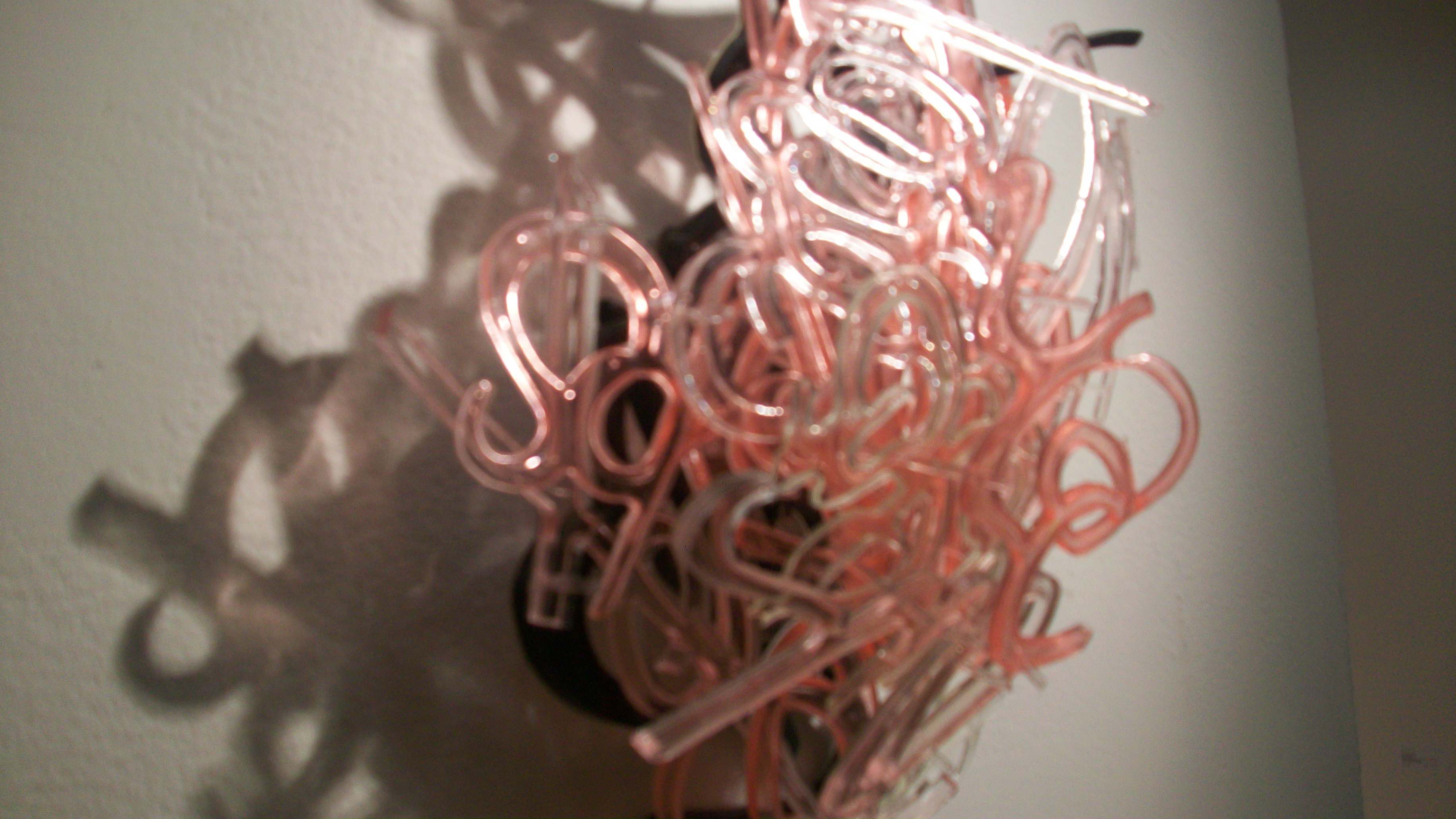
    Simeen Farhat, “She Looses her Temper”, 14 x 16 x 5 inches. Cast and pigmented resin & acrylic rods, 2014.

    Pakistani-born, Dallas-based artist Simeen Farhat has taken a classic novel ‘Alice’s Adventures in Wonderland’ as a starting point for her new installation for VOLTA NY 2014 edition, which ran from March 6-9 in Soho. VOLTA is called as ‘invitational solo project fair for contemporary art’, so Farhat’s solo exhibition was equally presented by a gallery who is already endorsed multiple times by the fair. Her exhibition, curated by Christine Pfister of Pentimenti Gallery from Philadelphia, emphasizes a materiality of the language puzzles. The artist is known for creating poetic works with dimensionality and message, that come with the use of different languages and ways of communicating in our cultural encounters. This time, her colorful and even candy-colored sculptures and installation speak about the problematic nature of cross-cultural communication, showing the emotions and frustrations that are attached to the rules of using our languages. Farhat’s previous works have drawn from such languages as Farsi (RUMI poetry) and Urdu. Text used around the ”Alice” installation is English.

    The immediate surface of the words come across as part of the form, and the text intermingles with the sculptural transparency. This already creates puzzles as we see only fragments of language, which, when viewed from a distance, create aesthetical form. When we step closer to the sculptures, the objects invite us to perceive them from different angles. Pink and black cast resin wall sculpture “She Looses her Temper”, is an example of Farhat’s sculptures that emphasizes the multiplicity of the form when viewed from various positions. As it comes to the emotional statements of texts, the ”pointiness” of words structure dynamic messages.

    Philosophy is important element in Farhat’s artist statement:

    “Words – written or spoken, understood or misunderstood, poetic or prosaic, curvilinear or rectilinear, are what motivate me to create my visual narrative. I am fascinated by how, through language, we understand a great deal about ourselves and surroundings, and how ideas: simple, complex and abstract, are conveyed and understood using symbols.” (Simeen Farhat)

    simeen farhat_image2
    Simeen Farhat, “She Looses her Temper”, 2014
    simeen farhat _image7
    Simeen Farhat puzzles with languages, Pentimenti Gallery, VOLTA NY2014.

    ”Alice’s tears” create undoubtely the center of Simeen Farhat’s VOLTA installation. The blue teardrops in various sizes seem to flow effortlessly from the ceiling, pouring down from Alice’s eyes when she has grown tall.  The viewer can imagine Alice, by experiencing the shades of blue in the sculptures, some of them so light-colored that they are almost invisible towards the white backdrop, some darker. The shapes also vary from softer and rounder to sharper ones, and they accumulate and reshape closer to the ground. The tears are seen differently depending on the lighting conditions; the shadows are creating part of the narrative too. Farhat has sometimes included textiles into her previous installations to reference the (female) ‘body’. For Alice, the handcrafted cast resin has worked miracles. Different blue shapes and sizes embody the space leaving room for imagination and story.

    Simeen Farhat has exhibited in the United States and internationally, including Pakistan, London, the UAE, India, Finland and Germany. Her collaboration with Pentimenti Gallery will continue through 2014, and her solo exhibition will open in Philadelphia later this year.

    for more information visit: www.pentimenti.com

  • Fog in art by Fujiko Nakaya

    Fog in art by Fujiko Nakaya

    Japanese artist Fujiko Nakaya’s environmental installations and fog sculptures have become widely known around the world.  According to her, fog represents an interactive medium which makes the audiences feel and participate in its pure natural wonder. Fog comes closer than clouds; although these are scientifically the same, fog calls for a different kind of dialogue with nature. The above fog sculpture by Fujiko Nakaya is at Toyota Municiple Museum of art in Toyota, Aichi.

    Born in Japan, Nakaya is a daughter of the physicist and science essayist Ukichiro Nakaya, who is credited for making first artificial snowflakes in the world. Inspired by natural weather phenomena, she created her first fog sculpture for Expo ’70 (Osaka Japan) to be presented at the Pepsi Pavilion. Ever since, Fujiko Nakaya’s works have been on display on international venues, including Guggenheim Bilbao and Australian National Gallery. In 2013, her Fog Bridge became a waterfront wonder for local and international audiences in San Francisco’s Exploratorium. The work was part of the year’s waterfront celebrations, highlighting the bay area and its special weather conditions (famous for its dense fogs).


    What makes ‘fog’ so dimensionally touching is that it as a natural phenomena varies in the circumstances. The fog sculptures live with the wind, temperature and humidity.

    Nakaya’s fog has also entered theatrical stages. She created stage sets for Trisha Brown, David Tudor, and Bill Viola.

    .