Tag: painting

  • Interview: Eric Decastro, a French painter

    Interview: Eric Decastro, a French painter

    French artist Eric Decastro is known for his large-sized paintings that he constructs using the dripping technique. He is focused on creating a balance of color and light by applying thick impasto into canvas. Since 2008, Decastro has been running an art space Kunstraum Dreieich | Artspace Frankfurt in Germany that promotes artists with the motto of welcoming them back. The artist himself has a solo exhibition A Whiter Shade of Pale, Level 2 in New York City at The Bronx Art Spaceuntil April 30. Decastro is also showing as part of the DOPPELGÄNGER -exhibition, which is currently at Torrance Art Museum in California, and runs until May 28. The group show is a dialogue between German and US artists, and is curated by Dr. Julia-Constance Dissel and Sandra Mann from Germany together with Los Angeles-based curators Ichiro Irie and Max Presneill. The exhibition explores similarities of practices within globally expansive and hyper-connected art production.

    In the solo exhibition at the Bronx Art Space, the visitor encounters a poetic cosmos, ‘which is intentionally designed to allow the illusion of landscapes or outer spaces.’ The theme of the Whiter Shade of Pale, Level 2 -exhibition is to explore issues of fugacity.
    Firstindigo&Lifestyle: How did you decide to become a painter? 

    EricD: I already knew as a child that I wanted to be an artist. When I was 5 years old I was able to paint in my mothers atelier. It was something I was destined to do and I finally fulfilled my dream.

    So what did you learn from your mother, who is the painter Mirei de Castro? How about your other influencers?

    EricD: I learned the basics from my mother. Painters like Richard Poussette Dart, Lee Krasner but also Cecily BrownFabienne Verdier, Paul Rebeyrolle, Gerhard Richter and Sigmar Polke, have all also influenced me.

    There is installation and performance development mixed with your paintings. In one installation you used, or it looks like, fake grass in the gallery as part of the show?  

    EricD: The installation Prevenue d’avance (Warned in advance) from the performance artist Mike Hentz (USA) and myself at a Kunstverein near Heidelberg 2012  has been furthering me a lot. Through Mike I was able to get a perspective for what one can call art. The lawn was actually real and has been tended and watered for a week in Kunstraum-Dreieich. After the event, it was fully removed. Then, the over dimensional “Dejeuner sur l’herbe” was a parody of the famous works of Edouard Manet.

    prevenudavance
    Eric Decastro, Dejeuner sur l’herbe, installation view.

    You have also painted tsunami? 

    EricD: After the Fukushima Tsunami, I did a complete series of works that looked like aerial shots of Tsunamis.

    Some of the dripping technique paintings come out with natural confrontations, what do you see yourself in the works, are there reoccurring themes that come out?

    EricD: One topic has been on my heart since 2008. My near death experiences have been both positive and negative for me, and I’ve been trying to depict this experience on canvases through a dripping technique in a meditative state. That’s how those paintings mostly have been created.

    A really interesting one is the point when you washed some of the acrylic painting out of the canvas, and went on the real action forward method of making art. Tell about the work, in which the canvas and you are hanging from the tree?

    EricD: This artwork was actually not created in the woods. I was walking with my dogs and saw this tree who looked like it could be a perfect frame for a canvas. I called a good friend of mine, a renowned Art-photographer Sandra Mann. We decided to do a photoshoot with one of my green paintings and put it in the natural frame of the tree.

    How does the performance aspect work with the painting, are they part of the same discipline for you?

    EricD: Of course the performance on a canvas in a natural state is my art. The work is being created, the performance oftentimes is the beginning of an idea that develops through painting.

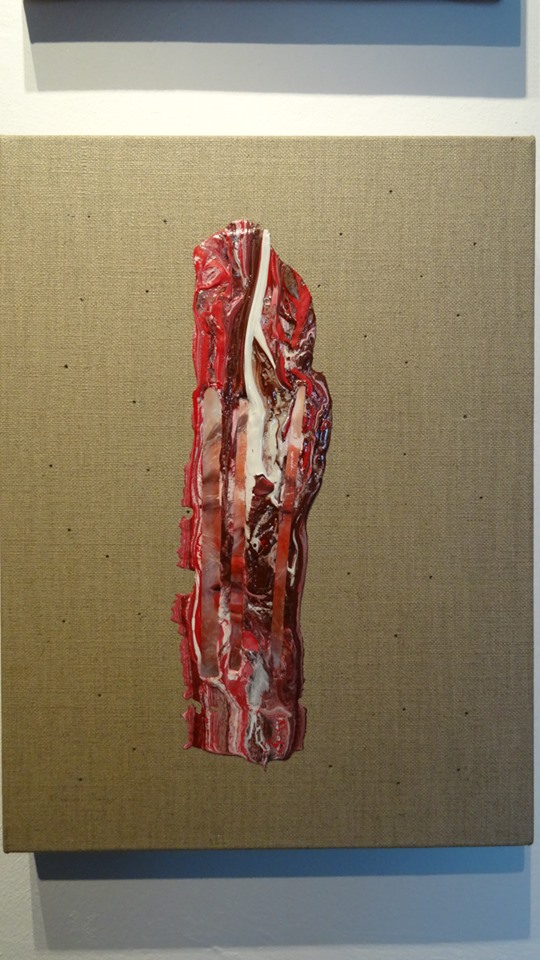
    For example, in “suffocating performance” the artist wrapped cellophane around his head to represent a type of suffocation. He was filmed and was also supervised (Don’t try at home). Afterwards I painted his performance “Suffocating Performance” for the exhibition “CARNAL DESIRE” in Museum Villa Rot. The other artists were Wim Delevoye, Hermann Nitsch,  and Fischli and Weiss. It’s a hommage to a boy from Kosovo who was suffocated and skewed and grilled all while his father was watching. I tried to depict the cruelty of this war.
    suffocate
    Eric Decastro, Suffocating Performance, Acrylic on canvas.

    Then, few questions about identity, how do you criss-cross between different countries, locations, and even continents? 

    EricD: I’ve been traveling my whole life. I really enjoy it and have been able to visit over 110 countries in this world. I’m getting my inspiration and positive energy from exceptional places. In the next time I’ll be traveling to Tibet, Nepal, Buthan and North India.

    You have recently been exhibiting in Peru, and one of your galleries is in France, how are these art cultures different from each other?

    My gallerist Mathias Bloch from Gallery Younique is French and my last exhibition was in “Alliance Française de Lima” so it was a home match for me as a French man myself. My abstract art is established in South America. A subsidiary of Coca-Cola (Inca-Cola) has recently bought one of my works.

    You must feel that you are dealing with a variety of roles, a gallerist being one, and then a painter, is there a difference that is significant?

    EricD: I’m not a traditional gallerist. I don’t participate in the art fairs. Kunstraum Dreieich  is an Artspace with the motto “Rendes-Vous des Artistes.” It’s supposed to be an opportunity for artists to be displayed in the circles of art collectors that I have tended. This concept works well in Europe and especially in a city like Frankfurt the art will sell really quickly.

    Art world is a phenomenon for its own sake yet many artists are involved in societal practice, mending the world so to speak. What do you wish to say about that? 

    EricD: Jonathan Meese said at Art-Basel in Miami in 2012 „Art is the new currency.“ He’s right, art is seen more like an investment nowadays. Never have people previously in history spent so much money on art as it is done today. Independently from whatever the artist wanted to reach with his art, whether a political message, improving the world, to amuse someone or as a wakeup call, art is and will be a good that can be traded in stock. Most buyers, buy art because they have a mindset to leverage the art.


    unnamed
    Eric Decastro uses dripping technique to create acrylic color patterns on canvas

    As April is the Earth Month, could you say something about, how does art and preserving our planet correlate, or meet thematically?

    EricD: To preserve the planet and to make it better for our children is more vital than to collect art and display it in museums. What kind of benefit comes from a world that has been destroyed when museums are full of artworks, and there are no humans to enjoy the art, because then all of humankind will be too busy to focus on survival than to look at art. Politics don’t react to the signs of mother earth, the glaciers have been melting, global warming is unstoppable, and still there is no change of mind or thinking. One should replace the democracy through Geniocracy.

    Tell a little bit about the project in Nepal, how long has it been in progress, and how did it start?

    EricD: My wife is buddhist, and through her Master Lopen Tensing Namdak Rinpoche we got the idea to build a boarding school for children from Nepal in Tibet through fundraising and even some profit from selling my paintings. Since then it was possible to finance the first step of the project. We have already built a hospice in Katmandu in 2012. I myself volunteer as a hospice worker in a hospice in Frankfurt for about 4 years now. The experiences I have made there have helped me to stay grounded and to be confronted with the topic of death and what happens after death. This has been something I have been processing for years.


    Eric Decastro online:

    Artist website: http://www.decastro-art.net/

    Artspace Frankfurt: http://www.kunstraum-dreieich.de/

    Current exhibitions:

    A Whiter Shade of Pale – Level 2 -solo exhibition at the Bronx Art Space, until April 30, 2016

    http://www.bronxartspace.com/

    DOPPELGÄNGER, at Torrence Art Museum, until May 28, 2016

    http://www.torranceartmuseum.com/


  • Julian Stanczak’s color energy

    Julian Stanczak’s color energy

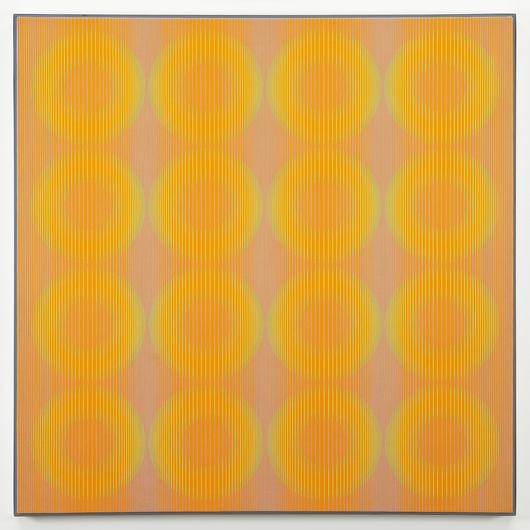
    If you can imagine color energy that bounces back from the walls with blues, reds, greens, and yellows with prismatic and subtle intensity that resembles music, Julian Stanczak’s paintings are for you. The seasoned painter at 86, believed in the power of the abstraction, and in the musical inspiration in his art-making, as he posed in front of his painting during the opening of his solo-exhibition in New York. Stanczak’s exhibition ‘From Life’ is now on view at the Mitchell-Inness & Nash -gallery and will run until December 6. As a young boy, the painter had wanted to be a cellist, and transferred his emotive passion into his paintings. Even a recent work from 2011, titled as ‘Proportional Mixing’ (2011), still handles colors in abstract modalities like in musical compositions. The gallery’s first solo exhibition of Stanczak’s work comprises of a dozen large-scale paintings from the 1960s to the present, including works that have not been seen in the public view for decades. Now on view are artworks, in which the colors are arranged in geometrical forms, lingering hypnotic chromatism and possessing internal vapor, communicating energy and organic presence.

    In 2000, the artist began to create small panels and combine them into wall constellations. He produces the canvases through a complex process of tape masks. The color layers are systematically added and unveiled coming out as repetitions, with spacings and rhythms. The artist relies on his own vision of a finished work without doing preliminary sketches. He emphasizes life experiences in his art, so naturally his own personal history comes to life in the artworks. Stanczak experienced huge differences in places as a young person. He was born in Poland in 1928, spent time in a labor camp in Siberia, and in Polish refugee camp in Uganda, Africa. He immigrated to the United States in 1950. He studied at the Yale University with Josef Albers and Conrad Marca-Relli graduating with M.F.A in 1956. During his formative years, the artist found his way to Phillips Collection in DC and was inspired by Paul Klee’s paintings and watercolors in the collection.

    JULIAN STANCZAK: FROM LIFE
    October 30—December 6, 2014
    534 West 26th Street

    http://www.miandn.com/

    Julian Stanczak wih his Quartet in Cadmiums, 1994, Acrylic on canvas, 4 canvases, each: 89 1/8 by 60 in.
    Julian Stanczak wih Quartet in Cadmiums, 1994, Acrylic on canvas, 4 canvases, each: 89 1/8 by 60 in.

    This slideshow requires JavaScript.

  • Teresa Dunn’s Event Horizon at First Street Gallery

    Teresa Dunn’s Event Horizon at First Street Gallery

    Teresa Dunn is a Michigan-based artist whose narrative paintings on panel explore worlds with texture and complexity. Her recent paintings, now on view at First Street Gallery in New York City, are full of figures who are confronting points of no return. The strong exhibition title Event Horizon displays works full of ‘tightrope walkers’, burning boats, exposed flesh and rising waters; all this as if the settings create dreamlike atmospheres.

    This slideshow requires JavaScript.

    The narratives put the characters and their motivations in tests when they look into the incongruous landscapes around them. The works are full of story, where mothers and fathers, animals and children, friends and strangers interact in tightly woven communities. The paintings depict absurdity and metaphorical allusions. Together the works link into each other, and so rearrange the reality in a new order. As the artist states:

    Peculiar reality becomes normal, as in dreams or memory. Amidst bizarre sequences of events, dreams are believable when we are immersed in them. Memories distort, dissolve, and rearrange themselves until we are unable to discern fact from invention.

    Dunn’s paintings seem to connect to a stronger sense of reality than what would perhaps be without the symbolic hindrance and delay. Her tactics of ’disconnect in perception’ shows the underlying ideas telling about identity and interaction. ’’Seasons, relationships, jobs, and cities attempt to define us. Peculiar occurrences, symbolism, and metaphor tie together some loose ends and fray others.’’ (Teresa Dunn).

    FIRSTINDIGO&LIFESTYLE: Your new exhibition Event Horizon is now on view in New York’s City and has gained attention. How would you describe the gallery?

    TERESA DUNN: I appreciate that First Street Gallery has given me the opportunity to show my work in New York. Being a resident of the Midwest it is more difficult to put my work into the world. Being in a community of supportive artists in a major art center is critical to keeping me in the conversation.

    Your works narrate multiple events which perhaps relate to natural disasters, as the burning boats, floods or risen water show. What does this vision mean to you?

    TD: The element of natural disaster is new in my work just appearing in this body of paintings. I am interested in the combination of the fire and the water events because the characters in my narratives seem to have to choose between two negatives–fire or water; precarious balance on the tightrope or falling to an unknown abyss; frigid wintery environment or blazing car fire. But not all of the people fear about the disasters some look with awe or indifference. Is the flaming horizon reddish from the setting sun or from a fiery disaster just out of sight? It is the ambiguity that life presents us that both makes it invigorating and terrifying.

    In one of the works there is in fact this chilly atmosphere, with two people, perhaps a couple, and the face in the background has a scull written on it. What kinds of representation do you relate to this particular image (titled: Because I could not stop for Death)?

    TD: In the painting to which you refer with the winter environment and the skull “Because I could not stop for Death” the title is borrowed from an Edna St. Vincent Millay poem. In this painting there are elements of my Mexican background from my mother’s side. In Mexico, images of skulls, death, and skeletons are traditionally not representative of an existential anxiety in they way we see them in American culture. Instead the skull represents the tie between those who come before and those who come after. I like presenting the seasonal metaphor of death as dormancy alongside the skeletons and the chicken protecting its egg in anticipation of the season turning to spring. The painting talks about life as cyclical as opposed to being simply linear. In fact all of the narratives intend to provide a non-linear approach to story telling in format and/or content.

    How did you become a storyteller, it is fascinating, also because we don’t that often see contemporary artists really entangle themselves into stories that much. What do you wish to say about it?

    TD: I have always been interested in story telling and from childhood drew pictures of people in unusual environments with dramatic events occurring. I enjoy observing life as it unfolds and am very compelled by people’s personal stories. My love of the story also carries into literature and film. In many ways I see the cinema as having the closest relationship to my work in the way that it deals with narrative in terms of time, space, and content. This is why I am currently drawn to more cinematic horizontal canvases. The Italian Renaissance is a huge influence on my work as well with the story being a critical part of image interpretation–in additional this period of paintings deals with time and space in a way that I find addresses a more circular or non-linear perspective in story telling. Where it is through multi-panel works; recurring characters; strange use of scale, space, or color, and complex composing.

    How about a conflict between nature and culture, between humans and their living habitats? Our future with environment, and climate change problem are timely topics now and so is a question how we as people face them; does this resonate to what you do?

    TD: My work is less directly about the current environmental problems we as a society face. Although they do present a very relevant and accessible metaphor to be interpreted in ways that are meaningful to the viewer.  In the conflict you suggest between humans, nature, environment, and culture these are exciting analogies to be used to deal with the way in which we interact with our communities, ourselves, and our trials and tribulations.

    Tell in few words how do you work as an artist, and balance between your university-teaching and painting?

    TD: Regarding teaching and painting: Painting always must come first. Understanding the issues at hand in my field feeds my teaching in the same way that I view life experience as feeding my artwork. It is a bit more difficult these days being a mother to a 2 year old to balance the three-painting, family, and teaching. However I am fortunate to teach at Michigan State University, an institution that highly values my creative research. This body of work was created during a sabbatical leave in the first half of 2014 and I currently have a research leave funded through a university grant which is allowing me to further probe these new ideas.
    Teresa Dunn’s Event Horizon is on view until October 4, 2014 at First Street Gallery – 526 West 26th Street, Suite 209, Hours: Tuesday-Saturday, 11 am-6 pm.

    See the artist website: www.teresadunnpaintings.com